
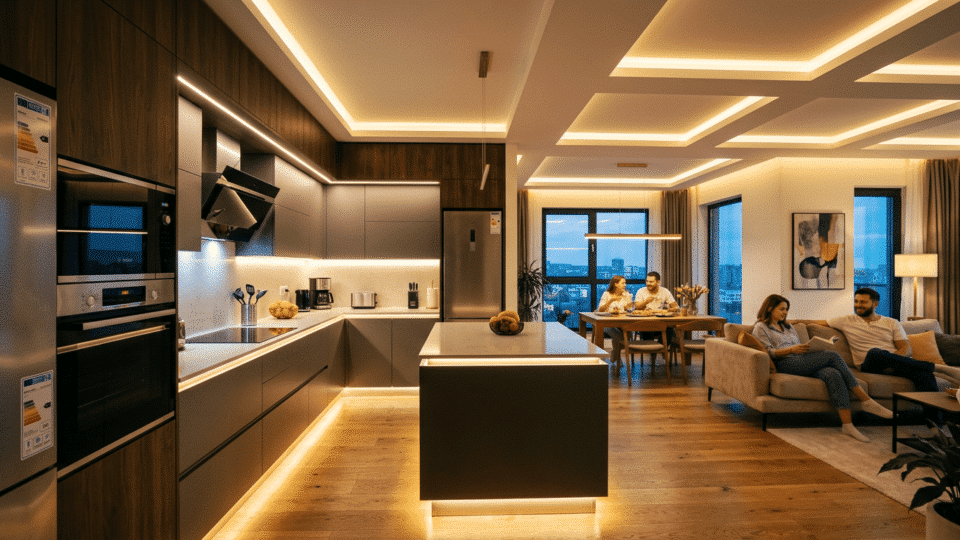
How can you cut household bills without major investment and, in some homes, achieve savings of up to 30%? There is no single measure that automatically removes a third of costs. But a combination of properly controlled heating, eliminating unnecessary consumption, reducing hot-water losses and using appliances intelligently can bring many households close to that threshold.
The key is to tackle the biggest uses of energy in the right order. In a typical home, heating and hot water generally account for the largest share of energy use. Lighting and standby power matter, but they should not be treated as the main culprit if the boiler, water heater or thermostat is being used inefficiently.
How to cut household bills: the 60–30–10 rule
A simple way to prioritise savings is to focus:
- 60% of your attention on heating and hot water;
- 30% on appliances and recurring consumption;
- 10% on standby power, lighting and small losses.
If you start at the other end and focus only on light bulbs and chargers, the savings will be small.
1. Lower the thermostat by 1°C
The European Commission estimates that lowering the temperature by 1°C can save around 7% of the energy used for heating. The Energy Saving Trust recommends a temperature between 18°C and 21°C for most homes, depending on comfort.
If your home is at 22°C and you reduce it to 21°C, the effect on comfort may be small, while the impact on consumption can be significant.
InfoBuz has separately explained the ideal indoor temperature in winter and how the thermostat affects the bill.
2. Do not overheat unused rooms
If you have thermostatic radiator valves, use them. A bedroom, hallway or rarely used room does not need to be kept at the same temperature as the living room.
It is important not to turn off the heat entirely in cold areas where there is a risk of condensation or mould. The aim is to reduce the temperature, not turn a room into an unheated space.
3. Schedule heating around when people are home
A programmable thermostat can reduce consumption without you noticing a difference.
For example:
- 20–21°C when you are at home;
- 17–18°C at night or when the home is empty for several hours;
- an automatic return to the usual temperature before you get back.
There is little sense in maintaining the same temperature all day if the home is empty.
4. Do not set the thermostat to 25°C to heat up faster
A conventional thermostat does not heat the house faster if you set it higher. It simply keeps the system on for longer.
If you want 21°C, set it to 21°C. A setting of 25°C does not make the boiler heat four times faster.
5. Check the flow temperature
With a condensing boiler, an unnecessarily high flow temperature can reduce efficiency. If the system allows it, lower temperatures encourage condensation and reduce consumption.
Flow temperatures for underfloor heating are normally lower than those for radiators.
There is no universal setting: the system must be able to maintain comfort at the chosen temperature.
6. Ventilate briefly and thoroughly
Leaving a window ajar for hours in winter cools the walls and furniture.
A more efficient approach is to:
- open windows wide for 5–10 minutes;
- create a quick cross-draught where possible;
- then close them fully.
The air is replaced while the thermal mass of the home loses less heat.
7. Seal air leaks
Inexpensive weatherstripping for windows or doors can produce greater savings than a smart plug.
Check:
- external doors;
- windows;
- loft hatches;
- holes for cables;
- areas around window and door frames.
8. Do not cover radiators
Sofas, heavy curtains and furniture placed in front of a radiator obstruct convection and radiant heat.
The thermostat may “think” that the room has not warmed up enough and keep the system running longer.
9. Use curtains intelligently
During the day, let sunlight into rooms that receive it. In the evening, close the curtains to reduce the sensation of cold window surfaces.
Do not, however, let the curtains hang over a radiator.
10. Shorten shower time
Hot water is a major source of consumption.
Cutting a shower from 12 minutes to 7–8 minutes can reduce the use of:
- water;
- gas or electricity;
- energy used for pumping.
In a household with several people, the monthly effect becomes noticeable.
11. Fit an efficient showerhead
A controlled-flow showerhead can reduce consumption without drastically reducing comfort.
Its cost is small compared with the savings on water and energy.
12. Do not keep the water heater at an excessively high temperature
If you have an electric water heater, an unnecessarily high setting increases heat losses.
The temperature should strike a balance between comfort, hygiene and consumption.
For more information on energy efficiency, see Underfloor heating vs radiators: consumption, comfort and total cost over 20 years, which provides complementary details on this subject.
Do not lower it to values unsuitable for microbiological safety if the tank stores water for long periods.
13. Insulate the water heater and exposed pipes
If you have a hot-water tank or uninsulated pipes in a cold space, inexpensive materials can reduce losses.
The Energy Saving Trust says additional insulation for a hot-water cylinder can reduce losses and annual costs.
14. Wash clothes at lower temperatures
In many cases, 30°C or 40°C is sufficient.
Most of a washing machine’s energy is used to heat water, not to turn the drum.
15. Avoid half-empty cycles
Washing machines and dishwashers are more efficient when used with appropriate loads.
Fewer cycles each week mean lower consumption of:
- energy;
- water;
- detergent.
16. Use the ECO programme
The ECO programme takes longer, but generally uses lower temperatures and less energy.
A long duration does not automatically mean high consumption.
17. A tumble dryer can be among the largest energy users
If you can dry clothes naturally, you can reduce consumption substantially.
If you use a tumble dryer:
- clean the filter;
- spin clothes thoroughly first;
- do not overload it;
- use the moisture sensor;
- avoid unnecessary cycles.
18. Set the refrigerator correctly
For food safety, a refrigerator should operate at around 4°C or below, but there is no need to set it unnecessarily close to freezing.
An appliance set too cold uses more energy.
InfoBuz has also published a complete guide to organising your refrigerator and the correct storage temperature.
19. Do not put large quantities of hot food in the refrigerator
Allow dishes to cool quickly towards a safe temperature before refrigeration, without leaving them at room temperature for hours.
Small portions and shallow containers cool more efficiently.
20. Check the refrigerator door seal
A seal that no longer closes properly makes the compressor run for longer.
A simple test is to trap a sheet of paper between the door and the seal. If it slides out very easily in several places, the seal may be weak.
21. Reduce standby consumption
Televisions, consoles, speakers, printers, receivers and other equipment can use power even when they appear to be switched off.
A power strip with a switch can eliminate unnecessary consumption across a group of devices.
Do not disconnect equipment that needs a permanent power supply, such as routers, alarm systems or medical devices.
22. Switch off unnecessary lights
LEDs use little power, but a light left on all night or in empty rooms still wastes energy.
The Energy Saving Trust recommends turning lights off when they are not needed.
23. Replace old bulbs with LEDs
If you still have halogen or incandescent bulbs, switching to LEDs is one of the simplest measures.
The saving per bulb is small, but across 10–20 fittings it can become meaningful.
24. Boil only the water you need
Heating a litre when you need one cup is wasted energy.
It is a small example, but one repeated daily.
25. Cook with a lid
A covered pot reaches the desired temperature faster and retains heat more efficiently.
On an electric or induction hob, simple savings can also be made by using the right size of pan.
26. Turn the oven off a little earlier
For many dishes, residual heat can finish the cooking.
Do not open the oven repeatedly: each opening releases heat and extends the cooking time.
27. Clean air-conditioner filters
A dirty filter reduces airflow and can increase consumption.
Regular cleaning costs almost nothing.
28. Do not set the air conditioner to 18°C if you want 24°C
As with heating, an extreme setting does not necessarily cool a room faster.
Set the temperature you actually want and use automatic mode or the appropriate fan setting.
29. Use shading in summer
Blinds, shutters and curtains can reduce solar gain during the hottest hours.
Less heat entering the home means less work for the air conditioner.
30. Check the bill, not just the meter
Savings do not come only from consumption.
Check:
- the active energy price;
- the daily subscription charge;
- fixed tariffs;
- the contract period;
- competing offers.
Low consumption on an expensive contract can result in a higher bill than somewhat higher consumption on a good offer.
31. Measure the consumption of suspect appliances
An energy-monitoring plug costs relatively little and can identify appliances using more power than you think.
Test:
- the refrigerator;
- the freezer;
- the water heater;
- the tumble dryer;
- the dehumidifier;
- the PC;
- old appliances.
32. Do not replace appliances purely to save energy
If an old refrigerator works well, it may be more economical to keep it than to spend thousands of lei for a small difference in consumption.
Replacement makes sense when:
- the appliance is very old;
- measured consumption is high;
- it needs replacing anyway;
- the new energy class provides significant savings.
33. Small automations can help
Smart plugs, sensors and thermostats can reduce consumption when they automate useful behaviour.
They do not save energy simply because they are “smart”.
InfoBuz has also published a guide to 15 useful smart-home automations without huge investment.
An example of 30% savings
Consider a home that spends an average of 900 lei a month on energy and heating during the cold season.
A realistic combination could look like this:
| Measure | Indicative saving |
|---|---|
| Thermostat -1°C | 5–7% |
| Heating schedule | 4–8% |
| Sealing and proper ventilation | 2–5% |
| Hot water and showers | 3–6% |
| Appliances and standby power | 2–5% |
| Better contract/tariff | variable |
The percentages should not be added up mechanically, because some overlap. But in a home with many inefficient habits, an overall reduction of 20–30% is realistic.
A 30-day plan
Week 1: record meter readings and the baseline bill.
Week 2: adjust the thermostat, heating schedule and hot-water settings.
Week 3: measure major appliances and eliminate unnecessary standby consumption.
Week 4: check the energy offer, seals, ventilation and resulting consumption.
Without measurement, saving remains only an impression.
What is not worth doing just to lower a bill
- being cold;
- lowering water temperature to unsafe levels;
- turning off heating entirely in damp rooms;
- buying “energy-saving” gadgets with no technical basis;
- replacing working appliances without calculating the payback period.
Conclusion
How do you reduce your household bill by 30%? Not through one trick, but through a well-chosen set of measures.
Start with heating, hot water and your energy contract. Then optimise appliances and unnecessary consumption. Only after that is it worth focusing on the very small savings.
The cheapest energy is still the energy you do not need to use.
Frequently asked questions
Can you cut your bill by 30% without investment?
In an inefficiently managed home, sometimes. In a home that is already optimised, it is unlikely without further investment.
How much do you save by reducing the temperature by 1°C?
The European Commission indicates potential savings of around 7% of the energy used for heating.
Do LEDs reduce the bill substantially?
They help, but their impact is smaller than that of heating and hot water.
Are smart plugs worthwhile?
Only if they automate actual consumption. They do not create savings simply by being installed.
What should I check first?
The thermostat, heating schedule, hot water and major appliances. These have the greatest potential for savings.
Sources: European Commission – energy-efficiency recommendations; Energy Saving Trust – thermostats and heating controls; Energy Saving Trust – low-cost measures to reduce consumption; ANRE – demand flexibility, 2026.




Discuția cititorilor
Ai o opinie sau o întrebare despre acest articol? Spune-ne ce crezi.
Fii primul care deschide discuția.
Te rugăm să păstrezi un limbaj civilizat și să discuți la subiect. Comentariile spam sunt filtrate automat.