
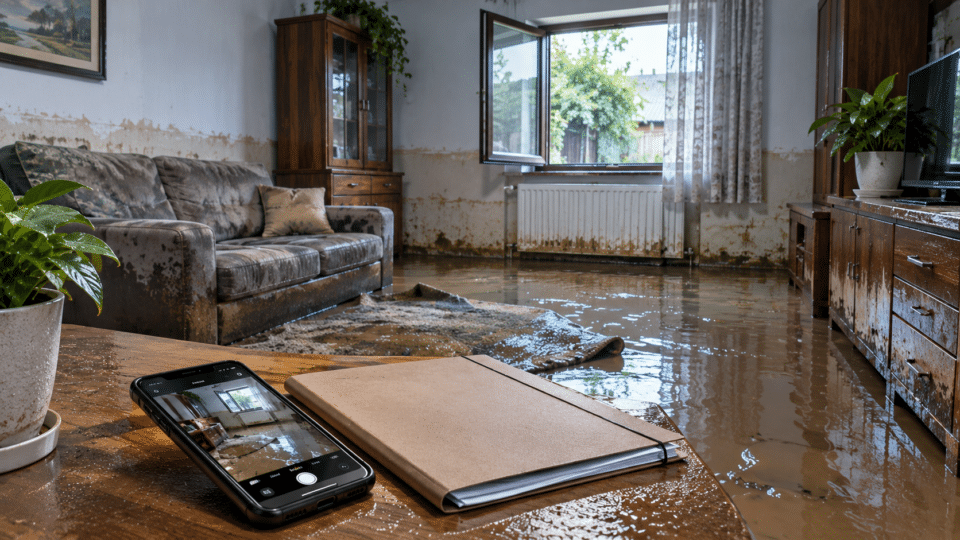
A flooded home is a situation in which the sequence of decisions can determine whether the response is safe, repairs are properly carried out and an insurance claim is difficult to substantiate. In the first minutes, the priority is not the flooring, television or insurance, but people’s safety: water can conceal electrical hazards, contamination and structural damage. Only after the risk has been removed should the damage be documented.
This InfoBuz guide explains, step by step, what to do in the first 24 hours after a flood, how to establish the cause and extent of the damage, whom to notify, and why PAD does not cover every instance of water entering a home. Natural flooding, a burst pipe, water from a neighbour and sewer backflow are addressed separately. Information on PAD is based on ASF Regulation No. 38/2023, Law No. 260/2008 and PAID’s claims instructions.
A flooded home: the first 10 minutes, before taking any photographs
- 1. Evacuate people. Children, older people and people with reduced mobility take priority. Leave if the water is rising or the building is unsafe.
- 2. Do not step into water that may be electrified. Do not touch switches, sockets, appliances or the electrical panel if the floor is wet or you do not have safe access.
- 3. Turn off the electricity only from a dry, safe location. If there is any doubt, call an authorised electrician or the electricity distribution operator.
- 4. Do not touch the gas installation if you suspect a leak. Leave the area and contact the emergency service or distributor from a safe place.
- 5. Shut off the water at the main valve only if you can reach it without risk. For plumbing failures, call a plumber or the building administrator.
- 6. Do not go down into a flooded basement. There may be an electrical hazard, contaminated water or structural damage.
- 7. Call 112 if people are in danger, there is a fire, a risk of electrocution or another serious situation. Do not use the emergency number merely to seek insurance information.
Basic advice on avoiding floodwater and electrical installations is also set out in Ready.gov’s flood guide and the CDC’s flood-safety materials. Do not try to retrieve belongings from an unsafe room.
Establish the cause first: four situations that may look identical but are not
| Likely cause | What to do immediately | Insurance that may be relevant |
|---|---|---|
| Flooding caused by a natural event | Ensure safety, notify the authorities, take photographs, notify the insurer | PAD for covered damage to the building; voluntary insurance for additional cover, subject to its terms |
| Burst pipe in the apartment | Safely shut off the water, call a plumber, document the failure | Generally not PAD; check the voluntary policy and any civil liability cover |
| Water coming from a neighbour | Notify the neighbour and building administrator; document the cause and damage | Voluntary insurance or the liability of the responsible person, as applicable |
| Sewer backflow | Avoid contact, request a technical response, document the water’s route | Depends on the cause of the backflow, included risks and any exclusions |
The distinction is decisive: PAD covers flooding as a natural phenomenon, alongside earthquakes and landslides, rather than every type of plumbing failure. Even in the case of torrential rain, the exact classification must be established from the event, the legal conditions and the assessment, not simply from the fact that water entered the home. For a full explanation of PAD risks, see InfoBuz’s analysis of what PAD does and does not cover.
The first 30–60 minutes: document the damage without compromising safety
If the area is safe and the authorities allow access, take photographs and video before moving objects or starting extensive cleaning. Do not, however, delay urgent steps needed to prevent injury or further damage merely to obtain images.
- Take a wide shot of each room, then detailed photographs of affected walls, floors, furniture and equipment.
- Capture the water level and marks left on walls; use a ruler or visible reference point only if it is safe to do so.
- Photograph the likely source: the damaged pipe, window, point of water entry or backflow, without putting yourself at risk.
- Keep original photographs with their date and metadata, where available; make a backup copy.
- Note when you noticed the event, its approximate duration and the people who responded.
- Record the name of the response company, the report number and any document issued by authorities.
- Do not artificially alter the scene for photographs or claim a cause you have not verified.
The first two hours: whom to notify and in what order
| Contact | When to contact them | What to request |
|---|---|---|
| 112 / ISU / competent authorities | There is danger or a natural event requiring intervention or official assessment | Intervention and, where applicable, official documents |
| Building administrator / owners’ association | A failure in an apartment building, common areas, a shared riser or affected neighbours | Technical assessment, identification of the installation and a record of the incident |
| Water and sewer operator / utility distributor | A network failure, backflow or relevant shared installation | A report number and documentation of the intervention |
| PAD insurer / PAID | Flooding that may qualify as a natural phenomenon | Notification of the event and a list of documents |
| Voluntary insurer | You have a policy with potentially relevant cover | Opening the claim and instructions on mitigating damage |
| Owner / tenant / neighbour | A rented home or an incident affecting other apartments | Written notice and a record of the situation |
If there are multiple policies, notify every potentially relevant insurer in accordance with its terms. Do not assume that notifying a voluntary insurer automatically amounts to notifying PAD. For a natural event, PAID recommends notifying the competent authorities and requesting documents concerning the occurrence of the event.
The first six hours: stop further deterioration without destroying evidence
Once electrical and structural hazards have been addressed, it may be necessary to remove water, protect dry belongings, stop a leak and ventilate in a controlled way. Document the initial condition and the steps taken. Mitigating the damage matters, but permanent repairs may require the insurer’s approval or assessment.
- Move unaffected belongings to a dry area, but only if doing so is safe.
- Do not switch on electrical appliances that have been wet or attempt to “dry” them by plugging them in.
- Do not remove affected flooring, plaster or installations before photographing them and speaking to the insurer, except for urgent safety work.
- Keep invoices for water pumping, transport, dehumidification, materials and emergency work.
- Do not immediately discard damaged belongings if they can be kept safely; seek instructions for contaminated or hazardous materials.
- If you notice new cracks, settlement or deformation of walls or slabs, do not re-enter without a specialist assessment.
The first 24 hours: the claim-file checklist to prepare
- The PAD policy and/or voluntary policy, including contract number and validity period.
- Identification and a document proving ownership or the right to manage the property, if requested.
- Dated photographs and videos, including wide shots and details of every affected area.
- A chronology of the event: when it began, how the water entered, when it was stopped and what interventions took place.
- Documents issued by the ISU, town hall or other authorities, where relevant and available.
- The plumber’s, building administrator’s or operator’s report or technical note, if the incident involves a failure.
- A list of damaged belongings and building elements, with photographs and preliminary estimates.
- Invoices, receipts, contracts and evidence of costs incurred to mitigate damage.
- Reference numbers for reports and correspondence with the insurer.
- Contact details for witnesses, if any, who agree to be contacted.
Not all documents are mandatory in every claim. ASF Regulation No. 38/2023 requires the insurer or PAID to inform the injured party in writing of the documents needed to settle the claim. Ask for the precise list for your case, so that you do not waste time gathering unnecessary documents.
PAD in 2026: what it covers, its value and what not to confuse it with
PAD is Romania’s mandatory home insurance against earthquakes, floods and landslides as natural phenomena. For Type A homes, the mandatory insured sum is 100,000 lei and the annual premium is 130 lei. For Type B homes, the sum is 50,000 lei, with a premium of 50 lei, under the applicable legal framework. Law No. 260/2008, in its updated form, and PAID.
These are insurance limits, not amounts automatically paid after every event. Compensation depends on the covered risk, the assessed loss and the legal conditions. PAD should not be presented as universal insurance for movable property, furniture, household appliances or ordinary plumbing failures. Voluntary insurance and its clauses must be assessed separately for such cases.
PAD deadlines: 60 days to report a loss and five working days for the assessment
Under Article 29 of ASF Regulation No. 38/2023, the insured person must report the loss within 60 days of the event. The regulation allows a later notification where it can be shown that meeting the deadline was impossible. Do not wait until day 59: notify the insurer in writing as soon as possible and keep confirmation of submission.
The damage assessment must be carried out within no more than five working days of receipt of the notification, or from the time when direct access to the disaster area is possible or permitted. The period may be longer with the parties’ agreement. Do not confuse this interval with a universal deadline for payment of compensation: opening the claim, assessing, valuing and settling it are separate stages.
When a claim is reported, the insurer must open the file, conduct the initial assessment and valuation, and communicate in writing the documents required. The assessment report must identify the damaged elements, circumstances, technical solutions and documents still needed.
Worked example: 140,000 lei in damage and a PAD limit of 100,000 lei
For illustration only, assume that a Type A home is affected by a covered natural flood, with eligible building damage assessed at 140,000 lei. PAD cannot pay more than 100,000 lei because of its limit. The difference is not automatically paid by anyone: a voluntary policy may be relevant, within the insured sums and terms agreed. The result may differ if some expenses are excluded or the eligible value is lower.
The law also governs the relationship between mandatory and voluntary insurance for shared risks. You cannot collect twice for the same loss beyond the actual damage. For details of the two layers of protection, read InfoBuz’s guide to the PAD policy.
A burst pipe, flooding from a neighbour or sewer backflow: when PAD is not the answer
A burst pipe in your own apartment
Shutting off the water and calling a plumber come first. Document the point of failure and request a note on the technical cause. PAD is not designed for ordinary pipe failures; check the “water damage” risk in the voluntary policy, including its limits, exclusions and deductible, if any.
Water from the upstairs neighbour
Photograph the marks, notify the neighbour and building administrator, and ask for the circumstances to be recorded. Liability depends on the actual cause and on whether the installation is privately or jointly owned. A voluntary policy may cover water damage and sometimes third-party liability, but coverage is not the same under every contract.
Sewer backflow after torrential rain
Do not automatically assume that every backflow after rain is a PAD risk. It must be established how the damage occurred and whether the conditions for an insured natural phenomenon are met. Request documentation of the operator’s intervention, retain images and notify the relevant insurers. For the technical causes of street flooding, see InfoBuz’s analysis of stormwater drainage and intense rainfall.
Mould after flooding: the critical drying window
Wet materials can develop mould quickly, sometimes within 24–48 hours, depending on conditions. The US Environmental Protection Agency (EPA) recommends promptly drying spaces and removing materials that cannot be safely cleaned or dried. This is a preventive benchmark, not a guarantee that mould will not appear after two days.
- Do not restore wet electrical installations to service before a specialist inspection.
- Do not use drying or dehumidifying equipment where the power supply is not safe.
- Use appropriate protective equipment when in contact with dirty water and contaminated materials.
- Avoid mixing cleaning products, especially chlorine bleach with ammonia or acids.
- Photograph affected areas before work that visibly changes the damage.
- For sewage contamination, extensive affected areas or vulnerable people, seek professional help.
Do not paint over a damp area to conceal staining. A lasting repair requires removal of the water source, drying of materials and checks for hidden deterioration. If insulation, plasterboard or layered flooring has been affected, some sections may need to be opened up in a controlled manner, after documentation and in accordance with insurance terms.
How to photograph damage properly without losing the context
| Shot | What it should show | Why it is useful |
|---|---|---|
| Wide | The whole room, walls and floor | Locates the damage |
| Medium | The wall area, furniture and water level | Shows the extent of the impact |
| Detail | A crack, swelling, water mark or damaged material | Shows the type of deterioration |
| Source | Pipe, drain trap, window or water entry point, if safe | Helps investigate the cause |
| Chronology | Successive, dated photographs | Shows the development of the situation and damage mitigation |
| Documents | Invoices, reports and report numbers | Evidence of interventions and costs |
What to include in a damage list: a simple model for owners
Use a table with these columns: room, affected item or element, description of damage, area/quantity, photograph, estimated cost, supporting document, observations. For example: “Bedroom — laminate flooring — swelling over approximately 8 m² — photos 014–019 — assessment required.” Do not invent costs or turn an estimate into an invoice.
Separate damage to the structure — walls, finishes and fixed installations — from movable belongings such as rugs, televisions or furniture. The distinction helps with the insurance assessment: PAD and voluntary cover do not necessarily define insured property in the same way.
How to avoid seven mistakes that can complicate compensation
- 1. Delaying notification to the insurer because you think repairs must be finished first.
- 2. Discarding all affected materials and belongings before photographing and assessment, without a safety justification.
- 3. Mistaking a burst pipe for natural flooding covered by PAD.
- 4. Failing to request a registration number for the claim notification and for interventions by authorities.
- 5. Switching on an electrical appliance that was underwater to see whether it still works.
- 6. Signing a report without reading its description of the damage and without recording observations about discrepancies.
- 7. Failing to keep invoices for urgent measures taken to mitigate the damage.
What to do if compensation is refused or appears too low
Request the decision and reasons in writing, including the clauses or legal basis relied on. Compare the assessment with photographs, technical documents and estimates. If there are significant differences, request a reassessment or a detailed explanation. Do not assume every refusal is abusive: there may be a genuine exclusion or an uninsured risk.
For insurance complaints, consult the Financial Supervisory Authority (ASF). For certain disputes between consumers and entities in the non-bank financial market, SAL-Fin may be relevant, subject to the procedure’s eligibility conditions. These mechanisms do not automatically guarantee an award of compensation.
Owner or tenant: who notifies and who repairs
In a rented home, notify the owner immediately and, where appropriate, the building administrator and relevant insurer. Repair obligations depend on the nature of the defect, the contract and applicable law. A tenant does not automatically become responsible for flooding merely because they lived in the apartment. If personal possessions are affected, check whether there is an insurance policy that covers them.
Apartment building: who is responsible for a shared riser
A shared riser, an individual connection and an installation within an apartment may be subject to different ownership and maintenance arrangements. Request a technical assessment and precise identification of the defective section. A building administrator cannot determine all legal responsibilities simply through a verbal statement. Keep correspondence with the owners’ association and the response company.
Practical scenario: rain floods the ground floor of an apartment building
Hypothetical example: after a downpour, water enters a ground-floor apartment from the street. The owner prevents access to the dangerous area, photographs the marks once access is safe, calls for intervention by the authorities and notifies the insurer. The technical cause is still unknown: it may involve natural flooding, a sewer problem or a combination of the two. PAD classification cannot be decided from a photograph of the water alone.
The owner later obtains the relevant documents, submits the damage list and takes part in the assessment. If they also have voluntary insurance, they notify that insurer as well. Before permanent repairs begin, they clarify what evidence must be retained and what urgent work may be done without compromising the claim.
Frequently asked questions about a flooded home
How long do I have to report a PAD claim?
The deadline set by ASF Regulation No. 38/2023 is 60 days from the event, with the possibility of justifying a later notification if compliance was impossible. The practical recommendation is to notify the insurer immediately.
How soon will an inspector come to assess a PAD claim?
The rule is no more than five working days from notification or from the time access to the disaster area is possible and permitted. The period may be extended by agreement of the parties.
Does PAD pay if my neighbour flooded me?
Not simply because a neighbour flooded you. PAD concerns flooding as a natural phenomenon. Check the voluntary policy and the potential liability of the responsible person.
Does PAD cover my television and furniture?
PAD is designed for covered damage to the home within legal limits, not as universal insurance for movable belongings. Check voluntary cover for furniture and appliances.
Can I start cleaning before the inspector arrives?
Yes. Urgent measures may be needed for safety and to limit deterioration. Document the initial condition and contact the insurer as soon as possible for instructions; avoid unjustified permanent changes before the assessment.
If water entered through the sewer after rain, will PAD pay?
That cannot be decided from this fact alone. The legal and technical cause of the event and its classification as a covered natural risk matter; notify the insurer and request an official assessment.
If I do not have invoices for furniture, do I lose any compensation?
No universal answer can be given. Required documents depend on the policy, the type of property and the assessment. Photographs, proof of ownership and other documents may help; ask the insurer for the exact list.
Can I complain about a refusal of compensation?
Yes. Ask for written reasons, request a review and consult ASF or SAL-Fin channels if the procedure applies.
Final checklist: what you should have by the end of the first day
- People are safe, and hazardous installations have been assessed or isolated by professionals.
- You have notified the competent authorities where the situation requires it.
- You have notified potentially relevant insurers and have confirmation of the notification.
- You have photographs and videos of the rooms and affected elements.
- You have a chronology of the incident and a preliminary list of damage.
- You have retained intervention documents and invoices for urgent expenses.
- You have received or requested the list of documents needed for the claim.
- You have started safe measures to limit moisture and contamination without concealing the damage.
Conclusion: safety, evidence, notification — in that order
When your home is flooded, the best decisions are often made in the first hours: do not enter water that carries an electrical risk, document the situation once the location is safe, limit deterioration and notify the insurer without delay. The difference between natural flooding and a plumbing failure can entirely change which policy is relevant. PAD is not a promise of compensation for every instance of water in a home.
Keep the documents and request written explanations at every stage. A well-documented claim does not automatically guarantee payment, but it reduces the risk of misunderstandings and helps you check whether the settlement follows the contract and applicable rules.
Official sources and editorial methodology
- ASF Regulation No. 38/2023 — Legislative Portal: PAD notification, the 60-day deadline, assessment and documents.
- Law No. 260/2008, updated version — Legislative Portal: PAD risks, insured sums and its relationship with voluntary policies.
- PAID — Claims: recommended steps after a natural disaster and contacting authorities.
- PAID Romania: information on the PAD policy.
- Ready.gov — Floods: protection of people and flood precautions.
- CDC — Flood Safety: post-flood risks and safe cleaning.
- EPA — Flooded Homes: drying materials and preventing mould.
- ASF: information and complaints concerning insurance.
- SAL-Fin: alternative resolution of certain financial disputes.
Editorial note: 18 November 2026. This article provides general guidance and does not replace emergency services, an electrical or structural assessment, or an analysis of policy terms. Deadlines and obligations for voluntary policies may differ from those for PAD. The lead image was generated using AI and does not depict a real event.








Discuția cititorilor
Ai o opinie sau o întrebare despre acest articol? Spune-ne ce crezi.
Fii primul care deschide discuția.
Te rugăm să păstrezi un limbaj civilizat și să discuți la subiect. Comentariile spam sunt filtrate automat.