
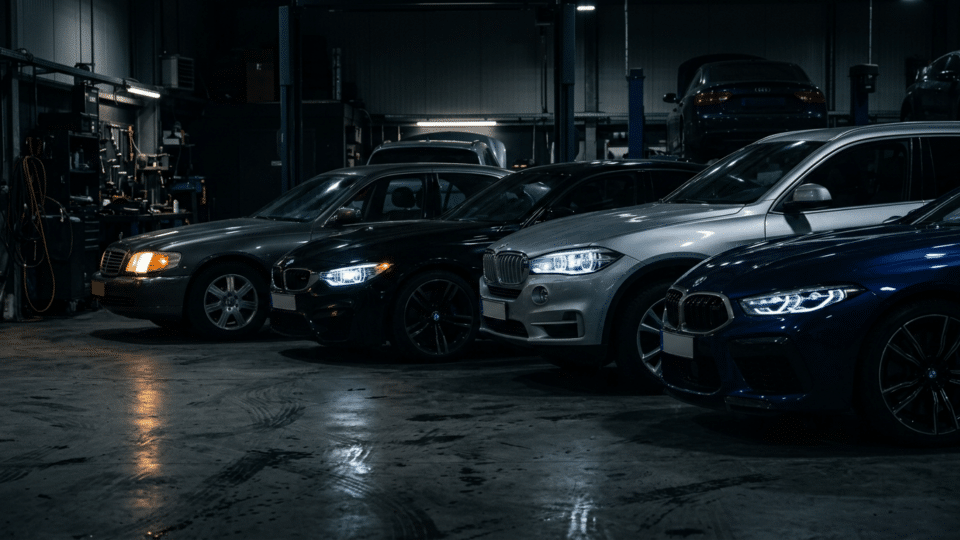
Halogen vs Xenon vs LED vs Matrix LED is not simply a comparison of brightness. The meaningful differences lie in beam distribution, illumination range, energy consumption, response time, repair costs and a headlight’s ability to adapt its light to traffic without dazzling other drivers.
In 2026, halogen remains the simplest and cheapest solution; xenon still delivers very good performance on many older premium cars; LED has become the dominant standard; and Matrix LED and pixel-based systems are turning vehicle lighting into an active, camera- and software-controlled system.
Halogen vs Xenon vs LED vs Matrix LED: a quick comparison
| Technology | Main advantage | Main drawback | Repair cost |
|---|---|---|---|
| Halogen | Cheap and simple | Less powerful light | Low |
| Xenon / Bi-Xenon | Strong beam and good long-distance performance | Ballasts, bulbs and AFS mechanisms | Medium |
| LED | Efficiency, long life, compact design | Expensive integrated modules | Medium to high |
| Matrix LED | Adaptive high beam without dazzling | Complexity, cameras and calibration | High |
1. Halogen: simple, cheap and easy to repair
A halogen headlight uses an incandescent filament inside a bulb filled with halogen gas. It is a mature, simple and inexpensive technology.
Its advantages are clear:
- inexpensive bulbs;
- straightforward replacement;
- very broad compatibility;
- no ballast or complex electronic modules.
Its shortcomings are apparent at night:
- lower light output;
- a more yellowish colour;
- lower energy efficiency;
- a less precise beam than modern systems.
2. Xenon: a major step up from halogen
Xenon HID does not use a conventional filament. Light is generated by an electric arc in a gas-filled lamp, controlled by a high-voltage ballast.
Its advantages over halogen include:
- more light;
- a colour closer to daylight;
- a longer beam;
- better efficiency.
On many premium cars from 2000–2015, Bi-Xenon remains highly competitive today if the projector, reflector and lens are in good condition.
Bi-Xenon: one source for low and high beam
In a Bi-Xenon headlight, a mechanical shutter changes the shape of the beam. In low-beam mode, part of the light is masked. In high-beam mode, the shutter retracts, allowing more light to be projected.
The benefit is that the same xenon source can provide both functions.
AFS: when headlights start following the road
AFS, or Adaptive Frontlighting System, adds dynamic control of light distribution.
The system may use:
- steering angle;
- speed;
- signals from sensors;
- vehicle body position;
- a front camera in more advanced systems.
HELLA explains that adaptive systems can alter light distribution for bends, urban driving, rural roads, motorways or difficult weather conditions.
3. LED: more efficient and easier to control
LED technology has changed headlight construction completely. A large lamp and a single reflector are no longer required. Manufacturers can use several LED sources, each controlled separately.
The main advantages are:
- lower power consumption;
- instant illumination;
- long service life;
- precise electronic control;
- compact design;
- the potential to create adaptive functions.
A failed LED does not always mean replacing a bulb
This is where the downside of modernisation appears. In many LED headlights, the light source is integrated into the module.
Depending on the vehicle, a fault may require a replacement:
- LED module;
- driver;
- control unit;
- fan;
- or complete headlight.
HELLA notes that modern LED headlights use dedicated electronic modules, connected through CAN/LIN and responsible for individually controlling LED channels.
4. Matrix LED: high beam without conventional switching
Matrix LED does not simply mean “more powerful LED”. The real difference is segment-by-segment control.
A camera detects vehicles ahead, and the headlight deactivates only the areas that would cause glare. The rest of the road can remain lit by high beam.
HELLA describes this principle for glare-free high beam: selected LEDs are switched off while road edges and areas without vehicles remain illuminated.
Why Matrix LED is so effective at night
A conventional headlight has two main settings:
- low beam;
- high beam.
Matrix LED has many independently controlled zones. The system can keep an area around the vehicle ahead dark while brightly illuminating the remainder of the carriageway.
The result is greater visibility distance without dazzling other road users.
Matrix LED and ADB are not exactly the same thing
ADB stands for Adaptive Driving Beam. Matrix LED is one possible technical implementation.
An ADB system may use:
- LED segments;
- micro-LEDs;
- digital pixels;
- laser modules combined with LEDs;
- other electronically controlled optical solutions.
5. Pixel LED and next-generation headlights
In 2026, the leading edge of the technology is no longer just Matrix LED with a few dozen segments.
HELLA offers SSL HD systems with up to 25,000 individually controllable pixels per chip, capable of highly precise light distribution and advanced ADB functions. Source: FORVIA HELLA.
These systems can control light almost like a digital projector.
Which headlights illuminate the farthest?
There is no universal distance. It depends on:
- the optics;
- the output of the light source;
- beam shape;
- regulations;
- the control system;
- headlight height.
A well-designed premium Bi-Xenon system can clearly outperform entry-level LED. A well-calibrated modern Matrix LED system, however, will be superior in dynamic light distribution.
For some adaptive systems, HELLA indicates an illumination range that can reach approximately 200–300 metres in favourable conditions and depending on the function used. Source: HELLA.
Colour temperature
Colour temperature affects appearance, but should not be confused with brightness.
Generally:
- halogen: approximately 3,000–3,400 K;
- OEM xenon: often approximately 4,000–5,000 K;
- OEM LED: approximately 5,000–6,500 K, depending on the system.
Very blue light does not automatically mean better visibility.
In rain and fog, whiter does not always mean better
A cooler beam can look more modern, but reflections from wet road surfaces may become more distracting.
The quality of the optics and the beam pattern matter more than the Kelvin figure alone.
Adaptive headlights in bends
AFS and adaptive LED systems can adjust the beam according to steering direction.
HELLA shows that adaptive bend lighting can better illuminate the inside of a corner through mechanical or electronic control. With LED and Matrix systems, this function can be achieved without physically moving the module. Source: HELLA.
What can fail in a xenon system
- the D1S/D2S/D3S/D4S bulb;
- the ballast;
- the igniter;
- the AFS motor;
- levelling sensors;
- the projector reflector;
- the lens;
- the control module.
What can fail in an LED system
- the LED driver;
- the LED module;
- the fan;
- the control unit;
- the temperature sensor;
- the ADB system camera;
- communication modules.
Matrix LED also adds the issue of calibration
Modern adaptive systems depend on the front camera and the vehicle being correctly positioned.
Calibration may be necessary after:
- windshield replacement;
- structural repairs;
- suspension replacement;
- work involving sensors.
HELLA warns that incorrect calibration can deactivate adaptive functions or force the system into a safety mode. Source: HELLA.
What is best for a used car?
For a used car, the ranking is not straightforward.
Halogen: the cheapest to maintain.
Bi-Xenon: very good if the headlights are in sound condition and parts are available.
LED: excellent, but check the price of a complete headlight before buying.
Matrix LED: the best functionality, but also the greatest risk of a substantial bill following an accident or electronic fault.
A modern headlight can cost as much as a major repair
On some premium models, a complete new Matrix headlight can cost thousands of euros.
That is why, when assessing a used car, it is worth checking:
- whether all segments work;
- whether there is condensation;
- whether the headlight is OEM;
- whether AFS/ADB works;
- whether diagnostic errors are present;
- whether the lens is cloudy or scratched.
Xenon or LED retrofits: why changing the bulb is not enough
A headlight approved for halogen does not automatically become a legal xenon or LED headlight simply because a more powerful source is fitted.
Headlight optics are designed for a particular light source.
A poor retrofit can cause:
- glare;
- an uneven beam;
- dark areas;
- problems at Romania’s periodic roadworthiness inspection (ITP);
- electronic incompatibilities.
Type approval matters
In Europe, headlights and light sources must comply with the applicable UNECE regulations.
HELLA summarises ECE lighting standards and stresses the importance of adjustment, calibration and system compatibility. Source: HELLA.
For that reason, the safest retrofit is one using approved modules and properly integrated both mechanically and electronically.
Why a well-refurbished headlight can beat a cheap new one
On cars with xenon projectors, the internal reflector can deteriorate over time.
A properly refurbished or replaced premium projector can perform better than a cheap aftermarket headlight with poor optics.
The lens, reflector and light source should be considered as one system.
Headlights must be adjusted after any work
A powerful but poorly aimed headlight is more dangerous than a weaker one aimed correctly.
Alignment should be checked after:
- replacing the headlight;
- replacing the projector;
- replacing the suspension;
- an accident;
- work on the AFS system;
- replacing the camera or windshield.
LED does not automatically mean Matrix
Many cars have full-LED headlights without a Matrix function.
An LED headlight may have:
- fixed low and high beam;
- cornering lights;
- basic High Beam Assist;
- AFS;
- Matrix / ADB.
The exact equipment specification needs to be checked.
High Beam Assist is not the same as Matrix
Basic High Beam Assist only switches high beam on and off.
Matrix LED keeps high beam active and selectively removes the area that would dazzle another vehicle.
The difference in comfort on rural roads is substantial.
Which technology is worth choosing in 2026?
For the lowest cost: halogen.
For a well-maintained used premium car: Bi-Xenon AFS can still be excellent.
For a balance of performance and complexity: full LED.
For the best adaptive lighting: Matrix LED / ADB.
Related: adaptive headlights and Bi-Xenon
InfoBuz has separately explained how AFS, Bi-Xenon and adaptive LED headlights work, and why they fail.
Conclusion
Halogen vs Xenon vs LED vs Matrix LED has no universal winner.
Halogen wins on cost. Xenon remains highly capable when the optics are in good condition. LED offers efficiency and long life. Matrix LED turns the headlight into an active system that adapts the beam in real time.
For a new car, Matrix LED is the most advanced option. For a used vehicle, however, the cost of a complete headlight, modules and calibration also needs to be assessed.
A good headlight is not the one that looks whitest in a car park. It is the one that puts light where it is needed, at the appropriate distance, without dazzling others.
Frequently asked questions
Is xenon better than LED?
A well-designed premium xenon system can be better than entry-level LED, but modern LED systems offer more precise control and superior adaptive functions.
Does Matrix LED keep high beam on all the time?
In suitable conditions, the system can keep high beam active and selectively mask detected vehicles.
Can LED be fitted to a halogen headlight?
Only if the light source, headlight and type approval allow it. Simply fitting an aftermarket LED bulb does not guarantee a legal or safe beam.
Why are Matrix headlights so expensive?
Because they include multiple LEDs or pixels, electronic modules, thermal management, communications, a camera and software.
Do adaptive headlights need calibration?
Yes, in certain circumstances. Work involving the windshield, camera, suspension or bodywork may require calibration.
Sources: HELLA — adaptive lighting and glare-free high beam; FORVIA HELLA — modern headlight technologies and Matrix LED; HELLA — High Beam Assist; HELLA — ECE lighting standards.


Discuția cititorilor
Ai o opinie sau o întrebare despre acest articol? Spune-ne ce crezi.
Fii primul care deschide discuția.
Te rugăm să păstrezi un limbaj civilizat și să discuți la subiect. Comentariile spam sunt filtrate automat.