
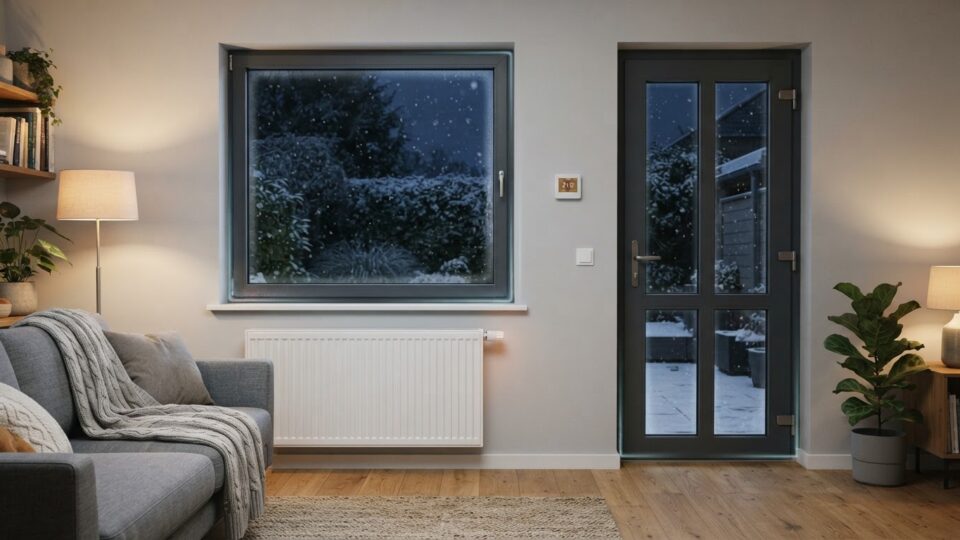
Energy loss at home does not come only from poorly insulated walls or old windows. In many homes, a significant share of heat escapes through worn seals, gaps, doors leading to unheated spaces, loft hatches, uninsulated pipes, radiators that are not working properly and inefficient heating-system settings.
The good news is that many of these problems can be addressed without a major renovation. Some cost only a few dozen Romanian lei; others require a simple technical intervention. Before investing in solar panels, batteries or a heat pump, it makes sense to ensure that the home is not wasting energy you are already paying for.
Energy loss at home: where to start
The European Commission says that around 40% of energy consumed in the EU is used in buildings, and that roughly 75% of European buildings have poor energy performance. Deep renovation can deliver very substantial savings, but it is not always the most realistic first step.
For an existing home, the logical order is:
- identify obvious losses;
- eliminate uncontrolled air leakage;
- optimise the heating system;
- reduce hot-water and electricity losses;
- only then consider major investments.
1. Window and door seals
The first place worth checking is around windows and external doors.
If you can feel a cold draught, the seal may have aged, become compressed or been fitted incorrectly. With PVC window frames, the issue can sometimes be the adjustment of the hardware rather than the seal alone.
A suitable sealing strip or proper adjustment can reduce air leakage without replacing the entire window.
The U.S. Department of Energy estimates that reducing draughts and air leakage can save approximately 5–30% of annual energy use, depending on the home. This is an indicative figure and should not be directly converted into a bill estimate for Romania.
2. The gap under the external door
A gap of just a few millimetres under a door can create a permanent cold draught.
Simple options include:
- a door brush or sealing strip;
- an adjustable threshold;
- an automatic drop seal;
- a draught excluder as a temporary solution.
The important thing is not to block an opening intentionally designed for ventilation or to supply air to a combustion appliance.
3. The loft access hatch
In a house with a cold loft, the hatch can become one of the weakest points in the building envelope.
Warm air rises, and if the hatch has no seal or insulation, both heat transfer and air leakage can occur.
A proper solution includes:
- a seal around the perimeter;
- thermal insulation on the hatch cover;
- a sufficiently tight closure.
4. Openings for pipes, cables and services
Some of the largest losses are not around windows, but where building services pass through walls, floors or ceilings.
Examples include:
- water pipes;
- gas pipes;
- electrical cables;
- air-conditioning lines;
- ductwork;
- openings leading to the loft or basement.
The DOE recommends identifying and sealing these points with materials suitable for the surface type and fire-safety requirements.
Do not use improvised flammable materials around chimneys and combustion appliances.
5. Sockets and switches on external walls
In some buildings, there are voids behind electrical back boxes through which air can circulate.
If you feel a draught around a socket on an external wall, the issue may lie in the wall’s airtightness layer.
Special gaskets for electrical back boxes are available, but work on electrical installations should be carried out with the power switched off and, if you lack experience, by an electrician.
6. An unused fireplace or chimney
An open chimney can act as a column through which warm air rises and escapes from the home.
If the fireplace is not in use, purpose-made solutions are available to reduce draughts.
Any chimney blocker must be removed before lighting a fire and must not compromise the ventilation of a combustion appliance.
7. A radiator that is cold at the top or heats unevenly
Air trapped in a radiator reduces its active surface area and can make the system work longer to provide the same level of comfort.
If the radiator is cold at the top and warm at the bottom, it may need bleeding.
If it is warm at the top and cold at the bottom, the issue may be different — low flow, sludge in the system or hydraulic imbalance — and bleeding alone may not solve it.
Energy Saving Trust recommends checking and bleeding radiators when air is trapped, to avoid unnecessarily compensating by raising the boiler temperature.
8. A radiator blocked by furniture or curtains
A radiator fully hidden behind a sofa or covered by heavy curtains transfers heat into the room less effectively.
Leave enough space around it for air to circulate.
Curtains can reduce heat loss through a window, but they should not cover the radiator in a way that traps warm air between the curtain and the glass.
9. Reflective panels behind radiators
For radiators mounted on poorly insulated external walls, purpose-made reflective panels can reduce some heat transfer into the wall.
This is not a miracle solution and does not replace wall insulation, but it is an inexpensive and easy measure.
Energy Saving Trust recommends such panels particularly behind radiators on uninsulated external walls.
10. A thermostat set higher than necessary
One of the simplest ways to use more energy is to keep the entire home warmer than necessary.
There is no perfect temperature for everyone, but even a modest reduction in the setpoint can cut consumption if the system runs for many hours.
For more information on energy use, see How to cut your household energy bill by 30% without major investment: 33 measures that really matter, which provides complementary detail on this subject.
It is important not to pursue savings by setting uncomfortably low temperatures, especially in homes with young children, older people or vulnerable residents.
InfoBuz has separately examined the difference between 18, 20 and 22°C, and how to choose the right winter temperature.
11. Heating rooms you use less
If every room is heated in the same way, you may be paying for comfort you do not use.
Thermostatic radiator valves make it possible to lower the temperature in certain areas without turning off the whole system.
Examples include:
- a rarely used guest bedroom;
- a hallway;
- a storage room;
- a floor that is unoccupied during the day.
However, do not let rooms become completely cold where there is a risk of condensation, mould or frozen pipes.
12. A poorly set heating schedule
A programmable thermostat does not save energy simply because it is “smart”. It saves energy only if it reduces heating when it is not needed.
An effective schedule may mean:
- a comfortable temperature before waking up;
- a lower temperature when the home is empty;
- a lower overnight temperature, if comfortable;
- avoiding switching the heating on many hours before it is needed.
In a house with high thermal inertia or underfloor heating, aggressive on/off strategies may be less efficient, so the schedule should be adapted to the system.
13. Uninsulated hot-water pipes
Pipes running through basements, garages, utility rooms or other cold areas lose heat before the water reaches its destination.
Pipe insulation is inexpensive and can reduce losses, especially along long runs.
For pipes exposed to sub-zero temperatures, insulation also reduces the risk of freezing — although it does not eliminate it in every situation.
14. A poorly insulated boiler or hot-water tank
If you have an older hot-water storage tank, check its insulation.
A tank that constantly loses heat forces the heat source to restart more often simply to keep the water at temperature.
Modern equipment generally has built-in insulation. For older systems, a purpose-made insulating jacket can reduce losses if the manufacturer permits it.
15. Standby appliances and inefficient lighting
Not all household energy use comes down to heating.
Televisions, games consoles, monitors, speakers, printers and other devices can use energy in standby mode. One device may use little, but dozens of devices can add up to continuous consumption.
LED bulbs also use far less energy than older technologies for the same amount of light.
Energy Saving Trust includes both eliminating unnecessary standby consumption and switching to LEDs among its quick ways to reduce bills.
Bonus: curtains and blinds can help, if used properly
In the evening, heavy curtains can reduce the sensation of a cold surface near windows and limit draughts.
During the day, if there is sunshine, opening them allows passive solar gain.
The simple rule:
- open them when the sun can warm the room;
- close them after sunset to reduce losses;
- do not cover the radiator.
Do not seal your home until it lacks ventilation
This is where an important mistake can occur.
Sealing uncontrolled draughts is useful. Blocking designed ventilation is dangerous.
Do not block:
- ventilation grilles;
- window trickle vents;
- air supplies required by combustion appliances;
- flues and chimneys.
A more airtight home needs proper ventilation to control CO₂, moisture, odours and the risk of mould.
Condensation is a sign, not just a cosmetic problem
If you frequently have water on windows, cold corners or mould, the problem may point to a combination of:
- high humidity;
- inadequate ventilation;
- thermal bridges;
- low surface temperatures.
Adding more sealing without addressing ventilation can make the situation worse.
How to find losses you cannot see
For a serious assessment, two tools are particularly useful:
Thermal camera
It can reveal cold surfaces, thermal bridges, areas with missing insulation and some paths of air leakage.
The result is most meaningful when there is a sufficient difference between indoor and outdoor temperatures.
Blower-door test
A fan temporarily fitted in a doorway creates a controlled pressure difference and makes it possible to measure a building’s airtightness.
It is the proper way to identify air leakage systematically, rather than simply by feel.
Which work should take priority?
| Problem | Indicative relative cost | Priority |
|---|---|---|
| Leaky seals and joints | Low | Very high |
| Loft hatch | Low to medium | High |
| Uninsulated hot-water pipes | Low | High |
| Radiators with trapped air / imbalance | Low to medium | High |
| Thermostat and scheduling | Low to medium | High |
| Entirely new windows | High | After diagnosis |
| Wall / roof insulation | High | Very high if inadequate |
Why you should not automatically start by replacing windows
New windows can reduce heat loss and draughts, but they are not always the investment with the best cost-benefit ratio.
If the real problem is an uninsulated loft, an unsealed hatch or major air leakage through the building envelope, replacing already decent windows may deliver less benefit than expected.
Energy Saving Trust recommends assessing the whole window — glass, frame, seals and installation — rather than just the number of panes.
Before solar panels, reduce unnecessary consumption
Solar panels produce energy. They do not eliminate losses.
If a home has major air leakage, inefficient radiators and unnecessarily high temperature settings, a photovoltaic system does not address the cause.
Before making a major investment, it is also worth reading InfoBuz’s analysis of solar panels, batteries and heat pumps, and the right order for investments.
A simple weekend plan
If you want to get started without renovating, you can check the following in this order:
- check every window and door for draughts;
- inspect the loft hatch;
- look for gaps around pipes and cables;
- check every radiator;
- move furniture away from blocked radiators;
- set the thermostat realistically;
- configure the heating schedule;
- insulate accessible hot-water pipe runs;
- check the hot-water tank;
- record energy consumption for a few weeks.
If the bill remains very high, the logical next step is an energy audit or thermal imaging survey.
Energy loss at home: the bottom line
The least expensive measures cannot turn an uninsulated house into a high-performance building, but they can eliminate a significant share of the obvious waste.
Proper sealing, heating adjustments, pipe insulation and intelligent use of the thermostat cost incomparably less than a full renovation.
Most importantly, do not start with the most expensive solution; start with the real problem. An efficient home is not one with the most technology, but one that loses as little energy as possible for the comfort it provides.
Frequently asked questions
What are the most common sources of energy loss in a house?
Air leakage around windows and doors, the loft hatch, service penetrations, insufficient insulation, inefficient radiators and poor heating settings are among the most common.
Is it worth replacing windows if I can feel a draught?
Not necessarily. Adjusting the window hardware, replacing the seal or sealing the joint between the frame and wall may sometimes be enough. The correct diagnosis should be made before replacement.
Should I seal all ventilation openings?
No. Grilles and vents designed for ventilation must not be blocked. Sealing should target uncontrolled air leakage, not ventilation needed for health and safety.
Does a smart thermostat automatically reduce the bill?
No. Savings arise only if it is configured to reduce heating when it is not needed and if the heating system is compatible with the control strategy.
What is the best investment before winter?
It depends on the home. For many houses, checking air leakage, adjusting the heating and insulating obvious problem areas offer a better cost-benefit ratio than immediately replacing expensive components.
Sources: European Commission – Energy Performance of Buildings Directive; U.S. Department of Energy – Why Energy Efficiency Matters; Energy Saving Trust – preparing your home for winter; Energy Saving Trust – energy-efficient windows and doors.




Discuția cititorilor
Ai o opinie sau o întrebare despre acest articol? Spune-ne ce crezi.
Fii primul care deschide discuția.
Te rugăm să păstrezi un limbaj civilizat și să discuți la subiect. Comentariile spam sunt filtrate automat.