
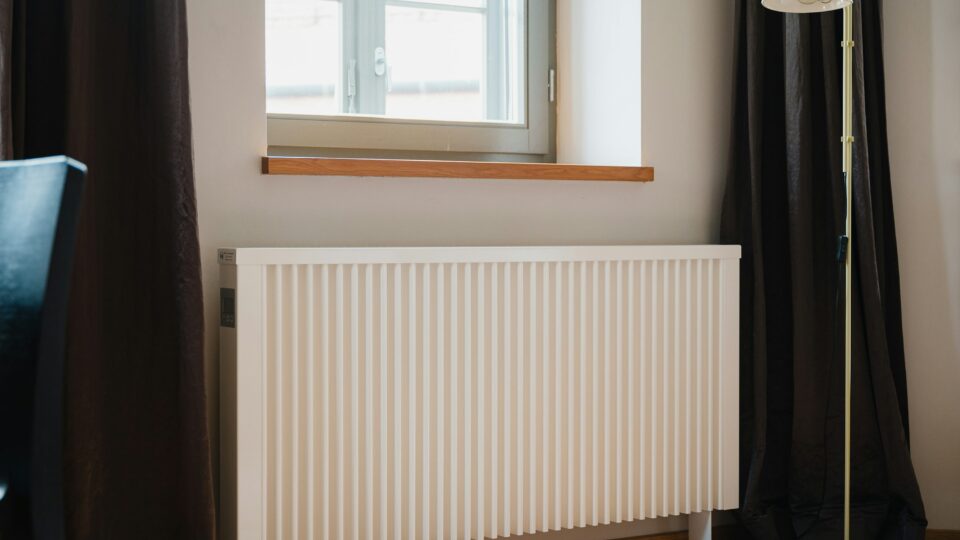
A radiator that is hot at the top and cold at the bottom, or the other way round, is one of the most useful symptoms for diagnosing a heating system. A radiator that is cold at the top often indicates trapped air, while one that is hot at the top and cold at the bottom is more likely to point to deposits, sludge or poor water circulation through its lower section.
The distinction matters because bleeding does not fix every type of cold spot. If sludge has built up at the bottom, opening the bleed valve may release a little air or water, but the radiator will remain cold where circulation is blocked. By contrast, if the top is cold and there are gurgling sounds, bleeding is the logical first thing to check.
This InfoBuz guide was updated on 1 November 2026 and applies primarily to water-filled radiators in systems served by an individual boiler, a boiler plant or another hydronic heat source. In apartment blocks connected to a district-heating system, certain work on the shared riser, valves or balancing must be carried out by maintenance staff or a plumber.
Radiator hot at the top and cold at the bottom, or vice versa: the quick answer
| Symptom | Likely cause | First thing to check |
|---|---|---|
| Cold at the top, warm at the bottom | Air trapped in the radiator | Bleed the radiator |
| Warm at the top, cold at the bottom | Sludge/deposits or reduced circulation | Flow, valves and the condition of the system |
| Cold on one side only | Low flow, a stuck valve or poor balancing | The TRV/lockshield valve and balancing |
| The whole radiator is cold | Closed/stuck valve, no flow, pump or control issue | Valves, thermostat, pressure and operation of the heat source |
| Several radiators are cold at the end of the system | Hydraulic imbalance | Lockshield-valve adjustment and system flow |
| It gurgles and remains cold at the top | Air in the system | Bleeding and checking the pressure afterwards |
Radiator cold at the top and warm at the bottom: you most likely have air
Air is lighter than water and collects in the upper part of a radiator. When an air pocket forms, hot water may circulate through the lower section but no longer fill the top fully. The typical result is a radiator that is warm at the bottom and cold or only lukewarm at the top.
Worcester Bosch describes precisely this symptom: a radiator that is cold at the top and warm at the bottom often indicates an accumulation of air and the need for bleeding.
How to bleed a radiator correctly
- Turn off the heating and allow the radiators to cool sufficiently for you to work safely.
- Prepare a radiator key or the appropriate tool for the valve, as well as a towel and a small container.
- Open the bleed valve at the top of the radiator very slightly.
- If there is air inside, you will hear a hissing sound.
- When water starts flowing steadily, without air, close the bleed valve.
- For pressurised systems with an individual boiler, check the system pressure after bleeding.
- Turn the heating back on and check the radiator temperature again.
Do not fully unscrew the bleed valve or work on a hot radiator. Water in the system can be hot enough to cause burns. If boiler pressure drops substantially, or you need to bleed the same radiators repeatedly, the problem may be more extensive than a simple air pocket.
Radiator hot at the top and cold at the bottom: why bleeding will not solve it
This is the opposite symptom and often indicates something else. If the top is hot, hot water is reaching the radiator. If the lower section remains cold, there is a strong possibility that water is not circulating properly through the lower channels.
Worcester Bosch notes that a radiator which is hot at the top and cold at the bottom can indicate a build-up of sludge or debris in its lower section. These deposits reduce the space available for water to circulate and act as a barrier between the heating water and the metal surface. See also Worcester Bosch’s technical explanation of radiators that are cold at the bottom.
What is “sludge” in a heating system?
Sludge is not necessarily dirt that has entered from outside. In older systems, oxygen, water and metal components can encourage internal corrosion. Corrosion products, metal particles and other residues can accumulate in areas where water velocity is low, including the bottoms of radiators.
In technical documentation on heating-system water, Worcester Bosch warns that contaminated water can block pumps, heat exchangers and valves, create cold areas in radiators, and increase consumption because the system must run longer to transfer the same amount of heat.
How to tell whether it is sludge rather than air
- the top is hot but the bottom remains cold;
- the cold area is mainly in the lower centre and may have an irregular shape;
- several older radiators show the same issue;
- water discharged when draining is very dark in colour;
- the radiators take a long time to heat up;
- the pump or boiler becomes noisier;
- the system has not been cleaned for many years.
A single symptom does not confirm the diagnosis. A plumber can distinguish between sludge, a stuck valve, insufficient flow and a balancing problem by measuring temperatures and checking circulation.
Radiator cold on one side: check the valves and flow
If a radiator is hot near the flow inlet and cold at the opposite side, flow through the radiator may be too low. The water enters hot, gives up heat quickly in the first section, and does not circulate sufficiently through the rest of the radiator.
Possible causes include a thermostatic radiator valve that is not open enough, a TRV pin stuck after summer, a lockshield valve that is too closed, local deposits or an unbalanced system.
A thermostatic radiator valve can stick after summer
A common occurrence at the start of the cold season is for the pin in a thermostatic radiator valve to become stuck in the closed position. The thermostatic head may be set to 5, but the pin in the valve body may not move freely, allowing very little water—or none at all—to enter.
If you are unsure how the valve works or notice leaks, do not force its components. An old valve may start leaking if handled aggressively. For homeowners, a visual check and confirming that the valve is open are reasonable steps; removal or replacement must be done correctly, with the system isolated where necessary.
What hydraulic balancing is, and why some radiators “take” all the heat
In a system with several radiators, water follows routes with lower resistance. Radiators closer to the pump or boiler may receive too much flow, while those farther away receive too little. As a result, some rooms may become very warm while radiators at the end of the system remain cold or warm up slowly.
Hydraulic balancing means adjusting flows so that every radiator receives enough heating water. In conventional systems, this is generally done using the lockshield valve, rather than by permanently restricting the thermostatic head.
How to recognise an unbalanced heating system
- radiators close to the boiler become very hot quickly;
- those farther away heat up slowly or remain partly cold;
- the issue affects several radiators in the same area;
- bleeding makes no difference;
- all valves appear to be open;
- the boiler reaches temperature quickly, but some rooms remain cold.
Completely cold radiator: do not immediately assume it is blocked
If a radiator is cold from top to bottom, the diagnosis is different. First check whether the thermostatic valve is open, whether the lockshield valve is closed, and whether the other radiators are working.
If all radiators are cold, the issue may lie with the heat source, thermostat, pump, pressure, supply or controls. If only one is cold, the problem is more likely to be local: a valve, a severe airlock, deposits or lack of flow.
For more information on boilers, see The ideal home temperature in winter: 18, 20 or 22°C?, which provides complementary details on this subject.
System pressure matters after bleeding
In a sealed system with a wall-mounted boiler, bleeding removes air but may also remove a small amount of water. If you bleed several radiators, pressure can drop below the range recommended by the boiler manufacturer.
There is no single universal value for all boilers. Many domestic systems operate within the manufacturer’s recommended range when cold, and the boiler manual must take priority. If pressure repeatedly drops without explanation, the system should be checked for a leak, an expansion vessel problem or other component issues.
When flushing a radiator or the whole system makes sense
If several radiators are cold at the bottom and there are signs of deposits, bleeding alone is not enough. Depending on the severity, a plumber may recommend cleaning one radiator, flushing the circuit or carrying out a more extensive system clean.
Worcester Bosch recommends assessment and flushing when sludge build-up creates cold areas in the lower section. Cleaning carried out incorrectly can dislodge deposits and move them into the heat exchanger, pump or valves, so the work must be tailored to the system.
Does a magnetic filter help?
In systems with ferrous components, an important share of the residue may be magnetic. A magnetic filter properly installed on the system return can capture particles before they reach the boiler again.
However, a filter does not instantly clear sludge that has already compacted at the bottom of a radiator. It is chiefly a protection and maintenance measure once the system has been brought into good condition.
What you can do yourself, and when to call a plumber
| Situation | You can check yourself | Better left to a plumber |
|---|---|---|
| Cold at the top, warm at the bottom | Simple bleeding | If it recurs frequently |
| Warm at the top, cold at the bottom | Check that the valves are open | Cleaning/flushing the system |
| The TRV appears stuck | Visual inspection | If it needs to be removed or is leaking |
| Low pressure after bleeding | Refill according to the manual, if you know the procedure | If pressure drops again |
| Several cold radiators | Compare how they behave | Hydraulic balancing / pump / deposits |
| Leaks or corrosion | Turn off the system and protect the area | Yes, as soon as possible |
Why a radiator with cold areas can increase the bill
A radiator using only part of its surface area transfers less heat to the room. The thermostat may call for heating for longer, the boiler may run longer, and users tend to raise the flow temperature to compensate.
The issue is not only one of comfort. Deposits and poor circulation can reduce the efficiency of the entire system and, in severe cases, place strain on the pump and heat exchanger. For other efficiency measures, see the InfoBuz guide How to cut your household bill by 30% without major investment.
Does a radiator need to be uniformly hot throughout?
Not necessarily. During normal operation, there is a temperature difference between the flow and return, so a radiator may be slightly warmer in one area and cooler in another. The problem arises when there are large, clearly cold areas or when part of the radiator contributes almost nothing to heating.
Likewise, an oversized radiator in an already warm room may be only lukewarm when the thermostatic head limits flow. That does not automatically mean there is a fault.
Myth: “if the radiator is cold at the bottom, it just needs bleeding”
This is one of the most common misconceptions. Air collects at the top, not at the bottom. A radiator that is cold at the bottom and hot at the top is more likely to indicate deposits or poor circulation. Bleeding may be of no use in this situation.
This distinction is also made in Worcester Bosch’s guidance: cold at the top = air; cold at the bottom = possible sludge or debris.
Frequently asked questions about radiators heating unevenly
Why is my radiator hot at the top and cold at the bottom?
The most common explanation is a build-up of deposits or sludge in the lower section, though insufficient flow may also be responsible. If the issue persists after the valves have been checked, the system is worth having assessed by a plumber.
Why is my radiator cold at the top and warm at the bottom?
Most often, air is trapped in the upper section. Correct bleeding usually resolves the problem, and pressure should be checked afterwards if the system is sealed and pressurised.
Do I need to bleed radiators every year?
There is no requirement to bleed them if they heat evenly and the system is working properly. Bleeding is done when symptoms are present. If air returns frequently, the cause should be identified.
Does black water from a radiator mean the system is dirty?
It may indicate corrosion products and particles that have accumulated in the circuit. Colour alone does not establish how severe the issue is, but together with cold areas at the bottom it is an important sign.
Can a cold radiator be caused by the pump?
Yes, particularly if several radiators are affected or those farther from the heat source are not receiving sufficient flow. However, a single cold radiator is more often a local problem.
Conclusion: the position of the cold area tells you where to look
A radiator that is hot at the top and cold at the bottom, or vice versa, does not indicate the same fault. If it is cold at the top and warm at the bottom, suspect air first. If it is hot at the top and cold at the bottom, consider sludge, deposits or poor circulation. If it is cold on one side or entirely cold, checks should extend to valves, flow, balancing and the heat source.
The right order saves time and money: identify the shape of the cold area, check the simple and safe elements, bleed only when the symptom points to air, and call a plumber when the issue points to deposits, balancing or system components. In many cases, bleeding is the right solution only for a radiator that is cold at the top, not one that is cold at the bottom.




Discuția cititorilor
Ai o opinie sau o întrebare despre acest articol? Spune-ne ce crezi.
Fii primul care deschide discuția.
Te rugăm să păstrezi un limbaj civilizat și să discuți la subiect. Comentariile spam sunt filtrate automat.