
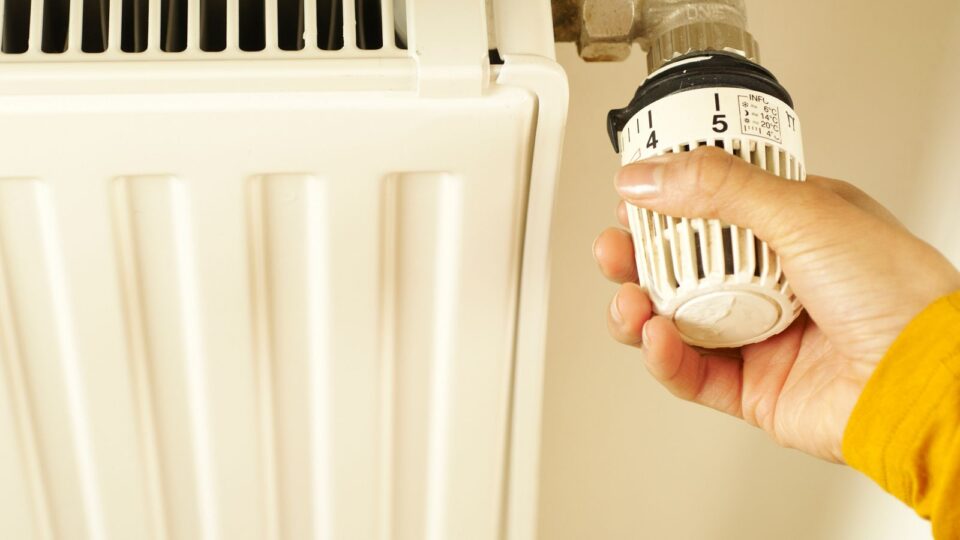
The ideal indoor temperature in winter is not the same number for every home and every family. One person may be comfortable at 19°C in a well-insulated flat, while another may feel cold at 21°C in a room with cold walls, draughts and poorly sealed windows. The useful question is therefore not simply “18, 20 or 22 degrees?”, but which temperature provides comfort and protection without unnecessary consumption in a particular home.
The World Health Organization (WHO) regards 18°C as a general benchmark for health protection in homes in temperate or cold climates during the cold season. The WHO also states that older people, children and people with chronic illnesses may need higher temperatures. In guidance updated on 28 September 2026, the Energy Saving Trust recommends an indicative range of 18–21°C for most people, depending on comfort and individual needs.
There is a second essential variable: humidity. A sufficiently heated room can still accumulate condensation if its walls or windows are cold and the air is humid. The US Environmental Protection Agency (EPA) recommends keeping relative humidity below 60% where possible, ideally within 30–50%, and removing the causes of accumulated water.
In this InfoBuz premium guide, we compare settings of 18°C, 20°C and 22°C; explain when lowering the temperature by one degree can reduce energy consumption; examine why the claim that “every degree saves 10%” is not universally true; outline what changes between a boiler, heat pump and underfloor heating; and set out how to run a sound seven-day test. We do not assign guaranteed prices or savings to homes in Romania without actual bills, consumption data and property characteristics.
The ideal indoor temperature in winter: 18, 20 or 22°C?
18°C is a health-protection benchmark for the general population in WHO guidance. It is not a mandatory target, nor proof that everyone will be comfortable at that temperature. If someone in the home has health problems, reduced mobility or sensitivity to cold, more warmth and personalised advice may be needed.
20°C can be a practical starting point for many living rooms, but it is neither a medical threshold nor a universally “perfect” temperature. Some people prefer 19°C, others 21°C, depending on clothing, activity, age, insulation, draughts and the temperature of indoor surfaces.
22°C may be comfortable for some occupants, but under comparable conditions it generally involves greater heat transfer to the outdoors than a lower temperature. If the same comfort can be achieved at 20–21°C, adjusting the thermostat may offer scope to reduce consumption.
| Indicative setting | What it may mean | Important limitation |
|---|---|---|
| 18°C | WHO benchmark for protecting the general population during the cold season | May be insufficient for some vulnerable people and in rooms with very cold walls |
| 19–20°C | A practical starting range for some adults and many homes | Comfort cannot be determined from the thermostat number alone |
| 20–21°C | A commonly chosen range for occupied rooms during sedentary activities | Consumption may be higher than at lower temperatures |
| 22°C and above | May meet individual preferences or needs | Should not be presented as a medical threshold required by everyone |
This table is indicative, not a clinical prescription. Main sources: WHO, Energy Saving Trust and the NHS.
What the WHO says about 18°C, and why the rule is not universal
In its chapter on low indoor temperatures in the WHO Housing and Health Guidelines, the WHO makes a strong recommendation: homes should be kept warm enough to protect people from the effects of cold. For climates with a cold season, 18°C is proposed as a balanced and safe temperature for the general population.
The WHO adds two qualifications. First, there is no single exact temperature below which every risk suddenly emerges for every individual. Second, a higher minimum may be needed for older people, children and people with chronic illnesses, particularly cardiovascular and respiratory conditions.
UK government guidance updated in April 2026 recommends heating frequently used rooms, such as the living room and bedroom, to at least 18°C where possible. It identifies vulnerable groups including older people, people with chronic conditions, pregnant women and young children.
Do not treat this recommendation as a reason to immediately lower every room to 18°C. If someone feels cold, has health concerns, or the home has draughts and very cold surfaces, the comfortable temperature may be higher. General guidance does not replace individual medical advice.
Is there a correct temperature for every room?
Yes and no. How a room is used matters, but every home also requires consideration of occupants’ vulnerabilities, humidity and how the heating system operates. It would not be right to publish a table of “laws” requiring the bedroom to be exactly 17°C, the bathroom 24°C and the living room 20°C.
| Room / use | Useful approach | What to check |
|---|---|---|
| Living room and workspace | Start within the approximate 18–21°C comfort range and adjust for activity | Correctly placed thermometer, draughts, cold walls |
| Adult bedroom | Adapt to comfort, health, bedding and the home’s conditions | Do not allow the room to become excessively cold or damp |
| Room of an older or vulnerable person | Do not treat 18°C as a maximum; more warmth may be needed | Medical advice, comfort and duration of exposure to cold |
| Sleeping infant’s room | Follow specific infant-sleep guidance; do not automatically apply the adult range | Suitable clothing, avoiding overheating and direct heat sources |
| Bathroom | Ensure comfort when in use and remove moisture after showering | Ventilation, condensation, surfaces and drying of materials |
| Little-used room | Reduce heating only in a way compatible with the building and installation | Risk of freezing, condensation, neighbouring rooms and mould |
An important qualification for babies: the NHS gives 16–20°C as a range considered comfortable and safe for infants’ sleep, together with appropriate clothing and bedding. This is guidance specific to babies’ sleep, not a rule for the whole home or a reason to overheat a child’s room.
Unused rooms present another issue: lowering the temperature too far can cool walls and encourage surface condensation, especially if humid air from warmer rooms circulates into them. “I will turn the radiator off completely and consume nothing” is not a universally healthy, guaranteed money-saving strategy for every building.
Why 21°C can feel comfortable in one home and cold in another
A thermometer shows the air temperature where it is installed, but the human body also exchanges heat by radiation with surrounding surfaces. If an external wall or window is very cold, you may feel uncomfortable even when the thermostat displays an apparently suitable temperature.
Air speed also matters: a leak around a window or a draught passing beneath a door can create a feeling of cold. Humidity, clothing, activity level and position relative to a radiator also affect perception.
Before raising the setting from 21°C to 24°C, look for verifiable causes: poorly sealed windows, radiators blocked by furniture, continuously open ventilation, inadequate insulation or a thermostat installed in an unsuitable place.
Effective adjustment does not mean only “a lower temperature”; it also means even heat distribution and the elimination of cold draughts. For work on windows, see InfoBuz’s guide to Uw values, sealing and the installation of efficient windows.
How much can you save by lowering the thermostat by 1°C? A sound calculation without invented percentages
The promise that “every degree lower saves 10% on the bill” is common. This formula is not a universal law. The percentage depends on outdoor temperature, heating duration, the building’s heat losses, ventilation, the efficiency of the boiler or heat pump, and fixed costs included in the bill.
The Energy Saving Trust publishes savings estimates for certain UK households, but pound values should not be converted into guaranteed savings for a Romanian flat.
A simplified physics example: 21°C versus 20°C
Assume a hypothetical home in which heat loss is approximated by the following relationship:
Heat-loss power = overall heat-loss coefficient × (indoor temperature − outdoor temperature).
If that coefficient is 120 W/K and the outdoor temperature is a constant 1°C, then:
- At 21°C indoors, the difference is 20°C, so approximate heat loss is 2,400 W (2.40 kW).
- At 20°C indoors, the difference is 19°C, so approximate heat loss is 2,280 W (2.28 kW).
- The difference is 120 W, or about 5% of the calculated heat loss at that moment.
Over a hypothetical ten-hour period under the same conditions, the simplified reduction would be 1.2 kWh of heat. This is not yet the saving in purchased gas or electricity kWh, because the heating system has its own efficiency and control method.
This is not an energy audit, a bill or a prediction of actual consumption. In practice, outdoor temperatures change; sunlight and appliances add heat to the home; doors and windows are opened; and systems may modulate their output. The calculation only demonstrates why a lower indoor temperature can reduce heat loss, and why the percentage cannot be assumed to be identical in every home.
Will setting the thermostat to 25°C heat the home faster than setting it to 20°C?
In many conventional systems with a room thermostat, no. The thermostat calls for heating until the selected temperature is reached; selecting a higher value does not automatically mean the radiator or boiler will heat faster at every point.
The Energy Saving Trust explains that there is no need to increase the thermostat setting when it is colder outside. The room may take longer to reach the desired temperature, but the thermostat should not intentionally be set above the comfort level sought.
Some modern systems use modulating controls, adaptive algorithms and weather compensation, and can adjust the heating-water temperature or output. In such cases, exact behaviour depends on the installation. Even so, arbitrarily raising the setting to 26°C is not a reliable way to save energy or achieve “turbo heating”; it may simply overheat the room if you forget to return it to the required setting.
Gas boiler: is it more efficient to leave it on continuously?
For many homes with a gas boiler and radiators, a schedule adapted to occupancy can avoid unnecessary heating. The Energy Saving Trust notes that, in general, there is no need to keep a boiler system continuously at the comfort temperature when the home is not in use.
A programmer can start heating before waking or returning home, and reduce the temperature during absences, without compromising occupants’ health or the safety of the installation. The best start time depends on thermal mass, insulation and the outdoor temperature.
A room thermostat measures the air temperature in the home, while adjustment of the water temperature in the heating circuit is a separate parameter. Do not confuse “20°C in the living room” with “50°C boiler flow temperature”. Changes to the heating medium should be made according to the boiler type, radiators, domestic hot-water production and the manufacturer’s instructions.
Do not disable frost-protection features or adjust gas components without authorised personnel. If the installation behaves abnormally, calling a qualified specialist is preferable to improvisation.
Heat pumps: why boiler rules should not be copied automatically
Heat pumps operate differently from conventional boilers. Many are efficient when delivering heat at moderate temperatures over longer periods, without large swings in demand. For that reason, very low night-time settings followed by a sudden demand for heat in the morning do not guarantee savings.
The Energy Saving Trust states that a heat pump does not necessarily have to run without stopping, but it is often more efficient to operate early and steadily at lower heating-water temperatures than to stop frequently and recover quickly.
The US Department of Energy notes that some heat-pump installations have auxiliary electric heating; a suitable thermostat can avoid unnecessary activation of resistance heaters when the temperature must return to the comfort setting.
For further information, see Smart homes without huge investment: 15 useful automations for comfort, security and savings, an InfoBuz article covering an aspect directly related to this subject.
For a heat pump, then, the strategy should be adapted to the weather-compensation curve, heat emitters, thermal storage, controller, any auxiliary resistance heaters and insulation. Some homes may benefit from small scheduled reductions; others operate more efficiently at a near-constant temperature.
For an assessment of the investment and differences between systems, see the InfoBuz guide “Solar panels, batteries or a heat pump?”.
Underfloor heating: what changes compared with radiators
A heated floor, together with the screed and finish, can have greater thermal inertia than an ordinary radiator. Depending on its construction, it may take longer for a change to the thermostat setting to affect room comfort.
For this reason, “I turn it completely off at 08:00 and turn it on at 18:00 when I get home” is not always a suitable strategy. If the installation responds slowly, the room may still be cold on return and require a long recovery period. In other homes, a smart schedule adapted to the system’s inertia may be useful.
The important point is not to copy another flat’s schedule. The system design, pipe spacing, insulation, screed thickness and type of floor finish all influence its behaviour. For correct values and procedures, consult your own documentation and the specialist who sized the system.
Should the temperature be lowered at night?
A moderate reduction in temperature at night may suit some homes with boilers, where occupants sleep comfortably and there is no risk of cold or condensation. In other cases, especially for vulnerable people, the bedroom should be kept sufficiently warm.
The Met Office states that people over 65 or with pre-existing health conditions may benefit from keeping the bedroom at at least 18°C at night as well. Young, healthy people with appropriate clothing and bedding may have different preferences, but should not ignore signs of discomfort and dampness.
Do not assume that “16°C in the bedroom is perfect for everyone”, and do not use NHS guidance specific to infant sleep to set the temperature for older people or an entire flat. The sleep of young children, the health of vulnerable people and mould control are separate objectives that must be reconciled.
Humidity of 30–50%: why it matters as much as the thermostat
Relative humidity expresses how close the air is to saturation at the measured temperature. It does not directly represent the total amount of water in the home. When air cools, relative humidity can rise even when no water has been added.
The EPA recommends keeping indoor humidity between 30 and 50% where possible, by controlling moisture sources, ventilation and, where necessary, dehumidification. In its mould guidance, the EPA also highlights an upper threshold of 60%, above which moisture-related risks become more significant.
This is a general humidity-management range, not a guarantee that condensation can never occur at 49%. A very cold wall corner can reach high local humidity even when a hygrometer in the middle of the room shows a lower value.
Cooking, showers, drying clothes indoors, many occupants and leaks can increase moisture. Mould prevention depends on both the source of vapour and the temperature of surfaces and ventilation. Overheating a room without fixing a leak is not a real solution.
For situations in which mould appears even in a new or well-insulated building, see the InfoBuz guide “Mould in a new home: thermal bridges and humidity”.
Why a home kept too cold can develop condensation and mould
When heating is reduced too far, some indoor surfaces can become colder. Humid indoor air may condense on windows, behind cupboards or in corners with thermal bridges. For condensation prevention, the EPA recommends either raising surface temperatures through insulation and air circulation, or reducing humidity by repairing sources and using ventilation or dehumidification, depending on the circumstances.
The idea that “if I do not use the bedroom, I can always keep it very cold and definitely save money” may therefore conceal a later cost: mould, damaged finishes, odours and repairs.
There is no single temperature that prevents mould in every building. Surface temperature, humidity, materials, ventilation and the duration of favourable conditions all matter. If a wall remains damp, do not limit the response to turning the thermostat up; identify the leak, thermal bridge or ventilation problem.
For renovated homes or homes with new windows, see InfoBuz’s explanation of mould appearing after insulated windows are installed and thermal renovation.
Proper winter ventilation: fresh air without unnecessarily cooling the home
A heated home also needs good indoor air quality. Cooking, showers and everyday activities produce moisture and pollutants. Ventilation can reduce their concentration, but the method should suit the building’s system and the outdoor temperature.
In a home without mechanical ventilation, controlled airing may be more useful than leaving a window permanently ajar during the cold season. However, there is no single airing duration that applies to every flat, and suitable practices differ according to floor area, the number of occupants, moisture levels and outdoor air quality.
Use bathroom extractors and cooker hoods if they are suitable and vent correctly. Do not block ventilation grilles to retain heat, especially where they are needed for combustion appliances. If the home has mechanical ventilation with heat recovery, consult the system’s operating instructions.
The InfoBuz guide to heat-recovery ventilation in a new home explains the difference between controlled air exchange and sealing a building airtight.
Where to place a thermostat and hygrometer for useful readings
Even an accurate thermostat can control the system poorly if it is placed in the wrong location. A device beside a radiator, in direct sunlight, in a cold draught or above heat-generating equipment may measure a temperature that does not represent the room.
For the thermostat: follow the positioning and instructions given by the manufacturer and installer. In principle, a location representative of people’s comfort, away from strong local sources of heat or cold, is useful.
For the hygrometer: keep it away from the shower, sink, very cold windows and direct heat sources when monitoring the room’s general humidity. Record readings at comparable times. A consumer hygrometer is useful for trends, but should not be treated as a laboratory instrument without verification.
For secondary thermometers: measure temperatures in rooms distant from the thermostat, especially if there are large temperature differences. A single reading from the hallway does not guarantee that the bedroom or corner room is at the same temperature.
A seven-day test: how to check whether you can save without losing comfort
Do not start by lowering every room to 16°C. Run a gradual, reversible test adapted to occupants’ health, especially where children, older people or people with chronic conditions live in the home.
- Day 1 – establish the starting point. Record the comfort temperature, heating settings and humidity in the rooms in use.
- Day 2 – check the thermometer. Compare the thermostat reading with an independently placed thermometer in a representative location.
- Day 3 – look for visible losses. Check windows, doors, covered radiators and unevenly heated rooms.
- Day 4 – change only one parameter. If safe and comfortable, reduce the main room setting by about 1°C, rather than changing every room and every programme at once.
- Day 5 – check occupants and surfaces. Record comfort, any condensation and humidity; if discomfort or dampness appears, return to the appropriate setting.
- Day 6 – review consumption. Use the meter reading or app data, bearing in mind that weather and heat gains can change.
- Day 7 – decide based on trends. Keep the setting only if it is safe, comfortable and compatible with the installation; otherwise adjust it.
A seven-day test cannot on its own prove an exact saving, especially if outdoor temperatures were warmer in the second half of the week. A robust comparison would require equivalent weather conditions or an analysis adjusted for heating degree days, as well as separation of other consumption.
If you have a gas bill, do not automatically convert cubic metres to kWh using an assumed constant; use the supplier’s conversion factor and information. In a home with a heat pump, electricity consumption includes variables related to seasonal efficiency, heating-water temperatures and, where present, auxiliary resistance heaters.
An indicative schedule for a family using a gas boiler
The following example shows how a schedule can be approached, not a universal recipe. It assumes a relatively well-insulated home, no occupants with special heating needs, no moisture problems and a programmable gas system. The values should be changed if occupants are not comfortable or if the installation manual recommends otherwise.
| Period | Example control logic | Why it matters |
|---|---|---|
| Morning, before waking | Schedule a return to a comfort temperature close to 20°C | The room can be warm when it begins to be used |
| Daytime, when the home is occupied | Maintain the lowest comfortable value, generally within 18–21°C for the general population | Avoids unnecessary overheating |
| Longer absences | A cautious reduction adapted to duration and the risk of cold or condensation | May reduce unnecessary heating without exposing the installation to risk |
| Night-time | A temperature suited to occupants’ sleep and health, without cooling rooms excessively | Comfort and protection take priority |
| Severe frost or long absences | Follow frost-protection features and installation instructions | Prevents damage to pipes and the building |
For a home heated by a heat pump or underfloor heating, a strategy with smaller fluctuations may be more suitable. Testing should begin with the actual equipment, not an internet table.
How to reduce the bill without lowering the temperature too far
Before sacrificing the temperature in a child’s room or the room of a vulnerable person, look for measures that affect heat loss and heating control:
- Eliminate unwanted draughts. Check window seals and closures without blocking necessary ventilation.
- Do not cover radiators. Furniture and heavy curtains can limit air circulation and heat distribution.
- Use thermostatic radiator valves correctly. These can help control room temperatures where the system is designed for them.
- Repair leaks and thermal bridges. Moisture problems require the cause to be fixed, not simply more heat.
- Air rooms and remove moisture generated by showering and cooking. Proper ventilation supports healthy indoor air.
- Maintain the heat source. Safe, efficient operation depends on servicing appropriate to the equipment.
- Check actual consumption. A meter, an app and bills can show trends; do not rely on universal advertising estimates.
- Insulate only in a way compatible with ventilation. A sealed home without adequate air exchange can accumulate moisture.
See also InfoBuz guides to preparing a home for winter and reducing an energy bill without major investment.
Do not heat your home with a cooker or improvised methods
When energy costs rise, people may be tempted to use a cooker, oven or unsuitable device as a heat source. This is not a safe alternative. Combustion appliances can produce carbon monoxide where they malfunction or ventilation is inadequate; the gas is colourless and odourless.
The EPA recommends venting gases from combustion appliances outdoors, maintaining those appliances and using smoke and carbon-monoxide alarms. Do not use a flame-producing device for space heating unless it was designed and installed for that function.
Also see the InfoBuz guide to the difference between smoke, gas and carbon-monoxide detectors. Do not cover mandatory ventilation openings for gas installations or interfere with safety components yourself.
Ten myths about thermostats and heating in the cold season
- “The WHO says everyone must live at exactly 18°C.” No. It is a general benchmark, and vulnerable people may need higher temperatures.
- “If I set 27°C, the room will reach 20°C faster.” This is not a rule for conventional thermostats; you risk overheating.
- “One degree lower definitely cuts the bill by 10%.” No. Savings depend on the building and system.
- “A heat pump should be turned off every day in the same way as a gas boiler.” The optimum strategy may differ according to control and thermal inertia.
- “If a bedroom is unused, I can leave it as cold as I like.” There are risks of condensation and, in some conditions, freezing.
- “Mould never appears at 50% humidity.” Very cold surfaces can have high local humidity.
- “The hallway thermostat tells me the temperature in every room.” Temperature distribution can be uneven.
- “New windows solve condensation by themselves.” Better airtightness without adequate ventilation can change the moisture risk.
- “It is cheaper to heat continuously to 23°C because the boiler does not have to restart.” There is no such guarantee; losses generally rise as the indoor–outdoor temperature difference increases.
- “I can heat a room efficiently with the cooker.” Using appliances not designed for space heating can create serious hazards.
Frequently asked questions about indoor temperature in winter
What is the ideal indoor temperature in winter?
There is no single perfect temperature for everyone. The WHO proposes 18°C as a general health-protection benchmark, while the Energy Saving Trust gives an indicative 18–21°C range for most people. Comfort and medical needs may require adjustments.
Is it healthy to live at 18°C?
For the general population in climates with winter, 18°C is a WHO benchmark. Vulnerable people may need a higher temperature. It does not replace an assessment of actual conditions and health status.
Is 20°C or 22°C better?
If a person is comfortable and safe at 20°C, consumption may be lower than at 22°C under comparable conditions. But 22°C may be appropriate in some circumstances; there is no general obligation to reduce the temperature.
How much do I save by lowering the thermostat by 1°C?
There is no universal percentage. Savings depend on the outdoor–indoor temperature difference, the building’s heat losses, heating duration and system efficiency. Consumption data and weather comparison are needed for a realistic estimate.
Is it good to turn the boiler off at night?
A schedule adapted to occupancy can save energy in many homes with boilers, but it must not create excessive cold, condensation, a risk of freezing or discomfort for vulnerable people. Follow the installation’s protection features.
Should a heat pump be left on all the time?
Not necessarily. Many heat pumps are, however, efficient with stable temperatures and small variations. The decision depends on the model, auxiliary sources, controls and heating system in the home.
Should I change the temperature frequently with underfloor heating?
Not necessarily. Depending on the screed thickness and installation, the system may respond slowly. Schedule it according to its thermal inertia and technical documentation.
What humidity should a home have in winter?
The EPA recommends, where possible, 30–50% relative humidity and keeping it below 60%. Condensation can nevertheless occur on very cold surfaces even when the room hygrometer shows a moderate value.
Why does mould appear in a room heated to 20°C?
There may be thermal bridges, leaks, inadequate ventilation or high local humidity. The air temperature in the middle of the room does not describe the temperature of every surface.
Should an unused room be heated?
It may be kept at a lower temperature, but freezing and condensation must be prevented according to the building’s construction. There is no universally safe setting for every unoccupied room.
How warm should a baby’s room be?
The NHS gives a 16–20°C range for infants’ sleep, with suitable clothing and bedding, while avoiding overheating. For special medical circumstances, follow the advice of a health professional.
Does a smart thermostat guarantee a lower bill?
No. It can help with proper scheduling and avoiding unnecessary heating, but savings depend on use, the installation and the building. An expensive device installed incorrectly does not replace insulation and correct adjustments.
Why does my thermostat show 21°C but I still feel cold?
There may be cold windows, draughts, poorly insulated walls, uneven heat distribution or a thermostat in an unrepresentative position. Check these issues before overheating the entire home.
When should I seek specialist advice?
Seek it when the installation behaves abnormally, there are gas smells, alarms, dangerous cold conditions, persistent leaks, extensive mould or rooms that do not heat up. Health issues related to cold should be discussed with a health professional.
Conclusion: the best thermostat setting is tailored to people and the home
The ideal indoor temperature in winter is not decided by one viral number. For most adults, a range of roughly 18–21°C can offer a starting point, while 18°C is a general health-protection benchmark rather than a maximum limit or individual medical recommendation. Young children, older people and those with chronic illnesses may have different needs.
A slightly lower temperature can reduce heat losses and consumption, but there is no universally guaranteed percentage for every degree lowered. Boilers, heat pumps and underfloor heating have different control strategies. A home does not become healthy simply because the thermostat shows 20°C: humidity, ventilation, windows and cold surfaces matter just as much.
Start by measuring temperature and humidity, eliminate obvious losses, adjust settings gradually and retain only changes that preserve comfort and safety. Good savings are savings you can verify without turning cold and condensation into hidden costs.
Official sources and editorial methodology
- WHO – Housing and Health Guidelines: low indoor temperatures, the 18°C benchmark and vulnerable groups.
- Energy Saving Trust, 28 September 2026 – when to turn heating on, the 18–21°C range and differences for heat pumps.
- Energy Saving Trust, 11 September 2026 – economical use of heating controls.
- Energy Saving Trust – thermostats, scheduling and room-temperature control.
- UK government, updated 28 April 2026 – protection during the cold season and temperatures in used rooms.
- NHS – Keeping warm and well, protecting people with health conditions and vulnerable groups.
- NHS – the specific 16–20°C recommendation for infants’ sleep.
- Met Office – keeping a home warm and conditions for older people.
- US EPA – 30–50% humidity, ventilation and combustion-appliance safety.
- US EPA – mould prevention and condensation control.
- US EPA – surface temperatures, moisture control and thermal bridges.
- Energy Saving Trust – why heat pumps can operate more efficiently with smaller setting changes.
- US Department of Energy – heat-pump controls and auxiliary electric resistance heaters.
Editorial research: 24 October 2026. The values in the 120 W/K example are hypothetical and describe an approximate instantaneous heat loss, not a measured saving or an energy-supply offer. The recommendations come from international guidance and must be adapted to the conditions, construction, climate, installation and health of occupants in Romania. The featured image is illustrative: BOOM Photography / Pexels, used under the platform’s licence.






Discuția cititorilor
Ai o opinie sau o întrebare despre acest articol? Spune-ne ce crezi.
Fii primul care deschide discuția.
Te rugăm să păstrezi un limbaj civilizat și să discuți la subiect. Comentariile spam sunt filtrate automat.