
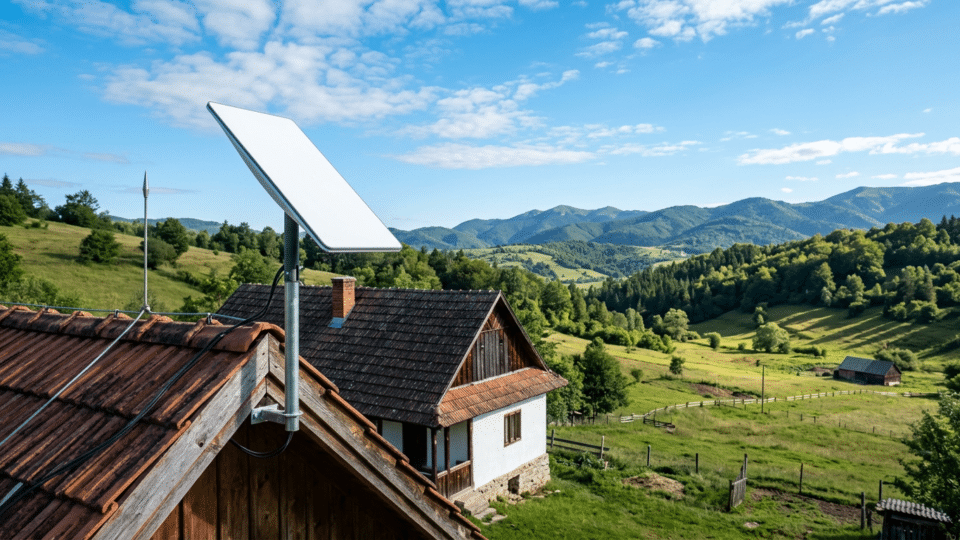
Satellite internet in Romania has gone in just a few years from a last-resort solution to a viable option for isolated homes, guesthouses, farms, construction sites, camper vans and users without fibre or reliable 5G. The major change has come from low Earth orbit (LEO) networks such as Starlink, whose satellites orbit far closer to Earth than conventional geostationary systems.
In 2026, Starlink is available in Romania, including through authorised retailers such as Altex and eMAG, while Starlink Mini equipment is also officially available in the country. The exact price of residential service depends on the address and the plan available in that area, however, and Starlink requires users to enter an address to display the current offer.
Satellite internet in Romania: what has changed
Conventional systems mainly used geostationary satellites at an altitude of about 35,786 km. Latency was high, and video calls, gaming and remote work were noticeably less responsive.
LEO networks use satellites a few hundred kilometres above Earth. The result is much lower latency and, in many circumstances, speeds comparable with those of good fixed-line connections.
Starlink: the main option for home users
Starlink remains the most accessible LEO solution for residential users in Romania.
In Romania, Starlink’s official offer displayed on 1 November 2026 starts at about RON 160 per month for Residential 100 Mbps, RON 210 per month for Residential 200 Mbps, and RON 320 per month for Residential Max, with speeds of up to 400+ Mbps where the network permits. Roam plans start at approximately RON 220 per month.
Residential 100 Mbps and 200 Mbps are available only in certain areas. Final pricing and availability should be checked for the exact address.
What speeds can you get?
In good conditions, Starlink can provide download speeds in the hundreds of Mbps. Official specifications generally indicate typical Starlink speeds of around 25–220 Mbps, with most users above 100 Mbps; uploads of around 5–20 Mbps; and terrestrial latency of roughly 25–60 ms, depending on the plan, location and congestion.
In practice, performance varies according to:
- local cell load;
- sky visibility;
- the plan selected;
- weather conditions;
- the type of dish;
- traffic priority.
It should not be treated as a permanently guaranteed-bandwidth connection.
Latency: the major difference from conventional satellite
With geostationary systems, round-trip latency can easily exceed 500–600 ms.
With Starlink, latency can in many cases fall into the 20–60 ms range, which is sufficient for:
- Teams and Zoom;
- VoIP;
- VPNs;
- casual gaming;
- remote desktop;
- live streaming.
Latency can nevertheless fluctuate more than it does on fibre.
Starlink Mini: portable internet
Starlink Mini is officially available in Romania.
It is designed for mobility and can be used with compatible Roam and Priority plans.
Its main advantages are:
- compact size;
- low power consumption;
- built-in Wi-Fi;
- easy transport;
- suitability for camper vans, camping and temporary use.
For a permanent home, the standard dish may offer better performance and stability.
Roam in Europe
Starlink Roam plans allow use in several European countries, including Romania, Bulgaria, Greece, Hungary, Austria, Italy and others.
For more context, see Romania has top-tier fixed internet but still lags on 5G, which examines an aspect directly related to this subject.
Broader international use is subject to different limits and conditions depending on the plan. Starlink says certain Priority services include priority access, a public IP address and longer periods of international use.
CGNAT and public IP
One important consideration for advanced users is the IP address.
Many residential Starlink connections use CGNAT. This means users do not automatically receive a dedicated public IPv4 address, and traditional port forwarding may not work.
For normal use, this is not a problem.
It can matter if you have:
- a home server;
- an NVR accessed directly from the internet;
- your own VPN server;
- services requiring inbound IPv4.
Certain Priority plans offer a public IP address.
What happens in rain or snow?
Starlink is designed to operate in difficult weather, but very heavy precipitation can cause temporary drops in performance.
The dishes include heating functions to melt snow, but ice accumulation, obstructions and extreme precipitation can affect the link.
The most important requirement: a clear view of the sky
Starlink needs a wide area of unobstructed sky.
Trees, buildings, poles or chimneys can cause brief interruptions.
For:
- streaming;
- browsing;
- downloads,
these may be almost unnoticeable.
For:
- video calls;
- gaming;
- latency-sensitive VPNs;
- remote desktop,
obstructions can become disruptive.
Starlink vs fibre
| Criterion | Starlink | Fibre |
|---|---|---|
| Speed | high, variable | very high, stable |
| Latency | good | excellent |
| Stability | very good with a clear sky | excellent |
| Installation | quick | depends on the network |
| Rural availability | very good | variable |
| Public IP | not on all plans | depends on the ISP |
If you have reliable 1 Gbps fibre at a good price, Starlink is generally not an upgrade.
Starlink vs 4G/5G
If you have good, unlimited 5G, a mobile connection may be cheaper and simpler.
Starlink becomes attractive when:
- the mobile signal is weak;
- the mast is heavily congested;
- speeds vary widely;
- there is no adequate data allowance;
- the location is isolated.
Starlink vs Viasat
Viasat remains an important name in satellite internet, but its residential model is primarily geostationary.
In 2026, the company advertises plans with base speeds of up to about 80 Mbps and bursts of up to 150–200 Mbps, depending on the plan.
The fundamental difference from Starlink remains latency: a GEO system cannot eliminate the physical delay caused by the much greater distance to the satellite.
In addition, residential Viasat availability is not uniform across Europe and must be checked separately for Romania.
OneWeb / Eutelsat: more for business than the home
Eutelsat OneWeb operates a major LEO constellation, but its offer is primarily geared towards:
- enterprise;
- government;
- maritime;
- aviation;
- telecommunications;
- backhaul.
For Romanian home users, it is not a direct Starlink alternative in the way a retail ISP is.
What about Amazon Project Kuiper?
Amazon is developing Project Kuiper as a LEO rival, but commercial availability for home users in Romania must be checked when it launches locally.
In 2026, Starlink has the advantage of commercial maturity and an already available network.
The real cost is not just the subscription
Costs to consider include:
- the kit;
- the mounting bracket;
- the cable;
- possibly an Ethernet adapter;
- an additional router;
- a UPS;
- electricity use.
In some promotions, equipment may be subsidised or offered under special conditions, but offers change frequently.
How much power does Starlink use?
Power consumption depends on the generation of the dish, the temperature and its operating mode.
A standard dish can consume tens of watts continuously, and the heating function can increase consumption.
This matters for a home with a solar-power system, battery or generator.
Starlink on a UPS
For users who depend on the internet for work, a small UPS can keep the connection running through brief outages.
The following need power:
- the dish;
- the router;
- possibly the switch;
- local network equipment.
Can you use your own router?
Yes. Depending on the generation of the kit, Starlink can be integrated with your own router.
For a large home, a dedicated mesh Wi-Fi system may provide better coverage than the standard router.
Is it good for gaming?
Yes, it is usable for many games without major problems.
But fibre remains superior because of:
- lower latency;
- less jitter;
- better stability;
- fewer brief interruptions.
Is it good for remote work?
Yes, provided the dish has a good view of the sky.
Teams, Zoom, VPNs and remote desktop work well in most cases.
For critical activities, a 4G/5G backup connection is a very good combination.
Starlink for guesthouses, farms and construction sites
This is where the service becomes particularly attractive.
It can bring fast internet to a location where installing fibre would require:
- months of waiting;
- excavation work;
- high costs;
- a network extension.
Starlink as a backup line
For companies and critical locations, satellite can be valuable even where fibre is available.
If the fibre is physically cut, Starlink can keep the following running:
- point-of-sale systems;
- VPNs;
- email;
- cameras;
- communications.
Where Starlink is not worth it
It is not the logical choice if:
- you have reliable gigabit fibre;
- you have very good, inexpensive 5G;
- you live among tall buildings without a view of the sky;
- you need the absolute minimum latency;
- you need public IPv4 without a compatible plan.
Where it is very much worth it
It is an excellent fit for:
- villages without fibre;
- isolated homes;
- farms;
- cabins;
- construction sites;
- camper vans;
- fixed-internet backup.
Satellite internet and home resilience
A Starlink connection combined with a solar-power system, battery and a router on a UPS can keep communications active even if local infrastructure is affected.
InfoBuz has also examined what to do in the first 30 minutes of a power outage.
Verdict
Satellite internet in Romania is no longer a slow, expensive solution reserved for extreme locations.
Starlink has changed the market with low latency, quick installation and speeds that can exceed 100–200 Mbps in many situations.
But it does not replace fibre where good fibre is available.
In 2026, the conclusion is straightforward:
- You have good fibre: keep the fibre.
- You have very good 5G: compare the price and data allowance.
- You have no infrastructure: Starlink is one of the best options.
- You need a backup: Starlink can be highly valuable.
Frequently asked questions
Is Starlink available in Romania?
Yes. Romania is a supported market, and Starlink lists local authorised retailers including Altex and eMAG.
Is Starlink Mini available in Romania?
Yes. Romania is on the official list of countries where Starlink Mini is available.
Is Starlink faster than fibre?
Usually not. Gigabit fibre is faster and more stable, but Starlink is highly competitive where fixed infrastructure is unavailable.
Does Starlink have a public IP?
Not on all plans. Residential plans may use CGNAT, while certain Priority plans offer a public IP address.
Does it work in rain?
Yes, but very heavy rain and other extreme conditions can temporarily reduce performance.
Sources: Starlink – plans and availability; Starlink Help Center – Roam, Mini and authorised retailers; Viasat – 2026 plans and speeds; Eutelsat OneWeb – LEO services.








Discuția cititorilor
Ai o opinie sau o întrebare despre acest articol? Spune-ne ce crezi.
Fii primul care deschide discuția.
Te rugăm să păstrezi un limbaj civilizat și să discuți la subiect. Comentariile spam sunt filtrate automat.