
Differences between a building’s main water meter and apartment meters are among the most common sources of disputes in an apartment block: residents add up the consumption recorded in their flats, yet the water bill shows more cubic metres. Where did the water go? Was it used, lost through a shared pipe, or recorded differently? And, above all, who pays the difference? The answer cannot be determined from a percentage alone: the readings, the installation and the form of the contract with the operator must all be checked.
In this InfoBuz ORIGINALS analysis, we explain how the difference is calculated, why apartment meters and the service-connection meter can show different figures, what Romanian law provides, and how an owner can request the necessary documents. Important: a water discrepancy is not, by definition, fraud, a physical loss or unrecorded consumption. These are possibilities to investigate, not conclusions.
What the main meter measures and what an apartment meter measures
The service-connection meter measures the volume of water passing through the boundary point between the public network and the condominium’s installation. A meter inside a home measures consumption on the circuit on which it has been installed, under certain technical conditions. If there are points of use upstream of the individual meters, leaks in the common installation, or readings taken on different days, the two totals are not directly comparable.
In condominiums with individual contracts, Article 31 of Law No. 241/2006 specifies that the boundary point remains the condominium’s service-connection meter. Individual contracting does not automatically transfer ownership of all common installations to the operator, nor does it make the technical difference disappear.
Practical example: an apartment block with 20 flats and a 30 m³ difference
Take a hypothetical example for a billing period in which all readings are comparable. The main meter shows consumption of 300 m³. The readings from the apartment meters in the 20 flats add up to 270 m³.
| Item | Value | Calculation |
|---|---|---|
| Main meter | 300 m³ | New reading minus previous reading |
| Total apartment meters | 270 m³ | Sum of individual consumption |
| Difference | 30 m³ | 300 − 270 |
| Difference as a share of the main-meter total | 10% | 30 ÷ 300 × 100 |
| Difference as a share of apartment-meter consumption | 11.1% | 30 ÷ 270 × 100 |
The same volume can be described as 10% or 11.1%, depending on the denominator. That is why a notice stating only “11% losses” is insufficient: it must also show the calculation method. Thirty cubic metres equals 30,000 litres, but that alone does not tell us where the water went.
How much would each flat pay under individual contracts?
Where the legal conditions for individual contracts with the operator are met, Article 31(7)(b) of Law No. 241/2006 provides that the difference between the service-connection meter and the sum of individual consumption is divided equally per property unit and billed individually. In this example, 30 ÷ 20 = 1.5 m³ for each property unit. This rule is tied to the arrangement described in that article; it should not automatically be extended to every apartment block where the owners’ association receives a collective bill. See the legal text.
For a building with a collective bill issued to the owners’ association, the contract, applicable allocation rules, the association’s lawful decisions and the technical circumstances must be checked. Do not assume that an equal split, a split proportional to consumption, by number of occupants or by ownership share is the only valid method in every situation. If the method used is not explained, owners can request documents and justification.
Eight possible causes of a water discrepancy
1. Readings were not taken on the same day
The main meter may be read on one day, while apartment meters are reported over several days. Water used between those points may appear as a discrepancy in one month and partly be corrected in another. The first check should be whether the periods are aligned, rather than an immediate search for a broken pipe.
2. Some apartment meters were not read and estimates were used
A temporarily vacant flat, an unreported reading or an incorrect reading can produce significant differences. If an administrator uses estimated values, it should be clear how and when they are adjusted. An estimate is not a physical measurement.
3. There is a leak in the common installation
A cracked basement pipe, a dripping connection, a discharging valve or a faulty joint can use water after it has passed the main meter, without that volume being recorded by apartment meters. A hidden leak can persist for weeks even if the floor does not appear wet.
4. There are common points of use
Taps used for cleaning, technical areas, shared installations or other consumption upstream of individual apartment meters must be identified and properly accounted for. The absence of a separate meter for common uses makes the analysis more difficult, but does not prove unlawful consumption.
5. Very low flows are measured differently
A meter has its own measurement range and accuracy conditions; very low flows may be detected differently by devices in different metrological classes. A slowly dripping tap is not necessarily recorded in the same way by every model. The technical difference depends on the type of meter, installation, wear and metrological verification, not on an assumed fixed 5% error applicable to every meter.
6. Apartment meters are old, stuck or incorrectly installed
Impurities, deposits, pulsating flow, installation position or malfunctions can affect recording. The only way to establish a metrological error is through appropriate verification by competent entities, not by comparing readings with a measuring cup or a phone app.
7. Some individual circuits have been omitted
Altered flats may have more than one riser, connection or water entry point. If an apartment meter measures only some of them, the total of the readings cannot naturally equal total consumption. Checks must be carried out lawfully and technically, without unauthorised entry into properties.
8. There is a calculation or transcription error
Transposed figures, meters using other units, readings assigned to the wrong flats, incorrectly applied adjustments and unclear photographs of meter readings can all create discrepancies. Before discussing fraud, compare meter serial numbers, old and new readings, and the formula actually used.
Can the difference be negative? Yes — and it does not mean the building produced water
If the total reported by apartment meters exceeds the main meter’s reading, this may result from readings covering different periods, adjustments to earlier overestimates, reading errors, meter replacements or measurement problems. A negative difference should be investigated as transparently as a positive one; it does not automatically justify an extra charge or a refund without checking the entire calculation.
How to check the difference properly: a 10-step process
- Request the operator’s bill for the exact period and the volume in m³ measured at the connection.
- Request the old and new readings for the main meter, with reading dates and, where available, photographs.
- Request the table of individual readings, with personal data that are not needed to justify the calculation anonymised.
- Compare the reading periods and identify estimated or adjusted values.
- Check whether all points of use and all risers are metered.
- Request the allocation method and the basis applied by the association in the specific case.
- Propose a lawful inspection of common consumption and accessible technical installations.
- Request an inventory of meters, serial numbers, installation documents and, where relevant, information on metrological verification.
- Compare at least two or three periods: an isolated discrepancy may have a calendar-related explanation, while a recurring discrepancy requires closer investigation.
- Request a written reply and a record of the measures taken; keep the documents and data.
How much water can a faulty tap lose? A calculation, not a diagnosis
Assume hypothetically that a leak has an average flow of 0.5 litres per minute. Over 24 hours, that amounts to 0.5 × 60 × 24 = 720 litres, or 0.72 m³. Over 30 days, the result is 21.6 m³. At 1 litre per minute, the figure would be 43.2 m³ in a 30-day month.
These are illustrative calculations, not measurements of an actual installation. Flow can change depending on pressure and the condition of the fault. The example nevertheless shows why an apparently small leak can produce a large difference on an entire building’s bill.
Who is responsible for the pipe, and who is responsible for the bill?
Technical responsibility for an installation, the payment obligation for billed water, and the method of allocation among owners must be distinguished. They do not automatically fall to the same person. The division between the public network and internal installation, the condominium’s documents, the operator’s contract and applicable rules must be considered together.
Under the individual-contract arrangement provided for by Article 31 of Law No. 241/2006, the operator divides the difference equally per property unit. Under the same arrangement, users bear, in proportion to their undivided ownership share, the costs of administering, maintaining and repairing common water and sewer installations. The point matters: allocation of the volume difference and funding the repair of a common pipe are two separate legal issues.
What rights does an owner have when the difference is not explained?
Article 28 of Law No. 196/2018 provides owners with the right to information about the association’s activity and to copies of documents, subject to covering reproduction costs under the law. An owner is entitled to an explanation of how their contribution was calculated and may, where applicable, submit a written objection within 10 days of the payment list being posted. The association president must reply in writing within 10 days of receiving the objection.
If documents are not made available, the law provides mechanisms for raising the matter within the association and the possibility of approaching the competent authorities, depending on the circumstances. We do not recommend withholding payment entirely or unilaterally stopping contributions as a form of protest. A dispute over an amount should be pursued through the appropriate procedural channels.
Template request to an owners’ association
Subject: Request for explanation and documents concerning the water-consumption difference for [month ___]. Please provide the volume recorded by the service-connection meter, the total of individual consumption, the dates and methods of reading, common consumption, any adjustment, the allocation formula, and the legal or contractual basis applied. Under Article 28 of Law No. 196/2018, I request access to the relevant documents and a written response concerning the difference of [___] m³ and the amount allocated to my flat. Date, flat number, signature.
This template is an information request. If you wish to formally challenge the payment list, say so expressly and observe the legal 10-day deadline from posting. Keep proof that the request was submitted.
Must all neighbours have identical apartment meters?
The rules depend on the type of distribution, the contractual arrangement and the operator’s requirements. Law No. 241/2006 sets explicit conditions for certain forms of individual contracting, including metrological verification and, where applicable, remotely read meters and requirements for the same type of device. It does not follow that every older building with a collective contract must immediately replace all apartment meters without an assessment of its legal and technical position.
Do smart meters automatically solve the problem?
Remote reading and synchronised readings can reduce transcription errors, delays and differences caused by readings taken on different dates. They can help identify unusual consumption. However, a smart meter does not repair a cracked pipe, does not guarantee the detection of every low flow and does not by itself establish an individual’s fault. Digitalisation provides better data; analysis and intervention are still necessary.
How to distinguish building losses from losses in the public network
The difference between the main meter and apartment meters must not be confused with water lost by the water operator in the public network before the service connection. These are distinct phenomena, with different measurement points and responsibilities. InfoBuz examined that issue separately in Romania loses water before it reaches the tap as networks enter the data era. National figures for non-revenue water cannot automatically be applied as the percentage difference on an apartment block’s bill.
Seven mistakes that can cost owners money
| Mistake | Why it is a problem |
|---|---|
| Comparing readings taken on different days | This can create an apparent discrepancy and shift consumption between months. |
| Declaring “theft” without findings | It confuses a suspicion with a proven fact. |
| Automatically applying an allocation method from another building | It ignores the type of contract and the local legal situation. |
| Leaving out common consumption | The remaining difference appears unjustified even though it may include real consumption. |
| Replacing an apartment meter without retaining the data | Continuity of the readings and verification of the adjustment are lost. |
| Comparing percentages with different denominators | “10%” and “11.1%” can describe the same quantity of water. |
| Paying or challenging a charge without documents | It makes it harder to identify the cause and any necessary corrections. |
Frequently asked questions about differences between main and apartment water meters
Is it normal for there to be differences between the main meter and apartment meters?
Differences can arise from readings, metrology, common consumption or leaks. Their existence does not automatically establish that they are correct, acceptable in scale, or payable in a particular way; checking the data and rules is essential.
Who pays the water difference in a building with individual contracts?
In the situation governed by Article 31(7)(b) of Law No. 241/2006, the difference is divided equally per property unit and billed individually. We do not automatically infer the same formula for other contractual arrangements.
If my apartment meter shows 0 m³, can I still have water to pay for?
Under certain arrangements, yes: there may be an allocated overall difference, common consumption or adjustments provided for by the applicable rules. Request the calculation and its basis; do not assume that every additional charge is unlawful.
If a neighbour does not report their meter reading, am I paying for their water?
A missing declaration can temporarily affect allocation, but without documents it cannot automatically be said that the other owners will permanently bear all of that consumption. It is necessary to see how consumption is estimated and adjusted under the applicable arrangement.
Can I request a copy of the bill and the allocation calculations?
Yes. Article 28 of Law No. 196/2018 recognises the right to information and copies of the association’s documents, subject to covering reproduction costs under the law.
How many days do I have to challenge the maintenance-charge list?
Article 28(3) provides for 10 days from the posting of the list, and the president must reply in writing within 10 days of receiving the objection.
Does a new meter guarantee there will be no more discrepancies?
No. It may reduce one type of error, but it does not eliminate consumption in the common installation, unsynchronised readings, leaks or administrative errors.
Conclusion: the difference should be explained with data, not allocated on assumptions
A correct bill starts with a correct comparison: the same period, the same volume, every point of use and a justified allocation formula. An owner has the right to know the data and to challenge an unclearly calculated contribution within the legal deadline. The association and operator have roles that must be assessed under the contract and applicable rules. When the difference recurs or rises sharply, the response should be a documented inspection of the installation and measurement, not an automatic accusation that someone is “stealing water”.
Official sources and methodology
- Law No. 196/2018 on owners’ associations — Legislative Portal: the right to information, explanations, challenging the payment list and condominium administration.
- Law No. 241/2006 on water supply and sewerage services — Legislative Portal: the boundary point, individual contracts and allocation of differences under the arrangement provided for by Article 31.
- Iași Prefect’s Institution — clarifications on Law No. 196/2018: practical explanations of challenging the payment list and owners’ rights.
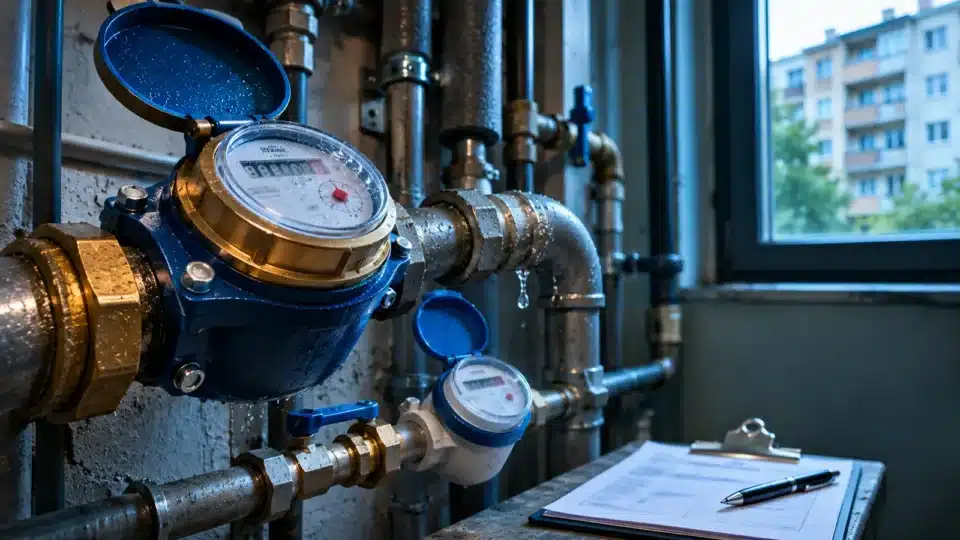
Editorial note, 17 November 2026: the calculations involving 20 flats, 30 m³ and a 0.5 litre-per-minute leak are hypothetical examples. They do not represent a finding at an actual apartment block or a tariff. The legal allocation depends on the type of contract and the applicable documents. The representative image is an AI-generated illustration, not a photograph of an identified installation.






Discuția cititorilor
Ai o opinie sau o întrebare despre acest articol? Spune-ne ce crezi.
Fii primul care deschide discuția.
Te rugăm să păstrezi un limbaj civilizat și să discuți la subiect. Comentariile spam sunt filtrate automat.