
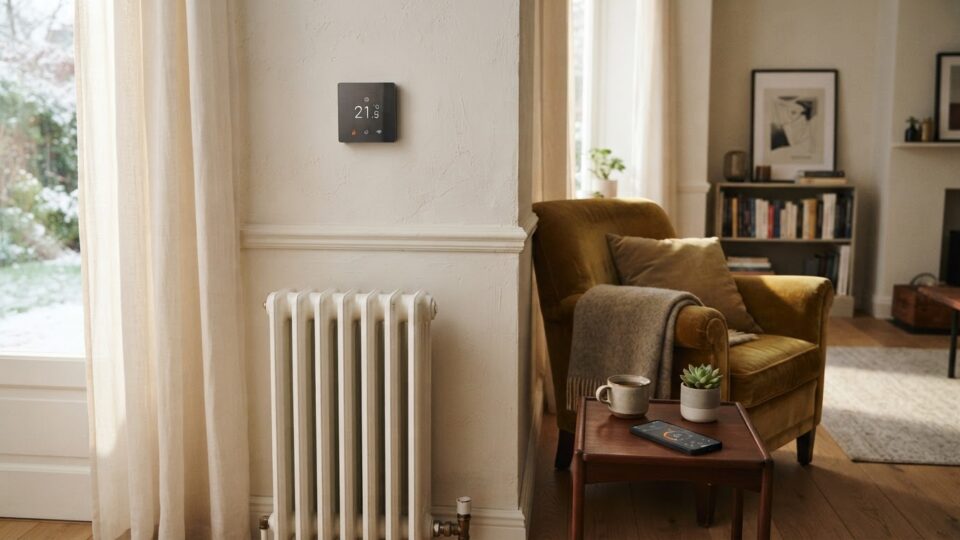
Smart or conventional thermostat? In 2026, the difference is no longer simply between a rotary dial and a phone app. A modern control system can schedule different temperatures by hour, turn off the heating when nobody is home, control rooms separately and, in some cases, communicate with the boiler through modulation to reduce on-off cycling.
But a “smart” thermostat does not automatically guarantee a lower bill. If you already have a well-configured programmable thermostat and a stable routine, the additional saving may be modest. If, however, you often leave the heating on, have an unpredictable schedule or heat rooms you do not use, an intelligent system can offer a real advantage.
Smart vs conventional thermostat: at a glance
| Type | What it does | Main advantage | Main limitation |
|---|---|---|---|
| Mechanical/simple thermostat | Maintains a set temperature | Low cost, simplicity | No advanced scheduling |
| Programmable thermostat | Sets temperatures for time periods | Good savings if configured correctly | Requires manual programming |
| Smart thermostat | Scheduling, app control, geofencing and sometimes learning | Flexibility and automation | Higher cost; dependent on compatibility and sometimes the cloud |
| Modulating control | Adjusts the boiler’s output, rather than simply switching it on or off | Smoother, more efficient operation | Requires a compatible boiler and protocol |
What actually saves energy
Whatever type of thermostat you have, savings come from a simple principle: heat the home only as much as necessary, and only when necessary.
Energy Saving Trust says heating controls — a programmer, room thermostat and thermostatic radiator valves — can reduce consumption when used properly. For a typical UK home, the organisation estimates savings of around £100 a year from installing and using heating controls efficiently.
These figures cannot be converted directly into Romanian lei for a home in Romania, but the principle remains relevant: better control reduces the time a boiler runs unnecessarily.
How much can your bill fall if you lower the temperature?
The US Department of Energy estimates that lowering the temperature while sleeping or away from home can save up to around 10% a year on heating and cooling, under certain conditions.
Energy Saving Trust also notes that lowering the thermostat by one degree — for example, from 22°C to 21°C — can produce significant savings.
What matters is that the actual percentage depends on:
- the home’s insulation;
- outdoor temperature;
- the heating source;
- the number of operating hours;
- the initial temperature;
- the building’s thermal inertia;
- the household’s habits.
A smart thermostat does not heat your home faster
This is a very common misunderstanding.
If you raise the set temperature from 21°C to 25°C, the boiler will not automatically heat the room faster. It will run until the requested temperature is reached.
Energy Saving Trust advises starting the heating a little earlier on very cold days, rather than excessively raising the setpoint.
A smart thermostat can automate this through features such as “early start” or “optimum start”, if the model supports them.
A programmable thermostat may be enough
For a household with a predictable routine — leaving for work at the same time, returning in the evening and going to sleep at roughly the same hours — a good programmable thermostat can provide almost everything needed to save energy.
You can set, for example:
- 20–21°C in the morning;
- a lower temperature while the house is empty;
- a return to a comfortable temperature before you get home;
- a nighttime setback.
In such a scenario, the financial difference between a quality programmable thermostat and a smart one may be smaller than marketing suggests.
When a smart thermostat starts to have an advantage
A smart system is more useful when the household’s routine changes often.
Examples include:
- working shifts;
- sometimes working from home and sometimes from the office;
- frequently going away at weekends;
- children arriving home at different times;
- forgetting to turn the heating off;
- wanting to check the temperature remotely.
In these situations, app control and automation can reduce unnecessary heating hours.
What is geofencing?
Geofencing uses a phone’s location to estimate whether you are at home or away.
A compatible thermostat can:
- lower the temperature when the last member of the household leaves;
- start heating before someone arrives home;
- send a notification before changing the setting.
The feature can be very useful in a home with a variable schedule.
It must, however, be configured carefully where several people live in the same home. If the system tracks one phone and that person leaves, the heating should not be lowered if other household members are still at home.
For more information about smart homes, see Smart home without huge investment: 15 useful automations for comfort, security and savings, which offers complementary details on the subject.
A “learning” smart thermostat: useful or marketing?
Some models learn the times at which you change the temperature and automatically build a schedule.
In a home with a consistent routine, that feature can be convenient.
In a household with a highly chaotic schedule, the algorithm may make more adjustments than necessary. Energy Saving Trust warns that smart functions can even increase consumption if the system starts heating earlier or maintains comfort for longer than you would have done manually.
In other words, “smart” means better control, not guaranteed savings.
On/off versus modulation: the important technical difference
This is where one of the biggest differences between systems emerges.
A conventional on/off thermostat tells the boiler only two things:
- switch on;
- switch off.
The boiler heats until the room reaches the setpoint, then switches off and starts again when the temperature falls.
A modulating control can tell the boiler to reduce or increase its output according to the actual heat demand.
Instead of frequent high-output cycles, the boiler can operate for longer at a lower output.
What is OpenTherm?
OpenTherm is a standardised communication protocol between a modulating heat generator and a thermostat.
The OpenTherm Association describes it as a manufacturer-independent system designed for communication between modulating HVAC appliances and controllers.
The advantage is that the thermostat can send more than a simple on-off command.
For example, it can request:
- a lower heating-water temperature;
- reduced output;
- operation adapted to actual demand.
OpenTherm does not mean every boiler works with every thermostat
If the boiler and thermostat are OpenTherm-certified, compatibility is generally more straightforward.
But many boilers use proprietary protocols — eBUS, EMS, BUS and other manufacturer-specific implementations.
Before buying a smart thermostat, check:
- the exact boiler model;
- the protocol it supports;
- whether modulation is available with that thermostat;
- whether a separate receiver module is needed.
Why a condensing boiler benefits from modulation
Condensing boilers are more efficient when they can operate with sufficiently low return temperatures and for longer periods at reduced output.
A modulating control can help the boiler avoid short cycles and keep the heating-water temperature closer to actual demand.
Final efficiency nevertheless depends on the entire system: radiators, flow temperature, balancing and the home’s insulation.
Smart thermostat and smart radiator valves: when it is worthwhile
One thermostat usually controls the temperature in one zone.
If you want different temperatures in every room, you need zoning.
Smart thermostatic radiator valves can allow for:
- 21°C in the living room;
- 19°C in the bedroom;
- 17–18°C in a rarely used room;
- a different schedule for each room.
This is where more meaningful savings can arise, because not every room is heated to the same temperature.
But there is a catch with smart radiator valves
If all valves close the radiators at the same time, the heating system must be designed to handle that situation.
Some installations require a bypass or a suitable control strategy to maintain flow.
In addition, the valve in the same room as the main thermostat must be configured correctly; otherwise, the two systems can work against each other.
Where should the thermostat be installed?
Placement matters as much as technology.
The thermostat should measure a temperature representative of the controlled area.
Avoid installing it:
- above a radiator;
- in direct sunlight;
- near an oven or cooker;
- beside an exterior door exposed to draughts;
- behind a curtain;
- in a cold corner that does not represent the rest of the room.
Wireless or wired thermostat?
A wired thermostat has the advantage of a simple, stable connection.
A wireless model offers greater flexibility in placement, but depends on:
- batteries;
- radio signal;
- a receiver;
- sometimes Wi-Fi or internet access for smart functions.
For basic operation, many systems continue to control the boiler if the internet goes down. This must, however, be checked for the specific model.
What happens if the internet goes down?
A good smart thermostat should retain local heating control.
Before buying, it is important to check:
- whether the schedule continues locally;
- whether the temperature can be changed on the physical unit;
- whether the app is only an interface or the system is fully cloud-dependent.
A heating system should not become unusable just because the router has no internet connection.
Privacy and the cloud
Smart thermostats may collect data on:
- the household’s at-home schedule;
- preferred temperatures;
- presence;
- the phone’s location, if geofencing is enabled;
- system consumption and behaviour.
Before making a purchase, it is worth checking the privacy policy and whether location functions can be disabled.
Smart thermostats and heat pumps: a different strategy
With a heat pump, the rules differ from those for a gas boiler.
Heat pumps are usually more efficient when operating steadily, with low heating-water temperatures and small setpoint variations.
Aggressively lowering the temperature at night and sharply reheating in the morning can be counterproductive.
Energy Saving Trust stresses that recommendations for boiler controls do not automatically apply to heat pumps.
Underfloor heating also has high thermal inertia
A heated floor may take hours to change the room temperature.
In this case, a thermostat that learns the system’s inertia and starts in advance can improve comfort.
But automations such as “switch off when I leave for two hours” may be pointless, as the system does not respond quickly enough.
A smart thermostat in a small flat
In a 50–70 m² flat with one zone and a consistent routine, a good programmable thermostat may be enough.
A smart model becomes attractive chiefly for:
- remote control;
- a variable schedule;
- consumption reports;
- geofencing;
- automation.
If these functions are not used, the additional investment is harder to recover.
A smart thermostat in a large house
In a house with several floors and rooms used in different ways, the advantage may be greater.
Here, the real saving comes mostly from:
- zoning;
- thermostatic radiator valves;
- separate schedules for zones;
- modulating control;
- cutting the heating of unoccupied rooms.
One smart thermostat in the living room cannot compensate for an unbalanced installation or rooms that overheat.
How to calculate whether the investment is worthwhile
The simple formula is:
Payback period = total system cost / estimated annual saving
An indicative example:
- thermostat + receiver + installation: 1,000 lei;
- actual saving: 200 lei/year;
- payback: about five years.
If the saving is only 80 lei a year, payback takes much longer.
If the system includes 8–10 smart radiator valves, the cost can increase considerably, but potential savings may also be higher if you were previously heating many rooms unnecessarily.
What to check before buying
Do not start with the app or the design.
Check the following, in this order:
- the exact boiler model;
- on/off or modulation;
- OpenTherm or a proprietary protocol;
- whether domestic hot water needs to be controlled separately;
- the number of zones;
- compatibility with smart radiator valves;
- operation without internet;
- power supply and batteries;
- installation cost;
- software updates.
Do not buy the thermostat before checking the boiler
An excellent smart thermostat may work only as an on/off device with a boiler that could support modulation through another protocol.
In that case, you may lose some of the system’s technical advantage.
The boiler manual and the thermostat manufacturer’s compatibility list should be checked before ordering.
The link with the optimum temperature at home
A high-performance thermostat cannot compensate for an unrealistic setpoint.
If you maintain 24–25°C throughout the home, consumption will remain high regardless of how intelligent the control is.
InfoBuz has separately explained how to choose between 18, 20 and 22°C, and why the right temperature depends on the home and the people in it.
Check energy losses before buying a thermostat
A control system can reduce operating hours, but it cannot fix a draughty window, an uninsulated loft or a poorly sealed hatch.
Before investing in automation, it is also worth reading InfoBuz’s guide to 15 sources of energy loss you can reduce without major renovation.
Smart or conventional thermostat: the verdict
Choose a conventional/programmable thermostat if you have a small home, a predictable schedule, one zone and want a simple, inexpensive solution.
Choose a smart thermostat if your schedule changes often, or you want remote control, geofencing, automation or zoning.
Choose a compatible modulating control if your boiler supports it and you want to optimise operation rather than simply add Wi-Fi.
In practice, the best investment is not necessarily the most expensive thermostat, but the system that suits the boiler, the home and your routine.
Frequently asked questions
Does a smart thermostat automatically cut the bill?
No. Savings depend on how it is configured and on your previous behaviour. If you already had an efficient schedule, the difference may be small.
Which is better: an on/off thermostat or OpenTherm?
If the boiler supports OpenTherm and the thermostat is compatible, modulating control can adjust boiler output more precisely than a simple on/off contact.
Are smart valves worthwhile on all radiators?
They can be worthwhile in a house with many rooms used differently. In a small flat, the additional cost may be harder to recover.
Does a smart thermostat work without internet?
It depends on the model. Many systems retain local control and the basic schedule, but app access and some cloud automations may become unavailable.
Can I install a smart thermostat myself?
Some models use a simple contact and are relatively easy to install, but work on a boiler involves electricity and heating equipment. If you do not have experience, it is safer to use an authorised installer and check compatibility first.
Sources: Energy Saving Trust – Heating controls; Energy Saving Trust – using heating efficiently; U.S. Department of Energy – Home Heating and Cooling Guide; OpenTherm Association – consumer information.




Discuția cititorilor
Ai o opinie sau o întrebare despre acest articol? Spune-ne ce crezi.
Fii primul care deschide discuția.
Te rugăm să păstrezi un limbaj civilizat și să discuți la subiect. Comentariile spam sunt filtrate automat.