
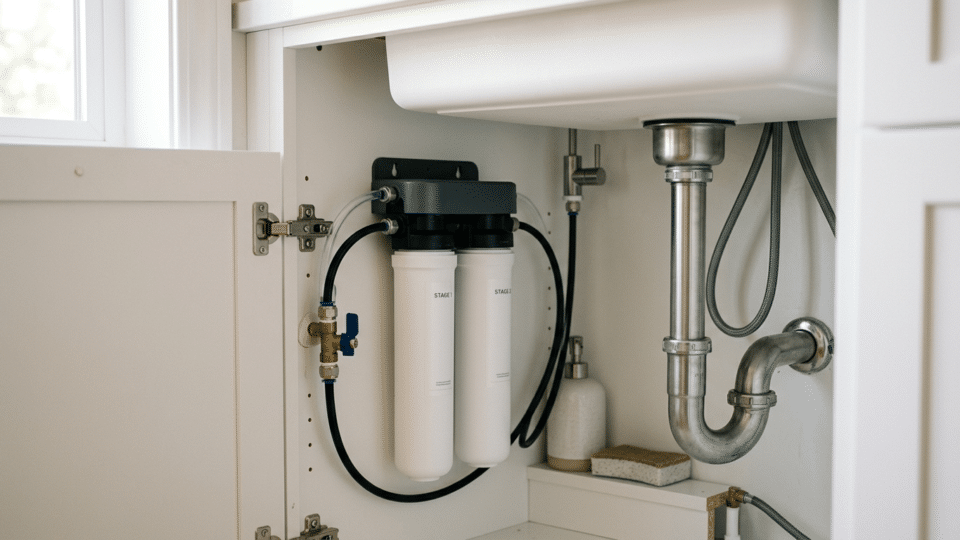
Romania has notified the European Commission of a draft measure that changes the health procedure applying to products, materials, substances and equipment that come into contact with water intended for human consumption. The issue is not a general requirement for homeowners to replace household filters, but a move to a European conformity-assessment framework for certain product categories.
What is known so far: Romania’s notification is still a draft, not a final order published in the Official Gazette. It was registered in the European TRIS system on 30 September 2026, and the standstill period indicated by the European Commission ends on 4 January 2027. Separately, Delegated Regulation (EU) 2024/370 has already been adopted and applies from 31 December 2026.
For anyone with an under-sink filter, a filter jug or plans for a new installation, the important distinction is this: the rules concern the hygienic safety of products and materials that contact water, not a promise that every filter automatically removes a particular contaminant.
Drinking-water filter rules: two systems, not one ban
The draft notified by Romania seeks to adapt the national procedure set out in Health Minister’s Order No. 275/2012 to the European framework. According to the European Commission TRIS system’s notification record for 2026/0533/RO, the draft distinguishes between products and materials for which the European Union has harmonised requirements and certain categories that would continue to be handled under the national health procedure, particularly treatment substances and filter media.
For further background on the European Commission, see also Romania must strengthen its rules for offshore operations, which offers complementary details on this subject.
This distinction matters because the word “filter” is too broad on its own to establish which regime applies. A product marketed to the public as a filter may combine a plastic or metal housing, seals, hoses, a cartridge and a filter medium such as activated carbon. Technically and legally, these may be separate elements.
Delegated Regulation (EU) 2024/370 lays down procedures for assessing the conformity of products that come into contact with water intended for human consumption, as well as for the bodies carrying out those assessments. The regulation aims to ensure that materials do not affect health, do not unacceptably alter the water’s taste, odour or colour, do not promote microbial growth, and do not release contaminants above the level necessary for the product’s intended use.
It does not follow that all products commercially described as “filters” automatically fall under the same European route, or that every product already installed becomes non-compliant on 31 December 2026. A specific classification requires the product category, the components that contact water and the manufacturer’s documentation.
31 December 2026 is a European threshold, not a home-filter replacement deadline
The date of 31 December 2026 appears in two closely related but different contexts. First, Delegated Regulation (EU) 2024/370 becomes applicable from that date. As an EU regulation, it is directly applicable in member states; in principle, it does not depend on the issuance of a Romanian order to exist.
Second, the Romanian draft is intended to organise the domestic transition and specify where the national procedure remains relevant. It should not be presented as a final measure while it remains in the European technical-notification procedure.
The regulation also contains a transitional provision. For products assessed as compliant with national hygiene requirements and holding a national certificate that remains valid on 31 December 2026, the application of the new European procedures is deferred until 31 December 2032. This is not an automatic extension for every product in shops or homes: it depends on the existence of a valid national certificate on the reference date.
Health Ministry documents also mention 31 December 2031. The ministry’s published explanatory note states that approvals and notifications issued under Order No. 275/2012 are valid for five years. The ministry therefore estimates that the latest national documents issued before the 2026 threshold may remain valid only until 31 December 2031.
There is no contradiction between 2031 and 2032. The first date follows from the duration of Romanian documents; the second is the transitional deadline provided by the EU regulation for products meeting its conditions.
What conformity for water contact actually checks
Certification or approval concerning contact with drinking water has a hygienic purpose. It concerns the risk that materials could affect water through the migration of substances, changes in organoleptic properties, or conditions favourable to microbial growth. Implementing Decision (EU) 2024/368 supplements this system with procedures and methods for testing and accepting final materials used in products that come into contact with water.
This is not the same as verifying a filter’s effectiveness against lead, chlorine, pesticides, bacteria, PFAS or other substances. Filtration performance depends on the type of filter medium, flow rate, duration of use, the water’s initial quality and the conditions under which the product was tested.
For that reason, a label such as “stainless steel”, “food-grade plastic” or “activated carbon” does not by itself demonstrate either the conformity of the complete assembly in a particular installation or that the product removes a specific contaminant. In choosing the right technology, the first questions are what problem the water has and what the manufacturer documents; the differences between activated carbon, reverse osmosis and performance standards are also explained in InfoBuz’s guide to water filters.
A simple map for a specific product
Before drawing a conclusion about a filter, cartridge or plumbing component, it is worth working through four questions. They do not replace an official classification, but they help prevent confusion between a commercial label and legal status.
| Question | Why it matters | What a buyer or user can check |
|---|---|---|
| What is the product in practice? | A complete piece of equipment, a component, a material, a cartridge or a filter medium may have different roles. | The technical data sheet, instructions and list of components that contact water. |
| Which part contacts drinking water? | Hygiene rules concern materials and products in contact with water. | The materials used for the housing, hoses, seals, tap and cartridge. |
| What document supports the product? | A water-contact document is not automatically a filtration-performance certificate. | The declaration of conformity, the relevant certificate, scope of use and validity period. |
| What does the filter claim to do? | A claim to reduce a substance should be supported by tests applicable to the model and its conditions of use. | The target contaminant, testing standard, capacity, flow rate and cartridge-replacement interval. |
What remains from the current Romanian procedure
The procedure approved by Order No. 275/2012 is the national framework used until this transition. The text available on the Legislative Portal requires, depending on the product category, documentation on composition, conditions of use, safety data sheets, quality certificates and test reports. Migration tests or toxicological assessments may be relevant for certain products.
These documents show why assessment cannot be reduced to a filter’s external appearance. Two cartridges that look similar may have different materials, conditions of use and technical evidence. At the same time, older national documentation should not automatically be confused with the European certification becoming relevant for products covered by the new harmonised framework.
What the change means for homeowners
The documents reviewed do not establish a general obligation for homeowners to replace filters, cartridges, taps, pipes or other equipment already installed by 31 December 2026. Nor do they show a public, complete and readily consumer-verifiable list of every model holding valid national documents on that date.
In practice, the change will matter more directly to manufacturers, importers, distributors and those placing products on the market or installing systems in new projects. For household buyers, the cautious approach is less dramatic: choose a product with clear documentation, retain the paperwork, and follow the manufacturer’s installation and maintenance schedule.
A filter installed incorrectly or used long beyond the cartridge’s service life does not become safe simply because its material has gone through a conformity procedure. Installation hygiene, replacement of consumables and compatibility with local water remain separate issues.
What remains to be clarified after the notification procedure
After 4 January 2027, it will be necessary to check whether the draft has been adopted, the form in which it appears in the Official Gazette, and its actual date of entry into force. Any official instructions on products already on the market, repairs, component replacements and the list of bodies able to assess conformity in Romania will also become important.
Until the final measure is published, it would be incorrect to speak of fines, new obligations for installers or filter-replacement deadlines for every household. The confirmed fact is narrower, but relevant: Romania is adapting its national procedure to a European system that begins applying on 31 December 2026, while seeking to retain a national route for categories not covered by European harmonisation.
Frequently asked questions
Do I have to replace my household water filter on 31 December 2026?
The documents reviewed do not establish such a general obligation. The date marks the application of Delegated Regulation (EU) 2024/370 to the categories it covers, not an automatic requirement for homeowners to replace all filters already installed.
Does a drinking-water contact certificate guarantee that a filter removes lead or bacteria?
No. Such a document primarily concerns the hygienic safety of materials that contact water. Effectiveness against a particular contaminant must be demonstrated separately through documentation and performance testing applicable to the product.
What is the difference between the 31 December 2031 and 31 December 2032 deadlines?
According to the Health Ministry’s explanatory note, 31 December 2031 follows from the five-year validity of the latest national documents issued before the 2026 threshold. 31 December 2032 is the transitional date provided by Regulation (EU) 2024/370 for certain products with a national certificate still valid on 31 December 2026.
Is the Romanian order already in force?
No. In the documents reviewed, the draft appears as a European technical notification. Notification 2026/0533/RO was received on 30 September 2026, with the standstill period ending on 4 January 2027. The final version must be checked after official publication.
Sources consulted
- Notification 2026/0533/RO on amending the health procedure for products in contact with drinking water — European Commission TRIS
- Delegated Regulation (EU) 2024/370 on conformity-assessment procedures for products in contact with water intended for human consumption — EUR-Lex
- Explanatory note on the institutional framework for applying Regulation (EU) 2024/370 — Health Ministry
- Health Minister’s Order No. 275/2012 on the health regulatory procedure for products in contact with drinking water — Legislative Portal
- Implementing Decision (EU) 2024/368 on testing and accepting final materials in contact with drinking water — EUR-Lex





Discuția cititorilor
Ai o opinie sau o întrebare despre acest articol? Spune-ne ce crezi.
Fii primul care deschide discuția.
Te rugăm să păstrezi un limbaj civilizat și să discuți la subiect. Comentariile spam sunt filtrate automat.