
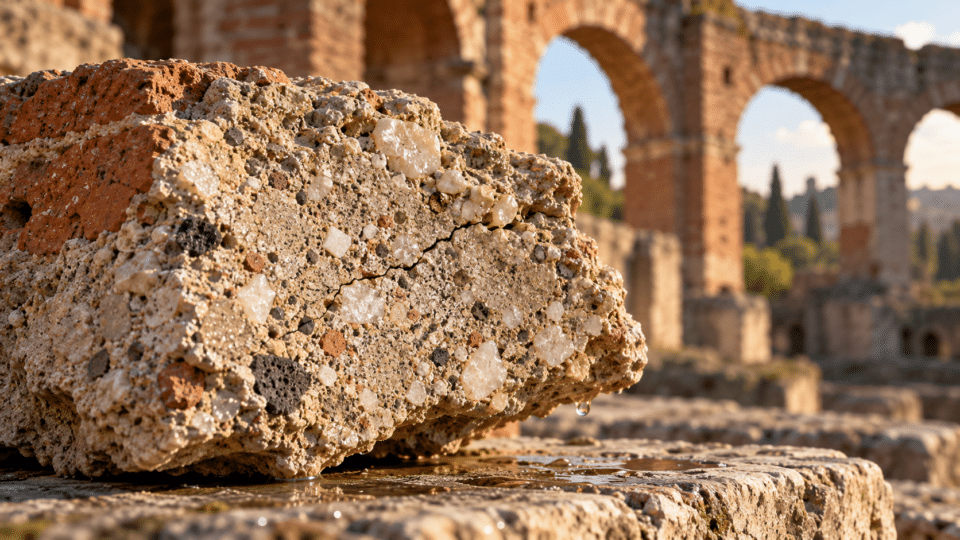
Roman concrete may contain a surprising mechanism: under the right conditions, certain calcium-rich inclusions can help fill cracks. Research published in Science Advances in 2023 proposed an explanation for the role of these grains, while an analysis of a construction site in Pompeii, published in Nature Communications in 2025, provided important evidence about the preparation method.
The finding has present-day implications. If a material can limit water penetration through small cracks, its service life could increase. To assess that promise, however, three things need to be kept separate: what was found in an ancient structure, what worked in an experiment, and what can be guaranteed in a modern structure.
For more information about MIT, see also The Lumina simulation: how the Universe emerged from darkness and what astronomers can test, which offers complementary details on this subject.
What do we actually mean by Roman concrete?
The term covers different materials and uses. In the structures studied, aggregates were bound by mortars based on lime and pozzolanic materials, including volcanic ash. The recipe and choice of aggregate could vary by location and application. The Science Advances study begins precisely with an analysis of specific components of these mortars.
Two terms are useful here. The binder forms the part that holds the mix together. Aggregates are the mineral particles and fragments embedded within it. Durability depends on how these components work together, as well as on pores and reactions that continue within the material. A hard surface does not mean that the chemistry inside has stopped.
This suggests a better question than that of a “lost recipe”: which processes can remain useful long after the material has hardened? A material can deteriorate, but it can also undergo reactions that fill some of its voids. The final effect must be measured under the real conditions in which it operates.
The white grains that changed the explanation
The team behind the 2023 study analysed lime inclusions in ancient samples using chemical and elemental mapping methods. The results support the use of hot mixing, with quicklime added alongside, or instead of, already slaked lime. The resulting inclusions may act as local reserves of reactive calcium. The paper explains their possible role in filling pores and cracks.
Quicklime reacts with water and releases heat. In a mix prepared this way, the reaction affects both the formation of the material and the nature of the inclusions that remain. The explanation is not simply the presence of a white speck; its composition, structure and interaction with the rest of the mortar all matter.
For the Roman concrete studied, researchers described a possible sequence: a crack intersects a calcium-rich area, water mobilises some of that calcium, and subsequent reactions may create mineral deposits in the opening. MIT’s account of the findings explains the formation of calcium carbonate and possible reactions with pozzolanic components.
Consider the difference between a crack that remains an open path for water and one in which material gradually deposits. The latter may become less permeable. That change does not automatically tell us how much structural strength has been recovered: watertightness and load-bearing capacity are different properties.
What the cracked-sample and water experiment showed
Researchers made mixes inspired by the mechanism, cracked them and monitored the passage of water. In the samples described by MIT, cracks closed in about two weeks, until water no longer passed through the sample; the comparison material, which did not include quicklime in its formulation, did not show the same result. This is the experiment summarised in the 6 January 2023 release.
The important word is “samples”. The result shows that the mechanism can work under the conditions tested. It does not establish a universal healing time for every wall, crack width or environment. A conclusion applicable to design would require parameters and verification for the particular situation.
Pompeii preserved the construction site, not only the finished wall
An old material can reveal what it contains, but reconstructing its manufacturing process remains difficult. At Pompeii, researchers had access to a working complex preserved by the AD 79 eruption: prepared materials, masonry under construction and completed sections. The Nature Communications study examines the Domus IX 10, 1 construction site.
In dry piles, the team identified fragments of quicklime mixed with other ingredients. This association directly supports the use of hot mixing. The analyses also tracked reactions involving minerals in volcanic aggregates, including deposits formed where they came into contact with the solution in the material’s pores.
The value of the discovery lies in the sequence: ingredients can be compared with material in use and with the finished wall. It is like the difference between guessing a recipe from a prepared dish and finding the ingredients, utensils and stages of work in the same room. The analogy illustrates the strength of the archaeological context; it does not replace laboratory analysis.
MIT’s report on the Pompeii research also discusses the relationship with Vitruvius’s descriptions, which set out the use of slaked lime before mixing. Finding a specific procedure at one construction site does not make every Roman building a product of the same method. It expands what can be demonstrated about builders’ practices.
Roman harbour concrete has other mechanisms as well
Marine structures add another element. Research published in American Mineralogist in 2017 examined the formation of minerals such as phillipsite and aluminium tobermorite in ancient harbour concretes. In the materials studied, reactions between volcanic components and water from the environment may contribute to the long-term development of cementing.
This finding is not identical to the 2023 crack experiment. They are parts of a wider picture: initial composition, environment and time can produce different mechanisms. Reducing them to a phrase such as “water repairs concrete” would discard the very conditions that make the science useful.
For an engineer, the next question is what can be transferred from one case to another. A beneficial mineral in a historic mortar does not demonstrate that the same exposure is suitable for a modern reinforced element. The comparison must account for the whole system, including steel and its working environment.
Why comparisons with modern concrete require care
In reinforced concrete, steel introduces a distinct durability issue. An alkaline environment can protect it through passivation. Chloride penetration or reduced alkalinity through carbonation can compromise that protection, while corrosion products can contribute to cracking and spalling of the cover layer. Federal Highway Administration technical documentation explains these mechanisms.
A material that reduces permeability may therefore be of interest for long-term protection, but any assessment must also include reinforcement. Closing a water path does not automatically repair a reinforcing bar that has lost cross-section to corrosion.
| Question | Why it matters |
|---|---|
| Does the crack close? | Shows how the observed opening changes. |
| Can water still pass through the material? | Assesses watertightness or permeability under the test conditions. |
| Is strength recovered? | Requires mechanical measurements distinct from surface appearance. |
| Does the reinforcement remain protected? | Matters for modern reinforced-concrete structures. |
| Does the effect repeat over time? | Durability involves exposure, cycles and potentially new cracking. |
The table is an assessment framework, not the result of a single study. It shows why a commercial promise must be tied to the property actually measured. “Self-healing” can describe a useful function, but the term alone does not specify a product’s structural performance.
There is also the issue of historical comparison. The monuments visible today are survivors, not a complete sample of all ancient construction. Assessing two solutions requires comparable functions, loads, geometry, maintenance and environments. The longevity of a monument is an excellent reason for research; by itself, it is not a ranking of all materials.
How Roman concrete is inspiring construction in 2026
Roman concrete has also inspired commercial development. In August 2026, MIT presented the work of Dmat, a company producing additives and mortars based on these ideas and its own developments. The article mentions infrastructure applications in Italy and Switzerland.
The report includes company claims about lifespan, emissions and integration into existing processes. They should be read as information about the technology and products being promoted, not as values guaranteed for every concrete to which lime is added. The public text does not replace a product data sheet, test report or the conditions of a specific use.
For such a solution, a useful assessment asks precise questions: what crack width is covered, under what moisture conditions, for how many cycles, and with what effect on mechanical properties? Compatibility with the mix, control during construction and the documents required for the project are equally important.
What homeowners can take from this research
Roman concrete offers a lesson about materials, not a diagnosis for a home. A visible crack can have different causes, and risk cannot be determined from the existence of a self-healing phenomenon in a study. For this practical issue, it matters to distinguish plaster cracks from those associated with the structure.
Durability and earthquake safety are not the same question either. The condition of the material is one part of an assessment, alongside the makeup and behaviour of the entire building. That is why checking the seismic risk of an apartment block requires specific documents and evaluations.
The most productive idea is that materials can be designed and studied so that their evolution over time becomes part of their performance. In the case of Roman concrete, research is investigating useful processes that can be understood, tested and adapted. Each step towards modern use must maintain the connection between a promise and the evidence supporting it.
Frequently asked questions
Does every ancient concrete repair its own cracks?
No. The research concerns particular samples, compositions and mechanisms. The presence of reactive inclusions and environmental conditions matter. “Roman concrete” covers a range of recipes and applications, which cannot automatically be assigned the same performance.
Does a closed crack mean that strength has been fully restored?
Not automatically. Visible closure, reduced water passage and recovery of mechanical properties are distinct outcomes. A test must state what it measured, and a structural conclusion requires checks appropriate to the stresses on the element.
Why is water important in these mechanisms?
Water can transport dissolved substances and enable reactions that form mineral deposits. The effect depends on composition and conditions. In other situations, water and the salts it carries contribute to deterioration, particularly when reinforcement protection is compromised.
Can we use a material inspired by these discoveries today?
Commercial developments and reported applications exist, including those presented by MIT in 2026. A product should be selected according to documented performance, compatibility and project requirements. A reference to Roman concrete provides the context for the idea; it does not replace those checks.
Sources and further reading
- Seymour and colleagues — Hot mixing: Mechanistic insights into the durability of ancient Roman concrete, Science Advances — 2023-01-06.
- MIT — Riddle solved: Why was Roman concrete so durable? — 2023-01-06.
- Vaserman and colleagues — An unfinished Pompeian construction site reveals ancient Roman building technology, Nature Communications — 2025-12-09.
- MIT — Pompeii offers insights into ancient Roman building technology — 2025-12-09.
- MIT — Startup brings ancient Roman concrete technology to modern construction — 2026-08-19.
- Jackson and colleagues — Phillipsite and Al-tobermorite mineral cements produced through low-temperature water-rock reactions in Roman marine concrete — 2017.
- Federal Highway Administration — Materials Related Distress: Hardened Cement Paste, HIF-15-018 — 2015.
Representative image: AI-generated editorial illustration for InfoBuz.









Discuția cititorilor
Ai o opinie sau o întrebare despre acest articol? Spune-ne ce crezi.
Fii primul care deschide discuția.
Te rugăm să păstrezi un limbaj civilizat și să discuți la subiect. Comentariile spam sunt filtrate automat.