
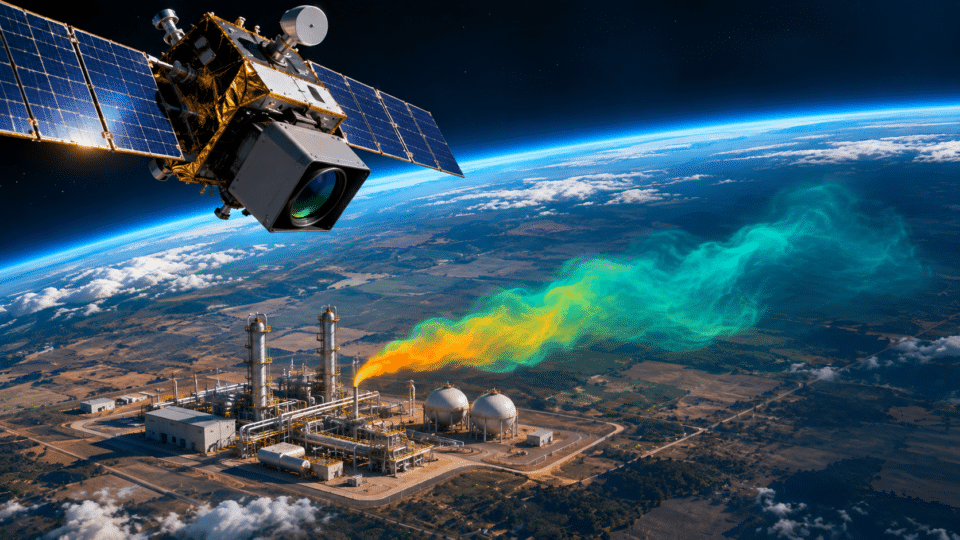
Methane detected from space: until recently, a major gas release could remain known almost exclusively to the industrial operator. Today, satellites can observe methane signals above oil fields, pipelines, coal mines or waste sites. But an orbital image is only the start of the investigation. The truly important questions are who checks the alert, who repairs the source, and how can we show that emissions have fallen?
On 12 November 2026, the United Nations Environment Programme (UNEP) announced that its MARS alert system had helped address and remedy 46 major methane-emission sources in 13 countries. The five new cases confirmed since the previous update, in Canada, Iraq, Kazakhstan and Mexico, represent around 125,000 tonnes of methane addressed through interventions. These are figures reported by UNEP, not an InfoBuz estimate and not the total number of leaks worldwide. Source: UNEP’s official November 2026 press release.
This InfoBuz ORIGINALS analysis explains the technology, the limits of the measurements, the distinction between detected and remedied emissions, the UN mechanism, and the European rules that also apply in Romania. We do not confuse coloured clouds in an illustration with an authentic satellite image, and we do not attribute a leak to a company without further evidence.
Methane detected from space: what do satellites actually measure?
Methane (CH₄) is a colourless gas. Satellites do not photograph it in the way they photograph smoke from a factory. Spectrometric instruments measure changes in reflected or emitted light at wavelengths where methane absorbs radiation. The data are processed to estimate the amount of methane in the observed air column and, in some cases, to identify an unusual concentration in a plume carried by the wind.
The TROPOMI instrument aboard Europe’s Sentinel-5P satellite uses observations in the ultraviolet and short-wave infrared spectrum, including for its CH₄ data product. Its measurements cover large areas and help identify regions with elevated concentrations, but they cannot automatically turn every pixel into a finding about a particular pipeline. Official Copernicus Sentinel-5P documentation.
The four levels of evidence: detection, location, attribution, remediation
| Stage | What can be said | What has not yet been demonstrated |
|---|---|---|
| 1. Signal detected | An instrument observed an anomaly consistent with increased methane concentration. | That it was caused deliberately or by an identified company. |
| 2. Probable source located | Analysis, plume position and wind point to an area or relevant infrastructure. | That a particular piece of equipment failed, without an inspection. |
| 3. Source attributed and notified | There has been further assessment, and authorities or operators have been contacted. | That legal liability has been definitively established. |
| 4. Measure verified | There is evidence of intervention and an assessment of its effect on emissions. | That every historical episode has been eliminated permanently. |
The distinction matters because a satellite sees the atmosphere, not an operating contract, maintenance log or the legal ownership of an installation. Commercial information, repeat observations, aerial photographs and ground inspections can complete the picture.
MARS: the UN system that turns observations into alerts
UNEP launched the Methane Alert and Response System — MARS in 2022 as part of the International Methane Emissions Observatory (IMEO). In 2026, the system uses data from more than 30 satellite instruments, artificial-intelligence models and specialist review to identify major emissions and send notifications to authorities and companies able to act. It is designed to prompt action, not merely to draw maps.
Initially focused on oil and gas, MARS expanded its alerting capacity to coal and waste in 2026. Data and response rates can be explored through the Eye on Methane platform, which also provides information on priority sources and monthly updates. Official UNEP description of MARS; Eye on Methane datasets.
How an alert travels from satellite to operator
- Raw data are analysed to distinguish a credible signal from instrumental artefacts, clouds or atmospheric conditions that are difficult to interpret.
- A possible large plume is compared with observations from other times or instruments and with infrastructure information.
- Specialists estimate the location and, where possible, the emission intensity, together with the degree of uncertainty.
- MARS notifies national contact points and relevant operators, requesting information and action.
- Authorities or companies verify the site, may repair the source, and submit documented results.
- Evidence of emissions reductions is assessed before a case is described as remedied.
A notification is not in itself a fine, a conviction or proof that the company concerned broke the law. It is the starting point for verification and emissions reduction. MARS publishes information that can help communities and journalists track whether there has been a response.
Results announced at COP31: what the 46 sources mean
According to UNEP’s communication of 12 November 2026, 46 major sources in 13 countries were addressed through interventions under MARS. Compared with the June reporting, five new cases were confirmed across Canada, Iraq, Kazakhstan and Mexico, with a total of roughly 125,000 tonnes of methane considered remedied in this new group. UNEP equates the climate impact of those five cases to approximately 2.5 million cars driven for one year.
This is an illustrative comparison of climate impact, not a calculation of cars actually removed from the roads. Nor does the number of remedied sources equal the number of alerts issued: there may be unconfirmed alerts, unidentified causes, sources not yet repaired, and events that could not be observed.
UNEP says that 13 countries reached a response rate of at least 80% for major alerts, including nine that reached 100%. A response rate does not automatically mean a remediation rate; an authority may respond to a notification without the problem being immediately eliminated. These indicators must be kept separate. UNEP press release.
Does a satellite detect every leak? No — and this is one of the most important limitations
Satellites are highly useful for large episodes and hard-to-reach regions, but they do not observe every small leak, every night-time emission or every moment in an installation’s operation. Clouds, dark surfaces, aerosols, viewing angle, overpass frequency and wind strength affect detectability. The absence of a plume in public data is not proof of zero emissions.
| Method | Main advantage | Main limitation |
|---|---|---|
| TROPOMI / Sentinel-5P | Wide coverage and frequent observations of regional concentrations. | Resolution is too coarse for many small leaks and for reliably attributing emissions to a particular item of equipment. |
| High-resolution satellites, such as GHGSat and Tanager-1 | Can observe certain sources or installations in greater detail. | Narrower coverage, targeted observations, and differing costs or availability. |
| Aircraft with specialised sensors | Detailed campaigns and detection of some smaller sources. | Requires planning, access and operational spending. |
| Drone / optical gas-imaging camera / ground instrument | Locates the fault and verifies the repair. | Does not on its own provide a full picture of a country’s emissions. |
The IEA Global Methane Tracker 2026 report on recent studies describes precisely the need to combine orbital, aerial and ground observations. Globally, some high-resolution constellations identify smaller sources than sensors designed to map broad regions, but make different trade-offs in coverage and revisit frequency.
How researchers estimate the amount of gas released
For a plume visible through spectrometry, the excess concentration can be combined with information on the plume’s geometry, wind speed and direction, and dispersion models to estimate an emission rate. The result may be expressed, for example, in kilograms or tonnes of methane per hour. It is not a direct weighing of gas flowing through a pipeline.
Uncertainty in wind speed or direction can materially change the estimate. Nor can a two-hour episode automatically be extrapolated over a year. It is necessary to know whether the source is continuous, intermittent or connected to a temporary intervention.
Worked example: an episode of 5 tonnes per hour
Assume solely as a hypothetical example a source emitting 5 tonnes of methane per hour. If it continued for 24 hours, the amount would be 5 × 24 = 120 tonnes. If the event lasted two hours, however, the amount would be only 10 tonnes. The twelvefold difference shows why an isolated hourly rate does not reveal the quantity actually emitted.
For climate comparisons, CO₂ equivalent is used on the basis of a global-warming potential over a specified period. The European Commission cites a factor of around 82.5 over 20 years and nearly 30 over 100 years. The hypothetical 10 tonnes would therefore correspond to approximately 825 tonnes of CO₂ equivalent over 20 years, using that factor; the choice of time horizon must always be stated. European Commission — methane and global-warming potential.
What the global figures show: emissions remain high despite the technology
According to the Global Methane Tracker 2026, fossil-fuel activities generated approximately 124 million tonnes of methane in 2025: 45 million tonnes from oil, 43 million from coal and 36 million from natural gas. These are sectoral estimates produced using multiple methods, not the simple sum of events recorded by satellites.
The IEA says there is still no sign of a firm global decline in methane emissions from fossil-fuel operations. The industry may have known major sources and relatively affordable reduction technologies, but implementation depends on regulation, economics, verification and infrastructure availability.
Where emissions come from: six different situations that can produce a plume
- Industrial pipelines and valves: losses through faulty seals, flanges or connections.
- Oil and gas wells: releases associated with extraction, separation, gathering or improper abandonment.
- Venting: the deliberate release of gas in certain processes, sometimes for maintenance or safety, but subject to applicable rules.
- Flaring: if gas is not fully burned, methane may be emitted; flaring and venting are not the same thing.
- Coal mines: methane originating in deposits and removed to protect workers.
- Waste sites: anaerobic decomposition of organic matter can produce methane, requiring capture and management.
Methane also has natural sources, including certain wetlands. An atmospheric signal must be associated with geographic, meteorological and industrial context before it becomes a claim about human responsibility.
EU Regulation 2024/1787: how emissions control is changing
Through Regulation (EU) 2024/1787, the European Union introduced rules on measuring, quantifying, monitoring, reporting and verifying methane emissions from the energy sector, alongside leak detection and repair, limits on venting and flaring, and obligations concerning decommissioned infrastructure. The regulation also covers certain information related to oil, gas and coal placed on the EU market.
Article 31 provides for a global monitoring tool based on satellite data and a rapid-response mechanism for very large emission events. When such an event is detected, the Commission may notify the jurisdiction where the source is located and request information on remedial measures.
A note on the timetable: an October 2026 proposal is not automatically adopted law
On 14 October 2026, the Commission proposed postponing certain reporting obligations under the regulation by one year. At the time of research, the mere existence of the proposal does not support a claim that all obligations have already been delayed or suspended. Legal deadlines must be checked against the consolidated version of the act and any subsequently adopted amendments. Proposal COM(2026) 569 final; European Commission page on methane emissions.
InfoBuz has previously published an analysis of the standardisation of methane-emissions reporting in the EU. This article covers a different subject: the technical process by which a satellite observation becomes an alert and a verified intervention, rather than administrative reporting forms.
What space-based monitoring means for Romania
Romania has gas extraction and transport infrastructure, processing facilities, wells and decommissioned assets, waste sites, and mining sectors with different emissions risks. Orbital technology can help identify major events, but a satellite detecting methane above Romanian territory does not automatically show who is responsible, or whether a repair deadline has been breached. Those conclusions require examination of the relevant legal documents and measurements.
For a publishable local analysis naming operators, a newsroom should confirm the number and time of observations, geolocation, instrument, data quality, and any clarification from the authority and operator. It is not responsible to attribute emissions to a gas field or company simply because it is near a coloured pixel.
Can the public check the data without a special account?
The Eye on Methane data-download platform provides public access to datasets and explanations of variables, including sources, detected plumes and response rates. For robust journalistic analysis, a GeoJSON or CSV file should be filtered by location and date, its methodology checked, and only then correlated with infrastructure and official responses. The fact that a country does not appear in a selected extract does not prove the absence of any emissions.
What should be checked before making a public accusation: InfoBuz’s seven-step protocol
- Identify the satellite and sensor that produced the observation, along with the exact date and time.
- Check the availability of raw data, declared quality level and uncertainty.
- Analyse wind and plume transport; the probable source is not always directly below the centre of the colour display.
- Compare with subsequent observations and, where available, instruments with better resolution.
- Verify the infrastructure’s ownership and operator through documents, not assumptions.
- Request comment from the operator and competent authority, without treating a lack of response as an admission.
- Distinguish between “detection”, “notification”, “reported repair” and “reduction confirmed by measurement”.
Why repairing a leak can also bring energy benefits
Methane is the main component of natural gas. In some cases, gas that is being lost can be captured and used, reducing climate impact and energy waste at the same time. The IEA estimates that effective global action on emissions from oil and gas could make almost 100 billion cubic metres of natural gas available each year, while ending non-essential flaring could unlock a comparable additional amount. These are aggregate technical potentials, not volumes that can be recovered immediately through a simple remote command. IEA, Global Methane Tracker 2026.
Some interventions have low costs relative to the value of the gas saved: replacing seals, periodic leak detection, vapour recovery, and electric equipment in place of gas-releasing devices. Other cases require major replacements, shutdowns or work under strict safety conditions. Not every emission can automatically be turned into a source of revenue.
Five common misconceptions about methane seen from space
| Claim | What follows from the available evidence |
|---|---|
| “The satellite photographs a green cloud of gas.” | False. Colours are graphical representations of a spectrometric measurement; methane is colourless. |
| “Every detected plume means an illegal leak.” | False. The source, activity and applicable rules must be identified. |
| “If nothing is visible, the installation has zero emissions.” | False. There are limits to detection, coverage and weather conditions. |
| “Forty-six remedied sources means there are only 46 problematic sources in the world.” | False. The figure concerns cases remedied and confirmed by MARS in UNEP’s update. |
| “An operator responded to a notification, so it made the repair.” | False. A response and a demonstrated reduction are different indicators. |
Frequently asked questions about detecting methane from space
Can a satellite see methane at night?
Most passive optical sensors used for certain methane products rely on reflected sunlight and therefore have night-time limitations. Other technical approaches exist, but continuous 24/7 coverage should not be assumed for every instrument.
How precisely can a methane leak be located?
It depends on the instrument, its resolution, weather conditions and the complexity of the sources. Some systems identify broad regions; others can narrow the area to the level of an installation. Identifying the faulty valve or item of equipment often requires work on the ground.
What are super-emitters?
They are sources or events with unusually large emissions in relation to their context. Definitions and technical thresholds differ between platforms, studies and regulations; a published figure should therefore be accompanied by the methodology used to classify a source.
Are oil and gas emissions more important than agricultural emissions?
Agricultural and waste-related sources are important to the global balance, but the oil and gas sector has many opportunities for rapid and relatively low-cost reductions. MARS expanded beyond oil and gas in 2026, but this should not be taken to mean that it observes every small agricultural source.
When can we say that a leak has been repaired?
When there is evidence of intervention and relevant verification that the emission has fallen or stopped, with information on the source and period assessed. A single satellite observation with no visible plume does not guarantee permanent remediation.
Can MARS data be consulted free of charge?
Yes. UNEP publishes datasets and related documentation on the Eye on Methane platform; the availability of particular records and their detail may depend on the stage of validation and publication rules.
Conclusion: the major change is not the satellite image, but the ability to verify action
Methane detected from space turns an invisible phenomenon into a matter of verifiable responsibility. Satellites do not replace inspectors, technical documents or physical repairs, but they can quickly indicate where a major loss warrants investigation. In 2026, success is measured not only by the number of plumes observed, but by correctly identified sources, alerts that are followed up and demonstrably reduced emissions.
The indicator worth following in 2027: the gap between alerts issued, responses received and cases for which there is evidence of remediation. This is the test of whether climate monitoring from orbit delivers concrete results on the ground.
Official sources and methodology
- UNEP — 12 November 2026 update: the 46 remedied sources, countries and five new cases.
- UNEP IMEO — Methane Alert and Response System: technical description of the system, instruments and notifications.
- UNEP — Eye on Methane datasets: downloadable data, metadata and verification tools.
- IEA — Global Methane Tracker 2026, key findings: sectoral emissions, reduction opportunities and estimates.
- IEA — recent studies on methane detection: satellites, aircraft, point sources and uncertainties.
- Copernicus Sentinel-5P — TROPOMI CH₄ product: satellite-observation methodology.
- EUR-Lex — Regulation (EU) 2024/1787: monitoring, response and reduction obligations.
- European Commission — proposal COM(2026) 569: proposal to postpone certain reporting deadlines.
Editorial note: research completed on 17 November 2026. Satellite observations, emissions estimates, source confirmation and assessments of remedial action are distinct categories of information. The numerical example of 5 tonnes per hour is hypothetical. The representative image is an AI-generated illustration: it does not reproduce authentic satellite data and does not identify a real installation.






Discuția cititorilor
Ai o opinie sau o întrebare despre acest articol? Spune-ne ce crezi.
Fii primul care deschide discuția.
Te rugăm să păstrezi un limbaj civilizat și să discuți la subiect. Comentariile spam sunt filtrate automat.