
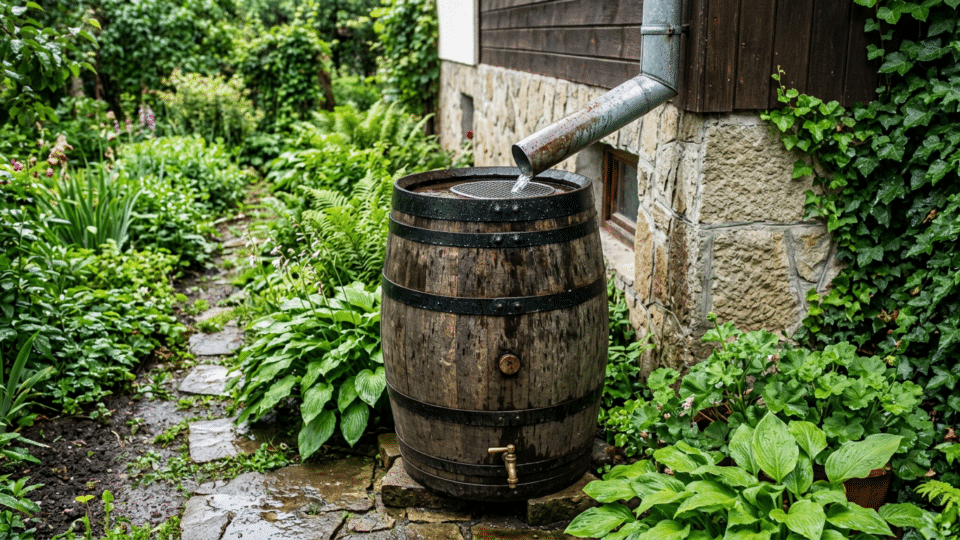
A barrel placed beneath a downspout to water the garden is not banned under a general rule, and the fine of up to €10,000 circulated online in 2025 does not exist. On 27 May 2025, Romania’s Ministry of Environment publicly rejected claims that, from 1 July 2025, Romanians would need authorisation to collect or use rainwater at home. The clarification was reported by AGERPRES.
That does not make every rainwater project rule-free or risk-free. A simple container fed by a gutter is different from an underground tank, a pump supplying toilets, or an outlet that changes how a plot drains. In practice, the overflow route and separation from the drinking-water system often matter more than the choice of barrel.
In brief: rainwater can prudently be used for watering, washing paths or other outdoor uses without food contact. It should not be assumed to be drinkable. If a project includes indoor plumbing, drainage works, excavation or discharge to a watercourse, the technical solution and, where applicable, the approval requirements need to be checked separately.
Rainwater collection: what the Environment Ministry clarified
The viral message disproved in May 2025 claimed that using rainwater would become illegal from 1 July and that property owners without authorisation could face fines of up to €10,000. According to the statement attributed to the Ministry of Environment, Waters and Forests, the legislation in force provides neither such a penalty for collecting and using rainwater at home nor the allegedly compulsory general authorisation referred to in the circulated messages.
The wording should be read precisely: it is a denial of a general ban and of the claimed fine. It is not implicit approval for every conceivable installation, and it does not mean there are no rules on pollution, water discharge or works connected with water.
Water Law No. 107/1996 covers, among other matters, the protection of water resources, discharges, and certain works or installations built on water or connected with water. The text consulted does not set out an explicit, universal authorisation requirement for every household barrel connected to a gutter. It does, however, prohibit pollution of water resources, and the rules for more complex works cannot be inferred from the simple case of an above-ground container.
Three projects that should not be confused
| System type | What it generally involves | The question that matters |
|---|---|---|
| Simple container beneath a downspout | An above-ground barrel or tank, a leaf screen, tap and outdoor use. | Is it stable, covered and fitted with an overflow that does not affect the house or neighbours? |
| Integrated household installation | A tank, pump, separate pipework and non-potable supply points, such as toilets. | Is it fully separate from drinking water, and does it have backflow protection? |
| Works with a potential impact on water | Significant excavation, drains, discharge into a natural receiving water, alteration of water flow, or works in sensitive areas. | Does the project fall into a category requiring a water-management permit or authorisation? |
Romania’s National Administration “Apele Române” states that, depending on the case, a water-management permit or authorisation is required for the planning, construction, commissioning or operation of works on water or connected with water. The institution’s page does not say that every residential tank beneath a downspout automatically falls into this category. It is, however, a strong reason not to treat works involving drainage or discharge as a simple garden accessory.
If excess water will be directed into a ditch, stream, public drainage channel or a neighbour’s land, or if an underground tank involves substantial work to the ground, checking with the relevant basin administration, town hall and a designer is a precaution rather than needless bureaucracy.
Start with how you will use the water, not the barrel’s capacity
The simplest and most prudent option is outdoor use: watering plants, washing paths or tools, with the usual care around slippery surfaces and cleaning products. For a garden, collected water can reduce mains consumption during periods with sufficient rain, but there is no fixed saving that applies to every household.
Supplying toilet cisterns may be technically possible in a separately designed system, but it changes the scale of the project. Dedicated pipework, clear identification of the circuit, backflow protection and a proper solution for when the tank runs dry are needed. Do not improvise a connection between a hose or pump and the drinking-water installation to “top up” the supply.
Do not use rainwater for drinking, cooking, washing fruit or personal hygiene merely because it looks clear. The US Centers for Disease Control and Prevention warns that water may pick up germs and chemicals from the air, roof, gutters, pipes and tank. Bird droppings, metals in some components and roofing materials are only some potential sources of contamination. For uses involving ingestion or bodily contact, testing, treatment and monitoring must be determined specifically for the system; a leaf filter does not make water drinkable.
For the difference between removing particles and actually treating water, see InfoBuz’s guide to what water filters can remove and what they cannot guarantee. A filter intended for mains water does not automatically validate water collected from a roof.
How much water you can capture: an indicative calculation, not a promise of self-sufficiency
The basic calculation is straightforward:
collectable volume (litres) ≈ catchment area (m²) × rainfall (mm) × system efficiency
One millimetre of rain falling on one square metre is geometrically equivalent to one litre. But the tank does not receive the entire volume: water is lost through the initial roof wash-off, splashing, evaporation, leaks, overflowing gutters and the roofing material. A technical review by the US Department of Energy gives a typical efficiency of about 0.75–0.90 for the systems assessed. The range is a design reference, not a guaranteed value for a house in Romania.
Hypothetical example: for a 100 m² catchment area, 20 mm of rainfall and assumed efficiency of 0.80, the calculation is 100 × 20 × 0.80 = 1,600 litres. If the tank holds 500 litres and was already full, the difference needs a safe route through the overflow. If the tank was empty, less rainfall than estimated may still fall far short of the expected volume.
Before buying, check recent rainfall and the forecast for your locality on the Romania Weather page, but do not size a tank around one heavy rainfall event. The distribution of rainfall, dry periods, the actual roof area and how much water can be used between rain events all matter.
The right tank empties enough before the next rainfall
An oversized, unused tank can hold water for too long, accumulate sediment and later lose rainwater through overflow. A tank that is too small fills quickly, but may still be a good choice when demand is limited and space does not allow more. A commercially available capacity of 1,000 litres is not a universal answer.
A practical approach starts with three figures: how many litres you use in a week for the intended purpose, how much water the roof can bring in during a typical rainfall, and where the surplus will go. Only then should you select the tank size. For watering only, two or more smaller tanks connected properly can sometimes be easier to place and empty than a single large cistern.
The overflow can protect or undermine the project
A full tank does not stop the rain. Without an adequately sized, correctly directed overflow, water can reach the plinth, pool near the foundations, erode the ground or spill towards a neighbouring property. Do not simply allow the discharge to fall at the base of the house.
The route should take water to an area where it can be received without affecting the building, neighbours, public property or a natural receiving water. The exact solution depends on the site, its slope, the soil, the local stormwater network and rules applicable in the locality. In a yard with poor infiltration, a basement, flood risk or sloping ground, a technical assessment is justified before installation.
For additional context, see A home prepared for a blackout: what you can power for 24, 48 and 72 hours, an article that examines an aspect directly related to this subject.
Romania’s national guide for buildings in flood-prone areas treats water management and building protection as design elements, rather than details to be resolved after installation. For a house exposed to standing water or flooding, the tank should be considered together with drainage for the whole yard.
Small components that matter in a simple system
A working outdoor system needs more than a container with a lid. Each component addresses a distinct issue:
- The inlet screen or filter stops leaves and larger debris; clean it regularly, especially in autumn.
- First-flush diversion reduces the dust and dirt that have accumulated on the roof between rainfalls from entering the tank. It does not replace treatment for drinking water.
- A securely fitted lid and fine mesh limit light, leaves and mosquito access. An open tank invites insects and contamination.
- The screened overflow connection must be able to take the flow when the tank is full and prevent insects entering.
- A stable base is particularly necessary for a raised tank. Water has mass: 1,000 litres weighs about one tonne, excluding the weight of the container.
- The tap and hose should be fitted so that they do not strain the tank walls, and should be capable of being drained before freezing if the manufacturer requires it.
Maintenance is not optional: clean the gutters, check the screen after storms, monitor sediment in the tank and inspect the overflow. A tank with stagnant water, leaves and silt is not only inefficient; it can become difficult to clean hygienically.
Do not connect rainwater to the drinking-water network
This is where an apparently economical solution can create the most serious risk. An improvised connection between rainwater and the drinking-water system can allow backflow: water from the non-potable circuit may enter the treated network when pressure differences occur.
If the project goes beyond watering with a hose and includes a pump or indoor supply points, ask a competent plumber for a separate, clearly marked installation fitted with the necessary protections. Do not assume that an ordinary valve or a manually closed tap provides the protection needed against contamination.
The same principle applies when choosing a pump: the required pressure, dry-run control, pipe positioning and frost protection must suit the project. An outdoor system with a tap can remain simple. An indoor network is no longer a project for improvisation.
Checks worth making before you buy
- Set one initial purpose, preferably an outdoor, non-potable one.
- Measure the roof area that actually drains into the selected gutter, not the building’s entire footprint.
- Calculate a rainfall scenario that includes losses, rather than assuming 100% efficiency.
- Decide the overflow route before positioning the tank.
- Provide a stable base, lid, insect screen and access for cleaning.
- Keep rainwater completely separate from drinking water.
- Stop the project and seek technical advice if it involves excavation, new drainage, discharge into water bodies or indoor supply.
Collecting rainwater can be a simple, useful household measure, but its value does not lie in a promise of complete independence from the mains. A good system captures what you can use, keeps the water for non-potable purposes and discharges the surplus without transferring the problem to the foundations, pavement or a neighbour.
Frequently asked questions
Is it legal to collect rainwater in a barrel in Romania?
In May 2025, the Environment Ministry rejected claims that there was a general ban, a mandatory permit for household use, or fines of up to €10,000 for simply collecting rainwater. Situations involving works, drainage or discharges must nevertheless be assessed separately.
Can I water my garden with rainwater?
Yes. Watering a garden is one of the non-potable outdoor uses for which collected water is generally suitable. The tank should be kept covered and fitted with an insect screen, and the water should not be confused with drinking water.
How many litres of rainwater can I collect from a roof?
As a guide, multiply the catchment area in square metres by rainfall in millimetres and by system efficiency. For example, 100 m², 20 mm of rain and efficiency of 0.80 produces approximately 1,600 litres.
Can I connect rainwater to toilets or my home’s plumbing?
It is possible only in a separately designed system, with backflow-prevention measures and no improvised connection to the drinking-water network. Consulting a competent plumber is recommended for such an installation.
Why do I need an overflow on the tank?
Once the tank is full, the water must be discharged in a controlled way. A poorly directed overflow can cause pooling near the foundations, erosion, or runoff onto neighbouring land or public property.
Sources consulted
- AGERPRES – Environment Ministry: legislation in force does not provide penalties for collecting and using rainwater
- Legislative Portal – Water Law No. 107/1996
- National Administration “Apele Române” – Water-management permits and authorisations
- US Department of Energy – Rainwater Harvesting Systems Technology Review
- CDC – Collecting Rainwater and Your Health: An Overview



Discuția cititorilor
Ai o opinie sau o întrebare despre acest articol? Spune-ne ce crezi.
Fii primul care deschide discuția.
Te rugăm să păstrezi un limbaj civilizat și să discuți la subiect. Comentariile spam sunt filtrate automat.