
Sodium-ion batteries, a newer storage technology, moved in 2026 from laboratory promise to commercial projects, storage agreements and initial mobility applications. They do not use lithium as the charge-carrying ion, but that does not automatically make them cheaper, safer or better-performing than lithium-ion batteries. The more important difference is this: sodium can provide another technological option for electricity storage and vehicles with moderate range in an industry still heavily dependent on LFP and other lithium-based chemistries.
According to the International Energy Agency’s Global EV Outlook 2026, the latest sodium-ion cells reach up to 175 Wh/kg, compared with up to 205 Wh/kg for LFP and 265 Wh/kg for NMC. The gap is real, but these peak cell-level figures should not be confused with usable energy, the size or the range of a complete battery pack.
Announced investment in Europe shows why the subject is worth watching now. In July 2026, Alfen and CATL presented a collaboration targeting 5 GWh of sodium-ion storage, while in October INTILION and CATL announced a memorandum covering 3 GWh of systems over the next five years. These are volumes targeted through agreements, not evidence that 8 GWh of batteries have already been installed. Alfen | CATL.
How sodium-ion batteries work — and why they resemble lithium-ion batteries
The principle is electrochemical. During charging and discharging, sodium ions move between two electrodes through an electrolyte, while electrons travel through the external circuit. Energy is stored in reversible reactions; the battery is not simply a container of salt. Nor is it the same technology as a conventional lead-acid battery, a molten-salt battery or a thermal-storage system.
Broadly speaking, a cell includes a cathode made from compounds able to incorporate sodium; an anode often made from hard carbon; a separator; an electrolyte; and current collectors. The exact chemistry differs by manufacturer. Some architectures use layered oxides, others Prussian blue analogues or polyanionic compounds. There is no single, universal “sodium-ion” battery with identical performance on every specification sheet.
The key comparison: sodium-ion vs LFP vs NMC
| Parameter | Sodium-ion | LFP (lithium iron phosphate) | NMC (nickel manganese cobalt) |
|---|---|---|---|
| Gravimetric energy density, cell level | Up to 175 Wh/kg | Up to 205 Wh/kg | Up to 265 Wh/kg |
| Global manufacturing maturity in 2026 | Scaling phase; far lower capacity | Broad industrial production | Broad industrial production |
| Potential strength | Low-temperature performance; material diversification | Cost and maturity in many applications | High energy density |
| Significant limitation | Less energy at the same mass/volume; immature supply chain | Contains lithium; lower density than NMC | More complex raw materials and costs |
| Likely applications | Stationary storage, urban and industrial vehicles | Electric vehicles, home batteries and the grid | Long-range vehicles and applications with high energy requirements |
The figures in the first row come from the IEA’s battery chapter in Global EV Outlook 2026. They are reported maxima for the newest cells reviewed, not guaranteed average values or a comparison of identical commercial packs. Cell technology, enclosure thickness, the cooling system, BMS electronics and the operating window all reduce energy density at system level.
The calculation that changes the perspective: how much 60 kWh of cells would weigh
Take a theoretical, cell-level comparison for the same nominal energy of 60,000 Wh. The equation is simple: mass = energy / gravimetric density. If the IEA’s cited maximum values could be used in full, the result would be approximately:
| Chemistry | Simplified calculation | Theoretical mass of 60 kWh of cells |
|---|---|---|
| Sodium-ion | 60,000 / 175 | about 343 kg |
| LFP | 60,000 / 205 | about 293 kg |
| NMC | 60,000 / 265 | about 226 kg |
The calculated difference between sodium-ion and LFP is about 50 kg at cell level alone; compared with NMC, it is about 117 kg. These numbers are a mathematical exercise, not the real weight of a 60 kWh automotive pack. They exclude housings, cabling, BMS, cooling, protection systems, architectural differences and energy reserves. Manufacturers also do not always achieve maximum energy-density figures in products brought to market.
Electric-car range: where sodium loses out and where it may gain
The IEA estimates that lower volumetric density may limit an average sodium-ion SUV configuration to up to around 350 km under average conditions, while lithium-ion batteries offer roughly 400–600 km in the agency’s comparison. This is not a comparative test of two identical commercial models and should not be turned into a range promise for a future car.
For an urban taxi, a delivery van on repeat routes, an industrial vehicle or a small car used mainly in town, modest range may be sufficient. For family cars regularly used on long journeys, every kilogram and litre taken up by the battery matters more. Sodium-ion is therefore not a universal replacement for LFP and NMC, but a niche alternative that may expand if its economics and performance justify it.
Cold weather: the main confirmed technical advantage
Sodium is attracting interest for low-temperature applications. The IEA says the latest generation of sodium-ion cells can retain around 90% of nominal capacity at -40°C, based on data for the technologies reviewed, and can operate at high temperatures of up to 70°C. These limits describe the capabilities of particular cells and test conditions, not permission to charge any battery at -40°C without a control system.
In operation, available capacity, discharge power, permitted charging power and service life must all be considered separately. A battery that can deliver current at sub-zero temperatures is not necessarily designed to accept fast charging in the same conditions. For vehicles and stationary storage, the thermal profile and BMS strategy need to be assessed from the final product’s documentation.
Why “sodium is cheap and abundant” does not automatically mean a cheap battery
Sodium is widespread in nature, and sodium-ion technologies can reduce dependence on lithium, nickel and cobalt in some architectures. But the cost of a cell is not the price of one kilogram of a chemical element. It includes cathode and anode materials, electrolyte, collector foil, factory yield, investment in equipment, energy, testing, transport and manufacturing losses.
In 2026, LFP batteries benefit from a huge, optimised industry. The IEA notes that sodium-ion faces cost and density disadvantages compared with LFP at current lithium prices. Sodium becomes more attractive if lithium-based raw-material prices remain high, factories achieve good yields, or an application benefits from better cold-weather performance. The IEA’s analysis of sodium-ion’s commercial momentum explicitly warns that an economic advantage is not yet guaranteed.
The overlooked supply-chain issue: hard carbon
For lithium-ion batteries with graphite anodes, the industry has a vast supply chain. In many sodium-ion batteries, the anode uses hard carbon, which has a different structure and manufacturing processes that still need to be scaled up. The IEA says this supply chain remains underdeveloped and concentrated in China. Moving from lithium to sodium does not instantly remove geopolitical dependencies.
For European manufacturers, the issue is twofold: who makes the cells, and who can manufacture high-purity materials at competitive volumes? If all critical components are imported from a small number of suppliers, a change in chemistry does not deliver industrial autonomy. InfoBuz’s analysis of Europe’s dependence on China for batteries and critical raw materials provides the wider context.
Where the industry stands in 2026: separating announcements from real factories
The IEA estimates that current sodium-ion cell manufacturing capacity is only slightly above 1% of lithium-ion cell capacity. For 2030, announced projects amount to roughly 7% of lithium-ion manufacturing capacity already committed for that year. These percentages refer to industrial capacity, not the share of sales, installed batteries or cars fitted with sodium-ion batteries.
An announced factory, installed nameplate capacity, commercially available capacity and actual delivered output are four different things. That distinction is crucial when press releases cite large GWh figures: a five-year framework agreement should not be entered in a table of completed production for the current year.
Europe: agreements for up to 8 GWh between CATL, Alfen and INTILION
Alfen–CATL: 5 GWh announced in July 2026
On 16 July 2026, Dutch company Alfen and CATL announced a collaboration to develop European sodium-ion storage systems targeting 5 GWh. The release cites goals including technology diversification, lower exposure to lithium-price volatility and adaptation to European grids. It does not, by itself, provide evidence that all installations associated with those 5 GWh have been accepted and delivered. Alfen’s 16 July 2026 release.
INTILION–CATL: 3 GWh over five years under a memorandum
On 27 October 2026, INTILION and CATL announced the signing of a memorandum of understanding (MoU) covering energy-storage systems of around 3 GWh for Germany, Switzerland, Austria and other markets over the next five years. An MoU is a stage of commercial cooperation; it does not automatically demonstrate delivery, grid connection or commissioning. The official CATL–INTILION release.
The TENER system and claims on service life
CATL presented the TENER Sodium system in June 2026, citing the product’s commercial maturity and a cumulative delivery target of 1 GWh by the end of 2026, with global deliveries scheduled from June 2027. In the INTILION partnership, the company cites more than 15,000 cycles and up to 25 years of operation for the system presented. These are manufacturer-stated specifications and projections, not independent evidence that all commercial units have already operated for 25 years. CATL — TENER Sodium launch.
The sum of 5 + 3 is 8 GWh of announced projects and commercial volumes. It does not mean 8 GWh of capacity already in operation, nor one guaranteed European contract. The projects may have different schedules, commercial terms and integration technologies.
Stationary storage: where kilograms matter less than system economics
For a grid-connected installation, designers size power in MW, energy in MWh, discharge duration, response speed, annual cycles, thermal management, safety and maintenance. Where site area and weight are acceptable, lower energy density can be a reasonable compromise. A more voluminous module may nevertheless increase the cost of containers, infrastructure, cooling and land. Here too, the full system — not the cell alone — must be compared.
At a solar plant, a battery does not generate energy; it shifts already generated energy through time. For arbitrage, frequency regulation or peak-shaving, the winning technology depends on cycling, round-trip efficiency, contract duration and market rules. Sodium-ion has no guaranteed advantage in every scenario.
Illustrative calculation: what 1 MWh of storage means
A system with nominal energy of 1 MWh contains 1,000 kWh. If it operates with a hypothetical usable window of 90% and delivery efficiency of 90%, the energy delivered in one cycle after charging would be around 810 kWh. These two coefficients are chosen strictly for illustration; they are not attributed to a sodium-ion model. In practice, manufacturers define usable energy, AC-to-AC efficiency and warranty conditions differently.
At a constant load of 10 kW, 810 kWh would theoretically cover around 81 hours, ignoring power limits, auxiliary losses, ageing and operational reserve. A real project must be sized according to the load, inverter, temperature and safety policies — not simply the energy on the cell label.
Would sodium-ion batteries make sense for a Romanian home with solar panels?
For a prosumer, the answer cannot be reduced to “sodium is cheaper”. The home-battery market is dominated by lithium-ion systems, particularly LFP, with inverters, BMSs, certifications and warranties already tested in thousands of configurations. In November 2026, a sodium-ion solution for the home must be verified as a locally available product, not as a promise drawn from an industrial project of several hundred MWh.
- Check electrical and communications compatibility with the inverter: voltage ranges, current and BMS protocols are decisive.
- Compare the price per usable kWh and the total installed cost, not only the quoted price of cells.
- Request the warranty in years, cycles, delivered energy and residual capacity, including temperature conditions.
- Check certification, overvoltage and short-circuit protection, fire-safety requirements and service availability.
- Calculate the economics from the consumption profile, tariffs, any time-of-use pricing and grid-export rules, rather than an idealised scenario.
For a comparison of self-consumption, savings and energy independence, see InfoBuz’s existing guide, Solar battery in 2026: do you save more, or buy energy independence?. This article does not recommend directly replacing an existing LFP battery with sodium-ion cells that are not approved for that system.
Are sodium-ion batteries safer? The answer needs nuance
The chemistry may offer potential advantages in thermal stability and cold-weather behaviour in some configurations. But a sodium-ion battery is not automatically non-flammable. The electrolyte, separator, cathode material, stored energy and internal faults determine the actual risk. Architectures and formulations differ, and comparisons should be based on recognised test data, not simply on the fact that the active element is called sodium.
A safe industrial system combines chemistry selection with charging control, a BMS, electrical protection, cooling, fault detection and enclosure design. Marketing claims of “zero fire risk” or “no thermal runaway in any situation” should be treated sceptically without methodology and reproducible public results. Building experimental high-energy DIY packs without suitable expertise and equipment is not recommended.
How many years do they last? Specification-sheet cycles are not a guarantee of real-world life
One full equivalent energy cycle is not the same as a partial charge of 10% or 20%. Service life may be stated in cycles, calendar years, total energy transferred and remaining end-of-life capacity. For that reason, “15,000 cycles” without discharge depth, temperature, currents and the degradation threshold is incomplete information.
For grid projects, guaranteed availability, module replacement, contractual liability and residual value also matter. Some cells may have very good longevity under a stationary-storage profile and weaker results in an automotive profile with variable power and temperature demands. An industrial specification sheet should not be extrapolated to every type of product.
Recycling and the environment: no lithium does not mean no impact
Sodium is more abundant, and avoiding certain critical metals may reduce some pressure on raw materials. But battery manufacturing uses energy, solvents, processed materials and infrastructure. Any environmental benefit must be demonstrated through life-cycle analysis that accounts for manufacturing emissions, efficiency, service life, transport and end-of-use treatment.
Recycling should not be treated as a process identical to lithium-ion recycling. Recovering metals with lower economic value may require different business models. In the EU, Regulation 2023/1542 on batteries and waste batteries sets requirements for battery categories regardless of chemistry, with different obligations phased in over time. It is incorrect to say that a sodium-ion battery is, by definition, exempt from collection and treatment responsibilities.
Romania: what real opportunities may exist by 2030
For Romania, the most relevant questions are not whether every automotive battery can be replaced tomorrow, but whether future storage projects can use diversified chemistries, under what conditions they are bankable, and whether local engineering services can integrate certified sodium-ion systems. Grid-scale storage contracts, large solar projects and industrial consumers with peak-demand profiles may be the first segments of interest.
For now, a large investment announced for “Europe” does not prove that a sodium-ion factory exists in Romania or that a particular producer has a local contract. Such claims would require releases from the Romanian beneficiary, permits and commissioning data. Without them, this is an opportunity, not verified installed capacity.
Indicators to watch in 2027–2030
| Indicator | Why it matters | Sign of maturity |
|---|---|---|
| GWh of cells delivered, not just announced capacity | Measures real market penetration | Delivery reports and commissioned projects |
| Wh/kg and Wh/l at cell and pack level | Shows progress in space and weight | Comparable data and independent testing |
| Installed cost in €/kWh and lifetime levelised cost | Shows economic competitiveness | Real offers and contracts with clear terms |
| Efficiency, degradation and warranty | Define revenue and usable energy | Standardised testing on relevant profiles |
| Diversification of hard-carbon and cathode supply | Reduces a new supply concentration | Verifiable suppliers in different regions |
| Safety incidents and operating experience | Tests marketing claims over time | Public multi-year operating data |
Ten myths about sodium batteries
| Claim | Verdict and explanation |
|---|---|
| “Sodium will fully replace lithium from 2027.” | Unconfirmed. The IEA sees a complementary market, and industrial capacity remains far smaller. |
| “Sodium-ion is necessarily cheaper.” | False. Final cost depends on industrialisation, volume, materials and application. |
| “It contains no difficult-to-source materials at all.” | False. Hard carbon and other components have their own industrial risks. |
| “A sodium battery cannot catch fire.” | False as a universal rule; composition and safety validation must be assessed. |
| “It works at -40°C, so I can fast-charge it in any conditions.” | False. The operating range is not automatically the permitted charging range. |
| “175 Wh/kg means 175 Wh/kg for the whole pack.” | False. The figure refers to cells, not the complete system. |
| “The 8 GWh announced in Europe are already grid-connected.” | False. They are commercial agreements for future volumes. |
| “A sodium-ion battery is simply a saltwater battery.” | False. It is a distinct electrochemical technology. |
| “More years stated on a data sheet automatically mean a 25-year warranty.” | False. The actual warranty terms must be read. |
| “Sodium batteries are outside EU battery legislation.” | False. The regulation covers battery categories independently of the chemistry used. |
Frequently asked questions
How much range can a car with a sodium-ion battery have?
The IEA offers an indicative comparison of up to 350 km for an average sodium-ion SUV. Actual range depends on usable capacity, vehicle efficiency, temperature, speed and configuration. It is not a certification for any particular model.
Why are sodium batteries not everywhere if sodium is cheap?
Because the price of an element is only a fraction of system cost, while the LFP industry has optimised factories, a mature supply chain and far higher volumes. Production of hard carbon and sodium-ion cathodes still needs to expand.
Are sodium-ion batteries suitable for winter?
Some recent cells perform well at low temperatures, but a product must be used strictly within the temperature, current and voltage limits set by its manufacturer and BMS.
Can I directly replace my solar system’s LiFePO4 battery with a sodium-ion battery?
Compatibility cannot be assumed. Voltages, charging profiles, currents and BMS communications may differ. Any change requires engineering and technical validation, not just a mechanical match between terminals.
Are sodium-ion batteries already made at industrial scale?
Yes, products and commercial projects are under development and being delivered, but total global capacity remains very small compared with lithium-ion. European agreements in 2026 must be assessed separately from actual deliveries.
What is the difference between sodium-ion and solid-state?
Sodium-ion describes the ion that carries charge. “Solid-state” describes the electrolyte architecture. They are different dimensions of classification, not two alternatives defined by the same rule.
Conclusion: the right battery depends on where energy needs to be stored
In 2026, sodium-ion has not “beaten” lithium. It has, however, gained something important: industrial validation, contractual interest and applications in which cold-weather performance or less dependence on lithium may justify a trade-off in energy density. For long-range cars, LFP and NMC retain concrete advantages. For stationary installations and urban vehicles, sodium has a window of opportunity if volumes and costs become competitive.
The question to follow in 2027 will not be how many announcements use the word “revolution”, but how many GWh have actually been delivered, integrated, tested and insured over the long term. A battery becomes a transformative technology when operating data confirm the promises made in the laboratory.
Official sources and the InfoBuz ORIGINALS methodology
- IEA — Global EV Outlook 2026, Electric Vehicle Batteries: energy densities, temperatures, manufacturing, materials and application scenarios.
- IEA — Sodium-ion battery momentum grows, but challenges remain: economic comparison and the limits of industrial maturity.
- Alfen — CATL agreement for 5 GWh, 16 July 2026: stated volume and commercial objectives.
- CATL — INTILION, 3 GWh memorandum, 27 October 2026: the five-year period and targeted markets.
- CATL — TENER Sodium launch, 22 June 2026: the manufacturer’s claims on the product and timetable.
- EUR-Lex — EU Batteries Regulation 2023/1542: the compliance and end-of-life framework.
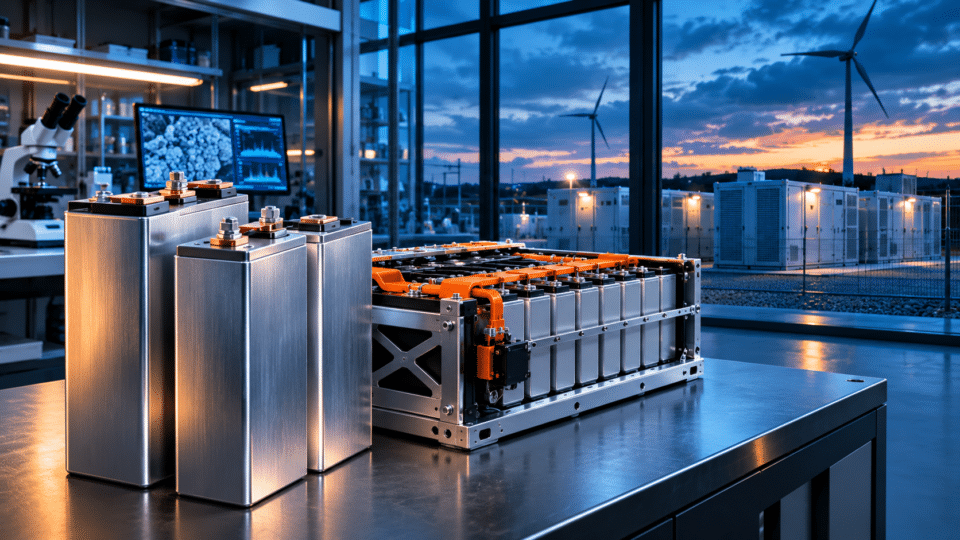
Research note: checked on 17 November 2026. Energy-density figures are cell-level maxima, not specifications for every product; the 60 kWh and 1 MWh calculations are illustrative and use stated assumptions. Company-announced commercial volumes have not been counted as capacity already commissioned. The representative image is an original AI-generated illustration and does not depict an identifiable CATL, Alfen or INTILION product.







Discuția cititorilor
Ai o opinie sau o întrebare despre acest articol? Spune-ne ce crezi.
Fii primul care deschide discuția.
Te rugăm să păstrezi un limbaj civilizat și să discuți la subiect. Comentariile spam sunt filtrate automat.