
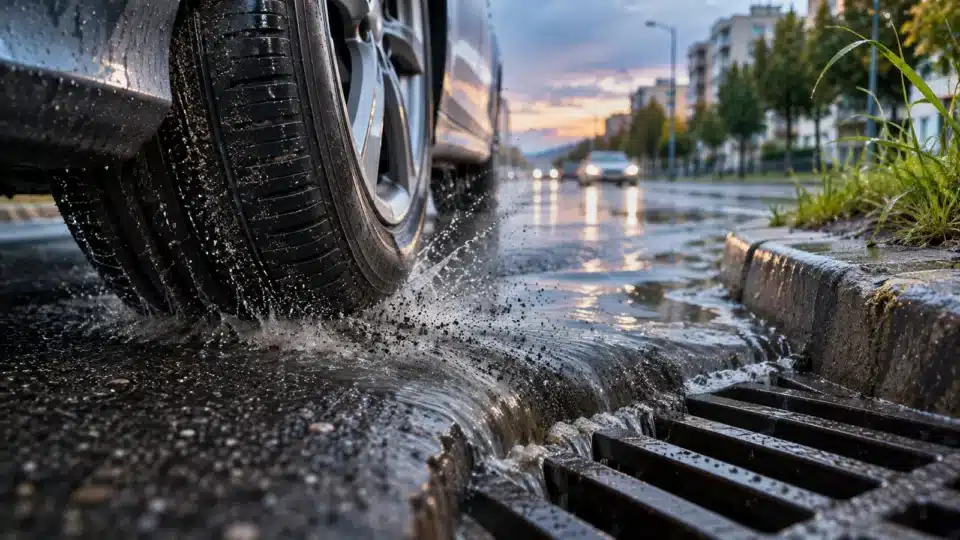
Tyre microplastics begin to form on every journey, including when a car produces no visible smoke and its engine emits no exhaust gases. Contact between the tyre and the road surface causes wear: some particles remain on the carriageway, become airborne or are carried by rain into soil and drainage systems. It is a largely invisible form of pollution, but one that matters for cities, waterways and ecosystems.
One crucial distinction is that scientific literature often uses the term tyre and road wear particles (TRWP). These are not always fragments of pure rubber. They may contain polymer material from tyres, mineral fillers, road-surface particles and chemicals. Calling them “microplastics” can be useful as a plain-language explanation, but the distinction matters when laboratory findings are interpreted.
In 2026, the issue is also receiving a regulatory response: the Euro 7 Regulation includes requirements on tyre abrasion, to be phased in over time. Meanwhile, researchers are studying a distinct substance, 6PPD-quinone, formed through the transformation of an additive used in tyres and found in stormwater runoff. This article distinguishes between established facts, estimates and claims that have yet to be confirmed. Regulation (EU) 2024/1257; US EPA — 6PPD-quinone.
Tyre microplastics: why they are not visible on the road
Tyre grip depends on the deformation of rubber and its friction against the roughness of the road surface. As a vehicle moves, a minute amount of material detaches in particles of widely differing sizes. Some are large enough to settle near the road, while finer fractions can be moved by wind and traffic. This process is not the same as burning diesel or petrol, and it cannot be eliminated by fitting a particulate filter to the exhaust.
Tyres contain polymers, carbon black or silica, vulcanising agents, antioxidant additives and other components. The composition of shed particles depends on the tyre formulation, the type of asphalt and driving conditions. Any analysis claiming to directly measure “kilograms of pure microplastic” should specify whether it has separated rubber from mineral particles and other materials in road dust.
The invisible route: from wheel to river
- Friction: driving and manoeuvring release material from tyres and the road surface.
- Deposition: some of it accumulates on roads, in gutters, at the roadside and in adjacent soil.
- Mobilisation: wind, traffic and rain move different fractions.
- Runoff: water from roads reaches drains, ditches and retention basins and, depending on the infrastructure, treatment systems or natural receiving waters.
- Transport: particles and dissolved compounds can travel through water and sediments.
- Exposure: aquatic organisms may encounter the particles, while some associated chemicals may be biologically active.
The precise route varies from city to city. Not every storm drain discharges directly into the sea or a river: some systems provide retention, settling, combined sewers or treatment. For local context, InfoBuz has separately explained how stormwater drainage works and why cities can fail during intense rainfall.
6PPD and 6PPD-quinone: two names that should not be confused
6PPD is an additive used to protect rubber against degradation caused by ozone and other oxidising agents. When it reacts with ozone, it can form 6PPD-quinone (6PPD-Q). This is a transformation product, not a size-based category of microplastic particles. It can be carried in road runoff and may affect sensitive aquatic organisms.
The EPA says studies have linked 6PPD-Q in stormwater runoff to rapid mortality in coho salmon (Oncorhynchus kisutch) under certain exposure conditions. The US Geological Survey monitors the compound in rivers and highway runoff and is studying suitable treatments. This does not mean that all fish species have the same sensitivity, or that a given level found in a US river is automatically present in the Black Sea. EPA; USGS, January 2026.
What a study published in 2026 found
A study published in September–October 2026 in Environmental Science & Technology Letters analysed road-runoff, waterway and estuary samples from Central California. The authors reported detecting 6PPD-Q in 98% of the samples analysed, with concentrations differing between runoff and waterways, and with some readings above toxicity benchmarks for sensitive species. The finding indicates a significant risk in the areas studied, but it does not represent the global percentage of contaminated rivers. 2026 study, DOI 10.1021/acs.estlett.6c00745.
The data require careful interpretation: the number of samples, the timing of a storm, the species, the laboratory and the measured concentration all affect the conclusion. It cannot be inferred that every fish dies if water contains a detectable trace of 6PPD-Q, nor that all urban-runoff toxicity can be reduced to this one substance.
Why the first rain after a dry spell matters
During dry periods, traffic-related particles and compounds can accumulate on road surfaces. At the beginning of a rainy episode, part of that deposited load is rapidly mobilised — a phenomenon discussed in the scientific literature as the first flush. Not every rain event produces the effect at the same intensity; the relationship depends on the length of the dry spell, rainfall volume, drainage and traffic.
For that reason, a serious investigation cannot rely on collecting a single bottle of water on a clear day. The USGS is studying differences between rain events and catchment areas, as well as the effectiveness of green infrastructure in reducing runoff-borne chemicals. USGS — monitoring tyre-derived chemicals in stormwater.
How much rubber does a tyre lose? A hypothetical calculation, not a measurement
To illustrate the scale, assume solely as an exercise that a car loses a combined 0.05 grams of tyre material per kilometre. Over 15,000 km, that would equal 0.05 × 15,000 = 750 grams a year. At an assumption of 0.10 g/km, the result would be 1.5 kg annually. These figures are not attributed to any commercial model and are not presented as verified averages for Romania.
| Assumed total wear | At 10,000 km | At 15,000 km | At 20,000 km |
|---|---|---|---|
| 0.02 g/km | 200 g | 300 g | 400 g |
| 0.05 g/km | 500 g | 750 g | 1,000 g |
| 0.10 g/km | 1,000 g | 1,500 g | 2,000 g |
The formula is mass = wear rate × distance. The result does not show how much reaches water or is inhalable: deposition, collection, fragmentation and treatment alter its destination. A calculation that automatically multiplied the mass by the number of cars in Romania would be highly uncertain without data on mileage, vehicle types, wear and local infrastructure.
Factors that influence tyre wear
| Factor | Possible effect | Important qualification |
|---|---|---|
| Vehicle mass | A greater load may alter the stress on the tyre | It does not allow a simple comparison across all models and powertrains |
| Hard acceleration and braking | Increase mechanical stresses and may accelerate wear | Road safety takes priority over any emissions calculation |
| Fast cornering | May increase slip and friction | Depends on suspension geometry, driving style and asphalt |
| Incorrect pressure | May cause uneven wear and other risks | Use the manufacturer-recommended pressure, not an improvised one |
| Wheel alignment | Incorrect toe or camber can accelerate tyre wear | Requires inspection at a service centre |
| Tyre material and design | Influence grip, durability and abrasion | Braking grip should not be sacrificed for a single environmental indicator |
| Road type and temperature | Change the stresses and abrasion mechanisms | Results from one test do not transfer identically to every road |
Do electric cars generate tyre microplastics?
Yes. Electric passenger cars have no tailpipe emissions while in use, but their tyres still wear down. Some models have a high mass and can deliver substantial torque to the wheels, factors that may influence wear. However, regenerative braking, vehicle profile, tyre type and driver behaviour make the simplistic claim that every electric car necessarily produces more tyre dust than every combustion-engine car untenable.
Assessments of road-traffic pollution need to distinguish tailpipe emissions from non-tailpipe emissions: tyres, brakes, road surfaces and the resuspension of dust. For an economic comparison of powertrains, InfoBuz has a separate analysis of diesel, petrol, hybrid and electric vehicles over 200,000 km.
What is known about human health
Exposure to particulate pollution from road traffic is an important public-health issue. Identifying effects specific to tyre-wear particles is more difficult, however: the material is heterogeneous, particle sizes vary, and the air also contains road dust, brake particles, industrial pollutants and aerosols from other sources. There is no basis for saying that one gram of tyre dust automatically causes a particular disease.
The demonstrated toxicity of 6PPD-quinone for certain aquatic species should not be converted into claims about human mortality without appropriate studies. In addition, measuring microplastics in biological samples and attributing individual clinical effects remain active areas of research.
Euro 7: how European rules change tyre-wear requirements
Regulation (EU) 2024/1257, in its consolidated version of 23 September 2026, introduces rules on tyre abrasion alongside conventional vehicle-emissions requirements. For new C1 tyre types (passenger cars), the relevant requirements begin on 1 July 2028; for new C2 types (light commercial vehicles), on 1 April 2030; and for new C3 types (heavy-duty vehicles), on 1 April 2032. Market application is subject to separate phased deadlines. Consolidated Euro 7 text.
| Category | New types | Restrictions on placing non-compliant models on the market |
|---|---|---|
| C1 — passenger cars | 1 July 2028 | 1 July 2030; transitional stock provisions until 2032 |
| C2 — light commercial vehicles | 1 April 2030 | 1 April 2032; transitional arrangements until 2034 |
| C3 — heavy-duty vehicles | 1 April 2032 | 1 April 2034; transitional arrangements until 2036 |
In a report dated 24 June 2026, the European Commission described measurement methods developed through UNECE, including a public-road convoy test and a laboratory drum test. The report says the C1 road test covers 8,000 km. Testing is intended to make products comparable, not to produce a perfect prediction of wear on every road. Commission report COM(2026)326.
Does the tyre label in shops already show microplastic emissions?
The standard European tyre label provides information on energy efficiency, wet grip and external rolling noise under the applicable rules. These criteria do not automatically amount to a quantitative score for microplastics released in use. Lower rolling resistance or lower external noise, by itself, does not demonstrate lower abrasion.
In 2026, the measurement methodology and integration of abrasion requirements are still developing. An article on a specific tyre would need comparable results from the relevant procedure as well as verification of safety performance. Buying a tyre solely on the basis of an “eco” marketing claim, without independent data, is not recommended.
Does the ban on intentionally added microplastics solve the tyre problem?
No. Regulation (EU) 2023/2055 restricts certain synthetic polymer microparticles intentionally added to products and mixtures. Tyre wear in use is an example of unintentional release, so the measure does not amount to a ban on driving cars or automatically eliminate particles generated while driving. Tyre wear is addressed through other instruments, including Euro 7. European Commission explanation of Regulation 2023/2055.
What this means for Constanța and the Black Sea
Constanța has urban traffic, port connections and rainfall that washes over built-up surfaces. In physical terms, particles deposited on roads can be mobilised during rain and directed into local drainage networks. The sources reviewed for this article contain no verified accounting of kilograms of rubber entering the Black Sea each year through Constanța’s drainage system. No figure is invented, and no simulation is presented as a measurement.
A genuine local study would need to identify catchment areas, the type of network, discharge points, retention facilities and the conditions under which water is treated. Samples would need to be taken before, during and after rain, using laboratory methods for TRWP and, separately, for compounds such as 6PPD-Q. A simple black layer found in a gutter does not chemically prove the presence of a particular amount of microplastic.
What a local monitoring protocol looks like
- Select two or more road catchments with differing traffic levels, along with a suitable reference point.
- Identify the sewer type and the actual route by which water is discharged.
- Record rainfall, the duration of the dry period and documented traffic estimates.
- Collect samples at defined times, using suitable containers and contamination controls.
- Measure solid particles, polymer fractions and, where the laboratory is accredited to do so, 6PPD-Q separately.
- Report detection limits and uncertainties, not merely a photograph of dark-coloured water.
- Compare the findings with other events, without automatically extrapolating to the entire county or the Black Sea basin.
What local authorities and road managers can do
| Measure | Potential benefit | Limitation |
|---|---|---|
| Drainage cleaning and maintenance | Reduces accumulation and allows flows to be managed | Does not eliminate chemicals already dissolved in water |
| Vegetated swales and retention areas | May retain sediment and alter the route of water | Require design and monitoring of effectiveness |
| Runoff-treatment systems | May reduce some contaminants | Effectiveness varies between particles and dissolved compounds |
| Traffic and water-quality data collection | Can identify problem locations | Does not replace investment |
| Procurement with verifiable tyre requirements | May encourage performance and longer service life | Wet-road braking safety must not be compromised |
The USGS is also studying vegetated channels and stormwater treatments in relation to 6PPD-Q. It would be inaccurate to promise that a rain garden removes 100% of the substance in all conditions. USGS — evaluating runoff treatments.
What drivers can do without compromising safety
- Maintain the pressure recommended by the vehicle manufacturer for the actual tyre size and load; check it when tyres are cold.
- Avoid hard acceleration and braking when unnecessary, but brake firmly when safety requires it.
- Have wheel alignment checked if wear is uneven or the car pulls to one side.
- Do not use damaged tyres or tyres below the legal wear limit simply to extend their life artificially.
- When replacing tyres, compare wet-braking performance, seasonal suitability, durability and credible tests.
- Keep the suspension and braking systems maintained, as they may affect handling and wear.
- Do not deliberately wash tyre dust or service residues into gutters, waterways or unprotected soil.
For winter driving conditions, see InfoBuz’s guide to fitting winter tyres. Pressures above the stated limits, or tyres with poor grip, are not recommended in pursuit of a presumed reduction in microplastics.
Myths about tyre microplastics
| Claim | Verdict |
|---|---|
| “Only diesel cars pollute through their tyres.” | False. Tyre wear occurs with every type of powertrain. |
| “A DPF removes tyre particles.” | False. A diesel particulate filter treats exhaust emissions, not wear at the tyre-road contact point. |
| “All the mass lost from a tyre goes straight into the sea.” | False. Pathways include deposition, air, soil, retention and treatment. |
| “6PPD-Q is the same as microplastic.” | False. It is a chemical compound formed through the transformation of an additive. |
| “All fish species respond identically to 6PPD-Q.” | Unconfirmed. Sensitivity varies between species. |
| “Euro 7 bans all old tyres from 2028.” | False. The timetable is phased by category and approval type. |
| “An eco tyre automatically has the lowest wear emissions.” | Unproven without comparable abrasion tests. |
| “When it rains, the particles disappear permanently.” | False. Rain can transport them into other environments. |
Frequently asked questions about tyre pollution
Are tyres a source of microplastics?
Yes. Their wear produces particles containing polymer materials, often alongside road-surface particles. For measurement purposes, TRWP is a more precise term for this mixture.
Can tyre particles reach drinking water?
Water pathways and treatment processes differ. Without specific analysis, it cannot be said that a given water-supply network contains tyre-derived particles at a particular level.
Is 6PPD-quinone dangerous to humans?
Research points to serious toxicity for some aquatic organisms. There are no grounds for directly applying the same effects or concentrations to human health.
Do electric cars release tyre particles?
Yes, like any vehicle fitted with tyres. The amount depends on mass, tyre construction, driving style, alignment, road conditions and many other variables.
Will Euro 7 require manufacturers to reduce tyre wear?
The regulation introduces abrasion requirements and standardised methods, phased in from 2028 for new C1 types. Details are set out in the applicable rules and acts.
Can tyre-particle pollution be measured in Constanța?
Yes, through a study involving sampling, appropriate chemical analysis and contamination controls. This article does not claim that such a local study has already been carried out.
Does rain wash all dust into the drains?
No. Some remains on the road or in soil, some may be transported through the air, and the fractions carried by water depend on the intensity of the event and particle characteristics.
Which tyre should I choose to produce fewer particles?
Look for credible test data, while also comparing wet safety, durability and suitability for the vehicle. There is currently no universal microplastics score that applies to every tyre on sale.
Conclusion: road pollution continues after the smoke disappears
The discussion of clean air cannot stop at the tailpipe. Tyres, brakes and road surfaces generate other flows of particles and compounds, sometimes carried to aquatic ecosystems through drainage networks. Research into 6PPD-Q shows that a relatively little-known chemical component can have serious consequences for sensitive species. At the same time, every ecotoxicological finding should not be turned into an alarmist claim about all people or all bodies of water.
What to watch in Romania in 2027–2030: standardised tyre-wear tests, the phased introduction of Euro 7 requirements, monitoring of road runoff, and stormwater retention and treatment measures. For Constanța, an investigation with added value would be based on samples and documents, rather than invented estimates of the annual quantity reaching the Black Sea.
Official sources and methodology
- EUR-Lex — Euro 7 Regulation (EU) 2024/1257, consolidated in September 2026: tyre-abrasion requirements and timetable.
- European Commission — report COM(2026)326 on tyres: testing methods and the C1, C2 and C3 timetable.
- US EPA — 6PPD-quinone: formation of the compound and observed effects in coho salmon.
- USGS — Tracking Tire Chemicals in Oregon Streams, January 2026: sources and monitoring of risks to water.
- USGS — Monitoring tyre-derived chemicals in stormwater, February 2026: monitoring and green-infrastructure approaches.
- Environmental Science & Technology Letters, 2026 — study of 6PPD-Q in California runoff: findings from a defined region, without global extrapolation.
- European Commission — Regulation 2023/2055 on intentionally added microplastics: the distinction between intentional addition and release through wear.
Editorial note: documented on 17 November 2026. The 0.02–0.10 g/km calculations are illustrative assumptions, not confirmed emission factors for Romania. No local measured data are presented for Constanța or the Black Sea. The effects of 6PPD-Q on some salmonid species are not extrapolated to humans or all species. The featured image is an AI illustration of a physical process, not a microscopic photograph of identified particles.






Discuția cititorilor
Ai o opinie sau o întrebare despre acest articol? Spune-ne ce crezi.
Fii primul care deschide discuția.
Te rugăm să păstrezi un limbaj civilizat și să discuți la subiect. Comentariile spam sunt filtrate automat.