
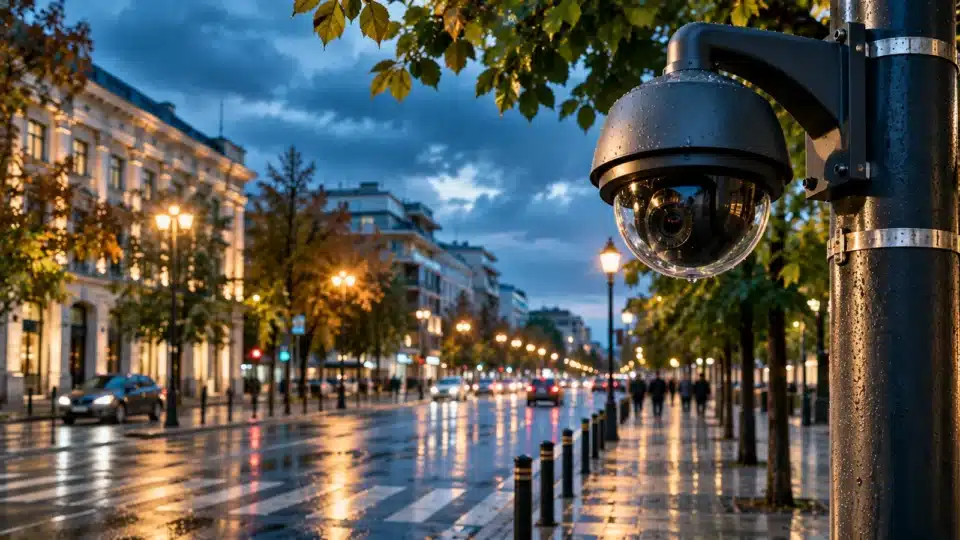
City surveillance cameras can help identify accidents, vandalism or illegal waste dumping. But when someone walks past one, essential questions arise: who decides what is filmed, who can see the footage, where is it stored, when is it deleted and how can you request information about yourself? In Romania, the answer depends on the institution, the purpose and the applicable legal framework—not simply on the presence of a camera.
One documented local example comes from Constanța City Hall, which has said that waste-collection platforms are under video surveillance and that Local Police have used footage to issue penalties in areas including Tomis 3, Faleză Nord and Poarta 6. Other communications mention the Brătianu, Km 4–5 and CET areas. This confirms the use of a particular municipal system, not the existence of a single monitor permanently tracking every person in Constanța. Constanța City Hall statement; another official statement.
We reviewed the GDPR, guidance from the European Data Protection Board (EDPB), Law 363/2018 on processing by competent authorities, and local-administration documents. This article does not claim that we carried out a technical inspection of the cameras or obtained a complete register of Constanța’s systems.
City surveillance cameras: who owns and controls them?
Not every device pointed at a street belongs to city hall. A camera may be installed by the local authority, the public-transport operator, a parking operator, a building manager, the police or a company. Some record only private property; others inevitably capture part of the public realm. The identity of the data controller is not determined solely by the logo attached to a camera, but by who decides the purposes and means of processing.
| Who operates the system | Example purpose | What should be checked |
|---|---|---|
| City hall / municipal service | Protection of assets, management of a site or another legitimate purpose | Organisational act, legal basis, purpose, retention period and access |
| Local Police | Monitoring conduct within its legal remit | The precise purposes, powers and data-protection regime |
| Transport / parking operator | Safety of passengers, vehicles or services | Information notices, access to footage and retention |
| Shop or private institution | Security of the premises and people | Whether recording public space is lawful and what minimisation measures are in place |
| Police / other law-enforcement authorities | Preventing or investigating offences within their legal remit | The special framework under Law 363/2018 and statutory limits |
A company contracted to install or maintain cameras may be a processor acting on the controller’s behalf. Other arrangements may involve joint controllers or entities with separate roles. The contract and data-protection documentation should clarify who sets the purpose and who has access. It is not correct to assume that the company which sold the cameras automatically owns all the footage.
Constanța: what official documents say about Local Police
The organisation and operating rules approved by Local Council Decision No. 95 of 15 April 2026 include a Dispatch, Weapons and Video Monitoring Service within the Local Police General Directorate. Its listed duties include processing images captured by cameras administered by the institution and providing necessary information to authorised officers when conduct within Local Police jurisdiction is observed. Official rules, section 20.3.5.
The document identifies an operationally responsible structure, but does not itself publish the total number of active cameras, a list of every location, the exact retention period for each system, or the names of employees who viewed particular footage. Those details should not be invented. Some information of public interest may be requested separately, subject to legitimate security and data-protection exemptions.
How long is footage retained? The 30-day myth
There is no general GDPR provision stating that all street cameras retain footage for exactly 30 days. Article 5(1)(e) of the GDPR sets out the storage-limitation principle: data must be kept in a form permitting identification of individuals only for as long as necessary for the purposes of processing. The specific period must be justified.
EDPB Guidelines 3/2019 state that recordings should, in many property-protection contexts, be automatically deleted after a short period; retention beyond 72 hours requires an increasingly strong justification. This is a proportionality benchmark, not a universal legal maximum of 72 hours. Footage relevant to a documented incident may be retained for longer if there is an appropriate legal basis and need. EDPB Guidelines 3/2019.
| Common claim | What is correct |
|---|---|
| “GDPR allows 30 days for every camera.” | No. The period depends on purpose, necessity, risk assessment and the legal framework. |
| “More than 72 hours is always unlawful.” | No. The EDPB calls for stronger justification for longer periods; it does not set a universal maximum. |
| “If there is an incident, all footage is retained indefinitely.” | No. Preservation must be defined, documented and justified. |
| “Public cameras always follow the same rules.” | No. GDPR and Law 363/2018 may apply in different fields. |
| “If there is no information sign, the camera is not recording.” | No. Missing information may raise compliance issues, but it does not prove that a device is inactive. |
GDPR or Law 363/2018: why the legal framework matters
The GDPR applies to many video systems run by institutions or companies. However, where competent authorities process data to prevent, detect, investigate or prosecute criminal offences, enforce penalties, or maintain and safeguard public order and security, in the circumstances provided by law, the separate framework under Law 363/2018 may apply. That law transposes Directive (EU) 2016/680.
Even within the same institution, different activities may fall under different frameworks. Not every use of a camera by a public body automatically falls under Law 363, just as not every processing operation is justified merely by invoking “security”. The purpose and statutory competence must be assessed in the specific case.
Does a camera film only, or record sound too?
An ordinary video camera may operate with a live feed, local recording, storage on a server, or a combination of these. A microphone is a separate feature and should not be inferred from the outside. Audio recording may make an intrusion into private life significantly greater and requires a separate assessment of necessity and lawfulness. A claim that conversations in a park are being recorded must be supported by system documentation, not by the shape of a camera housing.
Who is allowed to watch the footage?
Access to recordings should be granted to authorised staff within the limits of their duties, with appropriate authentication, authorisation and access-logging policies. Data cannot legitimately be viewed out of curiosity. A controller must have proportionate security measures: role-based access rights, account protection, updates, secure transmission channels and procedures for security incidents.
We cannot say how many operators watch live feeds in Constanța without specific documents. The existence of a dispatch centre does not prove continuous manual monitoring of every camera. Nor does a recording on a server automatically mean that anyone has watched it.
Can Local Police use footage to issue penalties?
Municipal communications describe the use of cameras to identify and penalise improper waste disposal under applicable local rules. They mention fines of up to 1,000 lei for the conduct described in the statements, under Local Council Decision No. 77/2021. This does not mean that every camera can establish every type of administrative offence, or that video footage replaces all procedural requirements. Constanța City Hall statement on waste platforms.
The lawfulness of an official penalty report and the evidential value of footage depend on the rule under which the conduct is sanctioned, the officer’s competence, identification of the person and the applicable procedure. Other administrative offences—for example, certain traffic violations—may have dedicated systems and rules. Procedures cannot automatically be transferred from one field to another.
What proper notice means when entering a monitored area
For processing subject to the GDPR, the controller must provide the information required by Articles 12–14, according to the circumstances. The EDPB recommends a layered approach: on entering a monitored area, a person should be able to establish that surveillance is taking place, who carries it out and where to find further details, including the purpose, retention period and their rights.
A generic “Premises under video surveillance” sticker may be insufficient if it does not allow the controller to be identified and essential information to be consulted. Conversely, not every detail needs to fit on one tiny sign; clear supplementary channels may be provided. Information obligations for activities covered by Law 363/2018 may have particular features and legal restrictions.
Can I request footage in which I appear?
In cases subject to the GDPR, Article 15 recognises the right of access to personal data. A request should be addressed to the correctly identified controller and may specify the day, time and location window so the recording can be located. The controller must also take account of the rights of other filmed people; this may require blurring faces or other measures before disclosure. The right of access does not automatically mean receiving an entire raw video feed containing dozens of passers-by.
For GDPR requests, Article 12 sets a general rule that a response must be provided without undue delay and within one month at the latest. This may be extended by a further two months where necessary and under the conditions in the Regulation, provided the person is informed within the first month. Under Law 363/2018, Article 16 provides a deadline for the controller’s response of no more than 60 calendar days, while Article 17 allows certain proportionate restrictions on access, for example to protect an investigation. These deadlines should not be conflated.
You had an accident or property was stolen: how to request preservation of footage
- Record the time, date, location and relevant direction as precisely as possible, without putting yourself at risk.
- Identify the institution, business or manager that may operate the camera.
- Promptly notify the competent authorities, in accordance with the law, if a criminal offence or danger is involved.
- Send the controller a written request to check and, where there is a legal basis, preserve the relevant time window before automatic deletion.
- Keep proof of your request and the response, without asking for unjustified publication of images of other people.
- Do not assume that a report alone requires the controller to preserve footage indefinitely or supply it directly to you.
A preservation request does not guarantee that data exists or remains available. The camera may have been inactive, may not have covered the location, or the legally justified retention period may already have ended. If the incident matters, speed is essential.
Template request for information about video surveillance
To the operator of the video system [institution/company]. Please confirm whether, on [date] and during the approximate period of [times], the camera/system in the area of [location] processed personal data relating to me. Please provide, to the extent legally applicable, the purpose and legal basis of processing, the retention period or the criteria used to determine it, the recipients/categories of recipients, and how to exercise the right of access. If there is footage relevant to the incident [brief description], I request that temporary preservation be assessed within the limits of the law. Details for identifying the request: [name, contact details and necessary information]. Please respond in writing and state the legal framework applied.
This template is for information only. Do not provide complete identity documents through insecure channels unless necessary. The controller may request proportionate additional information to verify identity. In an investigation, some information may lawfully be restricted.
Can a street camera automatically recognise faces?
Ordinary image recording and automated biometric identification are different processes. A camera may film people without calculating biometric templates to identify them. Software analysis, however, can introduce much more intrusive functions, such as remote identification or systematic tracking. It is not correct to assume that all municipal cameras recognise faces simply because they are high-performance devices or have zoom.
Article 5 of the EU AI Act severely restricts the use of “real-time” remote biometric identification in publicly accessible spaces for law-enforcement purposes, subject to narrowly defined exceptions and authorisation conditions. This does not mean that all AI-based video analysis is automatically prohibited, nor that such systems can be freely authorised by a simple decision of city hall. For the implications and timetable of the AI Act, see also InfoBuz’s guide to Europe’s AI rules.
How legitimate surveillance can become a risk of abuse
| Scenario | Risk to the individual | Recommended control |
|---|---|---|
| Unauthorised employee access | Viewing a person’s movements without a work-related reason | Restricted access rights, logging and checks |
| Excessive retention | Keeping movement routines without necessity | A verified retention policy and automatic deletion |
| Uncontrolled export of footage | Distribution of images of people or minors | An approval procedure and protection of recipients |
| Disproportionately aimed camera | Filming windows and private spaces | Restricted field of view and privacy masking zones |
| Biometric features introduced without assessment | Unjustified identification and profiling | Legal assessment, assessment of rights impacts and authorisation where required |
How many cameras are there in Constanța? Why we do not publish an invented figure
Public statements and the Local Police rules demonstrate that surveillance systems exist. However, the documents reviewed for this article do not provide a complete and current inventory of all public and private cameras capturing public space. Nor should the number of cameras administered by Local Police be inferred from statements about a few areas.
A verifiable count would require separate data requests covering cameras run by the local authority, traffic, transport and parking cameras, active versus installed equipment, and systems that were purchased but are not operational. A complete equipment map could also raise security concerns, so the level of detail suitable for publication must be considered responsibly.
Seven public questions a city hall could answer
- How many municipal cameras are installed and how many are active, broken down by type of site?
- Which institution is the data controller for each type of system, and what is the stated purpose?
- How long is footage retained in each system, and what justifies that period?
- How many employees or contractors have access, by role category, without disclosing sensitive data?
- Are accesses logged and permissions reviewed periodically?
- What procedure exists for lawful requests for access, preservation and deletion?
- Is automated video analysis used, including biometric identification? If so, what is the legal basis and impact assessment?
For communicable information of public interest, residents and newsrooms may submit requests under Law 544/2001. Different procedures may apply to a person’s own personal data, under the GDPR or Law 363/2018. InfoBuz’s guide to petitions and public-information requests explains the difference between these routes.
How to check whether a camera records you lawfully—without compromising its operation
- Identify the information sign and the institution or company operating the system.
- Look for the privacy notice and purpose, not only the name of the company that installed the equipment.
- Check whether the retention period, or a way to obtain it, is stated.
- If the device disproportionately captures windows, gardens or other private spaces, document the concern from a place where you are entitled to be.
- Ask the controller for an explanation, without attempting technical access to the system or trying to identify passwords and internal addresses.
- If the response is unsatisfactory, you may consider a complaint to the competent supervisory authority, in accordance with the law.
Frequently asked questions about public surveillance cameras
How many days does city hall keep camera footage?
There is no universal answer. The period must be set and justified for each system and purpose, in compliance with the applicable legal framework. We do not publish an unverified figure for Constanța.
Must footage be deleted after 72 hours?
Not in every case. The EDPB recommends short retention and an increasingly strong justification for keeping footage beyond 72 hours, but this is not a legal maximum applicable to every system.
Can I request a copy of street footage?
You may request access to your own personal data under the conditions set by law. The controller must assess whether footage exists, the rights of others and any applicable restrictions. Delivery of complete, unredacted footage is not guaranteed.
Can Local Police issue penalties on the basis of footage?
In certain fields, yes, subject to legal powers and procedures. In Constanța, official statements describe the use of footage for waste-related conduct. This does not establish a power to penalise any conduct through any camera.
Are surveillance cameras the same as facial recognition?
No. Filming a person is not the same as automated biometric identification; the latter is subject to additional restrictions and safeguards.
Can a private camera record the entire pavement?
It depends on the purpose, necessity, proportionality and legal framework of the processing. Disproportionate filming of public space does not automatically become lawful simply because the device is mounted on a private building.
Where can I complain if my footage is used abusively?
You can first ask the controller for an explanation. Depending on the nature of the processing, the relevant authority may be Romania’s National Supervisory Authority for Personal Data Processing; other procedures apply to other possible wrongdoing.
Can a park camera record sound as well?
Some equipment can technically do so, but this article does not assume that the function is enabled. The lawfulness of audio collection must be assessed separately. Official documentation is needed before making a claim about any particular park.
Public safety and privacy need not be set in false opposition
A camera can document an incident and protect people or property. The same technology, if used without limits, can produce excessive monitoring. The difference lies in a precise purpose, legal basis, justified duration, controlled access, information and independent scrutiny. Certain uses are documented in Constanța, but the full scale and the rules for each system require confirmation through further official information.
The next genuinely valuable journalistic step would be a document-based comparison of the municipal systems’ retention and access policies. Not a map designed to exploit security vulnerabilities, but an audit of public accountability: what is recorded, why, for how long and under what oversight.
Official sources and verification methodology
- EDPB — Guidelines 3/2019 on processing of personal data through video devices: retention, information, access and proportionality.
- Regulation (EU) 2016/679 — GDPR: principles of lawfulness, purpose and storage limitation, the right of access and data security.
- Law 363/2018 — Legislative Portal: the special framework for data processing by competent law-enforcement authorities.
- Regulation (EU) 2024/1689 — AI Act: restrictions on remote biometric identification in public spaces.
- Constanța City Hall — organisational rules, Local Council Decision 95/2026: duties of the Local Police dispatch and video-monitoring service.
- Constanța City Hall — video surveillance of waste platforms: documented example of footage used for penalties.
- Constanța City Hall — another update on surveillance of waste platforms: uses in other areas of the city.
- ANSPDCP — Romania’s data-protection authority: information and complaint routes.
Editorial note: documented on 17 November 2026. This article is not an inventory of all cameras, does not include measurements or access to surveillance systems, and does not determine the lawfulness of an individual system without its documentation. Retention periods are presented as principles and benchmarks, not universal rules. The featured image is an AI-generated illustration; it does not depict an identified camera in Constanța.



Discuția cititorilor
Ai o opinie sau o întrebare despre acest articol? Spune-ne ce crezi.
Fii primul care deschide discuția.
Te rugăm să păstrezi un limbaj civilizat și să discuți la subiect. Comentariile spam sunt filtrate automat.