
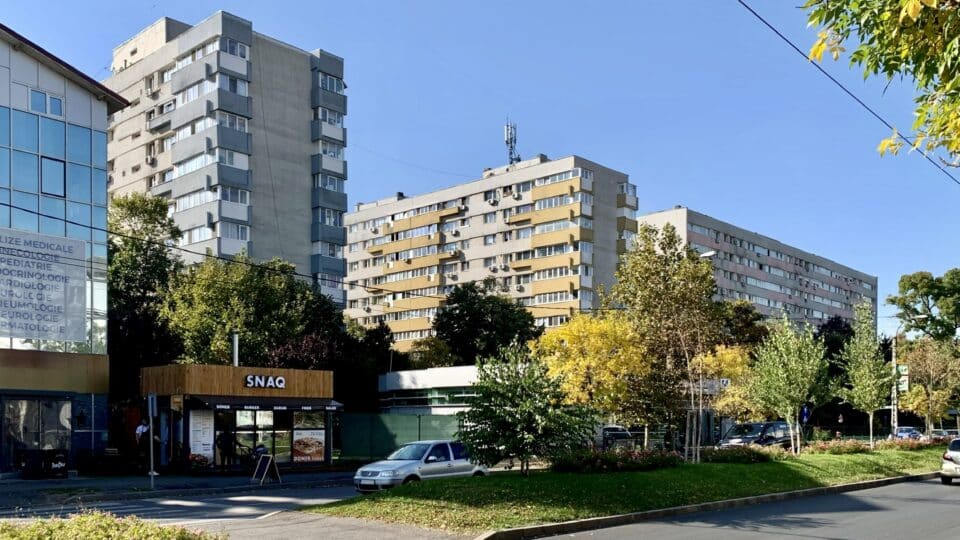
Apartment block seismic risk: if you live in a flat or plan to buy one, a building’s safety cannot be determined from the appearance of its façade, its year of construction or the presence of Romania’s well-known “red dot” warning sign. A block may be absent from every public list precisely because it has not undergone a technical assessment. And a recently renovated building may have an immaculate façade even though the renovation did not alter its load-bearing structure.
In Romania, a serious answer starts with verifiable documents: the technical assessment report, the seismic risk classification, local-authority records and, where the entry exists, the land register. This guide explains where to look, which documents to request and how to interpret the information without turning a clue into a verdict.
For more information about earthquakes, see Magnitude 4.8 earthquake in Vrancea felt in Bucharest: what the revised data say and why earthquake depth matters, which provides complementary details on the subject.
Editorially updated: 22 October 2026. Information on legal obligations is based on the consolidated version of Law No. 212/2022 consulted for this article. This guide is not a substitute for a specialist technical assessment.
How to check an apartment block’s seismic risk in six steps
If you have only a few minutes, follow this order:
- Identify the property precisely: the full address, building section, staircase, approximate year of construction and any extensions.
- Check municipal records. In Bucharest, start with the list of buildings published by AMCCRS.
- Ask the homeowners’ association for the technical assessment report, the building’s technical file and documents on structural works.
- Check the land-register extract, including any entries concerning the seismic risk class.
- Compare the findings with the current situation: the date of the assessment, the stated class, work carried out and completion-acceptance documents.
- If information is missing or contradictory, ask a certified technical expert to assess it—not a neighbour or a photograph for a verdict.
Important: “It is not on the list” says something about the records consulted, not that the building is safe. And “it has no red dot” does not mean “it has passed an assessment”.
What RsI, RsII, RsIII and RsIV classes mean
Law No. 212/2022 on reducing the seismic risk of buildings distinguishes four risk classes. They describe the expected performance of the assessed building in the design earthquake, not a prediction of when the next earthquake will occur.
| Class | What it indicates in plain language |
|---|---|
| RsI | Potential for total or partial collapse in the design earthquake; the most serious of the four classes. |
| RsII | Major damage is possible, posing a danger to occupants; total or partial collapse is considered unlikely in the scenario defined by the code. |
| RsIII | Moderate damage is possible and may endanger occupants’ safety. |
| RsIV | Expected seismic performance similar to that of buildings designed under the technical regulations currently in force. |
Do not read RsIV as a guarantee that a property will suffer no damage. No design code promises “zero damage” in every earthquake. The classification concerns a defined level of loading and the information available to the specialist at the time of assessment.
Why the red dot is not a safety test
The red sign has become a symbol of seismic vulnerability, particularly in Bucharest. The problem is that a visual indicator—whether it is present or absent—cannot fully describe a building’s position.
At least four distinct situations are often confused:
- A building assessed and classified as RsI. A report establishes high risk; the applicable measures and restrictions must be checked.
- A building assessed in another class. It may not carry the marking associated with maximum risk, but the report and its recommendations remain relevant.
- A building not assessed through a seismic technical assessment. Its class cannot be inferred simply from the lack of a listing or marking.
- A building with old documentation or later interventions. The original finding must be read alongside the date, assessment method and history of works.
Historical classifications such as U1, U2 or U3 must also be read in the context of the documents that established them. They designated urgency categories for interventions; they do not automatically become today’s RsI–RsIII classes merely because the numbers appear similar. For an updated conclusion, consult the report and, where appropriate, obtain a new assessment.
Step 1: Search the exact address in official lists
Bucharest: the AMCCRS list
The Municipal Administration for the Consolidation of Buildings at Seismic Risk (AMCCRS) publishes a list of buildings and provides information on assessed buildings and consolidation programmes. When this article was researched, the page stated that the table had been updated on 6 October 2026.
Search using the correct street name and street number, and check former versions of the address where relevant. For buildings with several sections or staircases, make sure the information relates to the structure you are investigating. If the data are unclear, seek written confirmation from the building manager or the authority.
The same website provides forms to request a copy of a technical assessment and to clarify a building’s classification. The availability of forms does not mean every applicant will automatically receive all documents without administrative checks.
Other cities
Search the city hall or the institution responsible for planning and construction using terms such as “technically assessed buildings”, “seismic risk”, “building consolidation” and “technical assessments”. If there is no accessible public database, request the building’s status in writing using its address. Local records differ; do not assume that an incomplete website represents the city’s entire stock of vulnerable buildings.
Step 2: Request documents from the homeowners’ association
The building manager or association president may know whether an assessment exists, but a verbal answer such as “the block is very solid” does not carry the weight of a report. Ask specifically:
- Is there a technical report on seismic actions for the entire property? Who prepared it, and when?
- Which seismic risk class appears in the signed conclusions?
- Are there recommendations for intervention, a consolidation project, a permit, an acceptance report or ongoing work?
- Have the basement, commercial ground floor, structural walls, columns, beams, floor slabs or internal partitions been altered?
- Is the building’s technical file, or at least relevant structural documentation, available?
Documents may be missing, especially for older buildings. That absence itself should be recorded; it is not proof that the building has no problems. In a block with several sections, specify which section and structural elements were covered by the assessment.
Step 3: Check the land register, but understand the limits of the extract
In the legislation applicable in 2026, Law No. 212/2022 provides for assessment conclusions to be sent to the National Agency for Cadastre and Land Registration (ANCPI) and for the seismic risk class to be entered in Part III of the land register. The regulations also contain provisions concerning entries for the entire property.
If you are the owner, you can obtain an extract through MyEterra; according to ANCPI information, documents relating to your property are available free of charge through that platform. For other applicants, ePay ANCPI displays the online fee for an information extract. When checked in October 2026, the fee was 20 lei for applicants not entitled to free access.
Take care when interpreting it: the absence of an entry in an extract does not guarantee that a building has no vulnerabilities. It may not have been assessed, the record may be awaiting an update, or there may be a cadastral identification issue. See also InfoBuz’s guide to obtaining a land-register extract without expensive intermediaries.
Step 4: Read the technical assessment, not just the class on its cover
A complete assessment report explains how the building was evaluated, the documents and investigations on which it relied, the deterioration identified and the measures recommended. Code P 100-3/2019, approved by Order No. 2,834/2019, is the official reference for the seismic assessment of existing buildings, insofar as no later regulations applied on the date of a particular assessment.
You should be able to identify five things: the assessment date, the expert’s name and certification, the building section or sections examined, the risk class and the recommended interventions. Ask whether the report was updated after major works or changes in regulations.
Do not try to turn isolated figures in a report into a simple safety score. Technical parameters depend on assumptions, methods and the level of knowledge available, and the conclusion must be interpreted by a specialist.
Step 5: Know the difference between rapid visual assessment and seismic technical assessment
Romania also runs rapid visual assessment programmes, useful for identifying vulnerable building types and prioritising investigations. But the Ministry of Development explicitly warns on its EVR platform that this procedure does not establish a seismic risk class and is not equivalent to an assessment carried out under Code P 100-3.
If you receive a rapid-assessment sheet placing a block in a priority category, do not present it as an RsI, RsII, RsIII or RsIV assessment. It is a signal that checks are needed, not their conclusion.
Step 6: Who can determine seismic risk if there is no assessment?
A seismic risk class is established following a technical assessment carried out by a certified technical expert in the relevant field for the mechanical resistance and stability requirement. The official register of experts is also identified in technical regulations on the Ministry of Development’s website.
In practice, owners or the homeowners’ association can begin the process and seek advice from the specialist department at city hall. Assessing an entire building involves access to documentation, investigations, evaluation of structural elements and, in some cases, testing. Cost and duration cannot credibly be estimated from the number of floors or a photograph of the entrance alone.
If someone promises a “risk class” after a brief visit or based only on the year of construction, ask for the technical basis and the full report before relying on that claim.
Buildings before or after 1977: how much does the year matter?
The earthquake of 4 March 1977 fundamentally changed how Romania approached earthquake-resistant design. The World Bank has documented vulnerabilities in some older buildings and how insufficient historical interventions left problems unresolved.
Still, the slogans “before 1977 = dangerous” and “after 1977 = safe” are both wrong. The year is a contextual indicator, not a diagnosis. What matters includes the regulations in force when the building was designed, how work was executed, material quality, performance in earlier earthquakes, maintenance, foundations and subsequent interventions.
A property built in the 1980s may require checks, while an older building that has been properly consolidated may perform substantially better. No new building is “immune”: design, execution and quality control remain crucial.
Five signs worth investigating, without claiming a diagnosis
Some visible signs warrant a technical check, but do not allow an owner to determine a seismic risk class alone:
- New or widening cracks, or cracks crossing structural elements. Not every crack in paint is structural; see InfoBuz’s analysis of the difference between plaster cracks and signs of a structural problem.
- Damaged columns, beams or floor slabs, including spalled concrete, exposed reinforcement or unusual deformations.
- An open or substantially altered ground floor, especially where commercial spaces have been repartitioned without clear documentation.
- Interventions to walls without a project, permit or specialist confirmation that the elements are non-load-bearing.
- Persistent water infiltration, corrosion or structural deterioration that may over time affect load-bearing elements.
These are reasons to request an inspection, not proof that collapse is inevitable. Their absence likewise does not prove that a block is safe. A freshly painted façade may conceal problems, but it may also reflect proper maintenance; without a technical check, you cannot know.
Three real-world types of scenario: the same question, different answers
Scenario A: the block does not appear on a public list. Do not conclude that it is classified as RsIV. Request information from the association and city hall; if no report exists, its technical status remains unclarified.
Scenario B: an old assessment exists, but there are no documents on works. Check the standard used, its recommendations, the history of interventions and whether a new assessment is appropriate. A report from several decades ago does not automatically describe the condition in 2026.
Scenario C: the property has been consolidated. Request the project, permit and acceptance documents, as well as technical conclusions available after the intervention. The word “consolidated” in a property listing is not enough.
These examples are illustrative, not verified cases at specific addresses.
What the law provides in 2026 for high-risk apartment blocks
In the consolidated version of Law No. 212/2022 consulted for this article, obligations differ according to the classification and the property’s circumstances. For RsI, the law establishes deadlines for design work and the start of intervention works, as well as specific restrictions on use. For example, Article 5 regulates prohibitions on renting out or granting use of residential spaces in RsI-classified buildings until interventions are completed under the conditions set by law. The current text of the law must be checked against the building’s specific documents.
In addition, Article 51, introduced with effect from 1 January 2026, provides for cadastral documentation and registration obligations for buildings assessed and classified as RsI or RsII, within the statutory period calculated from the date of classification. If you are an owner, do not wait to learn this when selling: seek information from the association and authorities in good time.
For questions about consolidation funding, consult city hall and the conditions of available programmes, including the programmes presented by AMCCRS for Bucharest. Eligibility, beneficiary contributions and timetables should not be assumed without checking the documents for the applicable programme.
How to check a flat before buying or renting
Seismic risk is material information in a property decision. Before paying a deposit or signing a contract, ask the seller or landlord in writing for information on assessments, consolidation work and any restrictions; compare it against authority records and speak to a specialist if there are discrepancies.
In listings, phrases such as “very solid concrete structure”, “no seismic risk” or “checked building” should be supported by specific documents, not photographs or marketing claims. Read also about the essential checks before buying a home.
Apart from structural safety, check home insurance and what the policy actually covers. Insurance does not replace an assessment or turn a vulnerable building into a resistant one. InfoBuz has also explained what Romania’s PAD policy does and does not cover.
A better method: three levels of certainty, not “safe” or “unsafe” labels
For your own documentation, information can be grouped as follows:
- Confirmed information: you have an identifiable technical report, an established risk class and documents on work performed. Even then, interpretation belongs to the expert.
- Incomplete information: a table, reference in documents or an old assessment exists, but essential parts are missing or there are inconsistencies.
- Unknown information: no relevant assessment has been identified. Do not equate the unknown with low risk.
This is a method of organising documents, not an alternative seismic classification system. The only legal classes remain RsI, RsII, RsIII and RsIV where the appropriate assessment has been carried out.
Frequently asked questions about apartment block seismic risk
Is a block without a red dot safe?
Not necessarily. It may have been assessed in another class, or it may not have a relevant technical assessment. Check the report, local records and, where relevant, the land register.
Can I find the seismic risk class online from the address alone?
In some localities, authorities publish lists that allow a property to be identified. In Bucharest, AMCCRS is a starting point. But an unsuccessful search does not mean the risk is zero.
Is a block built after 1977 automatically safe?
No. Design rules evolved substantially after 1977, but a building’s performance also depends on construction, ground conditions, maintenance, deterioration and later alterations.
Does a rapid visual assessment determine RsI, RsII, RsIII or RsIV?
No. The Ministry of Development states that this assessment is an identification and prioritisation stage, distinct from a seismic assessment under P 100-3.
Does the risk class appear in the land register?
Updated legislation provides for the class to be entered in the land register, but the absence of an entry in an extract does not replace checking the technical report and administrative status.
Can I order an assessment for my own flat?
You can request information and begin discussions with a certified technical expert, but seismic classification concerns the building’s performance and requires appropriate access, documentation and structural investigations—not merely a cursory examination of one flat.
The block has cracks. Does that mean it is RsI?
No. Cracks can have different causes, including non-structural ones. If they are new, developing or affect load-bearing elements, ask a specialist to check them. A class cannot be determined from the appearance of a crack.
Official sources and documents for checks
- Legislative Portal — Law No. 212/2022, consolidated version: class definitions and legal obligations.
- AMCCRS — Bucharest building list: public records, consulted on 22 October 2026.
- Ministry of Development — EVR platform: the distinction between rapid visual assessment and technical assessment.
- Legislative Portal — Order No. 2,834/2019: approval of Code P 100-3/2019.
- ANCPI — MyEterra and ePay: land-register extracts.
- INCDFP — seismological information: hazard, ground motion and earthquake monitoring.
Illustrative photograph: Neoclassicism Enthusiast / Wikimedia Commons, CC BY-SA 4.0. The image does not indicate or certify the seismic risk of the buildings photographed.
A block’s safety is checked in documents, not rumours
To establish an apartment block’s seismic risk, start with the exact address, check municipal records, request the assessment report and follow entries in the land register. If documents are missing or contradictory, the correct answer is not “safe”, but “there is not enough information for a conclusion”. That distinction protects against both unnecessary panic and a false sense of security.
A good home is not assessed only by price, layout and appearance. Before an important decision, it is worth knowing not only what the block looks like, but what evidence exists about how it might withstand an earthquake.








Discuția cititorilor
Ai o opinie sau o întrebare despre acest articol? Spune-ne ce crezi.
Fii primul care deschide discuția.
Te rugăm să păstrezi un limbaj civilizat și să discuți la subiect. Comentariile spam sunt filtrate automat.