
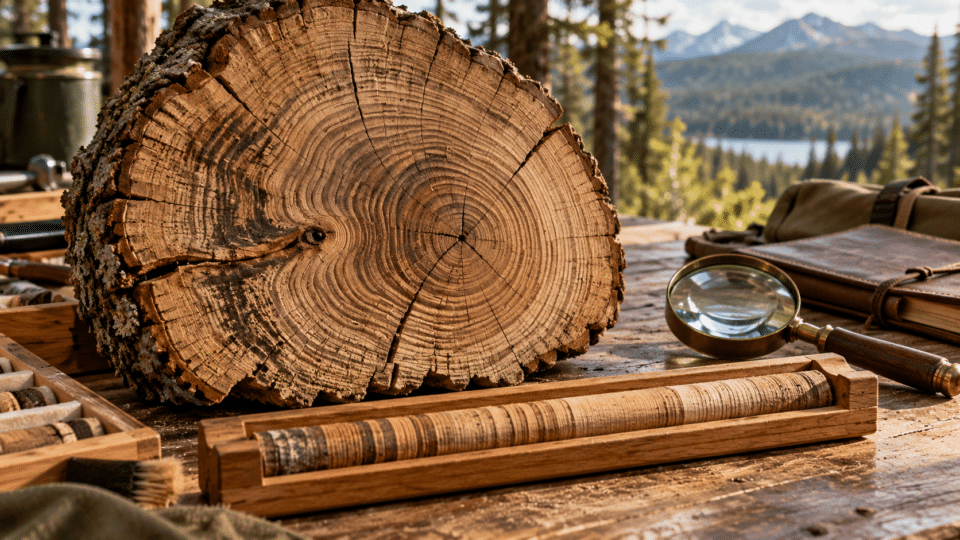
Tree rings can preserve clues to drought years, fires and environmental change, while some wood samples can be dated to the year in which they formed. To achieve that degree of precision, researchers compare patterns across numerous samples and check growth anomalies. Dendrochronology, as the University of Arizona Laboratory explains, is the dating and study of these rings, using methods more rigorous than simply counting them.
In a cross-section of a trunk, tree rings may initially look like a pattern of circles. Closer inspection reveals an uneven sequence: broad bands, very narrow sections, scars and changes in structure. Those differences are precisely what make it possible to reconstruct a chronology. A tree responds to the place where it grows, and the researcher must separate what belongs to its individual life from the signal shared across a region.
In this context, see also Genomes of 103 species reshape the story of bat origins, which presents further relevant information.
How tree rings form
In many species from regions with marked seasonality, growth activity produces different structures during the course of a season. In the classic example of conifers, earlywood has larger cells and thinner walls, while latewood has smaller cells and thicker walls. Together, they form a growth ring. The precise appearance depends on the species, as shown by the University of Arizona’s anatomical examples.
So a light band and a dark band should not automatically be counted as two years. Nor do all woody plants provide a calendar that is equally easy to read. Research begins by identifying the material, its structure and the conditions in which it formed. Precision comes from verification, not from applying a visual rule without exceptions.
Why “one ring equals one year” needs to be checked
In a difficult year, growth can be so limited that a ring is absent along a particular radius of the trunk. In other cases, a change during the season can produce a band resembling an annual boundary. WSL shows the case of a larch whose rings narrow and disappear locally: two counting paths across the same cross-section can lead to different results.
A simple comparison is a printed calendar with a missing page. The number of pages left no longer accurately indicates how much time has passed. If you also have the calendars of neighbouring households, you can spot the gap and correct it. In wood research, this verification uses similarities between growth series rather than assuming that every specimen has all its boundaries equally visible.
For that reason, a photograph of tree rings or a count made on a stump is, at most, a preliminary observation. Dating requires resolving very narrow, false or missing rings and establishing the position of the series in time. The Arizona laboratory explicitly describes these anomalies.
How a wood sample is assigned a calendar date
Researchers may use thin cores extracted with dedicated instruments, sections of already available wood, or samples from buildings and archaeological contexts. Surfaces are prepared so that boundaries can be observed, then features such as ring width are measured. Materials come from different sources, and sampling requires appropriate permissions and procedures. WSL describes the path from fieldwork to laboratory.
Next comes crossdating. The growth patterns of several samples are aligned to establish the corresponding years. Overlapping series can connect living trees, timber from buildings and older material preserved in favourable environments. This makes it possible to build a chronology longer than the life of any individual tree, according to the method presented by the Swiss institute.
Take a hypothetical example: a series from a living tree covers 1920–2020, while a beam retains a pattern that, after verification, matches 1850–1950. The overlap makes it possible to link them into a longer chronology. The dates in this example are chosen solely for explanation; in a study, the match must be supported by measurements, a sufficient number of rings and confirmation from other samples.
A short segment with two narrow rings is not a sufficient “fingerprint” in every situation. Two fragments may resemble one another by chance. The relevant question is how convincing the match remains when compared with alternatives and with material from the same context.
What tree rings can reveal about climate
Wood preserves the effects of growing conditions. The USGS includes tree rings among the natural archives used to reconstruct variations in temperature and precipitation, alongside ice, sediments and other records. This is indirect information, known as a proxy: measurable characteristics that help estimate past conditions.
A narrow ring cannot universally be translated as “it was cold”. In a dry location, water may limit growth; near the upper tree line, temperature may have a stronger influence. Age, competition, light, disease and local disturbances also matter. WSL explains site selection and the factors that alter growth. Researchers seek coherent relationships with available observations and test them before reconstructing the past.
| What is measured | What question it can help answer | Limit of interpretation |
|---|---|---|
| Ring width | How did growth change from one year to the next? | Several factors can produce a similar response. |
| Latewood density | Is there a useful climate signal at the site under study? | The relationship must be established for the species and site. |
| Cell structure and scars | When did a disturbance occur? | The cause requires contextual information. |
| Stable isotopes | How did physiological processes and environmental conditions vary? | Analysis depends on models and validation. |
| The pattern of a ring series | In which years did the wood form? | A sufficiently robust chronological match is required. |
The methods in the table are described by the Forest Biometry Laboratory at Ștefan cel Mare University of Suceava. They complement one another: an additional measurement can test an explanation, rather than automatically turning every variation into evidence of a single cause.
Tree rings therefore become an archive containing several types of information. Width and density describe different properties of wood, while chemical analysis adds further clues. A convincing result explains why a particular measurement was selected and what it can estimate. The precision of the year in which a ring formed should not be confused with the precision of the temperature reconstructed from it.
This sensitivity to local conditions also matters when considering isolated mountain ecosystems. Altitude, exposure and access to water can alter the response of trees growing relatively short distances apart. A good archive retains this information about place as well.
A striking case: the wood that fixed the year 1021
A study published in Nature identified evidence of a European presence at L’Anse aux Meadows in Newfoundland in the year 1021. The team used three pieces of wood from different trees, associated with the Norse context. The rings contained the signal of the atmospheric radiocarbon increase of 993, and the sequence to the edge of the wood made it possible to date the felling. The study describes the analysis and the limits of the samples.
The result shows what can emerge from the combination of chemistry, wood anatomy and archaeology. It fixes a documented moment of human activity. It does not automatically establish the first arrival, the duration of the entire settlement or the story of all voyages. A highly precise date can answer one narrow question exactly without resolving the whole history at once.
From the Carpathians to beams in old buildings
In Romania, researchers at Ștefan cel Mare University of Suceava study ring width and density, isotopes and cell anatomy. The laboratory works with living trees as well as subfossil, archaeological and construction timber. The research directions published by USV include climate reconstructions, environmental disturbances and the dating of materials that meet the method’s requirements.
For a historic beam, the date of the last preserved ring must be interpreted alongside the condition of the sample. If the outer layers are missing, the year in which the tree was felled does not automatically follow. There is also the time between felling, processing and use, as well as the possibility that the timber was reused. The date of the wood and the date of construction of the entire building are therefore questions checked together with documents and archaeology.
Preservation explains why some materials reach researchers after very long periods. We have separately described the conditions that favour the preservation of wooden shipwrecks in the Black Sea. Preserving an object’s form and making dendrochronological dating possible are different assessments, however: the sample must contain the necessary information and be relatable to an appropriate chronology.
A scientific archive must be verifiable
NOAA maintains the International Tree-Ring Data Bank, a public archive that includes measurements of width, density and isotopes, as well as chronologies. The data can be searched by location, species, author and other criteria. Access to series and metadata allows comparisons and independent checks rather than reliance on a single striking image.
When reading a report based on tree rings, it is worth following four points: what was measured, how many samples were used, how they were dated, and how broad the conclusion is. “We identified a drought year in one region” and “we reconstructed the climate of the entire planet” require evidence on very different scales. This attention makes a finding easier to understand and assess.
Frequently asked questions about tree rings
Does every visible circle represent exactly one year?
Not automatically. False bands, extremely narrow rings and sections where a ring is absent can occur. Anatomy and comparison between samples are needed to assign years correctly.
Does a tree have to be cut down to be studied?
Not in every case. Specialists can take thin cores with dedicated instruments or use wood that is already available. The choice of method and authorisation for sampling depend on the tree, the site and the research purpose.
Does a wide ring mean a warm summer?
Its meaning depends on local conditions and on the factor limiting growth. More water, more light or reduced competition can affect the result. Climate is reconstructed through tested relationships, not a universal legend of colours.
Can any old wooden object be dated?
The method requires a suitable series, enough identifiable features and a reference chronology or a valid marker. Processing, degradation, missing outer rings and unknown provenance can limit precision or prevent dating.
Sources and documentation
Documentation verified on 28 October 2026. The sources below explain the methods, conditions of use and limitations presented in this article.
- University of Arizona: the foundations of dendrochronology and crossdating
- WSL: tree-ring research
- WSL: locally absent rings and the example of a 700-year-old larch
- NOAA NCEI: International Tree-Ring Data Bank
- USGS: natural climate archives
- Ștefan cel Mare University of Suceava: Forest Biometry Laboratory
- Kuitems and colleagues: Evidence for European presence in the Americas in AD 1021, Nature
Representative image: AI-generated editorial illustration for InfoBuz.


Discuția cititorilor
Ai o opinie sau o întrebare despre acest articol? Spune-ne ce crezi.
Fii primul care deschide discuția.
Te rugăm să păstrezi un limbaj civilizat și să discuți la subiect. Comentariile spam sunt filtrate automat.