
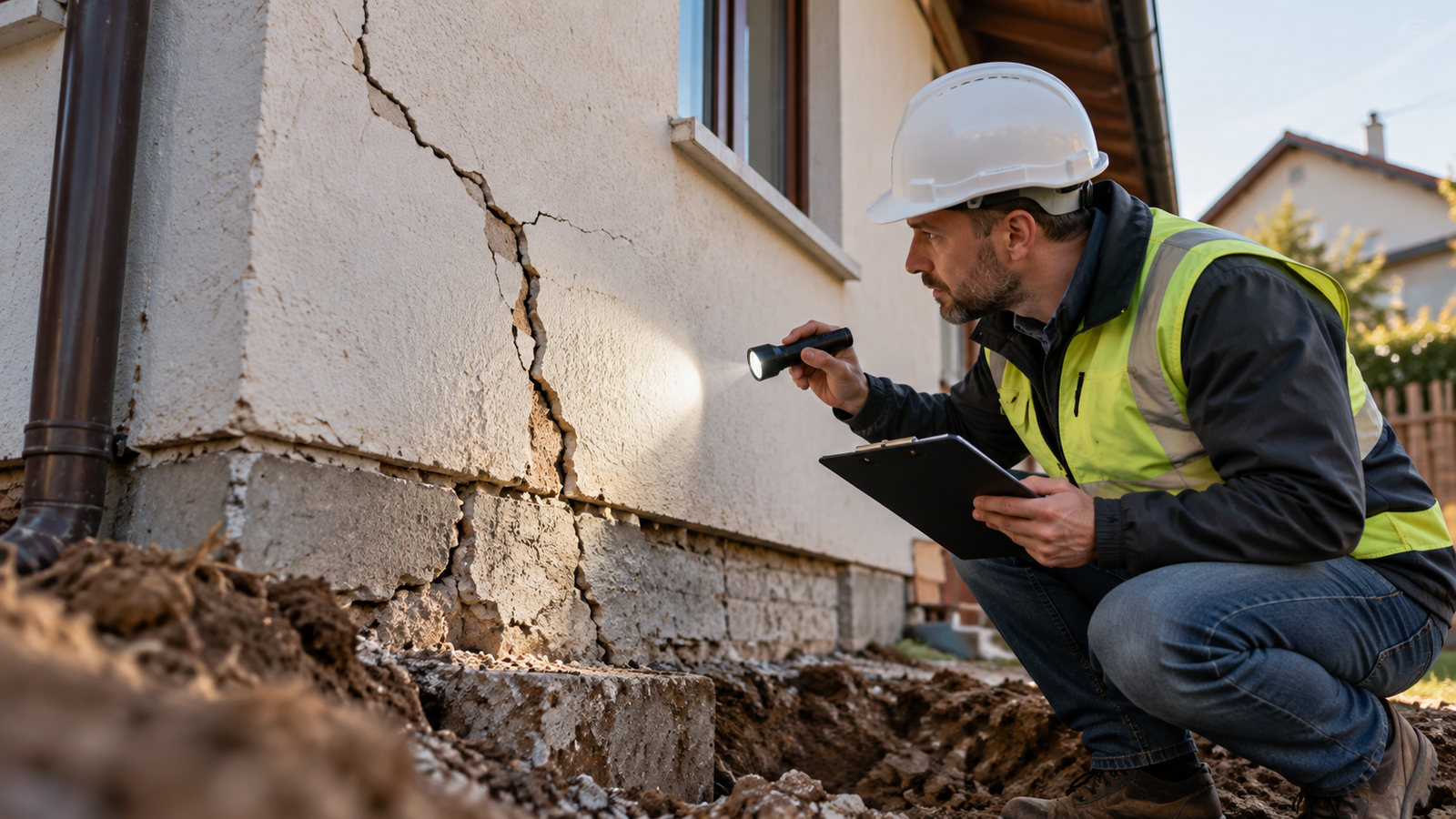
Cracks in a home can have different causes. A thin crack in plaster may be a normal result of materials drying. A crack that widens, also appears in the masonry, or is accompanied by distorted doors and floors may mean something else. In construction, the dangerous mistake is to diagnose a problem from a photograph: “it’s only cosmetic” or “the foundation is failing.” Both conclusions may be wrong.
Experts at RICS, the British professional body for surveyors and property specialists, recommend considering cracks in context: their pattern, development, moisture, openings in the wall and possible ground movement. The information here is for guidance only; it is not a substitute for the technical expertise required in Romania to assess a structure.
Cracks in a home: four different scenarios
| Possible appearance | Possible causes | What to check |
|---|---|---|
| Fine line in the finish layer | Drying, shrinkage, minor movement | Stability, substrate and the history of the finish |
| Crack near the corner of a window | Local movement, stresses, construction details | Whether it crosses the masonry and whether it is widening |
| Stepped crack through masonry joints | Differential movement or other mechanisms | Doors, floor slabs, foundations and development over time |
| Crack with displacement and visible distortion | May indicate a more serious problem | Professional assessment without delay |
The table is not a diagnosis. The shape of a crack is a clue, not enough evidence to establish its cause. An apparently superficial defect may conceal a deeper problem, while a visible crack may have been stable for years.
Why a new house may develop cracks
Building materials change over time: concrete and mortars undergo shrinkage and curing processes, plaster loses moisture, and temperature variations cause expansion and contraction. Joints between different materials are places where these differences may become visible sooner.
This does not justify ignoring every crack in a new house. What matters is whether the defect is confined to the finish, whether it is replicated on both sides of the wall, whether it is developing, and whether there are signs of water ingress or distortion.
What can cause differential foundation movement
According to RICS guidance on subsidence, ground conditions and changes in moisture play an important role. Clay soils can shrink when they lose water and swell when they absorb it; leaks from plumbing can alter the conditions beneath foundations. Vegetation, drainage and geotechnical characteristics can also affect the situation.
These mechanisms describe general possibilities. It cannot be claimed that a particular house has differential settlement without specialist investigations. The design conditions, foundations, ground and history of works are specific to each site.
A width of 3 mm: why one number is not a verdict
RICS notes that cracks which appear suddenly and are wider than approximately 3 mm may be a cause for concern in certain subsidence contexts. This is not a universal structural-safety threshold for every building in Romania. Location, depth, the material affected, development over time and other signs may matter more than comparison with a ruler.
A small but progressive crack may require inspection; a wider crack that is old and stable may be assessed differently. Classification cannot be based on the visible opening alone.
How to document cracks without intervening in the structure
- Photograph the area with a scale reference, and retain wider shots showing its position in relation to windows, doors and corners.
- Note the date, approximate temperature, and whether there has been heavy rain, water ingress or work nearby.
- Visually check whether the defect appears to be only in the finish or continues into the masonry, without breaking into or dismantling load-bearing elements.
- Watch for doors and windows beginning to stick, or visible changes to floors.
- Keep the building plans and documentation for the specialist.
- Do not permanently conceal the crack with filler or paint before establishing whether it needs to be investigated.
When to contact an expert
A crack that appears suddenly and is widening, a wall that seems displaced, a change in the geometry of openings, visible settlement of floors, or signs that a structural element has been affected are reasons for a prompt assessment. If you observe a situation involving a possible immediate risk of collapse, do not remain in the affected area and seek emergency assistance.
In Romania, a structural assessment should be carried out by a specialist qualified in the design or technical expert assessment of buildings, in accordance with the applicable legal framework. A painter or finishing contractor may repair surfaces, but cannot replace structural expertise.
For more information on construction, see also A house without utility connections is not designed around panels, but around the hardest week of winter, which offers complementary information on this subject.
What you should not do yourself
- Do not cut or chase channels into load-bearing elements to “relieve stress”.
- Do not inject materials or carry out improvised reinforcement without a design and assessment.
- Do not automatically blame neighbours, drought or trees without an investigation.
- Do not use an online template to decide that the home is safe.
- Do not ignore water ingress that may affect the ground or materials, but do not begin excavating near foundations without a design.
If you are planning to buy a house
Request the available documentation and repair history. A freshly painted crack is harder to assess than one documented over time, but the absence of visible cracks during a viewing does not guarantee there are no hidden problems. If there are signs of movement, make the decision conditional on an appropriate assessment.
For a new home, check the handover report, warranties and options for notifying the contractor, but do not assume that every defect can be resolved through a simple complaint. Safety and contractual liability are separate issues.
Conclusion: the development of a crack matters more than an assumption
Not every crack signals a structural problem, but no photograph can guarantee the opposite. The most responsible approach is to document it, monitor the context and call a specialist when there are signs of progression or distortion. A visible repair should follow an understanding of the cause, not conceal it.
Read more on InfoBuz
For context on planning and quality of works: the real cost of building a house in 2026.
Frequently asked questions
Does a thin crack mean the foundation is failing?
Not automatically. Some cracks result from shrinkage in finishes or minor material movement. However, the cause cannot be established reliably from thickness or a photograph alone: progression and distortion around the crack matter.
Is the 3 mm threshold a Romanian safety rule?
No. RICS guidance mentions this reference point in certain subsidence situations, but it is not a universal structural assessment standard in Romania. Depending on the context, a crack may need inspection even below that threshold.
Can I cover the crack with filler and see if it returns?
For a crack of unknown cause, covering it immediately may remove a useful indication of how it is developing. First document its location and progression, and seek an assessment when there are signs of structural damage. Work on load-bearing elements requires design and competence.
Who can say whether a home is safe?
A specialist qualified in the technical assessment of buildings, who examines the specific situation and, where appropriate, the design documents, ground conditions and structural elements. An online diagnosis based on a single image does not provide the same certainty.





Discuția cititorilor
Ai o opinie sau o întrebare despre acest articol? Spune-ne ce crezi.
Fii primul care deschide discuția.
Te rugăm să păstrezi un limbaj civilizat și să discuți la subiect. Comentariile spam sunt filtrate automat.