
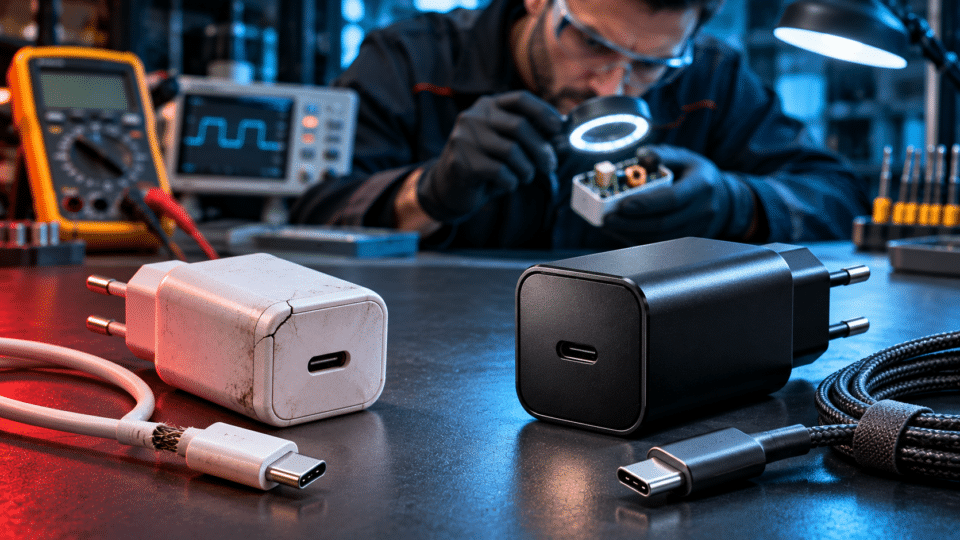
Suspect USB-C chargers are difficult to identify from a photograph alone: an adapter may look flawless yet have insulation problems, while a basic, inexpensive model may comply with the rules. A CE logo, a “120 W” claim, the word GaN or a sleek casing do not by themselves demonstrate electrical safety. For consumers, what matters is the product’s traceability, documentation, compatibility, physical condition and any official alerts.
The issue is not only charging speed. A power supply connected to a 230 V mains supply must safely separate the hazardous-voltage side from the USB output, manage temperature and foreseeable faults, and meet the applicable requirements. A non-compliant design may increase the risk of electric shock, overheating, smoke or fire. You cannot establish all of this through a simple test with a phone.
InfoBuz compared European requirements for CE marking, USB Implementers Forum (USB-IF) documentation, the results of an official market-surveillance campaign and rules on the legal guarantee. This guide concerns spotting suspect products and deciding not to use them, rather than choosing the ideal wattage—a subject covered separately in InfoBuz’s guide to choosing a USB-C charger.
Suspect USB-C chargers: 15 signs that warrant checking
No single visual clue is definitive evidence of counterfeiting. But a combination of missing traceability, conflicting labels and physical defects is reason to avoid the product until the matter is clarified.
- No manufacturer identification. There is no verifiable name or clear information about the responsible economic operator.
- The model cannot be identified. The product and packaging show different names, or there is no model number.
- Incomplete electrical information. Relevant input and output values are missing or illegible.
- Wattage claims that do not add up. The packaging promises 100 W, but the printed voltage and current combinations do not support that claim.
- Compliance logos used confusingly. Symbols resembling official markings are shown, but the product cannot be identified.
- Conflicting sales presentation. The photographs, description and delivered product differ, or indicate incompatible specifications.
- An implausible price with no identifiable seller. This does not prove a fake, but it increases the risk when combined with other signs.
- A cracked or distorted casing. Any crack that could expose components or compromise insulation means use should stop.
- Bent, loose or damaged pins. An insecure electrical contact can cause heating and arcing.
- A damaged USB-C port. The connector moves abnormally, has burn marks or melted plastic.
- A burning smell or smoke. Stop using it immediately; do not “test it one more time”.
- Unusual heat. Moderate warmth can be normal; overheating, distortion or pain on touching it are warning signs.
- New noises accompanied by other symptoms. A faint hum does not prove a fault, but crackling, smoke or rapid heating require use to stop.
- A cable with broken insulation. Exposed conductors, blackened connectors or melted areas make the cable unsuitable for use.
- The seller refuses to provide basic information. They cannot confirm the model, manufacturer, warranty terms or origin.
If there is smoke, flames or an immediate danger, move people away, evacuate if necessary and call 112, Romania’s emergency number. Disconnect the power only if you can do so safely; do not touch a smoking device or one with exposed electrical parts.
CE marking: what it does and does not guarantee
In the European Union, the CE marking is affixed by the manufacturer to declare that a product meets the relevant EU requirements. There is no central EU body that issues a universal “CE certificate” for every product. In many cases, the conformity assessment is carried out by the manufacturer, while technical documentation and the EU declaration of conformity must support the marking. The official explanation is available on the EU’s Your Europe portal.
CE is therefore not a guarantee that every unit on the market has been independently tested in a laboratory. Nor does the absence of a certificate from a private company automatically demonstrate non-compliance. A serious check starts with identifying the model, the applicable documents and the responsible economic operator.
Information to look for on the charger and packaging
- The manufacturer and identifying details, plus information on the importer or responsible operator where applicable.
- The exact model number, so it can be compared with official documentation.
- The electrical input—for example, 100–240 V AC, 50/60 Hz—where this is the product’s actual specification.
- The declared outputs: voltage and current combinations, and potentially USB PD and PPS profiles.
- The maximum total power and power per port on a multi-output power supply.
- Applicable compliance markings, instructions and relevant warnings.
- Clear information on the seller, invoice, warranty and support channel.
An adapter without identifiable information is best avoided. But do not infer authenticity from the spacing of the letters “CE” or from a photograph of the symbol: many simplified graphic explanations about supposed differences between logos are unreliable. Documentation and traceability matter more than visual myths.
USB-IF Certified: a separate check from CE marking
USB-IF is the organisation that administers USB specifications and a product-testing programme. Products that pass the relevant tests may be listed in the Integrators List and may be entitled to use official USB-IF logos, subject to licensing conditions. USB-IF — Compliance Program.
This is a useful additional indicator, but USB-IF certification and CE compliance are different things. Not every lawful, compliant charger must display a USB-IF logo, and a logo copied onto packaging does not prove certification. To check a claim, compare the manufacturer and exact model with the available official records, rather than relying on a similar trade name.
How to check a product that claims USB-IF certification
- Write down the brand and exact model number, not simply a name such as “Fast Charger 100W”.
- Find the manufacturer’s documentation and specifications for that model.
- Consult the official USB-IF programme and its information on certified products.
- Compare the model, category and declared capabilities with the product being offered.
- Do not treat a logo in a shop image as sufficient evidence.
- If the information conflicts, ask the seller for clarification before use.
Why a dangerous charger can look perfect on the outside
The most serious risks may be invisible without laboratory testing. A charger plugged into a wall socket has a mains-voltage input section and a low-voltage output intended for the device. Its design and manufacture must prevent a dangerous transfer of mains voltage to the USB port and limit thermal and electrical risks.
| Protection or feature | Its purpose | What a consumer can observe |
|---|---|---|
| Insulation between mains and output | Reducing the risk of electric shock | Cannot be confirmed visually; requires appropriate design and testing |
| Overcurrent and short-circuit protection | Limiting electrical faults | Cannot be checked by deliberately creating a short circuit |
| Thermal control | Reducing the risk of overheating | You may observe distortion, odour or unusual heating |
| Overvoltage protection | Reducing risk to equipment | Cannot be certified by a simple USB tester |
| Correctly rated connectors and cables | Appropriate electrical contact and current carrying | You can inspect wear, markings and compatibility |
| Electromagnetic compatibility | Limiting interference produced by the equipment | Requires specialised measurements |
For electrical equipment within its scope, the Low Voltage Directive 2014/35/EU sets safety requirements. Other European legislation may be relevant depending on the product. A list of technical abbreviations on a sales page is no substitute for demonstrating conformity.
What the European Commission found when testing chargers
In the CASP 2019 campaign on chargers, participating authorities selected 86 products from several categories: 38 USB chargers, 25 laptop/tablet adapters and 23 universal battery chargers. According to the official results, around 65% of the products in the sample did not fully meet the safety requirements checked, with results varying significantly between categories. European Commission — CASP 2019 Chargers.
That figure describes the selected 2019 sample; it is not the share of all chargers sold in Romania in 2026 and should not be used as a current statistic for the whole market. The tests covered, among other matters, protection against access to live parts, insulation resistance, internal wiring, overheating and fire resistance.
The relevant message for buyers is that outward appearance cannot replace electrical checks, and defects can have serious consequences. The Commission recommends stopping use of chargers that heat unusually, have cracked casings or damaged cables.
Safety Gate: where to check whether a charger has been withdrawn or recalled
Safety Gate — the European portal for alerts on dangerous products allows users to search public notifications concerning non-food products. Search by product name, brand, model, category, or terms such as “USB charger” and “power adapter”. Check the photograph, model number, country, nature of the risk and action taken.
If a model does not appear in an alert, that does not automatically mean it is safe: not every product on the market has been tested, and some alerts may identify only particular batches or models. Conversely, an alert concerning a similar product does not prove that every charger from the same brand is affected.
USB Power Delivery: why a 100 W charger does not automatically send 100 W to a phone
In a compliant USB Power Delivery implementation, the charger and device negotiate the supported power profiles. A phone requesting less power is not automatically supplied with the maximum output printed on the adapter. That principle, however, presupposes properly designed and manufactured equipment; it is not a guarantee for a faulty or non-compliant power supply.
In addition, a charger with a USB-C port does not necessarily offer every USB PD profile, and an unsuitable cable can limit charging. For a full explanation of watts, PPS and power sharing between ports, see InfoBuz’s guide to choosing a USB-C charger.
USB-C cables: 60 W, 100 W, 240 W and the markings that matter
In its current certification programme, USB-IF uses markings for USB-C-to-USB-C cables that indicate 60 W or 240 W, alongside data-speed markings where relevant. Higher-power cables have additional requirements, including appropriate electronic identification of their capabilities. USB-IF — Cables and Connectors.
There are also older cables and commercial products marked 100 W. A cable labelled 100 W is not automatically counterfeit; its standard, model and specifications need checking. Likewise, a “240 W” logo printed by an unknown seller does not itself show that the cable has passed USB-IF tests.
| What the product says | What you can cautiously infer | What you cannot infer |
|---|---|---|
| USB-C | The connector shape | The power, data speed or safety of the whole setup |
| 60 W | A declared capacity for a suitable cable | That the charger and laptop support the same power |
| 100 W | A declared commercial capacity, possible for some cables | That the marking automatically follows the current USB-IF logo programme |
| 240 W | A declared high-power capacity | That the product is genuine simply because it displays the number |
| USB PD / PPS | Declared compatibility with certain protocols | That the adapter’s electrical insulation is safe |
| GaN | A technology used in some power components | That the product is automatically superior or certified |
GaN: useful technology, not a safety certificate
GaN, short for gallium nitride, is a semiconductor material used in some power electronics. Depending on implementation, it can enable the design of compact, efficient chargers. But the label “GaN” alone says nothing conclusive about insulation quality, thermal management, the components used or the compliance of the manufactured batch.
A GaN adapter from a traceable manufacturer may be a good choice. An anonymous product displaying “GaN 140 W” without a model number or documentation does not become safe because of that label. Nor does low weight automatically prove poor construction: technologies and designs differ.
Three-port chargers: the total-power trap
An adapter advertised as “100 W” may deliver 100 W through one port under certain conditions, but total power is redistributed when multiple devices are connected. Some models reduce or renegotiate power when an additional port is occupied. That can be normal behaviour, not a defect.
The problem arises when a sales listing suggests that every port simultaneously delivers its maximum power although the total exceeds the adapter’s capacity. Check the official power-distribution table, not only the large number on the front of the packaging.
What to check in 90 seconds before buying
- Identify the seller, manufacturer and exact model.
- Compare the product with the manufacturer’s official page.
- Read the input, output and power-distribution specifications.
- Check whether instructions and information about the responsible economic operator are available.
- If USB-IF certification is claimed, find the official information for the model.
- Search the model in Safety Gate alerts and in any recalls published by the manufacturer.
- Check the returns policy, invoice and legal guarantee.
- Do not buy an adapter with conflicting descriptions or an identity that cannot be established.
What to check when unpacking, before first use
- Compare the model on the product with the invoice, packaging and online description.
- Inspect the casing, pins, ports and cable for cracks, distortion or signs of melting.
- Check that the electrical data are legible and consistent with the documentation.
- Read the warnings and conditions of use recommended by the manufacturer.
- Do not open the casing or try to test insulation by improvising wires connected to the 230 V mains supply.
- If there are serious discrepancies, stop and contact the seller.
An ordinary USB tester may display voltage, current and some protocol negotiations, but it does not certify insulation from the mains supply, fire resistance or every internal protection. Do not use an expensive phone as a tool for checking a suspect charger.
What to do if a charger smells of burning, produces smoke or becomes very hot
If you see smoke, flames, crackling or rapid distortion, treat it as a possible electrical incident: move away and call 112 if there is a danger. Do not handle a smoking device. If there is no active incident and you can disconnect the power without risk, stop using it and do not reconnect it to “confirm” the fault.
Keep documents and take photographs of the product only once the situation is safe. Do not try to open the adapter, replace an internal fuse or tape up a cracked casing. Internal components can remain electrically charged even after it has been unplugged.
Can a poor charger damage a phone or laptop?
Yes. Under certain conditions, a faulty or non-compliant power supply can cause unstable power, overvoltage, heating or damage. Not every battery or USB-C port problem is caused by the charger, however. Proper diagnosis may require checking the device, cable and power supply.
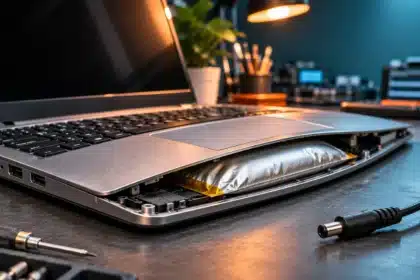
If a laptop battery is already swollen, do not charge it or try it with another adapter. Consult InfoBuz’s guide to swollen laptop batteries, which explains the safety measures.
Original, compatible and counterfeit chargers are not synonyms
| Category | What it means | How to check |
|---|---|---|
| Original | A product sold under the manufacturer’s brand through a legitimate channel | Model, packaging, traceability and authorised seller |
| Compatible, from another manufacturer | A product intended to work with the device without claiming to be original | Specifications, identifiable manufacturer, compliance and warranty |
| Counterfeit | A product that unauthorisedly imitates another product’s brand or identity | Brand/model inconsistencies and checks through the rights holder’s channels |
| Non-compliant | A product that fails to meet applicable requirements, irrespective of brand | Authority findings, documentation, testing and assessment |
A compatible charger is not automatically fake, and a product sold as “original” is not authentic simply because it bears a familiar logo. A product may also be non-compliant without being counterfeit, and vice versa. Do not accuse a particular manufacturer based on appearance alone.
Your rights in Romania if you bought a non-compliant charger
For goods bought by consumers from traders in the EU, the European framework generally provides a minimum two-year legal guarantee for relevant lack of conformity. Depending on the circumstances, consumers may have rights to repair, replacement, a price reduction or a refund. A commercial warranty offered by the manufacturer does not remove rights against the seller. Your Europe — Guarantees on goods bought in the EU.
If the product appears dangerous, stop using it. Contact the seller in writing, describe the fault and request a remedy. Keep the invoice, order confirmation, photographs of labels and correspondence. For consumer-protection complaints in Romania, consult the official channels of ANPC, the National Authority for Consumer Protection. Also check Safety Gate for safety alerts and recalls.
How to document a suspect product without putting yourself at risk
- Photograph the packaging and model label only if the device is cool and safe to handle.
- Record the purchase date, shop, order number and price.
- Keep screenshots of the sales listing and promised specifications.
- Describe the symptoms you observed, without trying to reproduce them.
- Do not open the charger to photograph its internal circuitry.
- Ask for safe return instructions if the product is damaged or presents a fire risk.
EU common-charging rules: what applies in 2026 and what comes next
For categories of devices covered by the common-charger Directive, USB-C has been the harmonised port since 28 December 2024; for laptops covered by the rules, the deadline is 28 April 2026. These requirements concern the covered equipment and charging interoperability, not the notion that any adapter with USB-C is automatically safe. European Commission — The EU common charger.
The Commission has also adopted Regulation (EU) 2025/2052 on future requirements for external power supplies, applicable from 14 December 2028. Those future obligations should not be presented as conditions already applicable to every charger in November 2026. For buyers, checking current compliance remains essential.
Details on the difference between the mandatory USB-C port on certain laptops and actual charger compatibility are explained in InfoBuz’s article on the European USB-C rule for laptops.
Five myths about suspect USB-C chargers
| Myth | What technical checking shows |
|---|---|
| “If it has CE, it must have been tested by the EU.” | CE is the manufacturer’s declaration; the assessment procedure depends on the applicable legislation. |
| “If it says GaN, it cannot overheat.” | GaN does not replace design quality and thermal protection. |
| “100 W automatically burns a 20 W phone.” | In compliant USB PD, the device negotiates power; a genuine fault remains possible. |
| “A cable without a USB-IF logo must be dangerous.” | The absence of a logo alone is not evidence of non-compliance. |
| “If it is not in Safety Gate, the product is safe.” | The absence of an alert is not a safety test. |
| “A 20-leu USB tester checks 230 V insulation.” | Ordinary testers cannot replace laboratory electrical tests. |
Frequently asked questions about suspect USB-C chargers
How can I tell whether a USB-C charger is fake?
Check the model, manufacturer, seller, documentation, specifications and any official information from the brand. Neither a low price nor outward appearance alone provides a verdict.
Is a charger without a USB-IF logo illegal?
Not automatically. The USB-IF certification programme and EU legal conformity requirements are distinct mechanisms. The absence of a USB-IF logo alone does not demonstrate illegality.
Is CE marking an independent certification?
Not universally. In many situations, the manufacturer assesses conformity and issues the EU declaration of conformity; the involvement of a notified body depends on the applicable rules.
Can a 100 W charger be used with a 25 W phone?
In principle, yes, if the equipment is compliant and compatible; USB Power Delivery negotiates the power supply. Check the protocols and cable, without assuming the phone will receive 100 W.
Is a 100 W USB-C cable counterfeit because USB-IF uses 60 W and 240 W?
No. There are different generations and commercial markings. Check the model and specifications; do not infer counterfeiting merely from the 100 W figure.
Is it normal for a GaN charger to be warm?
Some chargers warm up in use. But a burning smell, smoke, distortion, unusual overheating or damaged ports justify stopping use.
Can I open the charger to see whether it has protections?
That is not recommended. Internal components may present an electrical danger even after disconnection. Internal assessment should be left to specialists.
Where can I check whether a charger has been withdrawn from the market?
Check Safety Gate, the manufacturer’s website and communications from the competent authorities. Search for the exact model number and, if available, the batch.
What should I do if I bought an online charger that appears dangerous?
Stop using it, keep the documents and contact the seller for a remedy and safe return instructions. You can consult ANPC for complaints.
Conclusion: the best filter is not price, but traceability and safety
Suspect USB-C chargers cannot be reliably identified from a single symbol or their weight. A prudent choice means an identifiable manufacturer, verifiable model, consistent specifications, responsible seller and no signs of damage. USB-IF certification can provide additional information, while Safety Gate can confirm alerts, but neither replaces compliance obligations and risk assessment.
If you already have an adapter with a cracked casing, damaged pins, a burning smell or abnormal heating, do not try to establish at home whether it “still works”. Stop using it and seek assistance. A charger is replaceable; people’s safety and the home are not.
Official sources and editorial methodology
- European Commission / Your Europe — CE marking: the meaning of the marking, manufacturer responsibilities and the declaration of conformity.
- USB-IF — Compliance Program: USB product testing, certification, TID and the Integrators List.
- USB-IF — Cables and Connectors: 60 W / 240 W power markings and programme requirements for cables.
- USB-IF — Logo License: conditions for use of official logos.
- European Commission — CASP 2019 Chargers: results for the sample of 86 chargers and the types of risks tested.
- European Commission — Safety Gate: alerts and measures for dangerous non-food products.
- European Commission — The EU common charger: the USB-C timetable for devices and future 2028 requirements.
- Directive 2014/35/EU: requirements for electrical equipment within its scope.
- Your Europe — Guarantees on goods bought in the EU: the legal guarantee and consumer remedies.
- National Authority for Consumer Protection: information and complaints for consumers in Romania.
Editorial note: updated 18 November 2026. This is a research and verification guide, not the result of our own laboratory tests on chargers. It does not identify or accuse specific brands or models. The opening illustration is AI-generated and does not depict a real product declared non-compliant. We do not recommend opening power supplies, conducting mains-voltage tests or using damaged chargers.






Discuția cititorilor
Ai o opinie sau o întrebare despre acest articol? Spune-ne ce crezi.
Fii primul care deschide discuția.
Te rugăm să păstrezi un limbaj civilizat și să discuți la subiect. Comentariile spam sunt filtrate automat.