
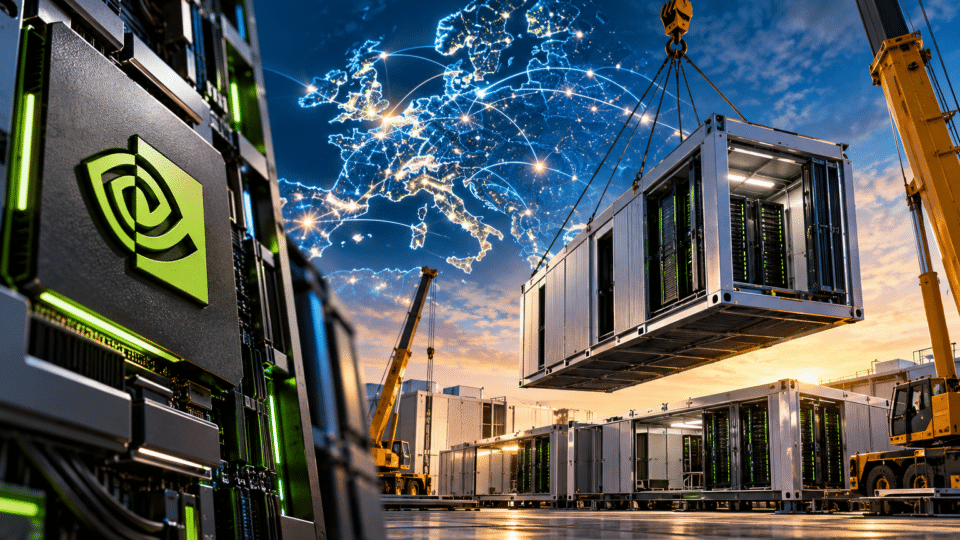
Artificial intelligence is no longer just a competition between chatbots. It is also a race for computing factories, power grids, cooling water, industrial land and chips powerful enough to run large models. On 21 October 2026, at GTC Berlin, NVIDIA announced DSX POD, an architecture for modular AI data centres that are built and tested in a factory before reaching the site.
The company says that, at a site that has already been prepared, installing such a unit could be reduced from about six months to as little as 14 days. This is the technical target presented by the supplier, not evidence that a complete data centre — including permits, high-voltage lines and urban infrastructure — can be built anywhere in two weeks. That distinction between the commercial promise and the real-world constraints is precisely what makes the announcement relevant to Europe.
What NVIDIA launched at GTC Berlin — and why it matters
At the Berlin conference, Jensen Huang, NVIDIA’s founder and chief executive, presented a new way of delivering computing infrastructure as standardised modules. NVIDIA’s official announcement of 21 October describes DSX POD as a reference architecture for systems based on the Vera Rubin generation, assembled and validated in purpose-built containers.
Rather than installing every rack, cable, power system, liquid circuit and interconnect from scratch in a data-centre hall, the approach moves much of that work into the factory. The units are then transported and connected to utilities already in place. It follows the principle of modular construction: standardisation reduces on-site variation and can make testing simpler.
For customers investing hundreds of millions in processors and accelerators, the delay between purchase and the start of computing production means capital costs without revenue. In AI, the time until a system produces its first commercial output — sometimes called time to first token — has become a financial variable. Equipment that has not entered service depreciates and can become technologically outdated while construction is under way.
The 14 days: what lies behind the headline figure
NVIDIA’s wording is “as little as 14 days” — in favourable conditions, as little as 14 days. But the announcement includes the key phrase prepared site: the location must already have access to electrical power, cooling, networking and the rest of the supporting infrastructure. That condition fundamentally changes the meaning of the promise.
Building a data centre from an undeveloped plot may involve geotechnical studies, planning procedures, environmental permits, investment in substations, high-capacity grid connections and negotiations with the grid operator. These stages can take far longer than the physical installation of modules. A pre-assembled container does not automatically solve a shortage of available grid capacity.
There is also the logistics. A module containing sensitive equipment and cooling systems must be transported, installed, checked under local conditions, integrated with other modules and connected safely. When the first commercial projects emerge in 2027, the important measure will be the duration of the whole project, not only the final stage described in marketing materials.
For more on artificial intelligence, see Muse Charm: Meta’s pocket AI gadget — what we know about its screen, 5G, price and launch, which offers complementary details on the subject.
Why NVIDIA’s focus is Europe, not just Silicon Valley
Europe has universities, engineers, research centres and advanced industries, yet a significant share of the infrastructure running the largest AI models is controlled by companies and regions outside the continent. In Berlin, NVIDIA presented estimates suggesting that Europe accounts for a small fraction of global AI computing capacity, while the United States holds a far larger share. Associated Press reported on Jensen Huang’s remarks, including the gap between Europe’s industrial ambitions and its current computing capacity.
These estimates should be understood as assessments presented in a conference setting, not as an independent global census of all data centres. “AI capacity” can be measured by GPU type, actual performance, available power or demand for tokens. A fair comparison requires the same methodology across all regions.
For European countries, the stakes go beyond technological prestige. Local infrastructure can help companies develop applications in European languages, meet data-protection requirements, benefit from lower latency and retain research and operational capabilities on the continent. But placing servers physically in Europe does not automatically guarantee sovereignty if chips, software or contracts remain dependent on outside suppliers.
Who is involved in the new ecosystem, and when it could be available
NVIDIA named an extensive partner network including Dell Technologies, Hewlett Packard Enterprise, Lenovo, Schneider Electric and Vertiv, alongside manufacturers and infrastructure suppliers such as Bull, Eaton, Delta, Quanta and others. Depending on their field of activity, these companies can manufacture, integrate, power, cool or operate the modules.
The announcement identifies early 2027 as the target for global delivery of these modular factories through partners. That does not mean that hundreds of functioning DSX POD centres already exist in Europe, or that a site has been selected in Romania. Each project requires confirmation of its investor, location, capacity, financing, timetable and its own official announcement.
Liquid cooling and water: the gains and the limits
AI data centres have become especially energy-dense. Racks packed with GPUs generate substantial heat, and conventional air cooling becomes difficult at very high power levels. The DSX platform promotes closed liquid loops and dry coolers, a solution that can reduce water use for facility cooling under certain conditions.
In a second NVIDIA announcement on 21 October, the company sets out scenarios involving up to a 100% reduction in water consumption for facility cooling and up to 30% less energy for the same number of processed tokens, using certain software technologies. The phrase “up to” is critical. It is not a guarantee that every centre will use no water or 30% less electricity in every condition.
A full environmental calculation must include electricity generation, water consumption in the energy supply chain, hardware manufacturing, and any losses or additions from installations. “Zero water for on-site cooling” is not the same as “zero water footprint for the entire AI system”. In addition, lower consumption per token does not guarantee lower total consumption if the volume of requests grows much faster.
InfoBuz has already explained why AI’s energy consumption could reach the scale of a city. NVIDIA’s new architecture is a possible response in terms of efficiency and deployment, but it does not remove questions about the electricity grid, energy sources and the costs borne by neighbouring communities.
The role of Siemens, carmakers and European industry
In Berlin, the discussion went beyond data centres. The automotive industry, engineering and factory automation increasingly use advanced simulations, robotic models and artificial intelligence to design products. NVIDIA presented collaborations with major European industrial names, and interest in physical AI — systems that understand and interact with the physical world — was evident.
For a carmaker, an AI model can help analyse factory data, simulate driving scenarios or develop robotic functions. But performance demonstrated in a laboratory or a presentation is not equivalent to authorisation for autonomous operation on public roads. Safety, testing and legal liability remain separate issues.
On the move from language algorithms to the design of medicines, materials and robots, InfoBuz has published an analysis of AI that shapes the physical world. The development of DSX POD adds one element: without robust computing infrastructure, many industrial applications cannot move from pilot projects to large-scale deployment.
Could Romania benefit from this race? Three practical conditions
- Electricity and connections: access to stable power and suitable connection capacity, without unfairly shifting costs to other consumers.
- Capital and customers: credible investors, usage contracts and demand for AI services sufficient to justify operating costs.
- Skills and regulation: specialists in security, electrical infrastructure, cooling, cloud services and data protection, alongside clear and predictable permitting.
Romania has software specialists and potential in digital services, but that does not mean NVIDIA’s announcement represents a confirmed investment in the country. A specific project would need to be supported by public information on its location, capacity and timetable. A serious economic assessment must estimate the number of permanent jobs rather than infer it from the value of the equipment installed.
What happens if AI factories become faster to install
The first effect could be a shorter period in which costly equipment sits unused. The second would be standardisation across multiple sites, which could reduce some integration errors. The third would be stronger competition among suppliers, if enough partners can build and operate compatible units.
There are risks as well: faster deployment may place greater pressure on energy capacity, concentrate the market around a limited number of technologies, and encourage investment before demand is sufficiently clear. Installation time is therefore a useful metric, but it does not by itself show whether a data centre is profitable, safe or sustainable.
Frequently asked questions
Will NVIDIA build any AI centre in 14 days?
No. The 14-day figure is an optimistic estimate for installing a modular unit at a site that has already been prepared. Permits, electrical connections and core infrastructure may require additional time.
Is DSX POD already on sale in Europe?
The 21 October announcement envisages commercial availability through the partner ecosystem from 2027. Deliveries and projects must be confirmed individually.
Does this mean AI will use less energy overall?
NVIDIA presents potential efficiency gains for certain configurations and workloads. Total consumption depends on growth in use, not only on the efficiency of each token.
Has a DSX POD project already been announced in Romania?
The launch announcement does not identify a specific investment in Romania. It would be premature to announce a local centre without official confirmation of the investor and site.
Official sources and context
- NVIDIA Newsroom, 21 October 2026 — the DSX POD launch and conditions for rapid installation.
- NVIDIA Newsroom, 21 October 2026 — DSX, cooling and energy-efficiency scenarios.
- Associated Press, 21 October 2026 — statements from GTC Berlin and Europe’s position in the AI industry.
- European Commission — AI Factories — public context on investment in European AI infrastructure.
Research date: 21 October 2026. The performance figures and savings presented by NVIDIA are the manufacturer’s claims and scenarios. Results in real data centres depend on the conditions of each project.









Discuția cititorilor
Ai o opinie sau o întrebare despre acest articol? Spune-ne ce crezi.
Fii primul care deschide discuția.
Te rugăm să păstrezi un limbaj civilizat și să discuți la subiect. Comentariile spam sunt filtrate automat.