
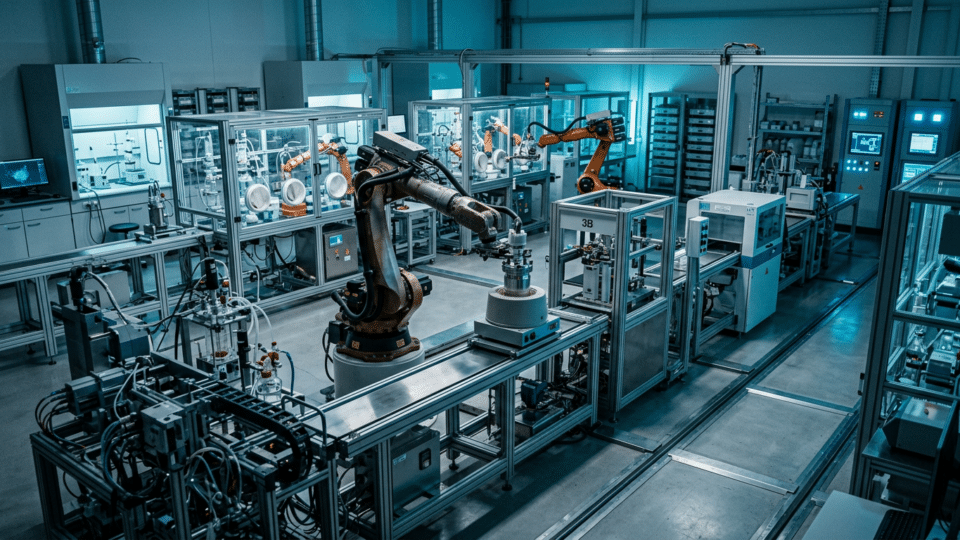
AI is designing the physical world in ways that, until very recently, seemed confined to experimental laboratories. In 2026, artificial intelligence is no longer just a system that generates text, images or code. Models are proposing crystal structures, optimising chip layouts, searching for therapeutic molecules, orchestrating robotic laboratories and even entering design workflows for reactors and robots.
This is a more consequential change than it may appear. A mistaken text can be corrected in two clicks. A new material, medicine, chip or reactor component must comply with physics, chemistry, manufacturing tolerances, safety requirements and cost constraints. In the physical world, a “hallucination” is no longer merely a false sentence—it can mean a failed experiment, a lost wafer or a design that cannot be manufactured.
That is why the real shift is not that AI “replaces the engineer”. It is beginning to participate directly in the idea → simulation → manufacturing → measurement → redesign loop. And when that loop is connected to robots and automated laboratories, the pace of discovery can change radically.
AI essentially leaves the screen when software starts proposing things that can be built, synthesised and tested in reality.
AI designs the physical world when it moves from prediction to design
The first major applications of AI in science were predictive. A model received data and tried to estimate a property: whether a molecule would bind to a protein, whether a material would be stable, whether a structure would hold up, or whether a chip would achieve the desired performance.
The new generation takes a further step. Rather than answering only, “How will this object behave?”, AI is starting to answer the reverse question: “What object should I build if I want these properties?”
This shift is often called inverse design. The engineer defines the target—for instance, a material with a particular conductivity, a chip with a particular density, or a molecule that binds to a protein—and the model explores a huge space of possibilities that would be impossible to check manually.
That is precisely why generative AI is becoming relevant to engineering. Generative models do not have to “write a nice answer”; they must propose a structure that can then be put through simulation and experiment.
Materials are the first striking example: from search to generation
Modern technologies are often constrained not by ideas, but by materials. Batteries need better electrolytes and electrodes. Data centres need materials for cooling and power. Solar panels, reactors, quantum computers and catalysts depend on highly specific compositions and structures.
For more on robots, see Life in 2040: an ordinary day if the technologies being developed today actually work, which offers complementary detail on this subject.
In 2023, Google DeepMind introduced GNoME, a model that predicted approximately 2.2 million new crystal structures. Of these, 380,000 were considered among the most stable and promising for experimental synthesis. DeepMind estimated that this expansion of the materials space was equivalent to hundreds of years of progress achieved through traditional methods.
What matters is that GNoME did not “make” 380,000 materials. It generated and filtered candidates. Real chemistry remained the final arbiter. That is where the next stage begins.
MatterGen aims to generate a material directly with the desired property
Microsoft Research has taken the idea closer to a conventional generative model. MatterGen is a diffusion model for inorganic materials that can generate stable structures conditioned on desired properties: chemistry, symmetry, and mechanical, electronic or magnetic properties.
In a paper published in Nature in 2025, researchers showed that materials proposed by MatterGen were more than twice as likely to be both novel and stable as those from some earlier methods, and more than ten times closer to a local energy minimum.
The most important part is experimental: the team synthesised a material proposed by the model and measured the target property at a value within approximately 20% of the target.
That is the difference between “AI imagined a crystal” and “AI proposed something a laboratory can make and measure”.
In 2026, the bottleneck is not only discovering the material, but finding the manufacturing recipe
A material can be stable in simulation and still be very difficult to synthesise. You need to know the temperature, mixing order, precursors, reaction time and intermediate stages.
In August 2026, Lawrence Berkeley National Laboratory presented an AI model intended to predict not only the final product of a solid-state reaction, but also the sequence of intermediate phases, impurities and the way atoms move through the material during synthesis.
This addresses a fundamental problem: discovering a useful material may take days, but finding a stable industrial recipe can take months or years.
If AI can design the material and then suggest a realistic synthesis route, it moves from an “idea engine” to a component of process engineering.
The autonomous laboratory closes the loop: AI proposes, the robot acts, the instrument measures
Berkeley Lab operates A-Lab, an automated materials laboratory in which robots prepare, heat and characterise samples, while software decides which experiment is worth conducting next.
The laboratory is designed as a closed-loop system. AI proposes a candidate, the robot attempts the synthesis, instruments measure the result, and the data are fed back into the algorithm for the next iteration.
Berkeley Lab says A-Lab can process approximately 50–100 times more samples per day than a human. Not because the robot “understands” chemistry like a researcher, but because it does not sleep or tire and can carry out thousands of repetitive operations precisely.
In February 2026, the laboratory also announced FORUM-AI, a project aiming to build an end-to-end agentic system for materials discovery that can combine literature, simulations, supercomputing and A-Lab.
The real move from generative AI to “self-driving science”
An isolated generative model produces candidates. An autonomous laboratory produces new information about reality.
The difference is substantial. A model can propose 10,000 options, but only experiment can establish whether one can be manufactured, what it costs and whether its properties hold up under real conditions.
In an autonomous loop, the system does not simply repeat experiments. It can choose the next experiment based on the previous one—exactly the mechanism that makes scientific research efficient.
In 2026, Berkeley Lab explicitly describes the goal of platforms in which AI formulates hypotheses, sends experiments to robots and refines those hypotheses based on the results. This is still frontier research, but the physical infrastructure already exists.
Chips provided one of the first industrial examples: AlphaChip
Designing a modern chip is an almost impossible puzzle for humans. Billions of transistors and functional blocks must be connected across a small surface while meeting constraints on latency, power consumption, heat and manufacturability.
Google DeepMind developed AlphaChip, a reinforcement-learning system for placing chip components. The method starts with an empty grid and places components one by one, receiving rewards based on the quality of the final layout.
DeepMind says layouts generated by AlphaChip have been used in Google’s last three generations of TPU accelerators and describes some results as “superhuman”.
Here, AI is not drawing an imaginary chip for a demonstration. It is contributing to hardware that is manufactured and used to train other AI models.
AI is designing the chips that will train the next generation of AI
This loop is one of the most interesting developments in technology. AI helps design the accelerator, the accelerator trains larger models, and larger models can be used to design better hardware.
It is not an infinite autonomous loop. Semiconductor manufacturing remains constrained by lithography, materials, cost, packaging, energy and yield. But the design stage may accelerate enough for hardware cycles to become faster.
In an industry where a single tape-out can cost tens or hundreds of millions of dollars, cutting design time and finding a better layout have enormous economic value.
Drugs may be the most ambitious form of physical design
A drug is essentially a molecular structure designed to alter a biological process without causing unacceptable toxic effects. The possible molecular space is so vast that it cannot be explored exhaustively.
AlphaFold changed the initial problem by predicting protein structures. The AlphaFold database now contains more than 200 million predicted protein structures. AlphaFold 3 expanded modelling to interactions between proteins, DNA, RNA, ligands and other molecules.
In 2026, Isomorphic Labs says its new Drug Design Engine, IsoDDE, goes beyond structural prediction alone and seeks to estimate molecular binding, identify binding pockets and support the rational design of entirely new drugs.
In May 2026, the company raised a $2.1 billion funding round to scale the AI engine and advance therapeutic programmes towards the clinic. The funding does not demonstrate medical success, but it shows how much capital is starting to bet on this paradigm.
An AI-designed drug has already moved beyond the computer-only stage
Insilico Medicine is developing rentosertib, a candidate for idiopathic pulmonary fibrosis. The company describes it as the first drug with an AI-discovered target and an AI-designed molecule to reach Phase II clinical trials.
In 2026, the programme had already completed a Phase IIa study. The company reported favourable signals in lung function at the highest dose studied, but these should be interpreted as results from a clinical programme still under development, not as evidence of an approved treatment.
Another Insilico candidate, ISM6331, a pan-TEAD inhibitor described by the company as AI-designed, entered a Phase I clinical trial, and first-in-human data were accepted for presentation at ESMO 2026.
That is the relevant threshold: AI no longer only proposes molecules that look promising in simulation. Some reach human trials, where real biology decides whether the design was sound.
But in medicine, validation remains far slower than design
A model can generate thousands of molecules in a day. A clinical trial can take years. That asymmetry is fundamental.
AI can reduce the time needed for target selection, molecule optimisation and some preclinical stages. It cannot fully compress toxicology, patient recruitment, pharmacokinetics and the demonstration of long-term efficacy.
This means the AI revolution in medicines may produce more programmes and discard weak ideas faster, but it does not eliminate biological testing.
Reactors follow the same logic: AI explores geometries humans would not test manually
In nuclear energy, AI does not “draw a reactor and turn it on”. Design is constrained by physics, materials, thermohydraulics and regulation.
But that complexity is exactly what makes AI interesting. Oak Ridge National Laboratory demonstrated an AI algorithm for optimising nuclear-core geometry as early as 2021. Researchers used a multiphysics emulator to assess thousands of geometries and reported an improvement of approximately 3× in their chosen temperature-distribution metric.
In 2025–2026, ORNL extended this work towards advanced manufacturing, digital twins and AI-driven design for nuclear components and systems.
These tools do not replace validated codes and safety analysis. They can, however, explore design spaces much faster than an engineer could do manually.
Fusion goes further: ORNL is developing an AI orchestrator to design a pilot plant
In 2026, ORNL presented the FADO project—Fusion Agentic Design Orchestrator—an agentic workflow intended for fusion-system design.
The idea is to combine HPC simulations, maintenance criteria, robotics and construction in a shared virtual environment. Rather than having every specialist manually run complex codes, AI agents can prepare and coordinate simulations and quickly eliminate designs that fail to meet requirements.
It is important to keep this in proportion: FADO is a research project, not a fusion plant autonomously designed by AI. But it shows the direction in which the engineering of extremely complex systems is seeking to go.
From digital twin to design generator: AI can assess an object before it exists
A digital twin is a computational representation of a real system. If the model is sufficiently accurate, parameters can be changed and the virtual consequences observed before metal is cut or concrete is poured.
Generative design adds a step: the algorithm can generate variants itself and assess them in the digital twin. For turbines, reactors, vehicles or factories, this means automatically exploring thousands of configurations.
The greatest advantage is not that AI always finds the “perfect” form, but that it can uncover unexpected trade-offs between weight, performance, cost and maintenance.
Robots turn digital design into action
“Physical AI” is the term increasingly used for models that perceive and act in the physical world. In January and March 2026, NVIDIA launched new generations of GR00T and Cosmos models for robots and autonomous vehicles.
The company is working with manufacturers including ABB Robotics, FANUC, KUKA, Universal Robots, Yaskawa and Boston Dynamics, among others, on applications ranging from industrial manipulation to surgery and autonomous construction.
Here, AI no longer only designs the object. It can learn the sequence of movements needed to manufacture, move, inspect or repair it.
This is the point at which generative AI, digital twins and robotics begin to converge into a single industrial workflow.
The factory of the future may operate like a closed-loop laboratory
Imagine a production line in which AI observes defects, modifies the design, simulates the change, generates new instructions for robots and then measures the resulting product.
Today, each of these components exists separately across different industries. What is changing is their integration.
When software can move quickly from data to design and from design to manufacturing, the product cycle shortens. Products can evolve more often, batches can become more customised, and processes can be optimised almost continuously.
Why the physical world is far harder to “generate” than text
A language model can produce ten paragraphs in seconds. If two are mediocre, the cost is almost zero.
In the physical world, every proposal has a cost. An experiment consumes reactants and time. A semiconductor wafer costs money. A medical test involves people. A nuclear component must be certified.
For this reason, physical-design models must be coupled with much stricter filters: physics-based simulations, quantum calculations, manufacturing constraints and experimental testing.
The greater the cost of an experiment, the better AI must be at selecting the next candidate.
“AI discovered it” does not automatically mean people are no longer needed
In almost all of the examples above, people define the objective, select the data, configure simulations, build the robot, validate the result and decide whether a product is worth taking further.
AI’s role is to compress an enormous search space. An engineer may assess dozens of options; an algorithm can assess millions, then bring only a few promising alternatives before the expert.
In that sense, AI does not necessarily replace human creativity. It changes the scale at which creativity can operate.
The greatest risk is perfectly optimising the wrong target
A generative system can be extraordinarily efficient and still produce a poor result if the objective is defined incompletely.
A material may have excellent conductivity but be impossible to produce cheaply. A chip may have low latency but poor yield. A robot may perform a task in simulation but be unsafe around people.
That is why physical design requires multi-criteria objectives: performance, cost, safety, sustainability, maintenance and manufacturability.
AI optimises what it is given. Good engineering begins by deciding what is worth optimising.
If laboratories become autonomous, competitive advantage shifts towards experimental infrastructure
In the software era, a company could win with algorithms and computing power. In the era of AI for science, it may also need robots, spectrometers, pilot facilities, clean rooms and access to factories.
This could create a new divide between countries and companies. It is not enough to have a model capable of designing a material. You must be able to make it and measure it.
In 2026, Isomorphic Labs explicitly says it is building not only models and software, but also the physical infrastructure needed to take drugs from design to the clinic.
Berkeley Lab connects supercomputers with A-Lab. The semiconductor industry connects design software with foundries. Physical AI connects world models with real robots.
AI is beginning to narrow the distance between what is possible and what can be built
For a long time, technological design was limited by the number of alternatives people had time to test.
AI changes that economics. It can generate candidates, quickly eliminate impossible options and direct experiments towards the most promising areas.
In materials, this means millions of candidate structures. In chip design, thousands of placements. In drugs, vast molecular spaces. In reactors and robotics, geometries and control strategies that humans would not explore exhaustively.
What may happen by 2030
- More AI-generated materials may reach commercial products, especially in batteries, catalysis and electronics.
- AI may become standard in EDA and chip layout, rather than remaining only an experimental tool.
- More AI-designed molecules may enter clinical trials, and the industry may be able to compare their success rate with conventional methods.
- Autonomous laboratories may become ordinary scientific infrastructure at major research centres.
- Digital twins and generative design may become more deeply embedded in energy, aerospace and construction.
- Physical AI may transform robots from programmed machines into systems able to generalise across tasks and environments.
What we should not believe yet
- AI cannot safely design every drug or reactor without people.
- A structure stable in simulation is not automatically a manufacturable material.
- A robot that works in a demonstration is not automatically ready for every factory.
- An AI-generated candidate is not a product until it has passed validation and manufacturing.
- Generation speed does not remove the limits imposed by physics, regulation and cost.
AI leaves the screen when its results must survive reality
Generative AI became popular because it can instantly produce visible things: text, images and video. But perhaps its most consequential use is taking place where the public does not see it—in laboratories, clean rooms, simulators and factories.
There, a model is not judged by how convincing it sounds, but by how well its result stands up to experiment.
If a material can be synthesised, if a chip can be manufactured, if a molecule works in the body, and if a robot performs its task in the real world, AI has moved from generating information to generating physical possibilities.
That is why the next stage of artificial intelligence may matter more than chatbots: it does not merely tell us what the future might look like, but begins to participate in designing the things from which that future will be built.
InfoBuz has separately examined the technologies that could change the world by 2030. AI’s emergence as a physical-design tool connects almost all of them: materials, energy, biotechnology, computing and robotics.
In addition, the article on AI’s energy consumption and the limits of electricity supply shows the other side of the same transformation: AI can design the physical world, but it requires an ever-larger physical infrastructure to do so.
Frequently asked questions about AI and the physical world
Can AI invent entirely new materials?
Yes. Models such as GNoME and MatterGen can propose new crystal structures. But their stability and manufacturability must be validated through calculations and experiments.
Is AI already designing commercial chips?
Yes. Google DeepMind says AlphaChip has been used for layouts in the latest three generations of Google TPUs.
Are AI-designed drugs in clinical trials?
Yes. Several candidates have entered clinical trials, and Insilico’s rentosertib has completed Phase IIa. That does not mean it is an approved medicine.
Can AI design a nuclear reactor?
AI is already used to optimise geometries, simulations and design workflows, but reactor design and licensing remain processes led by specialists and regulators.
What is physical AI?
It is a category of AI systems that perceive their environment and control robots, vehicles or other physical systems, often using world models and simulation.
What are self-driving labs?
They are laboratories in which AI selects experiments, robots perform them, instruments measure the results, and the system uses those data for the next round.
Sources and transparency
- Google DeepMind – GNoME: 2.2 million crystal structures and 380,000 stable candidates
- Microsoft Research / Nature – MatterGen: a generative model for inorganic materials design
- Lawrence Berkeley National Laboratory – AI modelling for solid-state synthesis, 3 August 2026
- Berkeley Lab – FORUM-AI and the A-Lab laboratory, 3 February 2026
- Google DeepMind – AlphaChip and TPU design
- Google DeepMind – AlphaFold and more than 200 million protein structures
- Isomorphic Labs – Drug Design Engine, February 2026
- Isomorphic Labs – $2.1 billion funding round, 12 May 2026
- Insilico Medicine – Rentosertib, Phase IIa completed
- Insilico Medicine – ISM6331 Phase I / ESMO 2026
- Oak Ridge National Laboratory – AI-based design of a nuclear reactor core
- ORNL – FADO: AI-assisted fusion power plant design, 2026
- NVIDIA – Physical AI and industrial robots, 16 March 2026









Discuția cititorilor
Ai o opinie sau o întrebare despre acest articol? Spune-ne ce crezi.
Fii primul care deschide discuția.
Te rugăm să păstrezi un limbaj civilizat și să discuți la subiect. Comentariile spam sunt filtrate automat.