
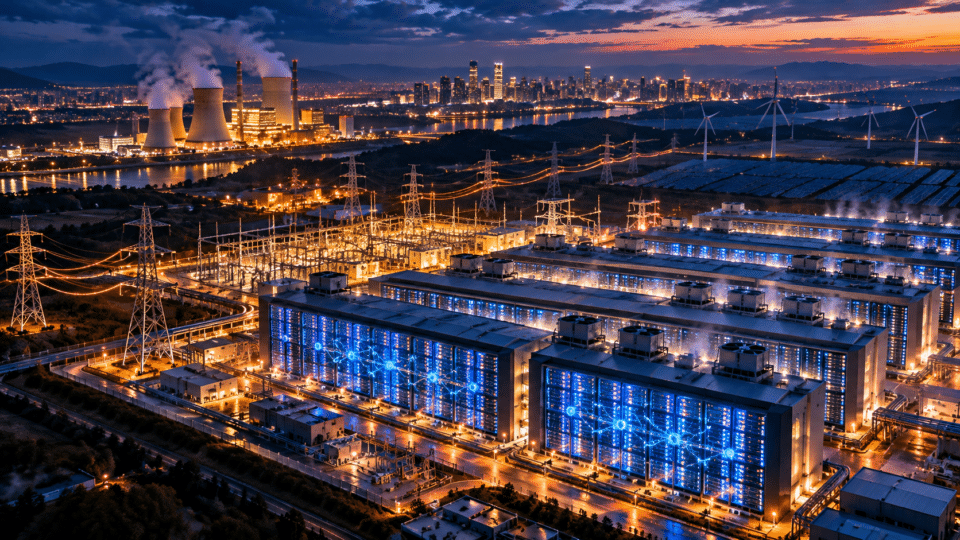
AI energy use is beginning to turn electricity into a distinctly non-digital constraint on artificial intelligence. Models can grow larger, chips faster and applications smarter, but every server must be powered, cooled and connected to a grid capable of delivering electricity almost continuously. In 2026, this is no longer a hypothetical problem. The largest AI data-centre projects are being planned at scales that, until recently, were associated with industrial complexes, refineries or entire cities.
The International Energy Agency estimates that data centres consumed about 485 TWh of electricity in 2025, and that global consumption could reach about 950 TWh in 2030. Data centres focused primarily on AI are the fastest-growing segment: their electricity use could triple over the same period. Yet the issue is not only the total amount of energy required, but where and how quickly it is needed.
A data centre can be built in a few years. A high-voltage transmission line, a new power plant or a major grid expansion can take much longer. This mismatch in timelines makes power one of the defining constraints of the AI boom. In some regions, the question is no longer “how many chips can we buy?” but “where can we find hundreds of megawatts available right here?”
How much electricity does an AI data centre actually use?
Not all data centres are alike. According to the IEA, a conventional data centre may have a power demand in the range of 10–25 MW. A hyperscale facility optimised for artificial intelligence can exceed 100 MW. At that scale, annual consumption can be comparable to that of roughly 100,000 households, depending on utilisation and the energy mix.
But the industry is no longer stopping at 100 MW. The IEA notes projects under construction at around 2,000 MW and planned projects reaching roughly 5,000 MW. Even larger projects were announced in the United States in 2026: in Portsmouth, Ohio, a proposed AI infrastructure project envisages up to 10 GW of data-centre development, alongside a similar amount of new generation capacity.
These figures do not mean that every campus will operate permanently at its maximum rated capacity, or that every announced project will be built in its original form. They do, however, show the direction of travel: AI is turning the data centre from a technical building into an industrial-scale energy consumer.
Why AI uses more power than traditional data centres
Modern artificial intelligence relies on accelerators such as GPUs and other specialised chips that can perform vast numbers of operations in parallel. Training large models requires thousands or tens of thousands of chips to work in synchrony. For inference—the stage at which a model responds to users—the same infrastructure processes growing volumes of requests.
The increase in energy use does not come from chips alone. High-density servers generate substantial heat, requiring sophisticated cooling systems. Internal networks connecting accelerators use high-speed communications equipment. Uninterruptible power supplies, transformers, backup systems and power-distribution infrastructure within the campus are also needed.
Berkeley Lab estimates that US data-centre electricity consumption could reach around 649 TWh in 2030 in its reference scenario, with an uncertainty range of roughly 521 to 843 TWh. In the central scenario, data centres would account for around 11.8% of total US electricity consumption, with a scenario range of approximately 9.5–15.3%.
The real issue is not the global share, but local concentration
Globally, data centres could account for around 3% of world electricity consumption in 2030. Taken in isolation, that figure may seem manageable. But electricity is not distributed evenly. Data centres cluster in regions with fibre-optic networks, available land, access to water, favourable tax conditions and already-strong grids.
This can create a paradox: there may be enough energy at national level, while the grid in one specific area cannot quickly deliver another 500 MW or 1 GW. High-power transformers, substations, transmission lines and power plants have long design and construction timelines. A digital campus may therefore end up waiting for physical infrastructure.
The IEA stresses that this geographical concentration makes data-centre integration more difficult than their share of global electricity use alone would suggest. In the United States, the Department of Energy has also warned that connection requests from hyperscale data centres of 300–1,000 MW or more can outpace the ability of local grids to expand.
One data centre can change a region’s energy plan
At scales of hundreds of megawatts, effects emerge beyond the boundaries of the data centre itself. Grid operators must assess whether sufficient generation capacity is available during peak hours, whether lines and transformers can carry the power, and whether the system remains stable when demand changes rapidly.
In May 2026, the US Department of Energy highlighted a phenomenon specific to AI data centres: their load can vary more dynamically than that of traditional data centres. Thousands of accelerators operate in synchrony, and coordinated changes in consumption can create oscillations that must be monitored to protect grid stability.
This is one important difference from a city. A city has millions of individual consumers whose appliances turn on and off at different times. A supercomputer can have a far more synchronised demand profile. From the perspective of the system operator, it is not only the number of megawatts consumed that matters, but how consumption changes from one second to the next.
Why AI companies are looking for their own power plants
As data centres grow, companies can no longer assume that the local grid will automatically provide any amount of power they request. More projects are emerging in which a new data centre is planned alongside a dedicated energy source.
For more on data centres, see The Earth has a vast heat reservoir: why Big Tech is starting to bet on advanced geothermal energy, which provides additional context on the subject.
In July 2026, the Department of Energy announced negotiations for a project at the Savannah River Site that would combine a 1 GW AI data centre with around 2 GW of local generation, initially fuelled by gas and later potentially incorporating nuclear power. In Portsmouth, the 10 GW project is presented alongside around 10 GW of new generation and major investment in the transmission grid.
Such projects are still at different stages of development and should not be treated as infrastructure already in operation. They nevertheless point to an important shift: at the scale of the next generation of AI, energy is becoming part of data-centre design, rather than simply a bill paid after construction.
InfoBuz previously examined this trend in its article on the Google, Kairos Power and Hermes 2 reactor project at Oak Ridge, one of the initiatives illustrating major technology companies’ interest in advanced nuclear energy.
Will AI drive a nuclear-power revival?
Nuclear power has a feature that is highly attractive to data centres: it can deliver large, steady amounts of electricity with low operational carbon emissions. For this reason, technology companies have begun signing agreements and investing in conventional and advanced nuclear projects.
Building new reactors, however, requires time, licensing, capital and complex supply chains. The IEA therefore estimates that, in the short term, much of the growth in data-centre energy demand will be met by a mix of sources, particularly renewables and natural gas, with a more visible nuclear contribution towards the end of the decade and after 2030.
This helps explain why AI expansion is not automatically synonymous with “green” energy. If a region rapidly adds data centres before new clean generation and grid infrastructure are ready, the system may rely more heavily on existing power plants or gas-fired generation. The climate impact depends on location, operating hours and the grid’s actual energy mix.
Can renewable energy keep up?
Solar and wind power can be deployed relatively quickly and at competitive costs, but a data centre operates around the clock. Solar output falls at night, while wind output varies. Continuous supply requires combinations of generation, geographically extensive grids, batteries, flexible power plants or other dispatchable sources.
That is why a contract under which a company buys enough renewable energy over a year to offset its consumption does not automatically mean its servers are powered by renewables in every hour. The industry is trying to move towards hourly matching of generation and consumption, but this is a much more difficult challenge than annual offsetting alone.
Over the long term, expanding transmission grids may be just as important as building new power plants. A region with abundant wind or solar power cannot help a data centre hundreds of kilometres away if transmission lines are congested.
Why estimates of the energy used by a ChatGPT question can mislead
Discussions about AI often invite the temptation to assign a fixed amount of energy to every question. In reality, consumption varies enormously depending on the model, hardware, prompt length, response length, inference method, server utilisation and data-centre efficiency.
The IEA notes that simple text requests can consume relatively little compared with the total infrastructure footprint, while complex reasoning tasks, video generation and agents carrying out long sequences of operations may require hundreds or even thousands of times more energy per task than a simple query.
More importantly, the efficiency of a new model can improve very quickly, but if use expands sharply and more intensive applications emerge, total consumption can continue to rise. This is a classic rebound effect: each operation becomes cheaper, but vastly more operations are carried out.
AI can help the grid that powers it
The relationship between AI and energy does not run in only one direction. The same technologies can be used to forecast solar and wind generation, optimise grids, support predictive maintenance, manage industrial demand and discover new energy materials or technologies.
Data centres can also become more flexible loads. Some training or batch-processing operations can be shifted to hours when energy is abundant or to another region. Where an application allows it, an operator could temporarily reduce power use during periods of grid stress.
But this flexibility has limits. Interactive services need to respond quickly, and many AI tasks depend on synchronising large numbers of accelerators. Not every data centre can be shut down or moved without cost.
Who pays for grid expansion?
This is where one of the most important economic debates begins. If a company requests a 1 GW connection, the operator may need to build transmission lines, transformers, substations and reserve capacity. If the project is later delayed or abandoned, those investments may remain underused.
Berkeley Lab reports that US authorities and utilities are developing new rate structures for customers with very large loads. The aim is to ensure that the financial risk of expansions dedicated to a data centre is not automatically passed on to households or other businesses.
This issue will become increasingly important as projects grow. An AI investment may bring jobs, tax revenue and infrastructure, but it can also affect local prices, grid-development plans and energy availability for industry.
What this means for Europe and Romania
Europe has an important advantage in its growing share of low-emission power, but it faces congested grids, long permitting periods and major price differences between regions. Data centres are concentrated in a handful of hubs, and some markets have already begun to restrict or make conditional the connection of very large projects.
For Romania, the opportunity is twofold: regional connectivity and access to nuclear, hydropower, gas and renewable generation could become advantages in attracting digital investment. But success does not depend only on installed capacity on paper. What matters is where the power is, the capacity of the transmission grid, how long connection takes and how predictable costs are.
InfoBuz has separately examined the energy pressures affecting Romania’s economy and household bills in 2026. The data-centre boom adds a new category of industrial consumer to that equation.
Will AI run out of electricity?
There is unlikely to be a global moment when “AI runs out of power”. More realistically, some projects will be delayed, relocated or scaled down because grid capacity is unavailable. Others will invest directly in their own generation, batteries, power plants or new transmission connections.
In one sense, this could become a force for economic discipline. If every new megawatt of computing requires significant energy investment, companies will have an even stronger incentive to develop more efficient chips, models and algorithms.
At the same time, efficiency does not guarantee a fall in total consumption. If AI becomes cheap enough to be integrated into every application, device and industrial process, the total volume of computing could grow faster than the savings per operation.
The AI race is also a race for megawatts
In the first phase of the AI boom, competitive advantage appeared to depend on models, data and chips. In 2026, a fourth resource is becoming just as important: electric power available in the right place at the right time.
This changes the industry’s geography. Land with fibre-optic connectivity and available power may become more valuable than a site near a major city. Regions with robust grids, fast permitting and abundant generation will attract investment. Those with saturated grids will see projects move elsewhere.
That is why the next major limit on artificial intelligence may not be algorithmic. It may be a transformer that has not yet been manufactured, a transmission line that has not been permitted, or a power plant that will not be ready for several years.
Frequently asked questions about AI energy use
How much energy does an AI data centre use? A hyperscale facility can exceed 100 MW, while next-generation projects can reach hundreds of megawatts or several gigawatts. Actual consumption depends on utilisation and infrastructure efficiency.
Will AI use 10% of the world’s electricity? Not under the IEA’s current central scenario. Data centres as a whole are projected to account for about 3% of global electricity use in 2030, although their share may be far higher in certain countries and regions.
Will data centres make electricity more expensive? The effect depends on the region, how grid expansions are financed and how much new generation is built. Authorities are developing special tariffs specifically to limit the transfer of risks to other consumers.
Is nuclear energy the solution for AI? It may be part of the solution, but not the only one. Renewables, gas, storage, grid expansion, efficiency and demand flexibility will all contribute at the same time.
Is AI becoming more efficient? Yes, hardware and software are advancing rapidly. However, efficiency per operation may be outweighed by growth in the number of users and the emergence of far more intensive applications, such as video and autonomous agents.
Sources and transparency
- IEA – Powering Artificial Intelligence: Strategies for integrating data centres into electricity systems, 14 October 2026
- IEA – Key Questions on Energy and AI, 2026 update
- IEA – Energy and AI: Energy demand from AI
- Lawrence Berkeley National Laboratory – United States Data Center Energy Usage Report: 2025 Update, June 2026
- US Department of Energy – Monitoring Oscillations from Large Data Centers, May 2026
- US Department of Energy – 1 GW AI project at Savannah River Site, July 2026
- US Department of Energy – Portsmouth project and AI energy infrastructure, March 2026
- Berkeley Lab – Electricity Rate Designs for Large Loads, 2026 update









Discuția cititorilor
Ai o opinie sau o întrebare despre acest articol? Spune-ne ce crezi.
Fii primul care deschide discuția.
Te rugăm să păstrezi un limbaj civilizat și să discuți la subiect. Comentariile spam sunt filtrate automat.