
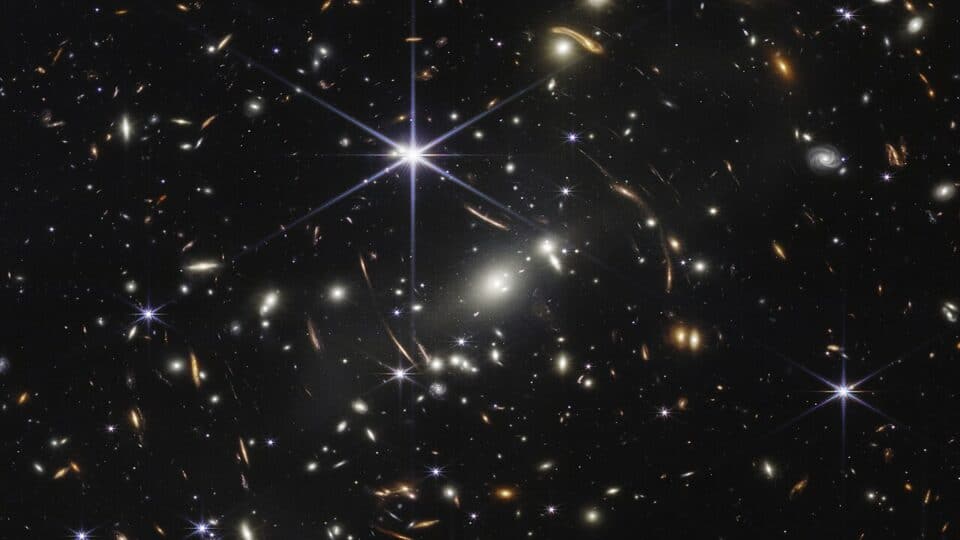
A star at an almost unimaginable cosmic distance may have exploded when the Universe was only about 1.15 billion years old. Light from that event travelled through space for more than 12.5 billion years, and the James Webb Space Telescope has now captured a signal so young that astronomers believe they may be seeing a possible stellar death only 4–10 days after the explosion, measured in the distant galaxy’s own frame of reference.
For more astronomy coverage, see also James Webb tracked the most distant known radio burst, which provides complementary details on this subject.
The object is called AT 2026abck and was observed on 7 August 2026 as part of an astronomy programme that repeatedly images the same patch of sky. The finding, reported in a study that is currently a preprint, is promising but does not yet amount to a definitive spectroscopic identification of a supernova. That distinction is central to both the astronomers’ excitement and what remains to be established.
What James Webb observed: a new point of light in a very distant galaxy
Under the NEXUS programme, the James Webb Space Telescope periodically revisits the same area of sky to search for objects that change over time. Researchers compared the images and found that a location with no detectable source on 28 May 2026 contained a bright infrared object on 7 August, later designated AT 2026abck.
This is not an image resembling the spectacular explosions seen in films. The NIRCam instrument recorded a minute change in brightness within a very distant galaxy. Repeated observations show the light increasing, and data analysed by the team led by Ming-Yang Zhuang suggest that the source was at an exceptionally early stage. The study is available directly on arXiv in the paper NEXUS: Discovery of a Luminous Young Transient at z=5.
In astronomy, a variable object of this kind is called a transient. The term alone does not establish whether the source is a supernova, an outburst near a black hole, or another phenomenon. Classification relies on its evolution over time, colours, position within the galaxy and, ideally, its light spectrum.
Why this is described as an explosion from 12.5 billion years ago
The Universe is expanding, and as the space between galaxies grows, the wavelengths of travelling light are stretched. This is the phenomenon of redshift. For the galaxy hosting the transient, the team measured z = 5.017 ± 0.001, a very high value.
That value corresponds to a period when the Universe was roughly 1.15 billion years old. Saying that the light travelled for more than 12.5 billion years refers to the lookback time, not a simple measure of the source’s present-day distance. Because of cosmic expansion, the current distance and the distance associated with the light’s travel time are not the same.
In other words, astronomers are not watching a star explode “today” in a far-off galaxy. They are only now collecting photons emitted in the very distant past. Astronomy makes this remarkable paradox possible: a telescope can explore cosmic history without travelling through time.
How it is possible to see only the first 4–10 days of the explosion
One striking aspect of the study is its estimate of the event’s age. Analysis of the light intensity and the timing of the last non-detection suggests that AT 2026abck was caught about 4–10 days after the explosion in the source’s frame of reference. This does not mean the light reached Earth in four days; it had already travelled for billions of years.
The Universe’s expansion also produces cosmological time dilation. At a redshift of 5.017, an interval of one day in the source galaxy appears in our observations to be stretched to roughly six days. The relationship is approximately a factor of 1 + z. Astronomers can therefore observe apparently slowed changes in phenomena that unfolded much faster at the source.
In the case of NEXUS, the gap between two observations was about 71 days on our calendar. After correcting for redshift, the interval is less than 12 days in the galaxy’s time frame. Comparing the images therefore provides not only evidence that the object appeared, but also a window onto when it suddenly lit up.
How hot and luminous the detected object was
The team modelled the temperature of the source’s photospheric layer at about 17,000 kelvin, with an estimated bolometric luminosity of around 3 × 10⁴³ erg per second. These are extraordinary values for such a distant source. The model suggests a luminous envelope with a radius of roughly 46 astronomical units—on the order of the distance from the Sun to beyond Neptune’s orbit.
That radius does not mean that the original star necessarily had precisely those dimensions. It is an inferred radius for the emitting region, derived from a simplified model of the spectrum and luminosity. Material ejected in an explosion and interaction with surrounding gas can rapidly enlarge the region emitting light. The distinction between the physical object and modelled quantities must be maintained.
An ordinary supernova, a superluminous supernova, or an as-yet unclassified phenomenon?
A core-collapse supernova occurs when a massive star can no longer counter gravity through fusion reactions and its core collapses. The ensuing explosion can scatter elements synthesised during the star’s life into space. Researchers consider this category the most likely explanation for AT 2026abck.
However, at this early stage the object is hotter and brighter than many Type II supernovae studied closer to us. One possible explanation is the violent interaction of the shock wave with dense material ejected by the star before its death. Another is rapid cooling of an extended envelope. The team also does not rule out placing it in a class of very luminous explosions, but the available data do not allow a definitive classification.
One argument against phenomena produced by the galactic nucleus is the source’s position: it lies away from the centre of its host galaxy. That favours the interpretation of a stellar death, but does not prove it on its own. To settle the classification, astronomers need further observations of how the light develops and, above all, spectroscopic data. Phys.org summarised the hypotheses in the scientific paper and the investigation’s limitations.
A young galaxy forming stars at an impressive rate
AT 2026abck is not floating alone in space. It was identified in a distant star-forming galaxy estimated to contain about 6 billion solar masses in stars alone. The team’s modelling puts its star-formation rate at around 20 solar masses per year. These quantities are not measured by direct weighing; they are inferred from the galaxy’s light and stellar-population models.
Young galaxies generally have chemical conditions that differ from today’s environments, which are rich in heavy elements. In astronomy, “metals” means almost any element heavier than helium. Their abundance can affect the evolution of massive stars, stellar winds and the way their lives end.
Seeing a stellar death in that environment offers information about the cycle of matter in a still-young Universe: gas forms stars, some stars die and enrich their surroundings with new elements, and later generations emerge from that material. It is part of the story that, billions of years later, made rocky planets and the chemistry of life possible.
Why the discovery is not the same as observing the first stars
Headlines about the “first stars in the Universe” sound compelling, but need qualification. The first stellar populations formed long before the point—estimated at 1.15 billion years after the Big Bang—at which AT 2026abck is observed. Although it is an extremely ancient explosion, there is no evidence that the object belonged to the first generation of stars, known as Population III. It would be an exaggeration to say that Webb photographed the death of the first star.
What is remarkable, and sufficiently striking in itself, is something else: astronomers may be seeing the first days of a supernova from an era when galaxy evolution was radically different from today. The observation was made in a field without magnification from a massive gravitational lens, an advantage when interpreting the intrinsic luminosity.
Why the NEXUS programme matters more than a single image
To catch a transient phenomenon, an observatory must look at the right place at the right moment—or return often enough. That is the idea behind NEXUS: repeated, standardised observations capable of detecting the appearance and disappearance of very faint sources in the early Universe.
A single deep image might show that a galaxy exists, but would not easily reveal that one of its bright points had just switched on. Observations over time make it possible to identify transients and estimate the source’s evolution. In this way, an observatory designed for infrared work also becomes a tool for studying the lives and deaths of distant stars.
InfoBuz previously covered another Webb result concerning the host galaxy of a fast radio burst. This is a different phenomenon: a fast radio burst usually lasts milliseconds at radio wavelengths, while an optical or infrared transient such as AT 2026abck is followed through changes in its brightness. Both illustrate how important precise source localisation is.
What must be checked before the discovery can be called “confirmed”
- Spectroscopic classification: data showing what kind of explosion produced the light, beyond photometric models.
- The light curve: subsequent observations to establish how quickly the source brightens and fades.
- Evolution models: comparisons among ordinary supernovae, interactions with circumstellar gas and superluminous classes.
- Scientific review: according to the available information, the preprint posted on 29 September 2026 has not yet completed the full journal peer-review process.
Frequently asked questions
Did Webb photograph a supernova from 12.5 billion years ago?
The telescope detected a very luminous transient in a galaxy at redshift z = 5.017. A supernova is the most plausible explanation, but a final confirmation of its type requires additional data.
Why does time appear to pass six times more slowly?
The expansion of the Universe dilates observed intervals by a factor of approximately 1 + z. At z ≈ 5, one day at the source appears stretched to around six days in our data.
Did one of the first stars formed after the Big Bang explode?
There is no evidence for that. The event is extremely old, but it has not been identified as the death of a star from the first cosmic generation.
Is the study confirmed in a journal?
The paper is published on arXiv as a scientific preprint. The observational data are real, but its classification and interpretation require further verification.
Scientific sources
- Zhuang and colleagues, NEXUS: Discovery of a Luminous Young Transient at z=5 — arXiv preprint 2609.38373, 29 September 2026.
- Phys.org, 13 October 2026 — an overview of the discovery and astrophysical interpretations.
- NASA, James Webb Space Telescope mission page — context on the instruments and infrared observations.


Discuția cititorilor
Ai o opinie sau o întrebare despre acest articol? Spune-ne ce crezi.
Fii primul care deschide discuția.
Te rugăm să păstrezi un limbaj civilizat și să discuți la subiect. Comentariile spam sunt filtrate automat.