
NASA is preparing a new generation of lunar vehicles, and the aim is no longer simply to take people to the surface and bring them back. In an update published on October 20, 2026, the US space agency outlined progress on robotic rovers and lunar vehicles capable of carrying astronauts, mapping terrain and searching for resources for a future base at the Moon’s south pole.
The plan includes the VIPER mission, scheduled for 2027, and two crew vehicles being developed by Astrolab and Lunar Outpost, with delivery to the Moon targeted by 2028. This is not a lunar city that has already been built, nor a permanent base operating today. It is the stage at which NASA is testing the mobility, navigation, power and operations without which a long-term human presence would remain only a plan.
For more on NASA, see Asteroid impact: what humanity can do if it discovers one only months in advance, which provides related details on the subject.
NASA announced Moon Base programme progress on October 20, 2026
In its update on Moon Base Rovers, NASA explains the rovers’ role in surveying terrain, moving equipment, carrying out experiments and detecting resources. Robert Pickle, director of the Surface Mobility Office, stresses that the performance of these vehicles will shape how future lunar infrastructure can be built and expanded.
The agency also released a video on the vehicles’ progress. The focus is not on a single spectacular launch, but on a logistical system in which several types of machine have different roles. One robot may scout a hazardous crater, another may carry instruments, while a vehicle designed for astronauts must combine resilience in extreme conditions with crew ergonomics and safety.
A functioning base needs transport between the landing area, research sites, material depots and power installations. Distances that appear short on a map can be difficult to cover in lunar regolith, a granular and abrasive material, across terrain with slopes and permanently shadowed areas.
Why the Moon’s south pole matters
Near the south pole are regions that receive sunlight for favourable periods, as well as craters that never receive direct sunlight. Some of these permanently shadowed areas may preserve water ice and other volatiles. Water could be valuable for consumption, industrial processes and, after being split, for producing fuel components, but that first requires identifying, characterising and feasibly extracting it.
The presence of ice in a region does not guarantee that it can be extracted economically or that it is readily accessible. Its concentration, depth, mixture with soil and temperature may vary. That is why robotic exploration is a necessary step before promises of “lunar filling stations” or fully self-sufficient colonies.
The region is also scientifically attractive. Craters, regolith layers and minerals may retain clues about ancient impacts, radiation and the history of the Earth–Moon system. By learning to operate there, engineers can develop technologies that may also prove useful for more distant exploration, including Mars.
VIPER: the robot that will search for water in craters that are almost impossible to explore
One of the most concrete projects is VIPER — Volatiles Investigating Polar Exploration Rover. NASA has announced that the robot will travel to the lunar south-pole region in 2027 aboard a Blue Moon Mark 1 lander. The mission aims to explore shadowed craters and collect data on water and other resources.
The current plan calls for more than 30 kilometres of travel across the surface, measuring thermal conditions, illumination and terrain properties. This distance is a mission objective, not a record already achieved. NASA says VIPER is at Johnson Space Center in Houston, where it is being built and undergoing final tests before transfer to the launch site.
Operations will be directed from Ames Research Center, where teams are already simulating challenging-terrain scenarios. If the robot succeeds in mapping the distribution of ice and understanding environmental variations, the data could influence site selection and infrastructure design for the future base.
Astrolab CLV-1 and Lunar Outpost Pegasus: vehicles for astronauts
NASA selected Astrolab and Lunar Outpost for the first development phase of crew lunar vehicles known as Lunar Terrain Vehicles, or LTVs. These machines are intended to operate remotely at first and later be driven by astronauts on Artemis missions.
Astrolab is developing the CLV-1, derived from its FLEX platform, while Lunar Outpost is building the Pegasus, an evolution of the Eagle concept. Both companies have delivered mock-ups or prototypes for ergonomic assessments involving equipment similar to Artemis spacesuits. The tests matter: operating controls with bulky gloves and positioning the body in a pressurised suit are radically different from driving an ordinary car.
For delivery of the vehicles to the south-pole region, NASA issued Blue Origin a task order under the Commercial Lunar Payload Services programme, with delivery targeted by 2028. Design and qualification stages are still under way. A target date is not the same as a guaranteed launch: space missions can be affected by technical and scheduling changes.
How much NASA’s rovers can carry and how far they can travel
NASA describes several planned capabilities for the LTVs. Before astronauts arrive, they are expected to be operated from Earth, travel up to 6 kilometres a day and produce detailed terrain maps. Once used by crews, they are expected to support up to three extravehicular activities during an Artemis mission.
Requirements include carrying around 80 kilograms of samples and tools and a range of up to 10 kilometres per battery charge, under the conditions described by NASA. These figures are targets for the vehicles being designed, not results already achieved during lunar missions. Real-world testing may lead to changes.
For a base, carrying capacity is not merely a matter of convenience. Every kilogram of tools or samples that crews do not have to carry by hand can extend the research area and the duration of useful activity. Faster travel, however, requires a reliable system for navigation, maintenance and crew recovery in the event of a breakdown.
How engineers are testing wheels for an entirely different terrain
On the Moon, the challenges do not end with lower gravity. Regolith, the fine dust at the surface, has sharp particles and can damage mechanisms, seals and optical components. Conventional pneumatic tyres are unsuitable for the full range of conditions, while mechanical and thermal stresses are extreme.
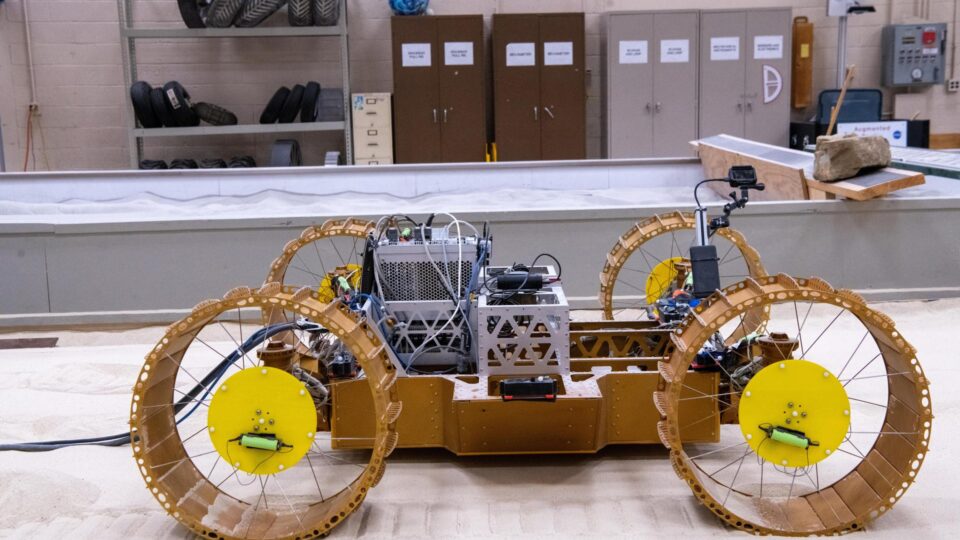
NASA has announced tests at Glenn Research Center for Astrolab CLV-1’s flexible airless wheels and Pegasus’s elastic metal-mesh wheels. Engineers are examining traction, weight distribution and responses to simulated regolith. This kind of test does not guarantee perfect performance on the Moon, but it can identify costly faults before launch.
Lunar Outpost is also drawing on robotic experience gained through the MAPP mission, which operated in the south-pole region in 2025, according to NASA. Another MAPP rover was scheduled for early 2027, while Astrolab is preparing the FLIP platform to test subsystems similar to those of CLV-1. Through these stages, the companies are seeking to reduce technical risk.
The lunar night, extreme cold and the power problem
For a rover, power can be as important as its motor. Dark regions at the south pole can reach temperatures of about minus 203°C, according to NASA’s update. Such conditions place stress on batteries, electronics, lubricants, cables and sensors.
A robot entering a shadowed crater must know how much power it has left, how long it can operate and whether it can return. Thermal insulation, component heating and energy-use strategy are critical. At a future base, the same issue will extend from vehicles to shelters, communications and experiments.
That is why lunar infrastructure also requires precise navigation systems, clocks and positioning references. InfoBuz previously explained the idea of an optical reference system for future lunar navigation. Mobility and communications infrastructure are interdependent components, rather than projects that can be fully developed separately.
How the project connects to Artemis missions
The Artemis programme aims to return astronauts to the lunar surface and expand exploration missions. The LTVs are designed to arrive before crewed missions, gather data and prepare the ground. They would then support astronaut travel to diverse geological areas across a wider area than would be realistic on foot alone.
In spring 2026, the Artemis II flight gave NASA data on the operation of a crewed vehicle near the Moon. For context, InfoBuz examined the archive of more than 800 GB of photographs and scientific data from Artemis II. The next challenge is very different: landing, surviving and travelling repeatedly on the surface.
A sustained presence is not built through a single launch. It involves a sequence of cargo deliveries, experiments, design changes and the gradual installation of equipment. For that reason, the term “lunar base” should for now be understood as a programme objective, not an operational complex already in place.
What is expected by the end of 2028
- Late 2026: Astrolab’s FLIP programme has a planned launch for robotic testing, subject to the actual schedule.
- 2027: NASA intends to send VIPER to the south pole, while several teams continue testing crew rovers.
- Late 2027: Astrolab and Lunar Outpost are targeting delivery of flight-qualified hardware to NASA.
- By 2028: delivery of the LTVs to the surface is planned before crewed Artemis missions.
These dates are targets announced by NASA on October 20, 2026. The schedule for complex missions may be revised according to testing, launch vehicles, lunar landers and funding. What can be verified today is technical progress, not the guaranteed success of every stage.
Frequently asked questions
Is NASA already building a permanently inhabited base on the Moon?
No. The agency is developing the technologies, missions and infrastructure needed for a sustained human presence. A fully operational base was not presented as an accomplished fact in the October 20 update.
When will VIPER reach the Moon?
NASA is targeting 2027 for the south-pole mission, with landing on a Blue Moon Mark 1 vehicle. Launch and operations remain subject to technical progress.
Will the rovers be driven by people or remotely?
Both. At the initial stage, the LTVs are expected to be operated from Earth for mapping and testing; after astronauts arrive, they will support the travel of Artemis crews.
Why is NASA looking for water ice?
Water could be an important resource for exploration and may preserve clues about the Moon’s history. The existence of deposits and the efficient extraction of them must be confirmed through direct measurements.
NASA sources
- NASA — Provides Progress Update on Moon Base Rovers, October 20, 2026 — VIPER and LTV planning, and Astrolab/Lunar Outpost tests.
- NASA — Moon Base rovers, landers and missions — mission architecture and programme objectives.
- NASA Science — VIPER — the scientific purpose of the search for volatile resources at the south pole.
- NASA Moon Base — general information on the lunar initiative.
Reporting completed on October 21, 2026. Images of ground equipment and artists’ renderings should be described as test images or illustrations, not as evidence that the relevant vehicles are already operating on the Moon.









Discuția cititorilor
Ai o opinie sau o întrebare despre acest articol? Spune-ne ce crezi.
Fii primul care deschide discuția.
Te rugăm să păstrezi un limbaj civilizat și să discuți la subiect. Comentariile spam sunt filtrate automat.