
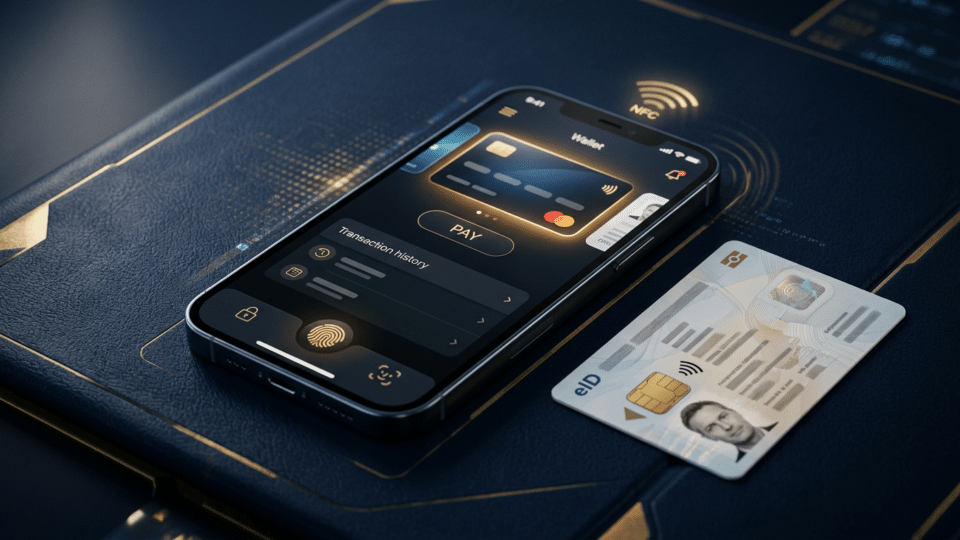
RO Wallet is Romania’s project to put a verifiable digital identity—and gradually other documents—on a smartphone. The official timetable points to a phased public rollout beginning in January 2027, with 14 January 2027 listed for version 1. This is a planned date, however, not evidence that the app is already publicly available or that every announced feature will be usable from day one.
For more information on Romania’s electronic identity card, see RO Wallet in stages: which documents remain outside the digital wallet for now, which provides additional detail on the subject.
The distinction matters for users: a wallet can have a test app, technical documentation and interoperability demonstrations before a public counter, bank, roadside check or university accepts its documents. According to the timetable published by Romania’s Ministry of Internal Affairs, holders of an electronic identity card (CEI) are expected to be the first able to enrol remotely.
In brief: RO Wallet is not presented as an immediate, universal replacement for the physical identity card. Use of the wallet is voluntary, and its practical value will depend both on the documents active in the app and on the institutions or companies connected as issuers and verifiers.
RO Wallet Romania: the first wave is tied to the electronic identity card
The Ministry of Internal Affairs says the first enrolment stage, planned from January 2027, is intended for holders of an electronic identity card. The process is expected to be completed remotely by reading the CEI chip with the phone’s NFC function and using the PIN associated with the document.
NFC is the very short-range communications technology used, for example, for contactless payments. In this case, the phone would read the chip in the electronic identity card to support identity verification. A photograph of the document or a screenshot of personal data would not be sufficient.
Not every technical requirement has yet been described publicly in detail. In particular, the sources consulted do not set out a final list of compatible phones, minimum Android or iOS versions, device-integrity requirements, or the procedure for phones without NFC. What is clear is that NFC and the CEI PIN form part of the enrolment scenario announced for the first stage.
For people with a conventional identity card without a chip, the ministry envisages a separate stage in the third quarter of 2027. This would require identity verification in person. That date, too, is part of the published plan, rather than a guarantee that every operational process will be available by then.
Which documents are priorities—and what is not guaranteed for the first version
The project’s public technical documentation places three categories in the first phase: personal digital identity (PID), proof of address or residence, and a mobile driving licence. PID is the verifiable digital equivalent of an identity-data set issued within the European ecosystem, rather than a simple scanned copy of an identity card.
Being “a priority in the architecture”, however, does not automatically mean being available and accepted everywhere at launch. The official RO Wallet documentation on the project’s initial scope describes development as iterative. Qualified electronic signatures and other attestations are indicated for later stages.
| Promise or feature | What has been publicly confirmed | What remains to be verified |
|---|---|---|
| Activation for CEI holders | Planned for the first stage, using NFC and a PIN. | Exact phone compatibility and the final in-app steps. |
| Digital identity (PID) | A priority for the architecture’s first phase. | Availability in the public version and the list of active verifiers. |
| Proof of address or residence | Included among priority features. | Where and in which procedures it will be accepted in practice. |
| Mobile driving licence | A stated technical priority. | Its procedural status in a roadside check and when it is activated in production. |
| Health card, diplomas and other attestations | Presented as possible directions for the ecosystem. | Whether they will be included in the initial version, who will issue them and who will verify them. |
The cautious wording, therefore, is that RO Wallet may carry these digital documents as they are issued and accepted within the ecosystem—not that all Romanians’ documents will appear on phones simultaneously in January 2027.
Why the app does not automatically replace physical documents
Under the RO Wallet system as described, users do not upload documents from arbitrary sources. Documents must be issued by authorised providers: public institutions or accredited private organisations. At the other end, the service seeking proof of identity or an attribute must be ready to verify the document.
This is the difference between a functional digital wallet and one that is useful in everyday life. If the app can store a mobile driving licence but the institution or officer required to verify it lacks the necessary procedures and tools, users cannot assume that their phone alone will suffice.
The European digital identity regulation, Regulation (EU) 2024/1183, states that use of the wallet is voluntary. Its existence should not remove alternative ways of accessing services. The public information consulted therefore offers no basis for suggesting that Romanians will have to give up physical documents or be required to install the app.
The regulation also establishes important privacy principles: users must be able to control the data they share, disclose it selectively and consult a transaction log. These European rules do not, however, amount to a public audit already available for the Romanian production version.
The timetable is a plan, not evidence of an app already launched
The RO Wallet project website sets out a sequence of milestones: public documentation and repositories by 31 August 2026; a test version and partner sandbox by 31 October 2026; beta testing and the projected certification of a minimum viable product by 22 December 2026; and then the official version 1 launch on 14 January 2027.
Each milestone means something different. A sandbox is an environment in which partners test their integration with the app: requests for attributes, wallet responses and error scenarios. It is not equivalent to a rollout for the general public. Similarly, an interoperability demonstration shows that certain technical flows can work between tested implementations; it does not prove that every service in Romania or the EU is ready to accept the documents.
There is also a nuance in the project’s own official information: its timetable displays 14 January 2027 for version 1, while the frequently asked questions section says the exact date for Romania will be announced after confirmation. Until there is a clear update, the date should be treated editorially as a scheduled deadline.
Four thresholds that change the answer to “does it work?”
A useful account of RO Wallet needs to distinguish four levels. They may appear almost simultaneously in official communications, but they do not mean the same thing to a user.
- Plan: a deadline or feature announced by the authorities.
- Test: an app, sandbox or flow demonstrated in a controlled environment.
- Certification: confirmation that the wallet meets applicable security and interoperability requirements.
- Real-world use: a document issued to the user and accepted by the specific service they are accessing.
At present, public evidence shows development, documentation, planning and interoperability testing. The materials consulted contain no final, independently verified list of all Romanian institutions that will accept each type of document at the launch of version 1.
The same caution is needed for the mobile driving licence. Its status as a technical priority does not support a conclusion that the physical licence no longer needs to be carried or that all checking procedures have already changed. Both the issuance of the digital credential and the rule applicable in the specific verification situation will matter.
If your phone is lost or stolen
The project FAQ says the wallet can be deactivated immediately after a lost or stolen phone is reported, and that documents can be obtained again on a new device through a secure process. This is an important principle: digital documents should not remain accessible to someone who gets hold of the phone.
The public information consulted does not, however, fully specify reporting channels, deactivation times, re-enrolment requirements or situations in which a user no longer has access to their phone number or authentication codes. Until the procedure is published, the basic practical measure remains protecting the phone with biometric or PIN locking, security updates, and the operating system’s location and remote-locking features.
Caution over fraud is also useful. A digital identity app is likely to become a subject exploited in fake messages about “urgent activations” or requests for a PIN. The CEI PIN, authentication codes and images of documents should not be sent via SMS, email or messaging apps. For ways to check such attempts, see InfoBuz’s guide to fake QR codes and quishing scams.
What to check before activating it
When the app is officially available, users can avoid confusion by checking a few straightforward points before treating the wallet as a replacement for the documents in their physical wallet:
- that the app has been published through official channels identified by the authorities, rather than through a link received in a message;
- that they hold a CEI, if they are in the first stage, and know the document’s PIN;
- that their phone has NFC and meets the technical requirements published for the final version;
- which documents have actually been issued in their own wallet, rather than merely announced as priorities;
- whether the institution or service where they will use the document confirms that it accepts it;
- which blocking and recovery procedure applies if the phone is lost.
RO Wallet may simplify identification and the controlled exchange of data, but its practical value will be determined by the pace of integrations, not simply by installing the app. For now, the most accurate description is: a phased rollout is planned, with initial access announced for CEI holders and with features that need to be confirmed separately in the public version and by the services that accept them.
Frequently asked questions
Is RO Wallet mandatory for Romanians?
No. The European regulation and the project’s official information indicate that use of the wallet is voluntary. The app’s existence does not mean that physical documents or other means of accessing services automatically disappear.
Who is expected to be able to activate RO Wallet first?
Under the Ministry of Internal Affairs plan, the first remote-enrolment stage is intended for holders of an electronic identity card. The process is expected to use the phone’s NFC function and the CEI PIN.
Will RO Wallet replace the physical driving licence and identity card?
It has not been confirmed that it will replace them universally at launch. Digital identity, proof of address and the mobile driving licence are technical priorities, but their acceptance depends on active documents and on integrated institutions or verifiers.
What happens if I lose the phone with RO Wallet?
The official FAQ says the wallet can be deactivated after a loss or theft is reported, and documents can be obtained again on another device through a secure process. The precise steps and timeframes still need to be published.









Discuția cititorilor
Ai o opinie sau o întrebare despre acest articol? Spune-ne ce crezi.
Fii primul care deschide discuția.
Te rugăm să păstrezi un limbaj civilizat și să discuți la subiect. Comentariile spam sunt filtrate automat.