
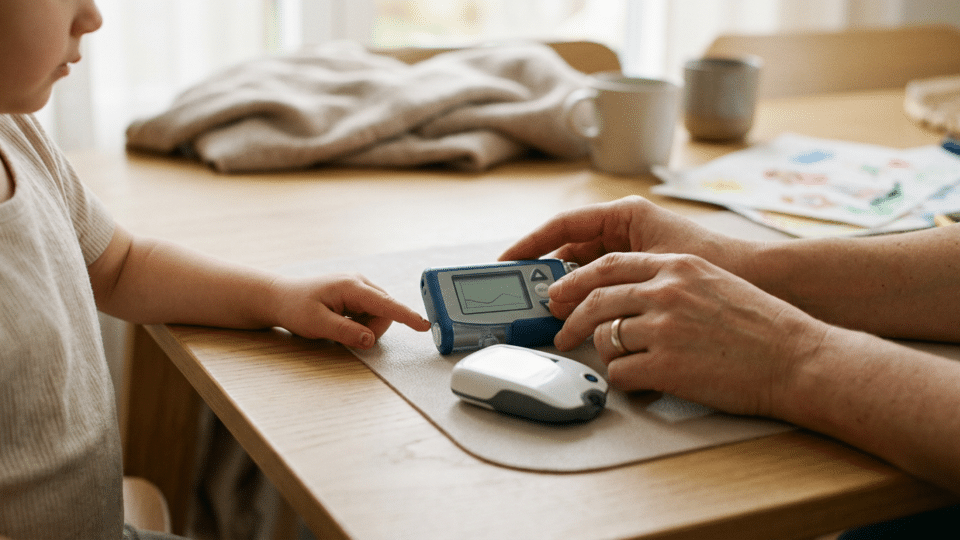
More than 4,000 children with type 1 diabetes are mentioned in a statement by the “Carol Davila” University of Medicine and Pharmacy concerning the planned integrated clinic at CF2 Clinical Hospital in Bucharest. For their families, the discussion about pumps and sensors is not abstract: it can mean fewer finger pricks, more continuous glucose data and, in some cases, fewer trips between the doctor’s office, hospital and the place where supplies are dispensed.
On November 3, 2026, Health Minister Alexandru Rogobete said he wanted insulin pumps and sensors to be available free of charge from community pharmacies. As of November 9, 2026, however, this was an announced intention, not a rule shown to be in force through a published legal act. The National Health Insurance House (CNAS) rules reviewed still kept devices within healthcare facilities with closed-circuit pharmacies.
What is known now: access to reimbursed devices does not automatically mean that every child receives every type of system, nor that a local pharmacy can already dispense one. Medical recommendation, clinical criteria, fitting, training and follow-up remain separate parts of care.
Insulin pumps for children: the pharmacy announcement has not yet changed the applicable rule
The minister’s statement addressed a practical problem: families may have to make repeated trips for sensors, pumps and supplies. In an interview reported by Radio Romania Actualități, Alexandru Rogobete said he had asked CNAS to change procedures and indicated that a draft legal act was being prepared for public consultation.
Several steps still lie between an intention and effective access: publication of the draft, adoption of its final form, updates to rules and reimbursement pathways, followed by the practical organisation of supply and stocks. Without those documents, it would not be accurate to tell parents that they can already go to any community pharmacy for a reimbursed pump or sensor.
The consolidated version of the technical rules for the National Diabetes Programme, available on the Legislative Portal, provides that diabetes-specific devices are procured, fitted and dispensed through healthcare facilities with relevant specialist structures and a closed-circuit pharmacy. This was the reference rule at the time of reporting.
An administrative change that has already been published should be kept separate from the promise concerning community pharmacies. Order No. 981 of May 29, 2026 allows prescribing periods of up to 90, 91 or 92 days for certain devices and consumables, depending on the type of prescription and the calendar period. The measure may reduce the frequency of certain formalities, but it does not demonstrate that dispensing has moved to community pharmacies.
The family’s actual pathway: five links with different rules and promises
An insulin pump is a device that delivers insulin continuously according to settings established with the medical team. Some systems use data from a continuous glucose monitoring sensor; HCL systems, also called hybrid closed-loop systems, can partly adjust basal insulin delivery on the basis of that data. Their complexity helps explain why dispensing a device does not replace medical follow-up.
| Stage | What is provided for or confirmed | What has not yet been demonstrated |
|---|---|---|
| Recommendation and eligibility | The specialist doctor determines the indication, under the programme rules. | A single, simplified published procedure for all types of devices. |
| Consent and training | The rules provide for informed consent and the ability to use the system. | That a pharmacy can replace initial therapeutic education. |
| Fitting | Fitting is linked to eligible healthcare facilities. | Transfer of initial fitting into the community-pharmacy system. |
| Dispensing devices and supplies | The closed-circuit system was still the regulatory reference reviewed. | A list of participating community pharmacies, stocks and the validation process. |
| Follow-up | This remains a medical responsibility, including assessment of use and effectiveness. | A uniform national support network for all families. |
1. A recommendation is not simply a prescription
The types of devices covered by the programme rules include insulin pumps, pump-sensor systems, tubeless systems and HCL systems. Their indications are not identical. Age, diagnosis, glycaemic control, a history of hypoglycaemia or other clinical criteria may matter, depending on the device category.
For that reason, the phrase “pumps for all children” would be inaccurate. The appropriate device and eligibility are determined individually by the specialist doctor within the programme. This article cannot replace that medical assessment.
2. Fitting and therapeutic education remain with the medical team
A family needs to know how to use the pump, change supplies, respond to possible alarms, check blood glucose when sensor data are unclear and act in situations that could become urgent. These are not merely logistical formalities.
The rules provide for informed consent and conditions related to use of the device. For certain systems, use below 75% in a month or a lack of clinical effectiveness may form part of an assessment that leads to supply being discontinued. This threshold should not automatically be read as an administrative penalty: it is also connected to safety, treatment effectiveness and the family’s need for additional support.
3. Pharmacy dispensing could remove one trip, not the whole pathway
If adopted in the form announced, distribution through community pharmacies could eliminate some trips to collect a device or supplies. It would not in itself eliminate specialist consultations, eligibility criteria, fitting or interpretation of clinical data.
Several public questions remain unanswered: which pharmacies will participate; whether all categories of pumps, sensors and supplies will be included at the same time; how prescriptions will be verified; what happens when a product is temporarily unavailable; and who is responsible for continuity of treatment. Until the rules are published, these details cannot be assumed.
For further information, readers can also consult Diesel remains under the special regime until February 1, 2027: what happens to the price at the pump, an article that develops an aspect directly related to this subject.
4. Follow-up is the part not seen at the counter
Data from the sensor or pump must be discussed with the doctor, and settings should not be changed at random. For parents, simpler distribution has real value only if it comes with continuity: accessible appointments, trained staff, clear information about supplies and a rapid response when problems arise.
This is where the difference between reimbursement and access becomes apparent. A device may be included in the programme, while a family still faces difficulties with travel, appointments, stock availability or therapeutic education. The documents reviewed did not identify public national data on waiting times, supply interruptions or the regional distribution of beneficiaries.
What the figure of more than 4,000 children actually means
“Carol Davila” University of Medicine and Pharmacy cites registry data reported in January 2026 and refers to more than 4,000 children with type 1 diabetes. The figure needs to be read precisely: a medical source reproducing data attributed to the ONROCAD paediatric registry states that, as of December 31, 2024, 3,996 children were enrolled in the registry, of whom 3,906 had type 1 diabetes mellitus.
The difference does not disprove the 2026 statement, but it shows why the reference year and definition matter. The sources analysed do not include a recent public report that provides both a fully updated national figure and a breakdown by device type, age, county, waiting time and actual beneficiaries.
Programme indicators should also not be confused with the number of children actually receiving treatment. The order on programme indicators for the programme year sets targets for beneficiaries of pumps, pump-sensor systems and continuous monitoring, but these are budgetary and administrative plans, not an implementation report.
The integrated clinic at CF2 addresses a different link
Alongside the discussion about pharmacies, the Health Ministry and “Carol Davila” University of Medicine and Pharmacy have confirmed a planned Centre for Diabetes, Nutrition and Metabolic Diseases for children at CF2 Clinical Hospital in Bucharest. On November 3, 2026, the ministry announced that the future centre would have 15 patient rooms and six medical consulting rooms, and that it would contribute to equipping it.
According to “Carol Davila” University of Medicine and Pharmacy, the project, developed with Save the Children Romania and CF2 Hospital, aims to bring together diagnosis, treatment, therapeutic education, psychological support and medical training. In other words, the clinic is designed to coordinate care, not as the equivalent of a national pharmacy network.
The centre was a project under construction, not a service already available to patients. The completion deadline reported at the launch event was the end of March 2027, but this should be treated as a project deadline, not a guaranteed opening date. The sources reviewed did not publicly identify all the operational information required: staffing arrangements, annual capacity, operating budget or the specific mechanism through which families outside Bucharest would be supported.
A medical distinction is also important. The clinic covers diabetes, nutrition and metabolic diseases, while the university separately cites data on excess weight among children. These data may help explain the need for a multidisciplinary approach, but they should not be used to suggest that type 1 diabetes is caused by lifestyle. They are distinct medical issues.
What a parent can do now
Until a possible change to the dispensing pathway is published, useful steps are those connected with the team following the child:
- discuss with the paediatric diabetologist whether there is an indication for a pump, sensor or another system, and which criteria apply in the child’s case;
- ask for an explanation of the local pathway: the facility that fits the device, where it is dispensed, prescription intervals and contact details for technical or clinical problems;
- ask in advance about continuity of supplies and the procedure in the event of a delay;
- not independently change insulin settings when alarms or unusual data appear, but instead follow the emergency plan provided by the medical team;
- follow only documents published by CNAS and the Health Ministry before considering a community pharmacy an available option.
The announced change could matter for families if it is translated into clear rules and a functioning network. But better access is not measured only by where a device is collected. It is also measured by the time to a recommendation, the quality of training, continuity of supplies and the medical team’s ability to follow the child over the long term.
How this article was documented
This article synthesises rules and orders published on the Legislative Portal, the minister’s statements as reported by the press, and institutional communications from the Health Ministry and “Carol Davila” University of Medicine and Pharmacy. The status described is that checked for November 9, 2026. No estimates of waiting times, stocks or the actual number of beneficiaries were used, because these data were not identified in a public national report. The purpose is to give families a clear distinction between the existing rule, the announced measure and projects under development.
Frequently asked questions
Can a child automatically receive a reimbursed insulin pump?
No. The device type and eligibility are determined by the specialist doctor, under the criteria of the National Diabetes Programme. Criteria may differ between a pump, a pump-sensor system, a tubeless system and an HCL system.
Can insulin pumps and sensors already be collected from community pharmacies?
As of November 9, 2026, the Health Minister had announced this possibility as an intention to change procedures, but no published legal act was identified to show that the measure was operational.
What would not change if dispensing moves to community pharmacies?
Medical recommendation, eligibility assessment, initial fitting, training, informed consent and the child’s follow-up remain the responsibilities of the medical team.
Is the paediatric diabetes clinic at CF2 already open?
No. At the time of reporting, the centre at CF2 Clinical Hospital was a confirmed project under development. The completion deadline reported at launch was the end of March 2027, not a confirmed date for starting patient services.
Sources consulted
- Legislative Portal – Technical rules for implementing the national curative health programmes, National Diabetes Programme
- Legislative Portal – Order No. 981 of May 29, 2026
- Health Ministry – Centre for Diabetes, Nutrition and Metabolic Diseases at CF2 Clinical Hospital
- “Carol Davila” University of Medicine and Pharmacy – First integrated university clinic for children’s diabetes, nutrition and metabolic diseases at CF2
- Radio Romania Actualități – the minister’s statements on distributing sensors and pumps through pharmacies









Discuția cititorilor
Ai o opinie sau o întrebare despre acest articol? Spune-ne ce crezi.
Fii primul care deschide discuția.
Te rugăm să păstrezi un limbaj civilizat și să discuți la subiect. Comentariile spam sunt filtrate automat.