
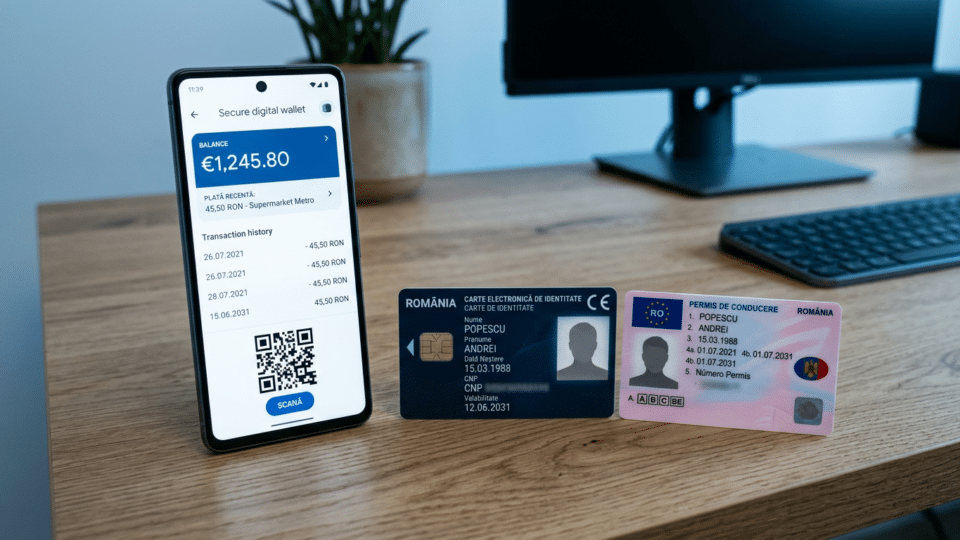
On 31 October 2026, what is scheduled is not a general launch of the app for citizens, but the opening of a test environment and a test mobile app for partners seeking to integrate RO Wallet. The distinction matters: a wallet may technically exist before a citizen can obtain a document in it, and before an institution, pharmacy, university or company accepts it.
In brief: Public information indicates that RO Wallet will be introduced in stages, with digital identity as its core function. There is not yet a definitive public list confirming that a driving licence, diploma, electronic prescription, European Health Insurance Card or electronic signature will all be available to the public at the same time when the Romanian version launches.
This article separates what has been confirmed from what is planned or merely illustrated in European projects. The approach is straightforward: for each function, it considers whether public evidence exists for the issuer, the digital document, the app, the verifier and an alternative for people who do not use a phone.
For more information on the European Union, see also The €3 charge is not per parcel: what is being added to orders from outside the EU, and what remains unclear for 1 November, which provides complementary details on this topic.
RO Wallet in Romania: the launch does not have one date for everyone
On 6 October 2026, the Ministry of Internal Affairs said that the sandbox and test mobile app would become available on 31 October for partners intending to integrate the system. This stage is aimed at the technical and institutional ecosystem; it is not an announcement that all Romanians can install the app and transfer their documents to their phones. The timetable and access stages are set out in the Ministry of Internal Affairs statement on the RO Wallet project.
For the public, the announced access differs according to the type of identity card:
- holders of the electronic identity card (CEI) are expected to be able to enrol remotely in January 2027, by reading their CEI via NFC and using its PIN;
- for holders of the standard identity card, the Ministry indicates in-person verification for enrolment, planned for the third quarter of 2027.
The project timetable page gives 22 December 2026 as the estimated date for certification of version 1/the minimum viable product (MVP), followed by a limited beta, and 14 January 2027 for the “official v1 launch”. At the same time, the official FAQ says the exact date for Romania will be communicated after confirmation. Those two formulations do not support treating 14 January as a definitive deadline for full access for all users.
In practice, an “official launch” may mean that a product is available in an initial form, rather than that every promised service works from day one. For holders of a standard identity card in particular, the Ministry’s timetable indicates that access may come considerably later than for CEI holders.
Which documents are planned for RO Wallet, and what is publicly demonstrated
A digital wallet does not automatically “replace” a physical document simply because it can display a copy or a piece of information. Real-world use requires an issuer that produces a verifiable credential, a compatible wallet, an integrated service or verifier, and a rule allowing that document to be used in the specific situation.
| Document or service | What public sources indicate | Status that can be stated | Limitation for citizens |
|---|---|---|---|
| Digital identity / PID | Ministry documentation focuses on PID and the wallet’s core functions; the General Directorate for Personal Records (DGEP) is designated as the PID provider. | Confirmed as a core function under development | There is no public evidence that it will be generally available in production when partner testing begins. |
| Mobile driving licence | It appears in the project manuals and examples, as well as in European use cases. | Planned / tested in the European ecosystem | No evidence has been published that the Romanian driving licence will be issued and generally accepted in v1. |
| Diplomas and qualifications | RO Wallet and the EUDI framework identify diplomas as a possible use case. | Planned / ecosystem example | There is no list of Romanian issuing institutions and services that verify diplomas in the app. |
| Electronic prescription and EHIC | They are listed on the RO Wallet manuals page. | Targeted functions | The page says guidance will appear as services become operational; it does not confirm simultaneous activation. |
| Electronic signature | It is envisaged in public materials, but technical documentation places EAA and QES in later stages. | Planned | It should not be confused with a qualified signature already available in RO Wallet. |
| Travel and border control | Travel documents are among the scenarios discussed at European level. | Unconfirmed for national use at launch | There is no public evidence that RO Wallet replaces a passport or physical identity document at the border. |
The principle is explained on the app’s official page: documents are added to the wallet by the institutions that issue them. In other words, RO Wallet’s existence does not automatically turn all public records into usable digital documents. Each integration must be confirmed separately.
PID is the foundation, not a synonym for all documents
PID, short for Person Identification Data, is the set of verifiable personal identification data. In the architecture published by the Ministry of Internal Affairs, this is the component on which initial development is focused, alongside the wallet’s core functions, including revocation of an app instance.
Romania’s PID rulebook identifies the General Directorate for Personal Records as the sole PID provider and the Ministry of Internal Affairs, through its technical structure, as the provider of the wallet and related infrastructure. However, the technical document still marks important sections on issuance, presentation, selective disclosure and the data life cycle as “under review”. This shows that the project has a public architecture under development; it is not certification that all processes are ready for mass use.
RO Wallet should not be confused with the CEI or ROeID. The CEI is the physical chip-enabled document that can support enrolment in the announced scenario. ROeID is a separate authentication service. RO Wallet is the app intended to hold PID and, gradually, other verifiable credentials.
Driving licence, diploma and prescription depend on the same integration chain
European examples are useful in understanding the project’s direction, but should not be turned into local promises that have already been met. The European Commission includes mobile driving licences, educational documents, e-health and other services among the use cases tested in pilot projects. This shows what the EUDI ecosystem can do, not what a Romanian can immediately use in RO Wallet.
For every document cited in presentations, the practical questions are the same:
- Who is the authorised issuer that produces the digital credential?
- Is the document available in the Romanian app for the relevant category of user?
- Who can actually verify it: the police, a university, a pharmacy, a bank or an employer?
- What data does the verifier request, and what can the user decline to share?
- What alternative remains available if the phone is lost, has no battery or there is no connection?
Only once all these links have been publicly confirmed can a document be described as practically usable, rather than simply envisaged in an architecture or a future manual.
Electronic signature is a separate function
Signatures are one area that may cause confusion. Under the European framework, qualified electronic signatures are governed by specific rules, and the regulation provides, under certain conditions, for free access for natural persons for non-professional purposes. But the project’s mention of signatures does not show that RO Wallet will provide, from day one, a qualified signature that can be used for any document.
The Ministry of Internal Affairs’ architecture documentation says that EAA and QES — electronic attribute attestations and qualified electronic signatures — are envisaged for later stages. Citizens and institutions therefore should not assume that the app will replace all current digital-signing processes at launch.
Voluntary in law, but the alternative must work in practice
The European regulation on the digital identity framework states that use of the wallet is voluntary. People who do not use it must not be disadvantaged in accessing services. A verifier’s data requests must be necessary and proportionate to the requested service, in line with the principle of data minimisation.
These rules provide important protection for people without smartphones, without sufficient digital skills, or who choose not to install the app. They do not, however, settle every usability issue. In the sources reviewed, no detailed procedures have yet been published for Romania on account recovery after changing phones, offline operation, accessible support for people with disabilities or legal representation.
The RO Wallet FAQ says that, if a phone is lost, the wallet is expected to be deactivated and documents made available again on a new device. That outlines a process, but until the full steps are published, it is not possible to assess how fast or accessible recovery will be in real situations.
Certification and interoperability are different launch thresholds
Taking part in European interoperability testing and publishing documentation are not equivalent to certification of the final product. RO Wallet is scheduled to be presented at EUDI Wallet Launchpad 2026, an exercise bringing together national implementations, issuers and verifiers for testing in conditions close to production.
ENISA, meanwhile, says certification schemes for European digital wallets are still being developed. A specific certificate, evaluation report and the app’s status should therefore be checked separately when they become public. At present, the project timetable refers to estimated certification; the sources consulted do not provide evidence that a certificate has already been issued for the Romanian version.
What to watch before relying on RO Wallet
Before the wallet can genuinely reduce the number of physical documents people carry, verifiable answers need to be published on several points: the firm date and scope of the v1 launch; the documents actually issued to the public; the institutions issuing them; the services accepting them; recovery and revocation rules; and certification and data-protection documentation.
Until then, the cautious conclusion is that RO Wallet has a public roadmap and a clearly defined core function — PID digital identity — but is not yet a demonstrated replacement for an entire physical wallet. Partner testing is a necessary step; its everyday usefulness will depend on the integrations that follow.
Frequently asked questions
Is RO Wallet available to all Romanians on 31 October 2026?
No. The Ministry of Internal Affairs describes 31 October 2026 as the date on which the sandbox and test mobile app become available to partners that will integrate the system. It is not presented as general public access.
Will RO Wallet replace the driving licence?
There is not yet public confirmation that the Romanian driving licence will be available and generally accepted in RO Wallet at the initial launch. A mobile driving licence is a targeted use case in the European ecosystem, but practical use depends on issuance and acceptance by verifiers.
Can people with a standard identity card use RO Wallet?
The Ministry of Internal Affairs has announced enrolment through in-person verification for holders of standard identity cards, planned for the third quarter of 2027. Remote enrolment is planned for January 2027 for CEI holders.
Is it compulsory to use the digital wallet?
No. The European regulation makes use of the wallet voluntary and requires continued access to services for people who do not use it.
Sources consulted
- Ministry of Internal Affairs – Press release 1247: status of the RO Wallet project and timetable of stages
- RO Wallet – About the project
- RO Wallet – Frequently asked questions
- Regulation (EU) 2024/1183 establishing the European Digital Identity Framework
- ENISA – Advances the certification of EU Digital Wallets









Discuția cititorilor
Ai o opinie sau o întrebare despre acest articol? Spune-ne ce crezi.
Fii primul care deschide discuția.
Te rugăm să păstrezi un limbaj civilizat și să discuți la subiect. Comentariile spam sunt filtrate automat.