
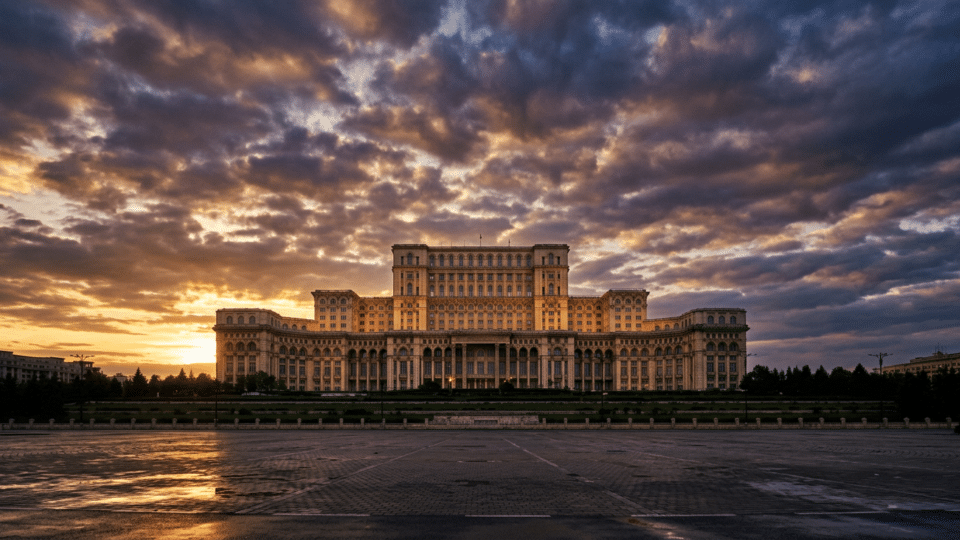
The Luca Niculescu government has led Romania since 20 October 2026, following its confidence vote, amid high economic expectations. The cabinet led by Luca-Alexandru Niculescu won 280 votes in favour and 58 against after months of political deadlock. For people working out their monthly budgets, however, the question is not simply who occupies Victoria Palace, the seat of government, but what will actually change for pensions, wages, taxes and household bills — and when.
For more on Romania’s economy, see Wholesale trade: why July’s 8.7% rise does not yet alter the signal of weakness in 2026, which provides related context.
There is a fundamental difference between a politically approved programme and a measure that is already legally effective. A confidence vote does not immediately change the pension reference-point value, the tax rate or energy bills. This article examines the commitments in the governing programme against the budgetary reality to identify what is worth watching during the first 100 days.
The Luca Niculescu government: 19 members and the 20 October confidence vote
Parliament approved the Niculescu cabinet on 20 October in a joint sitting of the Senate and Chamber of Deputies. The result — 280 votes for and 58 against — gave the new executive a majority for its installation, although the government is not based on a stable parliamentary majority coalition. The Associated Press and the Financial Times described the situation as the start of a minority government supported through ad hoc arrangements and votes.
The official instrument is Parliament Decision No. 4/2026, published in Official Gazette No. 876 on 20 October, followed by Decree No. 818/2026 appointing the government. The governing programme forms part of the confidence-vote documentation. Members of the new executive took their oaths that evening and held their first meeting. At this initial stage, it set priorities without announcing immediate changes to taxes or pensions, according to reporting on the first meeting and the prime minister’s remarks.
One important political distinction is that votes installing a government do not automatically translate into 280 votes for every future law. The executive will need continuous negotiations on the budget, administrative reforms and fiscal measures. A bill may be amended, delayed or rejected during the legislative process. Specific promises should therefore be followed in the form of enacted legislation, not only in speeches.
Pensions in 2027: what indexation promises, and what is still missing
One of the most closely watched issues is pension indexation in 2027. In presentations made during the confidence vote, the prime minister announced an aim to resume indexation while remaining within budget targets. Romanian Television recorded the pledge during the parliamentary debates. But several steps lie between an intention and the amount paid into a bank account: the applicable legal framework, the indicators used, budget provisions and administrative implementation.
Therefore, as of 21 October 2026, the new government’s installation alone does not guarantee a new pension amount for all pensioners in 2027. It would be wrong to say that every pensioner will receive a fixed amount or a percentage that has already been adopted when the relevant legal act and funding are not in place. General indexation must also be distinguished from recalculating an individual pension or resolving an appeal.
Why do the details matter so much? The same percentage increase produces different cash amounts when applied to different pensions. A pension of 2,000 lei and one of 4,000 lei will not receive the same increase in lei under identical percentage indexation. Purchasing power also depends on the prices of food, energy and medicines. For an examination of the reality behind the statistical average, see InfoBuz’s report on the average pension and pensioners’ expenses.
Minimum wage: a promise of an annual mechanism is not an immediate increase
The new programme refers to predictability and an annual adjustment of the minimum wage. This matters to employees, but the terms need to be read carefully: an adjustment mechanism is a rule for future decisions, not an announcement that the minimum wage has been increased today. The effective date, gross amount and calculation rules must appear in legislation and an official announcement.
There is also a difference between the gross minimum wage and the money workers actually take home. Taxes, social contributions, possible exemptions and legislative changes can alter the net amount. Even when the minimum wage rises, its effect on contracts already above that threshold is not the same for all employees; it depends on contracts, collective bargaining and each employer’s policies.
For businesses, changing the minimum wage involves more than an administrative decision. Companies with many workers paid at the minimum level must incorporate the new costs into their budgets, while small and medium-sized enterprises may experience the effects differently depending on productivity and profit margins. That is why it is impossible to estimate the impact without the figures and exact date of any decision.
Taxes: the flat tax remains an objective; abolition of the minimum turnover tax is a 2027 pledge
Luca Niculescu presented retaining the flat tax as part of the government’s direction, while the programme approved by Parliament includes an intention to abolish the minimum turnover tax from 1 January 2027. These points appear in a presentation of the governing programme. However, it would not be accurate to turn a policy timetable into the statement that “the tax has been abolished”. For companies, the applicable rule remains the tax law in force until it is amended.
The distinction matters particularly for year-end planning. A company should not revise its tax returns on the basis of a political statement alone; it must await publication of the necessary legal acts and tax guidance. Moreover, keeping a general tax regime does not guarantee that no secondary tax, contribution or local tax can change. A sound analysis considers each category of taxpayer separately.
The programme relies on investment, better revenue collection and the absorption of European funds. These are potential sources of revenue and economic growth, but they are not funds fully received today. When very large figures appear in promises, readers should ask how much is investment already under contract, how much is a financing plan, and how much has firm approvals and deadlines.
Energy bills: support for vulnerable consumers, without a promise of a single price for everyone
Another immediate concern is preparation for the winter of 2026–2027. At its first meeting, the new executive identified preparations for the cold season and a budget rectification as urgent matters, according to reporting by Știrile ProTV. Government documents also refer to protecting vulnerable energy consumers. This does not amount to an immediate, universal freeze on all gas and electricity bills.
The final cost of energy depends on the contract, tariff, consumption, regulations, taxes and any support schemes. For a household, the monthly bill may rise because usage is higher even if the unit price remains unchanged. Announcements of support must therefore be read alongside the eligibility criteria and the period for which it is funded.
In the case of promised new energy capacity, indicators such as installed megawatts describe projects’ nominal capacity; they do not automatically reduce every customer’s bill. Actual generation, networks, the wholesale market and investment in distribution are distinct elements. For context on costs and risks, InfoBuz examined the connection between energy, the budget and austerity in Romania.
The issue connecting them all: the budget deficit
Romania enters this new political phase under pressure from its budget deficit. In recent months, fiscal adjustments, financing negotiations and requirements to reduce imbalances have been central issues. The Associated Press and the Financial Times described the financial position and the fragility of parliamentary support as immediate challenges for the cabinet.
A government may seek indexed pensions, public investment and lower taxes at the same time, but the budget must cover the costs. If a permanent measure increases expenditure, its financing cannot simply be assumed. It may require new revenue, cuts elsewhere, borrowing or reallocations. The quality of public policy is apparent when an announcement comes with a realistic financial estimate, timetable and responsible institutions.
The governing programme is therefore, above all, a test of feasibility. Striking figures on roads, energy capacity or administrative savings should be tracked through approved budgets, contracts and quarterly reports. A political promise is not the same as a result that can be verified in practice.
The first 100 days: deadlines that matter to citizens
- The first month: the cabinet’s operational priorities, the budget rectification, decisions on winter and the establishment of the pipeline for draft legislation.
- By the end of 2026: the shape of the 2027 draft budget and fiscal measures announced for the start of the following year, if they are approved and published.
- In the first quarter of 2027: checking the implementation of the promised indexation and any minimum-wage changes against the legal acts that have entered into force.
- Over the next six months: the relationship between the government and parties offering ad hoc parliamentary support, which will matter for the adoption of reforms.
These milestones should not be mistaken for legally guaranteed deadlines for every measure. They are points at which concrete results can be checked. For readers, a simple test is to compare the promise, the legal act, the effective date and the beneficiary each time. This can help avoid claims such as “all Romanians will receive money tomorrow”.
Four questions that separate information from economic propaganda
Have pensions already increased following the cabinet’s installation?
No automatic increase in all pensions follows from the confidence vote alone. Indexation for 2027 is an objective of the new government; implementation and the amount must be checked against legal and budgetary acts.
Do taxes change from 21 October?
The cabinet’s installation does not in itself amend the Tax Code. Any change must be checked against published legislation and its entry-into-force date. Abolishing the minimum turnover tax on 1 January 2027 appears in the programme; it is not evidence that the measure is already being applied.
How long is the minority government certain to last?
No confidence vote guarantees unlimited parliamentary support. Political parties may support or reject future bills separately, and the duration of support arrangements depends on negotiations and results.
What is the first document to watch?
The governing programme approved during the confidence vote sets out intentions; the budget, emergency ordinances, government decisions and laws published in the Official Gazette show what actually applies. Both categories must be read for useful verification.
From the parliamentary vote to Romanians’ wallets
The Luca Niculescu government begins its term after a prolonged political crisis, but it does not start from zero when it comes to fiscal obligations and public projects. The immediate task is to move from the support won in Parliament to a credible timetable for the budget and reforms. For millions of people, its impact will be judged by money actually received or paid, not by the scale of promises.
Before the government was installed, InfoBuz examined Luca Niculescu’s negotiations to secure the 233 votes required. The question has now changed: after 280 votes in favour, will the cabinet be able to assemble majorities for projects involving real costs? The answer will emerge in the coming months through adopted measures and public assessments.
Sources consulted and research date
- Parliament Decision No. 4/2026 and Decree No. 818/2026 — the confidence vote and the new government’s programme.
- Associated Press, 20 October 2026 — the parliamentary result and the context of the minority government.
- TVR Info, 20 October 2026 — the prime minister’s statements during the confidence debate.
- Digi24 — governing programme — pensions, taxation, energy projects and investments.
- HotNews, 20 October 2026 and Știrile ProTV, 21 October 2026 — the swearing-in ceremony and the first government meeting.
Research updated on 21 October 2026. Proposals not yet turned into legislation are presented as political objectives, not as rights or obligations already in force.









Discuția cititorilor
Ai o opinie sau o întrebare despre acest articol? Spune-ne ce crezi.
Fii primul care deschide discuția.
Te rugăm să păstrezi un limbaj civilizat și să discuți la subiect. Comentariile spam sunt filtrate automat.