
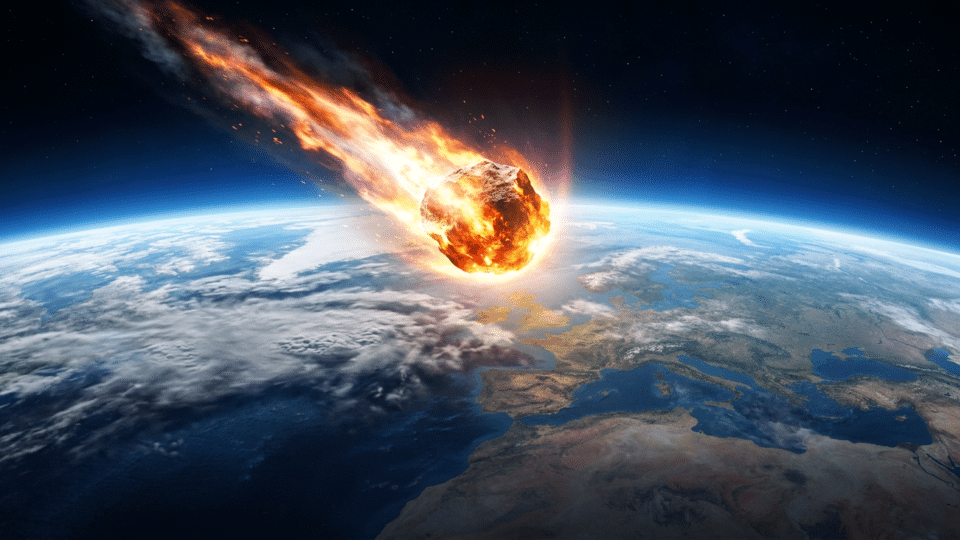
An asteroid impact discovered only a few months in advance would turn planetary defence from an astronomy problem into a race against time. The first question would not be “how do we destroy it?” but one both simpler and harder: where will it hit, how large is it, and do we have enough time to alter its trajectory?
NASA has already demonstrated that humanity can alter an asteroid’s motion. In September 2022, the DART mission deliberately struck Dimorphos and shortened its orbital period around Didymos by about 33 minutes. In March 2026, a more precise analysis showed that the impact had measurably changed even the orbit of the entire system around the Sun.
But DART had years of preparation and almost 10 months of flight after launch. If the warning came six months in advance, the equation would be entirely different. For some objects, a deflection mission could become impossible, and “planetary defence” would turn into civil protection: forecasting the impact area, evacuation and protection of infrastructure.
Importantly, this is a hypothetical scenario. NASA JPL currently says that there is no known asteroid posing a significant threat to Earth over the next century. The real issue is different: a significant share of the population of objects roughly 140 metres across has not yet been discovered, while smaller objects can appear with far shorter warning.
The first step is not launching a rocket. It is measurement
When a new asteroid is discovered, the first observations do not provide a perfect trajectory. Astronomers see a handful of points in the sky and construct a family of orbits compatible with those measurements.
That is why an impact probability can initially rise as new observations are added. It does not mean the asteroid has “turned towards Earth”. It means the region of uncertainty is narrowing and Earth remains within it.
NASA uses two complementary systems. Scout analyses newly detected, still unconfirmed objects for very short-term risks. Sentry tracks confirmed objects and searches for possible impacts over the next 100 years.
If an object had a real and high probability of impact within a few months, observatories around the world would immediately try to extend the observational arc. Optical and infrared telescopes would be used, along with planetary radar if the geometry allowed and, in some cases, space telescopes such as James Webb.
Asteroid size completely changes the response
There is no single scenario of “an asteroid heading for Earth”. The difference between 20 metres and one kilometre is the difference between a local atmospheric explosion and a potential global catastrophe.
- About 20–25 m: usually produces a major airburst. Chelyabinsk, in 2013, was about 20 m across; its shock wave shattered windows and injured around 1,500 people.
- About 50 m: can cause Tunguska-scale local devastation. NASA models estimate that the 1908 object was roughly 50–80 m across.
- About 140 m: falls into the category capable of regional devastation.
- About 300 m: an impact or airburst could affect a very large region, with continental-scale consequences in unfavourable scenarios.
- About 1 km: can produce severe global effects, including climate disruption.
This scale explains why evacuation may sometimes make more sense than a space mission. If an object measuring 50–80 m is discovered a few months ahead and the impact area can be defined with sufficient accuracy, moving the population may be safer and more realistic than attempting to build a last-minute deflection mission.
Six months out: how precisely can we know where it will hit?
At first, the possible impact zone may be a vast band crossing continents and oceans. As the orbit is measured more accurately, the corridor narrows.
NASA and its international partners practise precisely this problem through Planetary Defense Conference scenarios. In the fictional scenario prepared for the 2027 conference, an asteroid roughly 80–85 m across is discovered many years in advance. Yet the exercise shows something relevant to short-warning events: even when an impact is certain, the exact location can remain uncertain until very late.
In that scenario, the atmospheric impact location would reach an uncertainty of roughly ±10 km only 20 days beforehand, and roughly ±3 km four days beforehand. These figures are specific to the exercise and are not a universal rule, but they illustrate the operational problem: an evacuation must be prepared before the final point is known perfectly.
DART demonstrated that a kinetic impactor works
On 26 September 2022, DART struck Dimorphos at about 22,500 km/h. The goal was not to destroy the asteroid, but to make a very small change to its speed.
The result was far above NASA’s minimum threshold for success: Dimorphos’s orbital period was shortened by about 33 minutes. Material ejected by the impact amplified the effect, acting as additional recoil.
For more on NASA, see Artemis II: NASA releases more than 800 GB of photographs and data from the Moon. What the astronauts observed, which provides complementary details on the subject.
In March 2026, NASA published an even more striking measurement: DART changed the orbital period of the Didymos–Dimorphos system around the Sun by about 0.15 seconds. That may seem infinitesimal, but it is precisely the principle behind planetary defence. Alter the speed by a tiny amount early enough and, years later, the distance between Earth and the asteroid at the intersection point can become enormous.
NASA explains the idea intuitively: in many scenarios, there is no need to “throw” the asteroid somewhere else in the Solar System. It only needs to reach the meeting point a few minutes too early or too late.
The problem is time: DART is not a last-minute weapon
DART confirms that the technology works, not that it can be used with any amount of warning. For kinetic deflection, the time needed to build and launch the vehicle, its flight time to the target, orbital geometry and the scale of the required change in the asteroid’s speed all matter.
NASA analyses of planetary defence stress that a kinetic impactor is preferable when practical, but its effectiveness falls rapidly as warning time shrinks or object size increases.
An asteroid discovered only a few months in advance may already have a geometry that makes it impossible for a spacecraft to reach it before impact. Even if a rocket is available, not every launch can intercept every orbit.
In October 2026, Europe is set to check exactly what DART did
ESA is now sending its Hera mission towards the Didymos–Dimorphos system. On 7 October 2026, the spacecraft observed its target for the first time, from about 236,500 km away. Its main braking manoeuvre for approaching the system was scheduled for 15 October, and full rendezvous is planned for late 2026.
Hera will measure the DART crater, Dimorphos’s mass and structure, and the precise way in which the impact changed its dynamics. These data are essential because a kinetic impactor does not produce the same result on a monolithic asteroid, a highly porous one or a loosely bound “rubble pile”.
In other words, DART demonstrated that we can push an asteroid. Hera is trying to tell us how predictably we can repeat that result.
InfoBuz has also examined the economic dimension of space infrastructure in its article on the SpaceX–Blue Origin race for launches, satellites and orbital logistics. In a planetary emergency, rapid access to launch vehicles would become one of the most valuable resources that infrastructure could provide.
With only months left, the nuclear option enters the discussion
In official planetary-defence documents, a nuclear device is treated as a last resort for very large objects or cases in which warning time is too short for sufficient kinetic deflection.
The aim would not necessarily be “to pulverise the asteroid”. One method under analysis is detonation away from the surface, so that radiation vaporises an outer layer. The ejected material creates an impulse that can alter the trajectory. In other scenarios, if deflection is no longer possible, disruption is studied — controlled fragmentation intended to ensure that as much mass as possible misses Earth or enters the atmosphere as smaller fragments.
This is far more complicated than in films. Poorly controlled fragmentation can replace one impactor with several dangerous fragments. Its effectiveness depends on size, composition, rotation, timing and intercept geometry.
A NASA analysis published in 2026 for a planetary-defence exercise assessed kinetic impactors, ion-beam deflection and nuclear devices for deflection or disruption at the same time. The fact that NASA models these options does not mean there is a launch-ready “nuclear anti-asteroid system”; it means the scenarios are studied before a real crisis emerges.
“Blow it up” is not the default strategy
Popular intuition suggests that a dangerous asteroid must be broken apart. In reality, deflection is preferable when time permits.
A compact body that misses Earth by a few thousand kilometres is far easier to manage than a cloud of fragments whose trajectories must be calculated individually.
Disruption becomes relevant when there is so little time that the trajectory of the entire object can no longer be altered enough. Even then, the objective is to reduce energy and redistribute risk, not to produce a spectacular explosion in space.
If the asteroid is 80 metres wide, evacuation may save more lives than a rocket
An 80 m object can produce an explosion in the range of tens of megatons, depending on its composition and speed. It is a serious threat, but not one of global extinction.
NASA published a fictional 2026 scenario involving an asteroid about 80–85 m across. The modelling indicates that the main hazards would be blast overpressure and thermal radiation, with potentially severe damage over tens of kilometres.
If such an object were discovered too late for deflection, the goal would become refining the impact corridor and evacuating the area. For a Tunguska-type airburst, the distance from the explosion point matters enormously.
This is one counterintuitive aspect of planetary defence: for a sufficiently small asteroid and very short warning, the best technology may be a well-organised evacuation.
One month out: the largest civil-protection operation imaginable begins
If the impact is confirmed and deflection missions are no longer possible, priorities change.
- Continuous observations: every measurement reduces the uncertainty zone.
- Effects modelling: airburst, crater, shock wave, thermal radiation and, where applicable, tsunami.
- Phased evacuation: moving people before roads and airports are overwhelmed.
- Protecting infrastructure: hospitals, power, water, data centres, telecommunications and medical supplies.
- Moving mobile equipment: aircraft, emergency vehicles and critical resources out of the likely impact area.
- Public communication: preventing panic and regularly updating the risk area.
In such a scenario, social predictability becomes almost as important as orbital predictability. An unclear alert can cause unnecessary evacuations; one issued too late can leave millions without sufficient time.
If it hits the ocean, a tsunami is not automatically the dominant scenario
Popular culture assumes that every asteroid falling into the ocean produces a planet-wide tsunami. Real-world models are more nuanced.
For modest-sized objects, a large part of the energy may be dissipated in the atmosphere or in a relatively local cavity. A severe tsunami is possible under certain combinations of size, velocity, angle and depth, but not every ocean impact produces globally devastating waves.
NASA and its partners model blast, thermal radiation, ground effects and tsunami separately precisely because the dominant hazard differs from one scenario to another.
The final days: the impact location becomes far more precise
As the asteroid approaches, its position in the sky becomes easier to measure and, in some geometries, it can come within the range of planetary radar.
In NASA’s 2027 exercise, radar would become available just four days beforehand. At that point, the atmospheric impact location would be known to within a few kilometres.
This is when a broad regional evacuation can be narrowed into a much more precise zone. But governments cannot wait until the final four days to begin the operation.
On impact day, the most dangerous thing may be a window
Chelyabinsk offers a simple and surprisingly important lesson. Many people saw the extraordinary flash and moved closer to windows. The shock wave arrived several minutes later, shattering large areas of glass and causing most of the injuries.
For a predicted airburst, civil-protection messages would include staying away from windows, using sturdy structures and, depending on the scenario, sheltering away from exposed façades.
This distinction between the flash and the shock wave can save lives even when a full evacuation is no longer possible.
Can we build an “emergency rocket” kept permanently ready?
It is one of the ideas under discussion in planetary defence: vehicles or components prepared in advance, rapidly available launchers and architectures that can be adapted to a new target without years of development.
NASA has also funded “terminal defence” concepts for extremely short warnings, based on multiple interceptors that would fragment an object before it enters the atmosphere. These concepts are research, not operational systems on a launch pad today.
The greatest challenge is not just the vehicle. It is having a sufficiently well-characterised target. If an asteroid’s mass, structure and rotation are unknown, it is impossible to know exactly how much impulse must be applied or how it will respond.
Why reconnaissance is almost as important as deflection
In NASA and SMPAG exercises, one of the first options assessed is sending a rapid reconnaissance mission. A probe can measure size, mass, rotation and composition far better than remote observations.
But short warning creates a difficult choice: use months for characterisation, or immediately begin building a deflection mission based on incomplete data?
NASA’s 2026 analysis of hypothetical scenarios shows that this tension is real. To preserve the launch window, it may sometimes be necessary to start preparing a mitigation mission before reconnaissance has removed every uncertainty.
International cooperation would begin on day one
An asteroid does not respect borders. The international planetary-defence system includes the International Asteroid Warning Network — IAWN and the Space Mission Planning Advisory Group — SMPAG, mechanisms supported through the United Nations framework.
IAWN coordinates observations and communication about the threat. SMPAG brings together space agencies to analyse mission options.
A deflection decision would have international consequences, because altering the trajectory also temporarily changes the risk corridor. No serious country would treat such an operation as an ordinary unilateral project.
The best defence is discovering the object years in advance
Every deflection technology works better with time. With 20 years of warning, only a very small change in speed is needed. With six months, avoiding the same impact requires a much greater impulse and a much faster mission.
That is why NASA invests heavily not only in DART, but also in telescopes, catalogues and automated monitoring systems. CNEOS says that more than 90% of objects larger than one kilometre are already known, but that current objectives focus on finding a much larger proportion of the population exceeding 140 m.
In this respect, planetary defence resembles preventive medicine: the best intervention is the one begun before the problem becomes urgent.
What the case of 2024 YR4 taught us
Asteroid 2024 YR4 provided a real example in 2025–2026 of how probabilities change as observations accumulate. Initially, the data indicated a sufficiently high probability for the object to draw international attention in relation to 2032.
As observations were added, including observations by James Webb, NASA eliminated the significant risk to Earth. In March 2026, Webb observations also eliminated the scenario of an impact with the Moon in 2032.
The case matters for public communication. A probability that temporarily rises does not mean astronomers “got it wrong”; it is exactly the expected behaviour as a broad corridor of uncertainty is progressively narrowed.
What if the object is one kilometre wide and only months remain?
This is the genuinely difficult scenario. An asteroid about 1 km across can produce global effects, and evacuating a single region does not solve the problem.
With only a few months’ warning, a single kinetic impactor could be insufficient or impossible to deliver in time. Options under consideration would include multiple missions, disruption and, as a last resort, nuclear solutions.
But there is no guarantee today that humanity can neutralise any one-kilometre asteroid discovered only months before impact. That is exactly why early detection is the essential component of planetary defence.
Hollywood gets one important thing wrong: real heroism starts with astronomy
Films put the climax in the rocket striking the asteroid. In reality, the most important person may be the astronomer who discovers it 20 years earlier.
With enough time, a relatively modest impactor can make a very small change to the trajectory. With too little time, even the most powerful technologies become uncertain options.
That is why DART and Hera are more than spectacular missions. They turn planetary defence from a cinematic scenario into a measurable engineering discipline.
For another example of a rare natural risk with the potential for cascading effects on modern infrastructure, InfoBuz has also examined what could happen in an extreme Carrington-type solar storm.
Frequently asked questions about a potential asteroid impact
Is there currently a known asteroid that will hit Earth?
No. NASA JPL says there is currently no known asteroid that poses a significant impact threat over the next approximately 100 years.
Can we deflect an asteroid?
Yes. The DART mission demonstrated for the first time at real scale that a kinetic impactor can alter an asteroid’s orbit.
How much time is needed?
The more warning there is, the easier deflection becomes. For kinetic impactors, years or decades are far more favourable than months.
Can a nuclear weapon be used?
Planetary-defence documents analyse nuclear devices as a last resort for large objects or very short warning times. However, there is no universal operational system that guarantees success in every scenario.
Why not simply break it apart?
Fragmentation can create several dangerous objects. When time permits, changing the trajectory of the entire asteroid is usually preferred.
What if it is too late for deflection?
For objects with local or regional effects, civil protection, evacuation and precise forecasting of the impact zone can save a great many lives.
Sources and transparency
- NASA – DART planetary defence mission
- NASA – DART changed the Didymos system’s orbit around the Sun, 6 March 2026
- ESA – Hera’s first glimpse of Didymos, 7 October 2026
- ESA – Hera approach and braking phase, October 2026
- NASA JPL CNEOS – Planetary Defense
- NASA JPL – Sentry and Scout impact monitoring systems
- NASA JPL – 2027 Planetary Defense Conference hypothetical scenario
- NASA Technical Reports – asteroid reconnaissance, deflection and disruption mission options, 2026
- NASA – Planetary Defense Strategy and Action Plan
- NASA JPL – asteroid size, frequency and hazard overview
- NASA – Near-Earth Object Impact Threat Emergency Protocols
- NASA – 2024 YR4 observations and elimination of a 2032 lunar impact, 5 March 2026








Discuția cititorilor
Ai o opinie sau o întrebare despre acest articol? Spune-ne ce crezi.
Fii primul care deschide discuția.
Te rugăm să păstrezi un limbaj civilizat și să discuți la subiect. Comentariile spam sunt filtrate automat.