
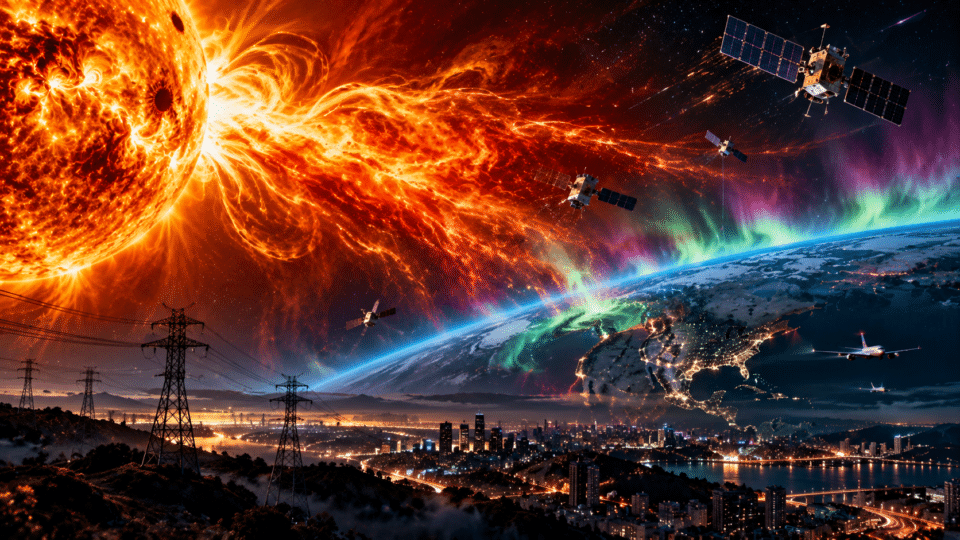
An extreme solar storm on the scale of the 1859 Carrington Event would not destroy the atmosphere or instantly shut down every phone on the planet. But it would strike precisely the infrastructure modern society has made invisible: satellites, GPS, radio communications, time synchronisation, power grids and the systems that depend on them.
In 1859, the world had the telegraph. Today, it has billions of connected devices, tens of thousands of satellites, GNSS-guided aviation, continental power grids and financial markets that rely on precise synchronisation. A storm comparable to Carrington would encounter a far more vulnerable world — but also one that is much better monitored and prepared.
The best way to understand the risk is not to imagine a single “strike”, but a sequence. Light from the flare arrives first. Energetic particles may follow. The vast cloud of plasma — a coronal mass ejection, or CME — can arrive many hours later. Each stage affects different technologies.
What follows is a realistic scenario for an extreme solar storm directed at Earth, based on the known effects of historical events, the G5 storm of May 2024 and monitoring systems operating in 2026.
1859: when the telegraph began to spark
On 1 September 1859, British astronomer Richard Carrington was observing a group of sunspots when he saw two exceptionally bright white regions. About 17 hours later, Earth was hit by an extraordinary geomagnetic storm.
Auroras became visible at unusually low latitudes. Telegraph networks in Europe and North America were disrupted, operators reported electric shocks, and some equipment produced sparks or set paper alight. In some cases, telegraphs could temporarily transmit using storm-induced currents even after their own power supplies had been disconnected.
The Carrington Event is now used as a benchmark for a geomagnetic superstorm. Its exact intensity must be reconstructed from historical observations, so estimates vary between studies. NOAA uses an estimate of around -1,200 nT for the Dst index in its comparative material, compared with about -410 nT for the G5 storm of May 2024.
What would happen if the flare occurred tomorrow
A modern Carrington-scale event would begin without anyone on the street feeling anything. The Sun would be about 150 million kilometres away, but the first part of the impact would arrive almost immediately on an astronomical timescale.
T + 8 minutes: the first impact reaches the ionosphere
The electromagnetic radiation from a solar flare — particularly X-rays and extreme ultraviolet radiation — travels at the speed of light. NOAA says the impact on the ionosphere can begin after about 8 minutes, the time light takes to travel from the Sun to Earth.
On the sunlit side of the planet, the ionosphere can change abruptly. HF radio signals may be absorbed or degraded, causing a radio blackout that can last from tens of minutes to several hours, depending on the flare’s intensity.
That does not mean the internet disappears after eight minutes. The immediate effect is primarily on radio communications that use the ionosphere — a major issue for transoceanic aviation, maritime communications, military operations and some emergency services.
T + tens of minutes to a few hours: energetic particles arrive near Earth
A major flare can accelerate protons and other particles to very high energies. They can affect satellite electronics and increase radiation exposure for astronauts and for high-altitude flights, especially on polar routes.
The FAA explicitly treats space weather as an operational risk. Solar radiation storms can make HF communications unusable in polar regions, affect GNSS and increase radiation exposure for crews and passengers at high altitudes.
Air operators could move flights away from the poles, reduce altitude in certain situations, or use routes with more robust communications and navigation alternatives. The result would be delays and additional fuel use, not the disappearance of global aviation.
T + 15–18 hours: the fastest CME can reach Earth
Coronal mass ejections are enormous clouds of plasma and magnetic field ejected from the solar corona. NOAA says the fastest Earth-directed CMEs can arrive in around 15–18 hours; slower ones take several days.
This is where the warning paradox arises. Astronomers can see that a cloud is heading towards Earth many hours in advance. But how severely it will interact with the magnetosphere depends largely on the orientation of the CME’s magnetic field, especially its southward-directed component.
That information becomes much more precise only when the cloud reaches the L1 point, about 1.5 million km upstream of Earth.
In 2026, there is a new “sentinel” between the Sun and Earth
Since 10 June 2026, NOAA has operated SOLAR-1, the first US satellite dedicated exclusively to operational space-weather observations. It is located at the L1 point and continuously measures the solar wind and magnetic field before they reach Earth.
Depending on the cloud’s speed, L1 data provide roughly 15–60 minutes of final warning before impact. This is not enough time to build a new transformer or reposition an entire satellite constellation, but it is enough for operational action: reducing grid loads, changing configurations, putting some satellites into safe mode or altering aviation operations.
SOLAR-1’s coronagraph also provides images of CMEs far more quickly than earlier generations of monitoring infrastructure, while its in-situ instruments transmit data with latency measured in minutes.
Zero hour: the CME’s magnetic field meets the magnetosphere
When the cloud arrives, its speed matters, but its magnetic orientation can determine how much energy is transferred to Earth’s magnetosphere. If that coupling is highly efficient, a severe geomagnetic storm begins.
NOAA classifies geomagnetic storms on a G1–G5 scale. G5 is the “Extreme” level. A Carrington Event would probably exceed many conditions seen in modern events for which direct instruments exist, although the operational scale remains capped at G5.
Auroras would spread to low latitudes. The display in the sky would be the beautiful side of a process that, on the ground, begins inducing voltages in long, conductive infrastructure.
The first hours: the power grid becomes one of the greatest vulnerabilities
A geomagnetic storm rapidly changes Earth’s magnetic field. Through electromagnetic induction, those variations generate electric fields in the ground. In regions with highly resistive geology, geoelectric fields can become more intense.
High-voltage transmission lines provide a very long, conductive path for induced current. Geomagnetically induced currents — GICs — can enter through transformer grounding points and cause saturation, heating, harmonics and abnormal operation of protection systems.
The USGS says that, during strong storms, hundreds or even thousands of volts can be induced on long lines. In March 1989, a geomagnetic storm far weaker than the Carrington estimate contributed to the collapse of the Hydro-Québec grid, leaving millions without electricity for about nine hours.
In an extreme modern scenario, operators would try to reduce transfers on vulnerable lines, bring reserves back online, reconfigure systems and, in some cases, disconnect equipment preventively to avoid damage.
Would the entire global power grid fail?
Probably not. Vulnerability is not uniform. It depends on latitude, geology, line orientation, transformer types, the state of the grid at the time and the measures taken by operators.
Some regions might experience only alarms and operational adjustments. Others could face local or regional outages. The most serious scenario is simultaneous damage to several large high-voltage transformers, because these are not pieces of equipment that can be replaced in a few hours.
The viral claim that “a solar storm would leave the entire planet without power for years” cannot be supported as a general prediction. But the loss of a significant share of critical transformers in one region could make recovery far longer than after an ordinary outage.
GPS would not necessarily disappear, but it could become unreliable precisely when it is needed
GPS and other GNSS constellations transmit very weak radio signals through the ionosphere. A geomagnetic storm changes the density and structure of electrons in this region, producing positioning errors, scintillation and temporary signal loss.
In May 2024, the G5 storm was strong enough to degrade GPS used in precision agriculture. Some automatically guided tractors drifted off course or were stopped, while NASA and NOAA also reported communications and navigation problems.
A Carrington-scale event could produce broader and longer-lasting effects. Aircraft, ships, drones, agricultural machinery and services that depend on precise positioning would switch to alternative procedures where those are available.
For an explanation of the connection between geomagnetism and everyday technologies, InfoBuz also has this article on current geomagnetic activity and its effects.
GPS’s hidden problem is time, not only maps
GPS does not only provide location. Each satellite carries atomic clocks, and its signals are used for synchronisation throughout the economy.
NIST and GPS.gov note that telecommunications, power grids and financial markets use timing derived from GPS. Mobile networks synchronise base stations, power systems use timestamps for protection and analysis, and financial institutions use precise time to order and audit transactions.
This does not mean a solar storm would erase bank accounts. Critical infrastructure uses local oscillators, clocks, holdover protocols and alternative sources. But widespread GNSS loss or degradation can reduce synchronisation accuracy and force systems onto backup modes.
InfoBuz separately examined how fundamental synchronisation is in its article on the change in how UTC handles the leap second.
Satellites would be hit from two directions
Energetic particles can cause charging, electronic errors and component degradation. At the same time, the storm heats the upper atmosphere, which expands and becomes denser at lower altitudes.
For satellites in low Earth orbit, even this extremely thin air is enough to create drag. During the May 2024 storm, NASA reported that thousands of satellites required orbital corrections and that Starlink service was degraded.
A much stronger event would put pressure on constellation attitude-control, communications and control systems. Operators could scale back non-essential operations, reschedule manoeuvres and put some platforms into protective configurations.
The risk is all the more important in 2026 because the orbital economy is much larger than it was only a few years ago. InfoBuz examined this dependency in its article on the race for orbital infrastructure between SpaceX, Blue Origin and new constellations.
Aviation would not stop, but some routes would become much more complicated
Polar flights are the most exposed because Earth’s magnetic field offers less protection near the poles, while HF communications are essential on routes without conventional ground coverage.
The FAA warns that solar storms can degrade GPS/GNSS, make HF unusable in polar regions and increase radiation doses for crews and passengers.
In an extreme scenario, airlines would reroute flights to lower latitudes and make more intensive use of ground-based navigation and landing systems. Some airports and routes would lose efficiency, rather than necessarily losing all functionality.
The internet would not be directly “fried” by the Sun
This is one of the most common exaggerations. Fibre-optic cables carry light through glass and are not vulnerable to geomagnetic currents in the same way as a long metal electricity transmission line.
But the internet is not just fibre. It requires data centres, routers, switches, power stations, repeaters, terminals, mobile networks and electricity.
If a region loses power, much equipment initially switches to UPS units and generators. If the outage continues, fuel, cooling and logistics become constraints. The internet could continue working in other regions, but local access and some routes could deteriorate severely.
A Carrington Event is therefore an infrastructure-cascade threat, rather than a cosmic switch that directly turns off the global web.
Mobile networks would last only as long as backup power does
Mobile phone base stations typically have batteries and, at some sites, generators. During a short outage, users may notice nothing. During an extended outage, site autonomy becomes limited.
In addition, backhaul between towers and the core network may depend on other affected infrastructure. Even if a phone has a charged battery, mobile service can deteriorate if the station, transport fibre or switching centre loses power.
In a regional blackout scenario, traffic would rise precisely as available capacity fell, as millions of people tried to call and use data at the same time.
Water and sanitation could become a problem before food
A modern city uses electricity for water pumping, treatment, sanitation and pressure control. Reservoirs and gravity provide some autonomy, and critical infrastructure has generators, but a prolonged blackout can affect distribution.
NASA used this very example in its analysis of the July 2012 solar superstorm that missed Earth: in an extended outage, urban water becomes one of the everyday vulnerabilities because pumps depend on electricity.
For practical advice on an ordinary outage, InfoBuz separately offers its guide, A 24-hour power outage: a plan for the refrigerator, water, light and safety.
Hospitals would keep operating, but logistics would become critical
Hospitals, emergency services and other critical facilities have backup power. In the first hours, generators and batteries would support essential areas.
The problem arises if a regional outage lasts days. Fuel must then be delivered, staff must be able to get to work, cold chains must be maintained and communications systems must function.
This is why the impact of a superstorm cannot be calculated only in failed transformers. Modern infrastructures are interdependent: power supports telecommunications, telecommunications support logistics, and logistics support power and medical services.
What the G5 storm of May 2024 showed
Between 10 and 13 May 2024, Earth was struck by the strongest geomagnetic storm since 1989. NOAA classified it as G5.
Power-grid irregularities, degraded GPS and HF communications, satellite problems and altered airline routes were reported. US precision agriculture suffered losses NOAA estimated at hundreds of millions of dollars because positioning degraded during the planting period.
Thousands of low-orbit satellites had to correct their orbits after increased atmospheric drag. Some Starlink services were degraded, and GOES-16 experienced transmission interruptions.
Yet the general population did not experience a disaster. Networks and operators took action. That distinction is essential: an extreme storm is dangerous, but it would not find a world that is completely unprepared.
2012: the superstorm that missed Earth
In July 2012, the Sun produced an exceptionally powerful CME that crossed Earth’s orbit, but the planet was not there when the cloud passed. NASA described the event as a “near miss” and used it as an example that very severe events can occur in the modern era.
Measurements by the STEREO-A probe allowed researchers to study a superstorm without ground infrastructure having to absorb the impact. The event became an important warning for space-weather planning.
The first 24 hours in a modern Carrington scenario
- 0–8 minutes: the flare is detected; X-rays reach Earth and may cause a radio blackout on the sunlit side.
- Tens of minutes: energetic particles may begin affecting satellites and operations at high latitudes.
- The first hours: satellite, power-grid and aviation operators receive forecasts and prepare protective measures.
- 15–60 minutes before the CME: SOLAR-1 and other L1 observatories measure the cloud’s actual magnetic field and allow a more precise estimate of severity.
- 15–18 hours or more: the CME reaches Earth if it is among the fastest.
- The first hours after impact: GPS/GNSS degrades, the aurora expands, GICs appear in grids, operators reduce loads and regional outages may occur.
- 6–24 hours: effects propagate through satellites, aviation, telecommunications and power grids; some services switch to backup systems.
What would happen in the following days
If there were no major physical damage, many services would return as the storm subsided and the grid was reconfigured. GPS and ionospheric communications would stabilise, satellites would begin assessment and orbital corrections, and power operators would progressively reconnect loads.
If large numbers of high-power transformers were damaged, however, recovery would become much slower. These units are large and specialised, and sufficient stocks are not always available to replace many of them quickly at the same time.
This is the difference between a blackout and an infrastructure crisis. The first may last hours. The second may require weeks or more in the worst-affected areas.
Could digital money or bank accounts disappear?
There is no mechanism by which a geomagnetic storm could directly “erase” bank balances from servers. Financial data are replicated, backed up and protected through several layers of redundancy.
What can be affected is access: degraded communications, data centres without sufficient power, POS terminals without a network connection, unavailable ATMs and time-synchronisation problems.
In a region facing a prolonged blackout, electronic payments may become difficult to use even if account data remain intact. Financial resilience therefore depends on power, communications and timing, not only database security.
Which technologies are surprisingly resilient
Household electronics would not all be “burned out” at once. A geomagnetic storm induces currents much more efficiently in long infrastructure — transmission lines, pipelines, cables and systems connected to the ground — than in the short cable of a laptop.
A switched-off phone or an unplugged laptop does not become useless merely because there is a geomagnetic superstorm outside. The issue is the service around it: electricity, communications, GPS and the internet.
This is an important reason not to draw an analogy with a nuclear electromagnetic pulse. The mechanisms and frequency spectra differ, and the vulnerable infrastructure is not the same in each case.
How prepared is the world in 2026?
Much better than in 1859, and better than in 1989. NOAA permanently operates the Space Weather Prediction Center. SOLAR-1 sends data from L1. Grid operators have procedures for geomagnetic disturbances. Aviation includes space weather in planning. Agencies are developing alternative Positioning, Navigation and Timing systems.
In the United States, NIST and DHS have published guidance on reducing critical dependence on GPS timing and building resilient PNT. Energy operators use geoelectric models and GIC monitoring to understand where risk is greater.
After the May 2024 storm, NOAA and other institutions used real-world experience to update procedures and exercises. Ironically, the first end-to-end US national exercise for a space-weather crisis took place just before that real storm.
A 2026 finding suggests extreme storms could exceed some older assumptions
In July 2026, NASA presented a study led by agency researchers and published in Nature that questions a long-used assumption in space weather: the idea that the response of certain currents in the upper atmosphere reaches a ceiling during very strong storms.
If this apparent saturation is indeed less robust than previously believed, extreme events may produce more intense magnetospheric responses than would result from simple extrapolations of storms observed so far. The study does not say that global collapse is inevitable; it says the possible physical range of severe storms deserves greater caution.
This is further evidence that a modern Carrington scenario must be treated as risk analysis, not as an exact prediction. The most important unknowns arise at the extreme end of the distribution, where there are very few directly measured events.
What cannot be predicted perfectly
It is possible to see that a CME is heading towards Earth and estimate its speed. It is much harder to know precisely, many hours in advance, the magnetic orientation that will determine how efficiently it couples with the magnetosphere.
This explains why a forecast can say “a major storm is coming” many hours beforehand, while the final level of impact is refined in the last hour.
There is also a geographical issue: the same storm does not produce the same electric field everywhere. Ground geology can amplify or reduce induced voltages. A simple global latitude map is not enough to predict exactly where the largest GICs will occur.
How much of the modern world would “survive”?
Almost all of it — but not without serious disruption. A Carrington Event is neither an extinction scenario nor a civilisation reset button.
The realistic scenario is a severe technological crisis: disrupted radio communications, satellites experiencing anomalies, degraded GPS, rerouted flights, timing problems and a genuine risk of regional or even very extensive blackouts.
How serious it becomes depends less on the spectacular aurora than on whether large transformers are protected or damaged. If the physical infrastructure survives, recovery may be relatively quick. If hard-to-replace equipment is lost in large numbers, secondary effects can last far longer.
The real vulnerability is the dependency between systems
A solar storm does not need to destroy every system to cause major problems. It only needs to affect several basic infrastructures at the same time.
Electricity keeps telecommunications networks alive. Telecommunications coordinate the teams repairing electricity. GPS synchronises telecommunications and parts of the power grid. The grid powers water pumps, data centres, warehouses and petrol stations.
For more on the power grid, see also AI energy use reaches the scale of a city: what happens when artificial intelligence meets electricity limits, which provides complementary details on the subject.
This is why the most important lesson of a Carrington scenario is not that “the Sun can destroy technology”, but that a highly connected civilisation must design redundancy into the infrastructures on which it depends.
Frequently asked questions about an extreme solar storm
Can a solar storm shut down the global internet? There is no realistic mechanism by which it could instantly stop the entire internet. It can, however, cause blackouts, satellite problems and communications disruptions, severely degrading access in some regions.
Can it destroy phones and laptops? Not generally. The most vulnerable systems are long conductive infrastructure and systems connected to power and communications networks.
How much warning would there be? Flare radiation arrives after about eight minutes, so there is almost no warning. For a CME, there are generally hours or days of warning, while L1 observations provide around 15–60 minutes of final information about conditions that are about to hit Earth.
Can GPS stop working? Yes. Accuracy can fall and receivers can temporarily lose lock under certain conditions. The G5 storm of May 2024 already caused serious disruptions to some GPS applications.
Would money disappear from bank accounts? No. The likely problem would be temporary access to services and synchronisation, not the deletion of balances.
Could another Carrington Event happen? Yes. Extreme events are rare, but the solar physics that produces them remains active today. The July 2012 superstorm that missed Earth is one piece of modern evidence.
Sources and transparency
- NOAA – Five historically huge solar events, including Carrington and Gannon
- NOAA Space Weather Prediction Center – Space Weather Impacts
- NOAA SWPC – Space Weather Phenomena and CME propagation times
- NOAA – SOLAR-1 enters operation, 10 June 2026
- NOAA NESDIS – SOLAR-1, data and operational latency
- USGS – The solar cycle, geology, and geoelectric hazards for power grids
- NASA – Near Miss: The Solar Superstorm of July 2012
- NASA – Impacts of the May 2024 Gannon storm
- FAA – Space weather impacts on aviation
- NIST – Critical infrastructure dependence on GPS timing
- GPS.gov – GPS and time synchronisation for infrastructure
- NASA – New 2026 study on extreme solar-storm effects
- National Academies – Severe Space Weather Events: Societal and Economic Impacts
InfoBuz, 18 October 2026. This article describes a hypothetical scenario based on documented effects of geomagnetic storms and official assessments. A Carrington-scale event does not have one fixed set of consequences: the real impact would depend on the CME’s magnetic-field orientation, regional geology, the condition of networks and preventive measures taken before its arrival.








Discuția cititorilor
Ai o opinie sau o întrebare despre acest articol? Spune-ne ce crezi.
Fii primul care deschide discuția.
Te rugăm să păstrezi un limbaj civilizat și să discuți la subiect. Comentariile spam sunt filtrate automat.