
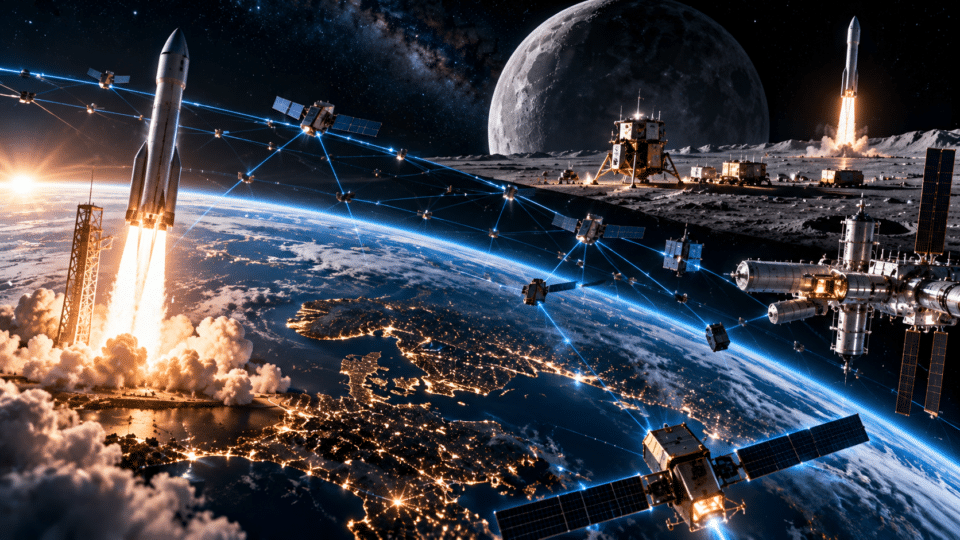
The space economy is no longer an exotic market dominated solely by government agencies and a handful of rocket builders. In 2025, the global value of space-related activity reached approximately $686 billion, according to the Space Foundation, while the World Economic Forum and McKinsey estimate that the space-based economy could reach around $1.8 trillion by 2035.
At the centre of this transformation are two companies founded by two of the world’s best-known entrepreneurs: SpaceX, founded by Elon Musk, and Blue Origin, founded by Jeff Bezos. But their competition can no longer be reduced to the question of who has the bigger rocket. The real stakes are infrastructure: who can launch most often, connect billions of devices, carry large payloads into orbit and to the Moon, and provide governments and businesses with reliable access to that infrastructure.
Rockets are only the first gateway. Beyond them lie constellations of thousands of satellites, orbital laser networks, direct-to-phone mobile services, military communications, internet for aircraft and ships, lunar logistics, landers and future orbital computing systems. In this race, the company that controls more layers of the infrastructure can turn space from a destination into an economic platform.
The space economy is about more than rockets and astronauts
When discussing the space economy, most of the value does not come from orbital tourism or extracting resources from the Moon. The OECD says the greatest economic value is already in the “downstream” segment: communications, navigation, positioning services, Earth observation, meteorology and applications that use this data.
Space systems support transport, energy, finance, agriculture, telecommunications and defence. In some advanced economies, a significant share of GDP depends directly or indirectly on satellite-based services. That is why orbital infrastructure is increasingly viewed in the same way as energy or telecommunications infrastructure: invisible to most people, but critical when it is unavailable.
In the same context, see also Earth has a vast reservoir of heat: why Big Tech is beginning to bet on advanced geothermal energy, which offers further relevant information.
The World Economic Forum estimates that much of the growth towards $1.8 trillion will come precisely from integrating space services into terrestrial industries such as transport, retail, agriculture, defence and digital communications.
SpaceX already has an advantage that few can replicate
SpaceX has built an economic model in which launches and orbital services reinforce one another. Falcon 9 launches satellites for external customers as well as for its own Starlink network. Starlink’s scale provides the company with steady internal demand for launches, while frequent flights lower costs and speed up rocket reuse.
In its June 2026 prospectus, SpaceX reported approximately 9,600 Starlink broadband and mobile satellites in orbit as of 31 March 2026, along with roughly 10.3 million subscribers. SpaceX said the constellation accounted for approximately 75% of active manoeuvrable satellites in orbit at that point.
This means Starlink is not merely a by-product of the launch business. It has become a global network with its own terminals, ground infrastructure, laser links between satellites, and services for consumers, businesses, aviation, maritime customers and governments.
Starlink is starting to turn satellites into mobile phone towers
One of the most important fronts in the competition is the direct connection between satellites and phones. SpaceX says the first generation of Starlink Direct to Cell includes more than 600 satellites and connects millions of users through compatible phones, without dedicated satellite antennas.
In October 2026, the company announced an agreement to acquire a portfolio of low-band spectrum in the United States, subject to FCC approvals. The strategy is to combine satellite-to-phone connectivity with terrestrial infrastructure and dedicated spectrum, bringing Starlink Mobile closer to the model of a telecommunications operator.
If this strategy expands, SpaceX will no longer be competing only with traditional satellite operators. It will move directly into the territory of mobile telecommunications companies and global connectivity infrastructure.
Amazon Leo is Amazon’s response to Starlink’s dominance
Amazon is developing its own satellite internet constellation, initially known as Project Kuiper and renamed Amazon Leo. The network is designed to include more than 3,000 satellites in low Earth orbit, linked through optical connections and supported by ground stations and fibre networks.
By 14 October 2026, Amazon said it had launched nearly 400 satellites across 14 missions. The company says it has already built more than 1,000 satellites at its own factory and has a manifest of more than 100 missions to expand the constellation.
The difference from SpaceX is enormous in terms of current operational scale, but Amazon has advantages of its own: AWS, cloud infrastructure, global logistics, enterprise relationships and a vast commercial base. If Amazon Leo can combine orbital connectivity with cloud and enterprise services, the competition could become one between two integrated ecosystems, rather than simply two constellations.
The paradox of the race: Amazon also launches satellites with SpaceX
One of the industry’s most striking realities is that rivalry does not eliminate dependence. Amazon Leo has launch contracts with Arianespace, United Launch Alliance, Blue Origin and SpaceX. In 2025, a Falcon 9 even launched an Amazon Leo mission.
This shows how difficult it is to build a mega-constellation quickly without access to several providers. Even a company associated with Jeff Bezos’s ecosystem buys services from Elon Musk’s company when it needs orbital capacity.
In economic terms, this is a sign of infrastructure power. A competitor can compete with you in the end market while also being your customer for the underlying infrastructure.
New Glenn changes the equation for Blue Origin
For Blue Origin, the key is New Glenn, its heavy-lift, reusable orbital launcher. Its first mission, in January 2025, reached orbit, although the booster was not recovered. The second mission, in November 2025, launched NASA’s ESCAPADE probes and successfully landed the reusable stage on an offshore platform.
In April 2026, New Glenn carried out its third mission, transporting an AST SpaceMobile satellite. Later, in May, an integrated static test suffered an anomaly that affected infrastructure at Launch Complex 36. Blue Origin began rebuilding and expanding the facilities, and in August announced the construction of a second pad, LC-36B, for a New Glenn 9×4 variant.
NASA added this New Glenn 9×4 variant to its Launch Services II contract in September 2026, allowing it to compete for future agency missions. This development matters: Blue Origin is seeking to move from a company with ambitious plans to a provider with repeatable launch infrastructure and institutional contracts.
Bezos’s real prize is the Moon, not just low Earth orbit
In 2026, Blue Origin reduced its focus on New Shepard suborbital flights and shifted resources towards lunar infrastructure. Blue Moon Mark 1, called Endurance, underwent thermal testing in the vacuum chamber at NASA’s Johnson Space Center and is intended for an uncrewed mission to the lunar south pole.
NASA is using Blue Origin and SpaceX in parallel to develop Human Landing System vehicles. SpaceX is developing the Starship HLS version, while Blue Origin is developing Blue Moon for later missions. Both companies are also working on cargo variants capable of carrying large equipment, rovers and infrastructure to the lunar surface.
This points to the next stage of the space economy: after access to orbit becomes cheaper and more frequent, competition shifts towards inter-orbital logistics and transport to the lunar surface.
NASA does not want to rely on one company for returning to the Moon
An audit by NASA’s Office of Inspector General, published in March 2026, found that both SpaceX and Blue Origin face delays and technical challenges in developing their landers. NASA is using competition between the two providers precisely to avoid dependence on a single architecture.
In 2026, NASA redefined Artemis III as a test mission in Earth orbit, with Orion and test versions of commercial landers, while the next human landing on the Moon is targeted for 2028. This gives SpaceX and Blue Origin more time, while maintaining competitive pressure.
The competition also has an economic dimension. If two companies can deliver people and cargo to the Moon, NASA and commercial customers can negotiate on price, availability and redundancy rather than relying on a monopoly.
Starship is SpaceX’s bet on an industrial-scale orbital economy
Falcon 9 built SpaceX’s current advantage, but Starship is the vehicle the company is designing for the next stage. The goal is a fully reusable rocket that can carry far more mass per flight than Falcon 9 and be relaunched quickly.
In July 2026, the thirteenth Starship test carried the first generation of next-generation Starlink V3 satellites. In its prospectus, SpaceX said a single Starship could carry up to 60 V3 satellites, potentially increasing the total downlink capacity launched by approximately 20 times compared with a Falcon 9 mission.
If this economy of scale can be achieved repeatedly, Starship would not simply be a rocket for Mars. It would become infrastructure for rapidly building constellations, stations, fuel depots, lunar systems and other orbital platforms.
Controlling launches may be more valuable than controlling a satellite
In 2026, the World Economic Forum examined the concentration of access to orbit and found that, in a comparable global sample excluding Starlink and certain Chinese and Russian data, a single family of launch vehicles had carried approximately 77% of payloads.
The point is not that one provider “owns space”, but that access to orbit can become a strategically concentrated point. A country may build an excellent satellite, but if it lacks access to an available rocket at the right time, its orbital capability remains grounded.
This helps explain why the United States, Europe, India, Japan and other countries are investing in their own launch vehicles or multiple providers. Launch redundancy is beginning to be treated like energy security: efficiency matters, but dependence on a single route can become a risk.
Why orbital connectivity is becoming strategic infrastructure
Starlink and Amazon Leo are not competing only for residential customers. LEO networks are being used or tested for aviation, maritime transport, governments, defence, emergency operations and connecting remote areas.
In October 2026, Amazon Leo and the US military announced a satellite connectivity demonstration using the Leo Pro terminal. Amazon has also signed agreements with aviation companies and telecom operators, and is seeking to turn the constellation into a connectivity layer for businesses and governments.
SpaceX has gone further in integrating Starlink with other space programmes. NASA selected Starlink laser terminals for Artemis III, enabling Orion to transmit 4K images through optical-link technology developed for the Starlink constellation.
This is a clear example of the platform effect: technology initially created for commercial internet becomes infrastructure for NASA missions.
The next frontier could be computing in orbit
In financial documents from 2026, SpaceX describes plans for future AI computing constellations in orbit, built on its experience producing and operating Starlink. The idea is for satellites to combine laser connectivity with computing hardware and solar power.
This remains a development plan, not mature commercial infrastructure. But the direction is significant: after communications, part of the space industry is beginning to explore moving data processing into orbit as well.
If launches become cheap enough and orbital solar energy can power specialised clusters, space could host not only communications relays but also processing centres. That would once again expand the definition of the space economy.
What “control of space” really means
No private company “owns” low Earth orbit or the Moon. Space is governed by international treaties, national legislation, spectrum licences, launch regulations and rules on satellite operations.
But economic control can emerge through infrastructure. If a company owns the rocket, constellation, terminals, spectrum, software, ground stations and commercial relationships, it can control a very large share of the chain through which a service reaches the customer.
This is why “control” should be understood here as infrastructure power and economic advantage, not legal ownership of space.
A $686 billion economy also brings a cost: orbital congestion
As more constellations are launched, orbital traffic and space debris become a growing problem. The World Economic Forum estimates that, unless orbital debris is managed more effectively, direct costs to the space economy could reach tens of billions of dollars over the next decade.
Large operators use automated collision-avoidance systems, but a growing satellite population means more conjunctions, more manoeuvres and an increasingly pressing need for international coordination.
Paradoxically, the success of mega-constellations makes orbital infrastructure more valuable and, at the same time, more fragile. If low Earth orbit becomes too congested, the cost of operating each satellite may rise.
Who wins: Musk or Bezos?
Today, in terms of launch scale and LEO constellations, SpaceX has a clear advantage. Falcon 9 has a very high flight cadence, Starlink has thousands of satellites and millions of customers, and Starship is being built to extend that scale.
Blue Origin, however, is at a different stage. New Glenn has demonstrated that it can reach orbit and recover its booster, the company is expanding its launch infrastructure, and Blue Moon positions it for lunar transport and NASA contracts. At the same time, the Amazon ecosystem is building its own Leo constellation.
The real contest may not produce a single winner. SpaceX could dominate launch and connectivity, Blue Origin could secure an important share of lunar logistics and heavy-lift launches, and Amazon Leo could become a major communications alternative.
More importantly, the market is large enough that the rivalry between Musk and Bezos is only one part of a global race involving companies, states and agencies in the United States, Europe, China, India, Japan and other regions.
Why the next monopoly will not look like the old ones
In digital infrastructure, power often comes from the ecosystem: the operating system, cloud, applications and data. Something similar could happen in space. A company may control access to orbit, then the orbital network, then the customer terminal and finally the service itself.
SpaceX is the most advanced example of vertical integration. Blue Origin and Amazon, however, are building similar components from different directions. States are seeking to avoid excessive dependence through contracts with multiple providers and support for their own infrastructure.
The World Economic Forum argues that multipolar access to orbit matters precisely for resilience. An economy dependent on a single launcher or constellation may be efficient under normal conditions, but vulnerable in the event of a failure, trade dispute or geopolitical crisis.
The next ten years could make space everyday infrastructure
When the space economy reaches $1.8 trillion, the biggest change may be that people will not feel they are “using space”. Just as people do not think about data centres when sending a message today, satellite connectivity, positioning, observation data and orbital services could operate in the background in the future.
A phone could automatically switch from a terrestrial tower to a satellite. An aircraft could have internet through a LEO constellation. An agricultural company could buy orbital data without knowing which satellite collected it. A NASA mission could use the same laser network developed for commercial customers.
At that point, the real power will not belong to whoever “gets to space first”, but to whoever succeeds in making space an ordinary, permanent and difficult-to-replace service.
InfoBuz has also examined emerging technologies that could change the world by 2030, as well as how major technology companies are investing in energy infrastructure for the next generation of data centres. The space economy follows the same logic: whoever controls the underlying infrastructure can control a disproportionately large share of the services built on top of it.
Frequently asked questions about the space economy
How much is the space economy worth? The Space Foundation reported approximately $686 billion for 2025, while other methodologies produce slightly different figures. The World Economic Forum and McKinsey estimate a market of around $1.8 trillion by 2035.
Which is larger today, Starlink or Amazon Leo? Starlink is far larger in terms of satellite numbers and customers. Amazon Leo is in a rapid expansion phase and reported nearly 400 satellites launched by October 2026.
Does Blue Origin compete directly with SpaceX? Yes, in heavy orbital launches, government contracts and lunar landers. In connectivity, the competition is indirect through Amazon Leo.
Can a company own orbit or the Moon? No. Companies operate under legislation and international treaties. Their power comes from infrastructure, licences, technology and services, rather than ownership of space.
Why is the Moon economically important? Because future missions will require regular transport of people, cargo, energy, communications and logistics. The first NASA contracts could create a commercial market for such services.
What is the risk posed by mega-constellations? Beyond cost and dependence, the large number of satellites increases orbital congestion, the number of avoidance manoeuvres and the risk of space debris.
Sources and transparency
- Space Foundation – State of the Global Space Economy 2026
- World Economic Forum / McKinsey – Space: The $1.8 Trillion Opportunity
- OECD – The Space Economy at a Glance 2026
- SpaceX – Starlink, Direct to Cell and infrastructure reuse
- Amazon – Amazon Leo mission updates, updated 14 October 2026
- NASA – Human Landing Systems: SpaceX Starship and Blue Origin Blue Moon
- NASA – New Glenn 9×4 added to Launch Services II, 29 September 2026
- World Economic Forum – Why the future of space access must be multi-polar, 29 June 2026
- World Economic Forum – Clear Orbit, Secure Future, 2026









Discuția cititorilor
Ai o opinie sau o întrebare despre acest articol? Spune-ne ce crezi.
Fii primul care deschide discuția.
Te rugăm să păstrezi un limbaj civilizat și să discuți la subiect. Comentariile spam sunt filtrate automat.