
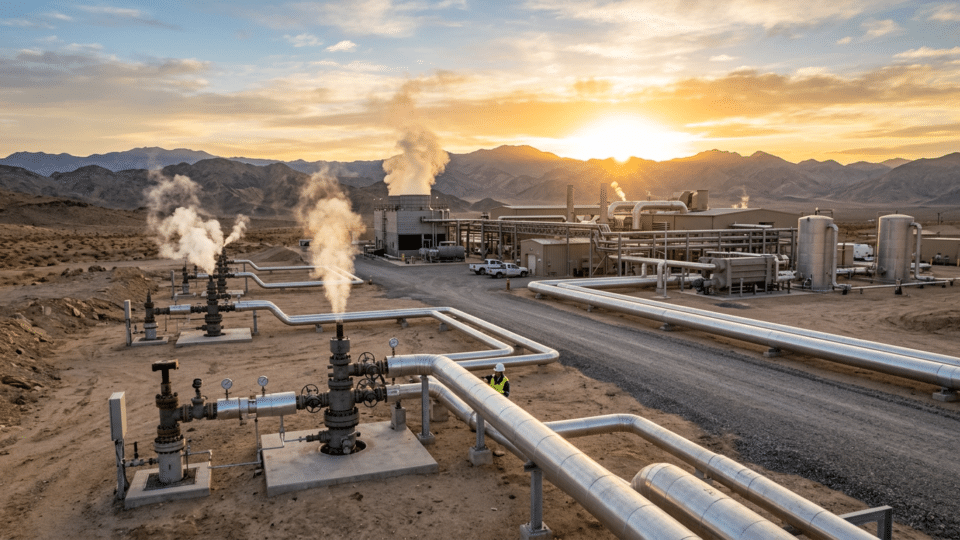
Advanced geothermal energy is beginning to move beyond the category of promising technologies and into the real infrastructure of the energy system. At the end of September 2026, Fervo Energy brought the first GeoBlock at Cape Station in Utah into commercial operation, with about 33 MW net. The project matters not only to the geothermal industry, but also to one of the biggest problems created by the AI boom: how to power data centres that need continuous, clean electricity precisely where the grid is already under strain.
Over the same period, Google signed a power-purchase agreement for 396 MW of geothermal electricity from Fervo, with an option that could take the total close to 1 GW. Separately, the commercial framework between the two companies opens the way for up to 3 GW by 2033. Meta, meanwhile, announced a partnership with Sage Geosystems for up to 150 MW of geothermal power intended to support the expansion of its data centres.
For more on data centres, see also AI power consumption reaches city scale: what happens when artificial intelligence runs into electricity limits, which provides complementary details on the subject.
That does not mean Google or Meta have become drilling companies. Big Tech firms finance and buy the power; geothermal developers drill, stimulate rock and build the facilities. But the fact that cloud giants are entering into contracts worth hundreds of megawatts sends a clear signal: for data centres, heat beneath the ground is beginning to be treated as strategic energy infrastructure.
The metaphor of a “battery beneath our feet” is appealing, but incomplete. Geothermal energy is first and foremost a heat reservoir, not a conventional battery. Some newer technologies can, however, also use underground pressure as a form of energy storage. The real attraction is that the Earth can provide an almost continuous energy source, with a small land footprint and a predictability that solar and wind do not offer on their own.
Advanced geothermal is not the same as conventional geothermal
Conventional geothermal works best where nature has already done almost all the work: hot rock is relatively close to the surface, water is present, and there is enough permeability for fluid to circulate.
That is why conventional geothermal plants are concentrated in places such as Iceland, California, Nevada, Indonesia, Kenya and the Philippines. The resource is excellent, but geographically constrained.
Enhanced Geothermal Systems (EGS) seek to overcome that constraint. Rather than looking only for naturally ideal reservoirs, developers drill down to sufficiently hot rock and create or improve the pathways through which fluid can circulate.
The concept borrows heavily from oil and gas technologies: directional drilling, horizontal wells, stimulation, downhole sensors and reservoir modelling. The difference is that the goal is not to extract hydrocarbons, but to transfer heat from the rock to the surface.
Why AI data centres need 24/7 power
A data centre cannot operate only when the wind is blowing or the sun is shining. Servers, cooling systems and network infrastructure need a constant power supply.
Solar and wind remain essential to decarbonisation and are often the cheapest new sources of electricity. But for a consumer requiring hundreds of megawatts around the clock, variable sources must be combined with the grid, storage or dispatchable generation.
This is where geothermal is attractive. The IEA says the global geothermal fleet had an average capacity factor of more than 75% in 2023, well above the averages for solar and wind. Some plants can also adjust their output and support grid stability.
InfoBuz has separately examined why Big Tech is also seeking nuclear power for the next generation of data centres. Geothermal belongs in the same category of “firm clean power”: low-emissions energy that can be available at night, in winter and when the wind drops.
Cape Station: the first greenfield EGS project reaches commercial operation
On 1 October 2026, Fervo announced that the first GeoBlock at Cape Station had reached its contractual commercial-operation date and was producing about 33 MW net. The company describes it as the world’s first greenfield enhanced-geothermal development to reach contractual commercial operation.
Cape Station Phase I is designed for about 100 MW and is divided into three GeoBlocks of roughly 33 MW each. Fervo says it already has 900 MW fully contracted at Cape Station and more than 4 GW under development at the site.
It is important to distinguish contracted capacity from capacity already being delivered. As of October 2026, only the first block had actually entered commercial operation. The remainder of the project is at various stages of construction and development.
Google moves from a few megawatts to hundreds
The first Google–Fervo collaboration began as a pilot project in Nevada. In 2026, the relationship moved to a different scale.
In March, the two companies set a framework for developing up to 3 GW of geothermal capacity by 2033, of which up to 1 GW could be accelerated during the first two years.
On 1 September 2026, Fervo also announced a 396 MW PPA with Google for electricity produced at the Cape Station GeoCluster. The agreement includes an option for about another 600 MW, which could take the total close to 1 GW by 2030.
Fervo says the electricity could serve as a foundational component for a potential Google data centre in Utah, although final data-centre plans remain subject to approvals and commercial conditions.
Meta bets on a different geothermal technology
Meta is not using the same architecture as Fervo. It has partnered with Sage Geosystems, which is developing geopressured geothermal and pressure geothermal technologies.
The partnership announced for data centres targets up to 150 MW of geothermal generation, with the first phase scheduled to enter operation in 2027.
Sage is also pursuing an additional approach: using wells and underground pressure for energy storage lasting several hours or days. In this case, the battery metaphor becomes more literal: energy can be used to pressurise underground fluid, then recovered when the grid needs it.
The company says its first commercial storage project in Texas entered service in 2026, while generation projects are being expanded.
The big revolution is not underground. It is in drilling technique.
The Earth has always been hot. What has changed is the industry’s ability to reach that heat faster and more cheaply.
Fervo has adopted techniques developed in shale oil and gas: long horizontal drilling, highly precise directional control, simultaneous operations across multiple wells and reservoir stimulation.
In July 2026, the company reported that its Sawtooth 7 well reached about 19,448 feet of measured depth, including a 7,500-foot lateral, in a resource of about 460°F, in just 21 days.
Fervo says its drilling pace improved by about 143% compared with the first Cape Station well of the same design family, and by much more compared with its earliest commercial demonstrations.
Those gains matter because drilling is one of the largest cost components in EGS. A day saved on an expensive drilling rig can translate into major reductions across an entire project.
Why oil and gas could be a major source of clean-energy know-how
Advanced geothermal is one of the few clean-energy technologies that can directly reuse a very large share of the oil and gas industry’s skills.
Geologists, directional drillers, completion engineers, well-service companies, equipment manufacturers and reservoir-modelling specialists deal with similar problems: high temperatures, pressure, rock, cementing and fluid circulation.
The IEA sees this transfer of technology and workforce from oil and gas as one reason next-generation geothermal could progress faster than an industry built entirely from scratch.
Why geothermal is so attractive near a data centre
In many regions, the main challenge for new data centres is not only the price of electricity, but the time needed to connect to the grid. A campus can be built faster than a high-voltage transmission line or a large power plant.
Fervo says it is also developing “behind-the-meter” models, in which a data centre receives part of its electricity directly from a local geothermal resource rather than relying solely on grid reinforcement.
That does not mean a data centre can operate in complete isolation using only one well. Redundancy, electrical equipment, maintenance and often a grid connection are still needed. But a geothermal source of tens or hundreds of megawatts can reduce the amount of new capacity that has to be brought in from elsewhere.
Geothermal has a surprising advantage: it uses little land
A geothermal facility draws energy from a volume of rock kilometres beneath the surface. At ground level, the remaining infrastructure consists of drilling pads, pipelines and the power plant.
Compared with the generation required from a large solar or wind farm, its direct land footprint can be smaller. For data centres close to cities or in areas where land is expensive, that can become highly valuable.
Geothermal also does not depend on daily weather conditions and can generate consistently, reducing the need to oversize capacity solely to account for weather variation.
How large is the global potential?
The IEA estimates that, if technology continues to improve and costs fall, geothermal could meet up to 15% of growth in global electricity demand by 2050.
In the agency’s technical scenario, developing up to 800 GW of geothermal capacity could become economic, with annual generation close to 6,000 TWh.
This is not a guaranteed forecast. It is a potential dependent on costs, regulation, access to capital, drilling success and project acceptance. Today, geothermal accounts for only a small fraction of global electricity generation.
The US target: $45/MWh for EGS
Through its Enhanced Geothermal Shot, the US Department of Energy has set an ambitious target: to reduce the cost of EGS by 90% from reference levels and reach about $45/MWh by 2035.
A DOE report on commercialising next-generation geothermal says project-cost estimates have already fallen sharply from 2021 levels, mainly because of better drilling, stimulation and facility design.
The $45/MWh target should not be confused with the current cost of every project. Some projects will cost more, while others may become cheaper. It is an industrial-maturity target for the coming decade.
AI is helping extract energy for AI
There is also an interesting technological loop. In June 2026, Fervo, Pacific Northwest National Laboratory and NVIDIA announced the development of an EGS “digital twin”.
The platform is designed to combine real-time field data, physical reservoir models and AI predictions. Its aim is to optimise fluid circulation, identify changes in the reservoir and raise production over a project’s lifetime.
The AI that demands energy is thus also becoming a tool to find and use the energy that powers it more efficiently.
Not all “advanced geothermal” works the same way
The industry uses several technology families:
- EGS: creates or improves rock permeability so fluid can circulate through a hot reservoir.
- Closed-loop geothermal: fluid circulates in a closed circuit, without significant contact with rock outside the well.
- Geopressured / pressure geothermal: uses underground pressure and heat, and can combine generation with energy storage.
- Superhot rock: pursues far higher temperatures, with very high energy potential but also extreme materials and drilling challenges.
No technology is a universal winner. The appropriate solution depends on geology, depth, temperature, drilling costs and the energy application.
The most discussed risk: induced seismicity
EGS can involve injecting fluid under pressure to open or enlarge existing fractures in rock. This operation can produce microseismicity and, under certain conditions, events felt at the surface.
The industry uses seismic monitoring, geomechanical models and traffic-light systems to reduce the risk. Even so, induced seismicity remains one of the main challenges for public acceptance and permitting.
That means EGS cannot be installed without geological studies simply because heat is available at depth.
Water is another important constraint
Some EGS systems require significant volumes of water for stimulation and the initial filling of the circuit. Part of the fluid can be lost into the rock and must be replaced.
In arid regions, this can create competition with agriculture, cities or ecosystems. Future designs will favour fluid reuse, non-potable sources and technologies with the lowest possible losses.
Closed-loop geothermal can reduce some risks associated with contact with the formation, but heat transfer and well costs remain challenges in their own right.
Geothermal is not “zero impact”
A geothermal plant has lifecycle emissions and uses steel, cement, pumps, fluids and energy for drilling. Some conventional geothermal reservoirs can release gases dissolved underground.
But operating emissions and land use are generally low compared with fossil fuels, while closed EGS systems recirculate fluid in a controlled loop.
The accurate description is “very low-emissions energy with high availability”, not “energy with no impact at all”.
Why geothermal can complement, not replace, solar and wind
A resilient energy system does not need one technology alone. Solar can generate very cheaply during sunny hours. Wind can provide large volumes in favourable regions. Batteries shift energy between hours. Hydropower and nuclear provide other forms of flexibility and steady generation.
Geothermal can add a particularly valuable piece: constant, low-emissions power that is independent of the weather.
That is why its value may be greater than a simple comparison of cost per MWh suggests. A megawatt available at 3am on a windless day does not have the same system value as a megawatt generated only when there is already a solar surplus.
Romania has reasons to watch this development closely
Romania has a history of using geothermal energy for heating and hydrothermal resources in the west of the country. But next-generation EGS technologies could eventually expand the geographical area beyond the traditional zones with readily accessible thermal water.
That does not mean Romania can replicate Utah’s projects tomorrow. Geological mapping, characterisation drilling, assessments of temperatures at depth and an economic framework that justifies the investment would all be required.
But there is an important advantage: drilling expertise, oil and gas engineering, and existing infrastructure could lower the barrier to entry if the technology becomes competitive.
For broader context, InfoBuz has also examined emerging technologies that could reshape energy infrastructure by 2030. Advanced geothermal lies precisely at the intersection of the energy transition and the know-how of the conventional drilling industry.
What could change the game over the next five years
- Faster drilling: every reduction in drilling time lowers capital and equipment costs.
- More productive wells: higher flow rates mean fewer wells for the same output.
- Better controlled reservoirs: sensors and AI models can reduce the risk of unproductive zones.
- Large contracts with hyperscalers: Google, Meta and other buyers can finance projects before the utility market moves.
- Faster regulation: permitting wells and power lines may become as important as the technology itself.
- Storage integration: pressure geothermal systems can combine generation with energy flexibility.
Why Big Tech can accelerate an entire energy industry
A geothermal project has high costs before it sells its first MWh. The resource must be identified, wells drilled, the plant built and permits obtained.
A long-term agreement with a buyer such as Google or Meta reduces commercial risk. The developer can show financiers that there is a creditworthy customer for the electricity produced.
This is why Big Tech can have a disproportionate effect. Not because data centres represent all energy demand, but because they can sign contracts large enough to enable the first commercial projects using a new technology.
The Earth is not an infinite battery, but its heat reservoir is vast
An individual geothermal reservoir is not infinite. If it is developed too aggressively, the rock may cool faster than it is thermally replenished. Design must balance flow rates, temperature, and the distance between injection and production wells.
At planetary scale, however, the heat resource is immense. The IEA and DOE estimate technical potential far above current electricity consumption, if technology can reach enough regions economically.
The accurate formulation, then, is this: the Earth is a gigantic energy reservoir, but each project must be designed as a sustainable thermal development.
AI is looking for power in the planet’s oldest rocks
It is one of 2026’s more interesting technological ironies. The newest artificial-intelligence models are pushing electricity systems towards their limits, while one of the solutions under consideration draws on heat that has been in the Earth for billions of years.
Cape Station shows that EGS can reach commercial operation. Google’s contracts show there are buyers for hundreds of megawatts. Sage and Meta’s projects show that several architectures are competing for the same opportunity.
Advanced geothermal will not replace solar, wind, nuclear power or the grid. But if drilling continues to become cheaper, it could become one of the most valuable sources of steady electricity for a world in which digital consumption is growing ever faster.
And when a data centre needs power at any hour, whatever the weather, the heat beneath our feet begins to look far more compelling than it did a few years ago.
Frequently asked questions about advanced geothermal energy
What is advanced geothermal energy?
It is a broad term for technologies such as EGS, closed-loop geothermal and pressure geothermal, which seek to generate electricity from resources that do not have the ideal characteristics of a conventional geothermal reservoir.
What is EGS?
Enhanced Geothermal Systems use wells and controlled rock stimulation to create a circuit through which fluid can absorb heat and carry it to the surface.
Why is Google buying geothermal power?
Because geothermal can provide low-emissions electricity 24/7, making it useful for data centres with continuous demand. Google has agreements with Fervo covering hundreds of megawatts and a framework for larger-scale development.
Is geothermal a battery?
Conventional geothermal and EGS are heat sources, not batteries. Some pressure-geothermal technologies can, however, also be used for energy storage by pressurising underground fluid.
Can it be built anywhere?
New technologies greatly expand the potential area, but not every location is economic. Temperature at depth, rock type, geological stress, water, grid access and drilling costs all matter.
Are there seismic risks?
Yes. EGS can induce microseismicity and, rarely, felt events. Monitoring and pressure control are essential to reducing the risk.
Sources and transparency
- Fervo Energy – Cape Station commercial operation, 1 October 2026
- Fervo Energy – Google 396 MW PPA, 1 September 2026
- Fervo Energy – Google geothermal framework of up to 3 GW through 2033
- Fervo Energy – Sawtooth 7 drilling record, 8 July 2026
- Fervo / PNNL / NVIDIA – EGS-Twin platform, 22 June 2026
- Meta – Sage Geosystems geothermal project for data centres, updated 2025
- Sage Geosystems – project pipeline and pressure-geothermal deployments
- IEA – The Future of Geothermal Energy
- IEA – investment in next-generation geothermal, 2026
- US Department of Energy – Enhanced Geothermal Shot, $45/MWh target
- US Department of Energy – Pathways to Commercial Liftoff: Next-Generation Geothermal Power






Discuția cititorilor
Ai o opinie sau o întrebare despre acest articol? Spune-ne ce crezi.
Fii primul care deschide discuția.
Te rugăm să păstrezi un limbaj civilizat și să discuți la subiect. Comentariile spam sunt filtrate automat.