
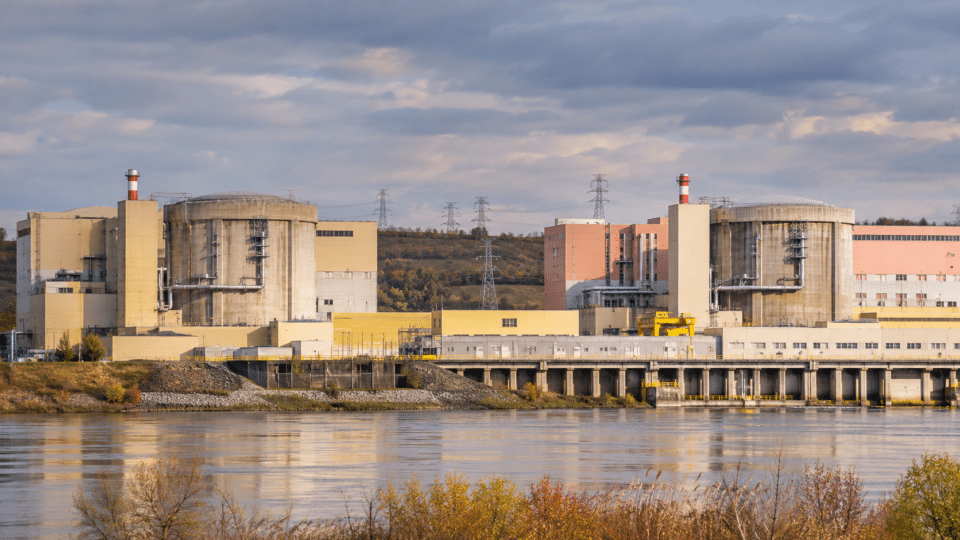
Unit 2 at the Cernavodă Nuclear Power Plant was reconnected to Romania’s National Energy System (SEN) on Wednesday, November 11, 2026. At the same time, after a technical fault once again took Unit 1 off the grid, Nuclearelectrica announced a revised timetable: Unit 1 is scheduled to be reconnected on November 12, while both reactors are expected to return to nominal output on November 13. The information is contained in an official report filed with the Bucharest Stock Exchange on November 11 at 10:52 a.m.
If the deadlines are met, the episode will bring to an end a difficult period for Romania’s nuclear generation. After several months offline because of low water levels on the Danube, Cernavodă Unit 1 returned to the grid on November 6 but was disconnected again on November 9. The incident occurred in the plant’s conventional section, around the steam turbine and condenser, rather than in the nuclear reactor. This article reviews company statements, system data and officials’ explanations to distinguish confirmed facts from issues still under investigation.
Information updated on November 11, 2026. The dates of November 12–13 are officially communicated estimates, not confirmation that the operations have already been completed.
At a glance: the current position of Cernavodă’s two reactors
- Unit 2: was connected to the National Energy System on November 11; it is expected to reach nominal output on November 12, 2026.
- Unit 1: is scheduled to be reconnected on November 12, after repair work is completed; nominal output is expected on November 13.
- The Unit 1 fault: the problem was reported in the turbine condenser’s vacuum-control system; the underlying cause has not yet been established in a final public report.
- Nuclear safety: Nuclearelectrica says the November 9 incident did not affect nuclear safety, personnel or the environment.
- Energy impact: once back at nominal output, the two units are expected to again cover about 20% of Romania’s electricity consumption, according to the company.
The official timetable: when Unit 1 returns and what Unit 2 is producing
Nuclearelectrica’s latest current report supersedes earlier estimates. On Wednesday, November 11, the company explicitly confirmed that Unit 2 was already connected to the SEN. The next stage is a controlled increase in output to its nominal level, scheduled for Thursday, November 12.
For Unit 1, the official statement gives November 12 as the reconnection date, after the interventions are completed, and November 13 as the target date for nominal output. In that context, it would be premature to say that both units are already operating at maximum capacity: synchronisation with the grid and reaching nominal output are distinct stages.
On November 10, the company had announced an estimate of two to four days for technical work on Unit 1, separate from restart operations. The following report, dated November 11, set out a more precise timetable. It remains conditional on meeting operational and nuclear-safety requirements.
What failed at Cernavodă Unit 1 on November 9
After being resynchronised on November 6, Unit 1 ran continuously for only about three days. On the afternoon of Monday, November 9, the power it delivered began to fall, and at about 5:57–5:59 p.m., the unit was no longer supplying electricity to the grid, according to system data reported by specialist media. Nuclearelectrica confirmed that evening that the unit had been disconnected following a fault in the plant’s conventional section.
Data attributed to Transelectrica, Romania’s power-grid operator, described the event as a problem with the vacuum-control system in the turbine condenser. Pavel-Casian Nițulescu, a state secretary at the Energy Ministry, later pointed in a public appearance to an ejector associated with maintaining the condenser vacuum. The technical statements point to the same area of the plant, but identifying a component is not the same as fully establishing the underlying cause.
In its official statement of November 9, Nuclearelectrica said the shutdown was carried out in accordance with operating procedures and that nuclear safety, personnel and the environment were not affected. The company also said that its root-cause analysis report would be presented later.
Technical explanation: why vacuum matters in a turbine condenser
A nuclear power plant produces electricity in several stages. The reactor generates heat; the heat is used to produce steam; the steam drives a turbine; and the turbine turns an electrical generator. After leaving the turbine, the steam enters a condenser, where it is cooled and converted back into water so that it can be recirculated in the thermal cycle.
Very low pressure, commonly called a “vacuum”, must be maintained in the condenser. That pressure difference allows steam to expand efficiently through the turbine. Ejectors and non-condensable-gas extraction systems remove air and gases that would impair the vacuum. If pressure in the condenser rises above permitted limits, turbine operation becomes inefficient or technically unacceptable, and protection systems may require output to be reduced or the unit to be shut down.
In other words, a loss of condenser vacuum can halt electricity generation and delivery even though the problem is not in the nuclear-fuel area. This distinction explains why the event had material consequences for grid supply but was not described by the operator as a nuclear accident. This is a general explanation of how the system works; the precise failure mechanism of the equipment at Cernavodă remains under investigation.
Nuclear accident or industrial fault? What the official documents say
There is no official confirmation of a nuclear accident connected with the November 9 shutdown. Nuclearelectrica refers to a fault in the unit’s conventional section and says protection systems and safety procedures worked. The Energy Minister stated publicly that the problem was in the steam-turbine area, not in the reactor.
At the same time, the absence of an effect on nuclear safety does not mean the incident is unimportant. Unplanned outages reduce available generating capacity, can require complex interventions and put pressure on production scheduling. That is why the technical investigation and preventive measures matter even where nuclear-safety functions are unaffected.
During the drought period, the regulator, CNCAN, separately explained that the controlled shutdowns of the units were preventive measures, with no radiological consequences for the public or the environment. The shutdown caused by insufficient water and the technical fault of November 9 are two different events and should not be conflated.
Why both units shut down in the summer: the role of the Danube
The availability crisis began before the November incident. According to information from the operator and CNCAN, Unit 1 was placed in a controlled shutdown on July 28, 2026, and Unit 2 on August 13, 2026, amid very low levels on the Danube. A thermal power plant, including a nuclear plant, needs a sufficient water source to remove heat from its cooling processes.
There is an important technical distinction here: water drawn from the Danube is not the heavy water circulating in the primary circuit of the CANDU reactor. These are separate systems. Dependence on the river concerns the operation of cooling facilities and compliance with the plant’s technical parameters, including safety margins.
On October 29, Nuclearelectrica reported a local increase of about 10 centimetres in the water level at the pump intake basin. However, the company warned that the trend was not yet sustained across the wider Danube basin and that restart criteria had not been met. The decision was postponed until the parameters stabilised, according to an official statement.
The restart of Unit 1 began on November 4, after the minimum necessary conditions had been met. At that time, the operator warned that running the first unit used capacity from the cooling-water supply system, meaning that starting Unit 2 required a sustained rise in the Danube’s level. That threshold was subsequently reached, allowing procedures for the second unit to begin.
Full timeline: from the July drought to the return to the grid
- July 28, 2026: Unit 1 is placed in a controlled shutdown amid severe hydrological conditions.
- August 13: Unit 2 is disconnected; neither unit is any longer producing nuclear power for the grid.
- October 11 and 29: Nuclearelectrica confirms that the units remain safely shut down; the local water-level rise is still insufficient to resume generation.
- November 4: Unit 1 restart operations begin after minimum criteria are met.
- November 6: Unit 1 returns to the National Energy System.
- November 9: Unit 1 is disconnected following a fault in the conventional section; meanwhile, restart operations for Unit 2 begin.
- November 10: Nuclearelectrica updates the timetable for Unit 2 and announces an estimated two-to-four-day period for work on Unit 1.
- November 11: Unit 2 is effectively reconnected to the SEN; the company sets a new timetable for Unit 1.
- November 12 (estimate): Unit 2 reaches nominal output and Unit 1 is reconnected.
- November 13 (estimate): Unit 1 reaches nominal output; both units are expected to operate at normal capacity.
Why Unit 2’s return matters for Romania
Cernavodă operates two CANDU 6 units, commissioned commercially in 1996 and 2007. Their combined gross capacity is about 1.4 GW, while combined net capacity is in the order of 1.3 GW, according to World Nuclear Association data. Under normal operating conditions, nuclear power provides an important part of domestic generation, independent of daily variation in wind and sunshine.
Nuclearelectrica estimates that, once both units return to nominal output, the plant will again provide about 20% of Romania’s electricity demand. This is an order-of-magnitude reference provided by the operator, rather than a constant share in every hour: the real proportion changes with demand, the availability of other sources and cross-border flows.
Unit 2’s return ahead of Unit 1 is therefore a meaningful change: the system begins to recover nuclear generation even though the first unit has not completed all its interventions. Reconnection does not mean an immediate return to maximum output, as the plant must move through controlled load-increase stages.
Energy imports and prices: how large is the impact?
While both units were absent from the grid, Romania had to balance consumption through its other domestic plants, production adjustments and imports. System data from November 10, analysed by business media, indicated net imports of more than 3,000 MW at certain points. These figures describe specific moments, not a constant level throughout the day.
For more on Cernavodă, see also Romania enters November with elevated energy risk: the 5:00–9:00 p.m. window becomes critical, which provides additional detail on the subject.
It is important not to attribute the full volume of imports solely to the Cernavodă outage: the energy balance depends simultaneously on national consumption, hydro, thermal, wind and solar generation, as well as commercial exchanges with neighbouring countries. The unexpected loss of a unit of several hundred megawatts does, however, increase the need to cover a shortfall at certain hours.
On the wholesale market, replacing unavailable capacity can increase exposure to high prices, particularly during periods of high demand and insufficient domestic generation. There is no automatic link, however, between a technical incident lasting a few days and an immediate increase in every consumer’s bill: the effects depend on contracts, tariffs, consumption patterns and market developments. Generation, imports and prices must be tracked separately for a sound assessment.
For continuously updated energy context, InfoBuz also has a Romania Energy Live page, as well as an analysis of Romania’s energy mix.
Why the technical director is being replaced and what is being investigated in maintenance
In its November 9 statement, Nuclearelectrica’s management announced its decision to replace Cernavodă NPP’s technical director from December 1, 2026. The company said it would assess maintenance activities, accelerate the review of procedures and draw up an operational remediation plan benchmarked against relevant international standards.
The decision reflects concern over the frequency of unplanned unavailability, which company management says has not met its own performance standards. At the same time, Energy Ministry representatives have said publicly that they are also examining whether human factors may have contributed to the maintenance process. This is a hypothesis being examined, not an established conclusion or an attribution of blame.
The legitimate technical questions are: which equipment actually failed; what triggered the loss of vacuum; what servicing and testing had been carried out before the restart; whether there were warning signs; and what measures can prevent a recurrence. Documented answers must come from the final technical report and statements by the competent institutions, not speculation.
What could reduce the risk of further shutdowns
The problems of 2026 fall into two categories and require different responses. Hydrological vulnerability concerns access to sufficient cooling water, the configuration of water-intake facilities, monitoring of water levels and resilience during severe drought. Technical availability concerns equipment reliability, redundancy, monitoring, testing and maintenance quality.
In general terms, relevant measures could include updated hydrological assessments; improved monitoring of pumps and cooling systems; consideration of options for adapting to low river levels; additional checks of the vacuum system; and systematic analysis of the causes of unplanned outages. These are possible technical areas for assessment, not projects that InfoBuz says have already been approved or implemented at Cernavodă.
Indeed, the operator had already announced consultations with specialists in October on medium- and long-term solutions so that similar hydrological episodes would have less effect on generation. Its stated priority remains operation within nuclear-safety limits.
Questions and answers on the Cernavodă situation
Has Cernavodă Unit 2 restarted?
Yes. It was reconnected to the SEN on November 11, 2026. Nominal output is expected on November 12, according to Nuclearelectrica’s report published that day on the Bucharest Stock Exchange.
When will Cernavodă Unit 1 restart?
Nuclearelectrica has scheduled reconnection for November 12 and nominal output for November 13, 2026, subject to the completion of work and procedures.
Why did Unit 1 shut down only three days after returning?
The incident involved the plant’s conventional section, particularly the turbine condenser and vacuum-control area. The underlying technical cause had not been definitively published as of November 11; the operator said it would carry out a subsequent analysis.
Was there a radiation risk for the public?
According to the available official statements, the November 9 disconnection had no impact on nuclear safety, personnel or the environment. CNCAN also explained the preventive and safe nature of the shutdowns during the drought period.
Did the Danube cause the turbine fault?
There is no official conclusion establishing such a causal link. The Danube’s low level led to the controlled summer shutdown; a separate problem occurred in November in Unit 1’s conventional system.
Will electricity become more expensive because of the shutdown?
A major unavailable capacity can add pressure to the wholesale market and to import requirements, but an automatic rise in individual bills cannot be inferred from this incident alone.
What to watch next
- Confirmation that Unit 1 synchronises with the grid on November 12, followed by its reaching nominal output on November 13.
- Confirmation of nominal output at Unit 2 on November 12 and stable operation in the following days.
- The final report on the root cause of the November 9 incident and the preventive measures announced.
- Updates on maintenance and technical management, including the change scheduled for December 1.
- Developments in Danube hydrology and electricity demand, which may affect availability and system balancing.
Additional context and a timeline are available in InfoBuz articles on Unit 1’s first November restart, why both reactors were shut down because of the Danube and the impact of the period without nuclear generation.
Documents and sources reviewed
- Nuclearelectrica / Bucharest Stock Exchange, report of November 11, 2026 – confirmation of Unit 2’s connection and the timetable for Unit 1.
- Nuclearelectrica / Bucharest Stock Exchange, report of November 10, 2026 – estimate for the interventions and initial timetable update.
- Nuclearelectrica, statement of November 9 – Unit 1’s disconnection, nuclear safety and management measures.
- Nuclearelectrica, statement of November 4 – restart conditions and the link to Danube levels.
- Nuclearelectrica, statement of October 29 – water levels and restart criteria.
- CNCAN, briefing of September 9 – the preventive nature of shutdowns caused by hydrological conditions.
- Digi24, November 10 – official statements on the ejector, vacuum and maintenance checks.
- World Nuclear Association, report updated in October 2026 – reference data on the CANDU reactors and their capacity.
Editorial note: This article distinguishes between confirmed facts, operational estimates and general technical explanations. If the operator changes the deadlines or publishes its root-cause report, the information should be updated before being recirculated as breaking news.









Discuția cititorilor
Ai o opinie sau o întrebare despre acest articol? Spune-ne ce crezi.
Fii primul care deschide discuția.
Te rugăm să păstrezi un limbaj civilizat și să discuți la subiect. Comentariile spam sunt filtrate automat.