
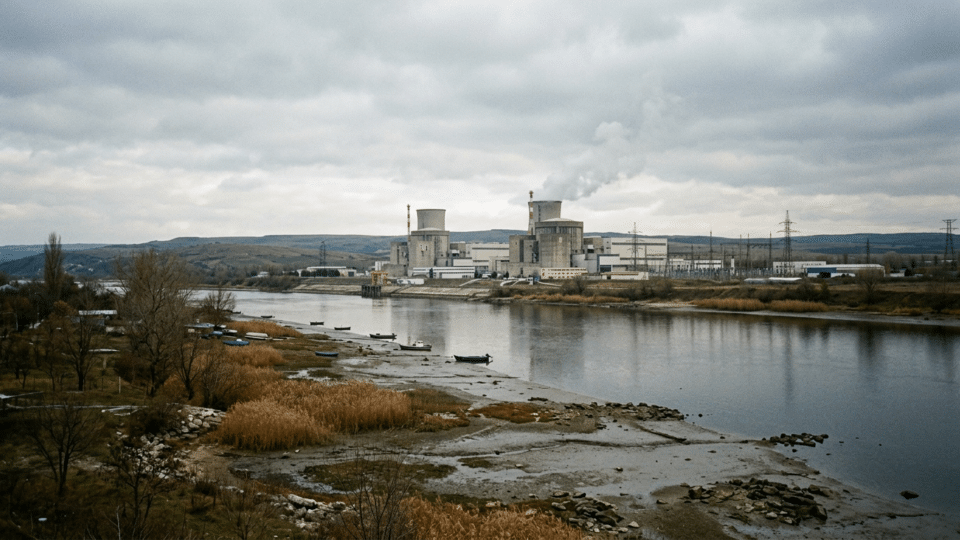
On 4 November 2026, the restart of Cernavodă Unit 1 officially entered the technical manoeuvres phase. Nuclearelectrica, Romania’s state-owned nuclear power company, told the Bucharest Stock Exchange that the minimum conditions for beginning operations had been met, and that reconnecting the reactor to the National Energy System is estimated for Friday, 6 November. It is the most significant development for Romania’s nuclear generation since both units were shut down in a controlled manner because of exceptionally low water levels on the Danube.
The announcement does not mean that Unit 1 is already generating electricity, or that both reactors will restart at the same time. Starting a CANDU unit involves checks, manoeuvres and a controlled increase in output. Unit 2 remains offline until hydrological conditions allow both units to operate safely. Based on Nuclearelectrica’s official report, information from the National Commission for Nuclear Activities Control (CNCAN), and the system timetable, InfoBuz explains what happens next, why Danube water matters and how much the return of nuclear generation could help Romania.
Cernavodă Unit 1 restart: the official announcement of 4 November 2026
In a current report dated 4 November 2026, the company confirmed the start of Unit 1 start-up manoeuvres after the minimum necessary conditions had been met. The document, submitted to the Bucharest Stock Exchange and the Financial Supervisory Authority, gives Friday, 6 November 2026, as the estimated date for resynchronisation with the National Energy System (SEN).
For further information on Transelectrica, Romania’s power transmission operator, see also The first turbine at Mintia has been fired up. When will electricity reach the grid?, which offers additional context on the subject.
Chief executive Mihai Laurențiu Gioară said the resumption of operations matters for energy security and system stability. Company management also said that staff had kept the reactors in safe conditions throughout the shutdown, while Nuclearelectrica and the authorities seek measures to reduce vulnerability to possible future drought episodes.
The essential point: Nuclearelectrica has confirmed that the procedures have begun, not that they have been completed. The reconnection date is an operational estimate, dependent on technical progress and the continued maintenance of the necessary parameters.
At a glance: six key points
- 4 November 2026: start-up manoeuvres began at Unit 1.
- 6 November 2026: Nuclearelectrica’s official estimated date for resynchronisation with the grid.
- 7 November 2026: the system timetable reported in the press indicates a return to normal operating conditions, provided there are no changes.
- About 700 MW: the installed capacity of one Cernavodă unit; actual electricity supplied rises gradually after synchronisation.
- Unit 2: has no firm restart date because the water level needed for both reactors must be ensured.
- Nuclear safety: the summer shutdown was preventive and controlled, not the result of a nuclear accident.
The restart timetable: what happens between 4 and 7 November
Wednesday, 4 November: start of the manoeuvres
Plant teams began the technical actions set out in operating procedures. At this stage, the plant is preparing the unit’s controlled return; the mere beginning of manoeuvres does not mean significant power is being supplied to Romania’s national grid.
Friday, 6 November: estimated synchronisation with the National Energy System
This is the date stated explicitly in Nuclearelectrica’s official communication. According to a Transelectrica timetable reported by Adevărul on 4 November, synchronisation was scheduled for 13:00. The time is an operational plan cited by the press, rather than an independent guarantee in Nuclearelectrica’s report.
Saturday, 7 November: gradual ramp-up towards normal output
The same report indicates that normal operating conditions would be reached on Saturday at 19:00. In practice, a generation schedule can be adjusted for technical or nuclear-safety reasons. A further statement from the operator and the evolution of actual power supplied to the SEN will provide the decisive confirmation.
The Cernavodă crisis timeline: how both units came to be shut down
The problem did not emerge overnight. Hydrological drought in the Danube basin gradually reduced water flow and levels, affecting the conditions for supplying the plant’s cooling circuits. According to a CNCAN notice of 9 September 2026, the shutdowns were preventive measures carried out in a controlled manner, with no radiological consequences for people or the environment.
- 28 July 2026: Unit 1 was shut down in a controlled manner as Danube levels fell.
- 13 August 2026: Unit 2 was shut down in a controlled manner; the plant no longer supplied nuclear generation from its two reactors.
- September–October: authorities continuously monitored hydrological conditions and applied measures to maintain plant safety.
- 29 October: Nuclearelectrica found a local improvement in water conditions at the intake basin, but considered the trend insufficiently stable for a restart.
- 30 October: the government maintained, until 30 November, the possibility of applying exceptional energy-market safety measures.
- 4 November: the minimum conditions for beginning Unit 1 start-up manoeuvres were met.
For earlier context, InfoBuz explained why Danube levels led to the shutdown of the two reactors and the energy system’s vulnerabilities when nuclear generation is unavailable.
Why does a nuclear power plant depend on Danube levels?
Cernavodă uses Canadian CANDU 6 reactors, which use natural uranium as fuel and heavy water in their nuclear circuits. Heat generated by fission is transferred through heat-exchange systems to the steam circuit, which drives the turbine and electricity generator. An effective cooling system is needed to condense steam after the turbine and remove waste heat.
One distinction is important: Danube water does not circulate directly through nuclear fuel. The reactor’s primary circuit and the cooling-water route from the external source are separate systems. Even so, the availability of a water source to remove heat is essential to plant operation and to maintaining safety margins.
What is the intake basin, and why can a few centimetres matter?
The intake basin is the area from which pumps draw the water required for cooling circuits. If the level falls, unfavourable hydraulic conditions can arise for pump operation, reducing operational margins. Operating thresholds are not determined by the impression that there is still water present, but by design limits, required flow rates, intake conditions and safety requirements.
At the end of October, Nuclearelectrica reported a local rise in the level at this basin, but said the required level had to be maintained for several days and show an upward trend. A few rain showers or a short-lived rise therefore do not automatically justify starting both units.
Do reactors still require cooling when they are shut down?
Yes. After the chain reaction is stopped, nuclear fuel continues to generate residual heat, which must be removed in a controlled way. The plant has dedicated and redundant systems to maintain safety functions. CNCAN said water levels allowed normal operation of cooling systems associated with the shut-down reactors, and that the situation had not caused radiological consequences.
There is a significant difference between keeping a reactor safely shut down and operating it at power: generation requires far greater heat removal. This is why the thresholds and conditions for restarting are more restrictive.
What do Unit 1 “start-up manoeuvres” mean in practice?
In the nuclear industry, a restart is a sequence of checks and operations carried out by authorised personnel under approved procedures and operating limits. It is not comparable to flipping a switch. At a general level, such a return involves confirming the availability of auxiliary and cooling systems, checking process parameters, returning the reactor and conventional systems to their specified operating states, preparing the turbine-generator, synchronising with the grid and increasing output in a controlled manner.
This describes general principles of nuclear plant start-up, not an official list of the specific manoeuvres carried out at Cernavodă. The order of operations, acceptance criteria and decisions to proceed are solely the responsibility of the operator and regulator under the operating documentation.
For consumers, the pivotal moment is synchronisation of the generator with the SEN. From then on, the unit can start supplying power to the grid, initially at lower output and then progressively, depending on technical parameters.
How much electricity could Unit 1 return to Romania’s system?
Each of Cernavodă’s two units has installed capacity of roughly 700 MW. With both reactors available, the plant normally supplies around one-fifth of Romania’s national electricity production, according to Nuclearelectrica’s corporate presentation data. Unit 1 alone can make a substantial contribution, particularly during periods of lower solar generation and rising demand.
As a mathematical exercise, not a forecast, constant output of 700 MW over 24 hours equals 16,800 MWh, or 16.8 GWh. Actual generation differs depending on net electrical output, the plant’s own consumption, the speed of load increase and any technical limitations. Full delivery of that amount should not be assumed on the day of synchronisation.
If national peak demand is 8,500 MW, 700 MW represents approximately 8.2% of that instantaneous load. The comparison shows the order of magnitude, but is not an exact estimate of nuclear generation’s share of the energy mix on 6 or 7 November. For an explanation of the terminology, see InfoBuz’s analysis of Romania’s electricity mix.
Why is Unit 2 not restarting at the same time?
The explanation appears in Nuclearelectrica’s 4 November report: operation of Unit 1 will use large volumes of cooling water, reducing the level in the intake basin accordingly. The simultaneous start of both units cannot therefore be assumed merely because the river level has risen enough for the first unit.
Restarting Unit 2 depends on a sustained rise in Danube levels and on meeting conditions for safe operation. Nuclearelectrica gave no firm date for this second stage in its 4 November report. Any date mentioned without a new official confirmation should be treated as a scenario, rather than an approved timetable.
In this sense, Unit 1’s return is both good news for the energy system and a practical test of the stability of hydrological conditions. If levels do not remain within the required limits, the operator must prioritise safety and may alter the schedule.
What effect could the restart have on energy prices and imports?
More domestic generation does not automatically mean lower bills
Restoring a major and relatively steady domestic source of electricity can reduce the need to cover demand through other power plants or imports, particularly during certain hours. This is favourable for security of supply and could ease pressure in the wholesale market if other conditions remain comparable.
However, there is no automatic relationship between restarting a reactor and an immediate reduction in household electricity bills. Final prices depend on supply contracts, suppliers’ purchases and commercial strategies, applicable taxes and network charges, and market developments over a longer period. Nuclearelectrica did not announce any guaranteed reduction in electricity prices in its 4 November report.
What changes for businesses and the National Energy System
For industry and the transmission operator, the return of dispatchable nuclear capacity strengthens the balance between generation and consumption. The system must continuously ensure that domestic generation and imports cover consumption, exports and losses. During the period without nuclear generation, that balance relied more heavily on other sources, weather conditions and regional interconnections.
The effect on imports will depend on actual demand, hydro, gas, coal, wind and solar production, as well as regional prices. It is reasonable to speak of potential for lower imports, not their disappearance or guaranteed self-sufficiency.
Is Romania still under an energy alert?
Yes. The announcement of Unit 1’s restart does not in itself cancel temporary measures. Through acts adopted on 30 October 2026, the government extended until 30 November the framework allowing Transelectrica to apply graduated system-management measures should the security of the SEN be threatened. A government communication published by AGERPRES mentions bringing reserve capacity online, adjusting electricity exchanges and, only in crisis conditions, possible consumption restrictions.
These intervention powers do not mean that outages or rationing will automatically occur. At the time of the government communication on 30 October, the consumption-limitation rules had not been put into effect and the SEN had remained balanced. The situation should be followed through updated information from the authorities.
InfoBuz has also published an analysis of November energy risks and the sensitive 17:00–21:00 period, when demand can put pressure on available capacity.
Is there a nuclear danger to people in Cernavodă or Dobruja?
Based on the available official information, the 2026 reactor shutdowns were not caused by a nuclear accident. CNCAN described the July and August procedures as preventive measures and said there had been no radiological consequences for people or the environment. Nuclearelectrica subsequently said both units had been maintained in a safe shutdown state and that safety functions had remained assured through dedicated systems and procedures.
This does not mean an operator can disregard cooling issues. On the contrary, the decision to shut down in a controlled manner and to make restart conditional on water levels shows why nuclear safety must take precedence over the interest in immediately producing more electricity.
For readers in Constanța County and communities near the plant, the useful information is to follow announcements from Nuclearelectrica and CNCAN, rather than alarmist claims on social media. The current report does not indicate a nuclear incident.
What did the 2026 drought change, and what long-term solutions need to be prepared?
The hydrological crisis showed that nuclear plants, while providing more stable output than wind or solar, also depend on cooling infrastructure and resources. A persistent drought can simultaneously affect hydropower output and the availability of thermal or nuclear generation units, increasing regional energy risk.
Nuclearelectrica says it is working with authorities and partners on short-, medium- and long-term solutions to reduce the effects of similar situations. Areas to follow include hydrotechnical measures near the intake, assessments of cooling-system resilience, hydrological monitoring and forecasting, and planning capacity reserves within the SEN.
These areas should not be confused with projects that have already been financed or completed: the 4 November report does not announce a new completed technical project for the water supply. Details will need to be validated by later documents and decisions.
How the current episode relates to Unit 1 refurbishment
Alongside the November restart, Nuclearelectrica is preparing the refurbishment of Unit 1, a separate project involving major works planned for 2027–2030 and intended to extend the unit’s operating life by about 30 years. The current restart does not mark the start or completion of that refurbishment.
Similarly, projects for Units 3 and 4 are a separate component of Romania’s national nuclear strategy. For now, operational attention is focused on safely returning Unit 1 and then assessing conditions for Unit 2.
What to watch after Nuclearelectrica’s announcement
- Confirmation of resynchronisation: a new Nuclearelectrica report on the actual connection to the SEN.
- Power supplied: a step-by-step rise to normal operating conditions, without confusing installed capacity with actual energy generated.
- Water levels: the sustained evolution of the Danube and the intake-basin parameters.
- Unit 2: a separate official announcement on the start of manoeuvres and the estimated reconnection date.
- Energy-security measures: updates from the government and Transelectrica concerning the cold season.
- Prices: market and import developments, without rushing to conclusions about immediate bill reductions.
Frequently asked questions about restarting Cernavodă
Has Cernavodă’s Unit 1 reactor already started?
On 4 November 2026, Nuclearelectrica confirmed that technical start-up manoeuvres had begun. In that report, the company had not yet said that Unit 1 had been resynchronised and was supplying power normally to the SEN.
When will Unit 1 generate electricity again?
Resynchronisation is estimated for 6 November 2026. The system timetable reported in the press indicates 13:00 and a gradual increase in output until the evening of 7 November; both markers are conditional on the progress of operations.
When will reactor 2 restart?
Nuclearelectrica has not communicated a certain date. Unit 2 can restart only after a sustained increase in Danube levels and after all conditions for safe operation are met.
Why cannot the plant operate when the Danube has little water?
Cooling installations require flows and levels compatible with the safe operation of pumps and with heat removal. Safety is assessed through technical parameters, not merely by the visible presence of water.
Does restarting the reactor mean electricity will become cheaper?
Not automatically. Additional domestic generation may ease pressure on the market and on imports, but final prices depend on several factors and on consumers’ contracts.
Is there a radiation risk because of the shutdown or restart?
CNCAN, the nuclear regulator, said the preventive summer shutdowns had no radiological consequences. The start-up takes place under strict safety procedures; no nuclear incident was reported in the 4 November announcement.
A significant step, but not the end of the hydrological crisis
The restart of Cernavodă Unit 1 is the most important development for Romanian nuclear energy in recent months. The start of manoeuvres on 4 November and the target of reconnecting to the SEN on 6 November point to the return of around 700 MW of capacity at a sensitive point at the beginning of the cold season.
However, the situation remains dependent on Danube levels. Unit 2 still has no firm restart deadline, and the lesson of this episode reaches beyond the return of one reactor: energy infrastructure must be prepared for prolonged droughts, climate variability and periods of high consumption. We will update this analysis when the operator confirms actual synchronisation and announces the status of Unit 2.
Sources and documents consulted
- Nuclearelectrica – Current report on the start of Unit 1 start-up manoeuvres, 4 November 2026.
- CNCAN – Monitoring the situation at Cernavodă Nuclear Power Plant in the context of hydrological conditions, 9 September 2026.
- Romanian Government, via AGERPRES – safety measures for the energy system, 30 October 2026.
- Adevărul – operational reconnection timetable reported from Transelectrica data, 4 November 2026.
- Nuclearelectrica – overview of the Unit 1 refurbishment project.









Discuția cititorilor
Ai o opinie sau o întrebare despre acest articol? Spune-ne ce crezi.
Fii primul care deschide discuția.
Te rugăm să păstrezi un limbaj civilizat și să discuți la subiect. Comentariile spam sunt filtrate automat.