
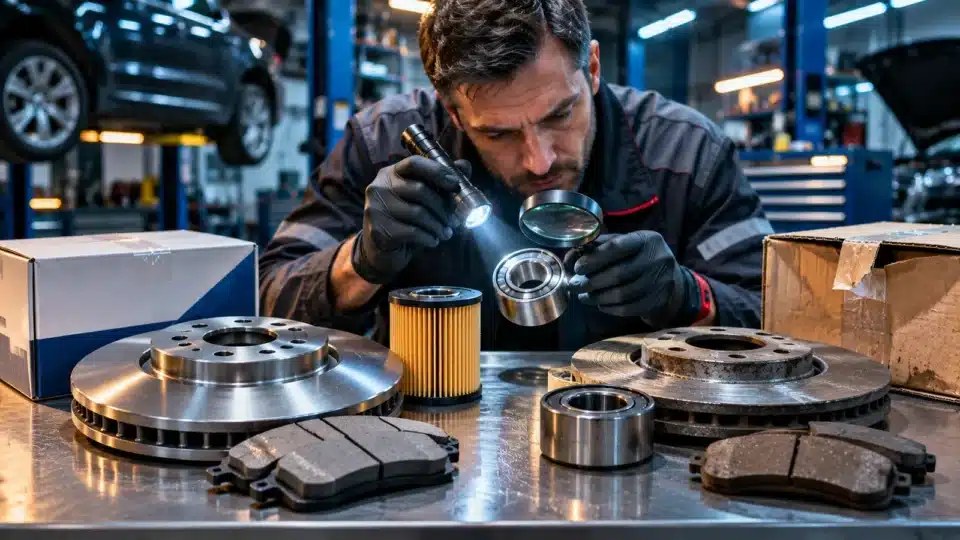
Counterfeit car parts can arrive in boxes that closely imitate the packaging of well-known manufacturers. A bearing, brake pad, filter or sensor may look genuine at first glance, even though its origin, materials and quality control are unknown. The issue is not just price: when a part is used in a braking, steering or passive-safety system, the consequences of failure can be serious.
How can you check whether a car part is authentic before fitting it? What do OEM, OE and aftermarket mean? Is a QR code or hologram enough? InfoBuz sets out a practical 12-step verification protocol, based on manufacturers’ documentation, sales rules and reporting mechanisms available in Romania and the European Union.
One essential clarification: not every inexpensive part is fake, and not every aftermarket part is counterfeit. Legitimate independent manufacturers, including automotive-industry suppliers, sell compatible parts under their own brands. A part that unlawfully uses another manufacturer’s brand, trade identity or packaging, however, may be counterfeit even if it works temporarily.
Counterfeit car parts: the difference between OE, OEM, aftermarket and fake
| Term | What it means in practice | Is it automatically an original part for the vehicle? |
|---|---|---|
| OE / Genuine | A part sold through the vehicle brand’s channel, with specific identification and traceability | It is an original part, but compatibility must still be checked by VIN and part number |
| OEM | A commercial term used for a manufacturer that supplies equipment or parts to the automotive industry; its precise meaning varies between listings | Not every part made by the same supplier is identical to the OE part |
| OES / original-equipment supplier | A part sold by a recognised supplier, under its own documentation | It may be legitimate and compatible without the vehicle brand’s logo |
| Independent aftermarket | A part legally made and sold by an independent manufacturer | It should not be confused with a fake; quality varies by product |
| Counterfeit | A part or package that unlawfully imitates another party’s commercial identity | No; its origin and compliance are questionable |
| Remanufactured | A rebuilt and inspected part, in line with the stated process | It may be legal, but must be accurately presented and technically checked |
| Second-hand | A used part with a variable history | It is not automatically fake; wear and compatibility pose other risks |
There is no universal commercial definition of the “OEM” label across all parts websites. Buyers should therefore check who made the part, who is selling it, its catalogue number and the compatibility documentation, rather than relying solely on an abbreviation in the listing title.
Why counterfeit automotive parts are more dangerous than a poor-quality accessory
An automotive component is designed to withstand mechanical, thermal, chemical and long-term stresses. If its material, tolerances, heat treatment or manufacturing process does not meet the requirements, a fault may emerge in conditions that a visual inspection cannot anticipate. A fake part can look convincing while having never passed the relevant tests.
| Component | Possible risk if the part is non-compliant | Recommended checks |
|---|---|---|
| Brake pads and discs | Unstable friction, overheating, cracking, altered stopping distance | Markings, documents, origin, compatibility and professional installation |
| Wheel bearings | Play, heat build-up, noise, accelerated wear | Part number, batch, geometry, traceability, installation instructions |
| Ball joints, pivots and links | Play or breakage under load | Manufacturer identification and specialist inspection |
| Airbags and pretensioners | Incorrect deployment or failure to operate | Authorised supply channel and the manufacturer’s procedures |
| Oil and fuel filters | Insufficient filtration, pressure loss, contamination | Part number, sealing, manufacturer, distributor |
| Sensors and electronics | Incorrect signals, intermittent faults | Part number, version, diagnostics after installation |
| Spark plugs and ignition components | Overheating, irregular running, damage | Packaging, part number, dimensions and distribution channel |
The table describes possible risks; it does not state that every suspect part will cause these faults. Definitively identifying a counterfeit may require verification by the manufacturer, traceability documents or technical expertise.
How to spot a counterfeit car part: a 12-step protocol
- Check the seller: the company’s identity, contact details, commercial documents, returns policy and operating history.
- Identify the correct part: find the OE number and equivalents confirmed by VIN, engine type, year, braking system and specification.
- Compare the catalogue number: check it in the manufacturer’s official catalogue, not only in the shop description.
- Examine the packaging: printing, logo, spelling, seals and labels can offer clues, but are not conclusive proof.
- Check batch details and traceability: the serial or batch code should be consistent with the documentation, where the manufacturer uses them.
- Use the official authentication system: only the app or webpage specified by the manufacturer; a QR code can also lead to a fake website.
- Compare the part’s appearance: engravings, markings, finish, geometry, material and weight, without treating design differences as automatic proof of a fake.
- Look for legally required markings: only for the category in which they are mandatory; not every part is required to carry the same symbol.
- Check the paperwork: invoice, warranty certificate, instructions and compliance documents where applicable.
- Assess the price: an unusually large discount warrants additional checks, but price alone does not prove counterfeiting.
- Consult the manufacturer or official distributor: send photographs, the part number and batch details where there are concerns.
- Do not fit a suspect critical part: keep it with its packaging and seek clarification before use.
QR codes, holograms and security labels: how much protection do they offer?
A QR code may open a webpage, but the mere presence of a code does not certify authenticity. A label can be copied, and a website resembling the manufacturer’s can be created by a fraudster. Enter the brand’s official address manually or use the app specified in the manufacturer’s documentation. Check the domain, certificate and validation message, then retain the result.
Nor is a hologram an absolute guarantee. Manufacturers periodically change packaging and verification systems; old photos on forums can become irrelevant. For brands such as Bosch, Brembo, ZF and Schaeffler, start with the official pages for Bosch Aftermarket, Brembo Parts, ZF Aftermarket and Schaeffler Vehicle Lifetime Solutions, then follow the current instructions for the specific product.
Brakes: where apparent savings can become dangerous
Brake pads and discs must suit the braking system, including its dimensions, caliper, axle, engine specification and type-approval conditions. Certain categories of replacement braking parts fall under the UN/ECE R90 framework, but applicability depends on the type of part and vehicle. It would be incorrect to claim that every automotive part must carry an R90 marking.
In practice, a buyer can check whether the product’s markings and documentation match its stated category and use. An engraved marking alone does not prove that a product is authentic: counterfeiters can imitate inscriptions as well. For the international regulatory framework, see UNECE — WP.29 Vehicle Regulations.
How to check a set of brake pads
- Confirm the exact part number compatible with the braking system, rather than relying only on the vehicle model and year.
- Check the manufacturer’s identity, batch code and information in the official catalogue.
- Compare the pad shape, thickness, sensor position and included fittings with the specifications.
- Request an invoice and retain the packaging until installation has been checked.
- If there are concerns about the friction material, do not attempt to establish authenticity through improvised road tests.
Bearings, joints and steering components
For a bearing, a shiny surface and apparently smooth rotation do not guarantee the heat treatment, quality of the balls, races or seal. For ball joints and other joints, mechanical strength and fatigue behaviour cannot be checked at home simply by pressing them by hand. For critical components, documentation, origin and correct installation matter more than the look of the packaging.
A genuine bearing fitted incorrectly can fail, while a counterfeit bearing fitted correctly may still have unknown properties. Diagnosis must distinguish a manufacturing defect from damage caused by installation, contamination, incorrect tightening or wear in neighbouring components.
Airbags, pretensioners and passive-safety systems
These components are not suitable for empirical checks. An apparently identical airbag may have unknown specifications or history. Do not connect a suspect component to “test” it, and do not dismantle pyrotechnic mechanisms without the proper procedures and qualifications. For replacement, use the vehicle manufacturer’s documentation and a competent workshop.
In the event of a safety alert or recall, identify the vehicle by VIN and consult the manufacturer or dealership. The European Safety Gate portal allows searches for dangerous-product alerts; however, a part’s absence from the portal is not proof that it is safe or authentic.
Filters, sensors and electronic parts: harder-to-detect fakes
Filters may differ in filter paper, valves, bonding and seals—features that are difficult to assess without dismantling and testing them. A sensor may send plausible but inaccurate readings, with the problem wrongly attributed to other components. Do not use the result of an OBD test as proof that a part is authentic: diagnostics show how the system behaves, not the product’s commercial supply chain.
Counterfeit part or merely incompatible part? Two different problems
A product may be entirely authentic but still unsuitable for the vehicle. A near-identical part number, a different revision, an incorrect brake-disc size or an incompatible sensor version can cause faults. Verification therefore has two separate elements: the product’s authenticity and technical compatibility. Neither replaces the other.
| Question | How to check it | What it does not establish |
|---|---|---|
| Is the part authentic? | Origin, part/batch number, manufacturer verification | That it fits the vehicle |
| Is it compatible? | VIN, OE number, catalogue and specifications | That it came through a legitimate channel |
| Is it compliant? | Documents and markings relevant to its category | That it has no individual defects |
| Has it been installed correctly? | Workshop procedure and technical inspection | That it is not counterfeit |
What RAR certification means and what to request in Romania
In Romania, the Romanian Automotive Register (RAR) has responsibilities for the type approval, certification and oversight of certain automotive products and activities, within the limits of the applicable legal framework. Not every bolt, filter or accessory requires the same RAR document. Requirements differ according to the product category and intended use.
For a suspect part, ask the seller for the documents relevant to its category and verify the information through the official RAR website. Do not accept a generic document as proof that every item sold is authentic; compliance documentation and commercial traceability answer different questions.
The European framework for motor-vehicle type approval and market surveillance is set out, among other measures, in Regulation (EU) 2018/858. The applicable technical rules must be consulted for each component category, without assuming that there is one universal certification.
How to check an online car-parts shop
A shop with good photographs, prices in Romanian lei and positive reviews is not automatically safe. Check its legal identity, address, delivery terms, returns policy, warranty and whether it issues an invoice. A retailer that refuses to specify the actual manufacturer, the part number or supporting documents may warrant extra caution.
InfoBuz also has a separate guide, How to check an online shop before you pay. With car parts, checking the seller should be supplemented by validating the part number and compatibility.
Price: how to interpret a 70% discount
An offer far below normal prices may have legitimate explanations: clearance stock, a promotion, older-generation packaging or bulk purchasing. But it may also indicate a product of uncertain origin. There is no official percentage threshold that automatically turns a discount into evidence of counterfeiting.
Illustrative example: if a part costs 400 lei at several distributors and appears for 110 lei from an unknown seller, the gap warrants checking the retailer’s identity, the part number, batch details and returns policy. It does not justify publicly alleging that it is fake without confirmation.
What to do if you have already bought a suspect part
- Do not fit it if it is safety-critical and there are serious indications that it is not authentic.
- Photograph every side of the packaging, labels, codes and the part itself.
- Keep the invoice, order confirmation, communications with the seller and batch number.
- Verify the product through the manufacturer’s official channel; request a written response where possible.
- Contact the retailer to seek clarification, replacement or resolution of the complaint.
- If the issue concerns consumer rights, check the complaint procedures at ANPC.
- If you suspect fraud or counterfeiting, report it to the competent authorities and provide the documents, without destroying the product.
- If the part is already fitted and affects braking, steering or passive safety, stop using it until it has been assessed by a specialist.
Returns and warranties: your rights with online purchases
In the EU, online purchases from traders are generally covered by the rules on a 14-day right of withdrawal, subject to the exceptions provided by law. Legal protection also exists for lack of conformity, under the applicable conditions. These rights should not be confused with a voluntary commercial warranty, and sales between private individuals may be governed differently. See the European Commission — consumer rights.
If a part has been installed, used or damaged, its legal position may require an individual assessment; do not assume that every fitted part can be returned without consequences. For a non-compliant product or one suspected of being fake, retain the evidence and request the appropriate remedy in writing.
How to document concerns without wrongly accusing a retailer
Responsible reporting does not turn a crooked label into a conviction. Photographs and testimony must be checked, the manufacturer should be asked whether it can confirm the batch, and the retailer concerned should have an opportunity to respond. A specific case may require technical expertise or an intellectual-property assessment.
OECD and EUIPO reports describe international trade in counterfeit goods and its economic risks. They cannot be used to claim that a particular percentage of car parts sold in Romania are fake where there is no separate estimate using an appropriate methodology. OECD — Mapping Global Trade in Fakes 2025; EUIPO Observatory.
Hypothetical case study: two apparently identical bearings
A vehicle owner finds one bearing at a well-known distributor and another, at a significantly lower price, in an advertisement with incomplete seller details. Both bear the same printed part number. The difference does not prove that the second is fake, but it calls for checks: the serial number, documents, official catalogue and supplier confirmation. If the manufacturer cannot validate the origin, fitting a critical component is not a prudent choice.
This case is constructed solely for explanatory purposes. It does not represent a test carried out by InfoBuz, does not involve a real brand or retailer, and is not a technical finding.
A possible investigation in Romania: tracing a part from importer to workshop
An original analysis could follow a category of higher-risk components, such as bearings or brake pads, through three sales channels: a dealership, an independent distributor and a marketplace. For each offer, it would document the price, seller identity, part number, batch details, documents and the manufacturer’s response. Any laboratory comparison would require a methodology, agreements and independent expertise.
- Select part numbers for the same vehicle, using the VIN and official catalogue.
- Make documented purchases through different channels, retaining the packaging.
- Verify serial numbers using manufacturers’ official mechanisms.
- Request relevant compliance and traceability documents.
- Commission technical analysis by a competent laboratory where justified.
- Seek a right of reply before publishing allegations.
- Publish the limitations: the sample does not represent Romania’s entire market.
Frequently asked questions about counterfeit car parts
Is an aftermarket part a fake part?
No. Aftermarket describes the replacement-parts market, in which many legitimate manufacturers operate. Counterfeiting involves the unauthorised use of commercial identity or other fraudulent elements.
If it has a hologram and QR code, is the part definitely genuine?
Not necessarily. Visual features can be imitated. Verification should be carried out through the manufacturer’s official system, supported by documents and traceability.
Can I identify a fake bearing by its weight?
An unexplained difference may be a clue, but weight alone does not confirm authenticity. Design variants and revisions may differ.
Do all brake discs have to carry an R90 marking?
Requirements depend on the part type, vehicle and applicable regulations. Do not use a single marking as a universal rule for all automotive components.
Can RAR verify the authenticity of any part?
RAR has type-approval and certification responsibilities for regulated categories, but it should not be assumed that it can commercially authenticate every individual item of every brand. The manufacturer and official distributor are important sources for confirming origin.
Can a genuine part be defective?
Yes. Authenticity does not eliminate the possibility of a manufacturing defect, damage in transit or incorrect installation.
What should I do if I have already fitted suspect brake pads?
Avoid using the vehicle until a competent workshop has checked the system. If there are serious indications of counterfeiting or non-compliance, seek an assessment and replacement with parts of verified origin.
Is checking the part number against the VIN enough?
No. The VIN helps establish compatibility; authenticity requires verification of origin, batch details and the commercial channel.
Conclusion: check the origin before checking the price
When you unknowingly buy counterfeit car parts, the risk is not merely financial loss. With safety components, hidden faults can have disproportionate consequences. A compatible part must also be authentic, and an authentic part must be installed correctly.
The most practical safeguard remains a combination of an identifiable seller, verified part number, traceability, documents, manufacturer authentication and professional installation. No single hologram, photograph or app can replace all those checks.
Official sources and editorial methodology
- OECD — Mapping Global Trade in Fakes 2025: context on international trade in counterfeit goods, without unjustified extrapolation to Romania’s parts market.
- EUIPO — Observatory: intellectual property, counterfeiting and market studies.
- Romanian Automotive Register: information on type approval, certification and automotive products within its remit.
- UNECE — WP.29 Vehicle Regulations: technical regulations, including the framework for braking components.
- Regulation (EU) 2018/858: motor-vehicle type approval and market surveillance.
- European Commission — Safety Gate: relevant dangerous-product alerts and recalls.
- ANPC: complaints and consumer rights in Romania.
- European Commission — consumer rights: right of withdrawal and product conformity.
- Bosch Aftermarket, Brembo Parts, ZF Aftermarket, Schaeffler Vehicle Lifetime Solutions: official channels for identifying and documenting parts.
Editorial note, 17 November 2026: This article is a prevention guide, not a technical assessment of actual products. The risks described are possibilities, not diagnoses. The price and verification examples are hypothetical. Specialist assessment is recommended for safety-critical parts. The featured image is AI-generated and does not depict an identified counterfeit.




Discuția cititorilor
Ai o opinie sau o întrebare despre acest articol? Spune-ne ce crezi.
Fii primul care deschide discuția.
Te rugăm să păstrezi un limbaj civilizat și să discuți la subiect. Comentariile spam sunt filtrate automat.