
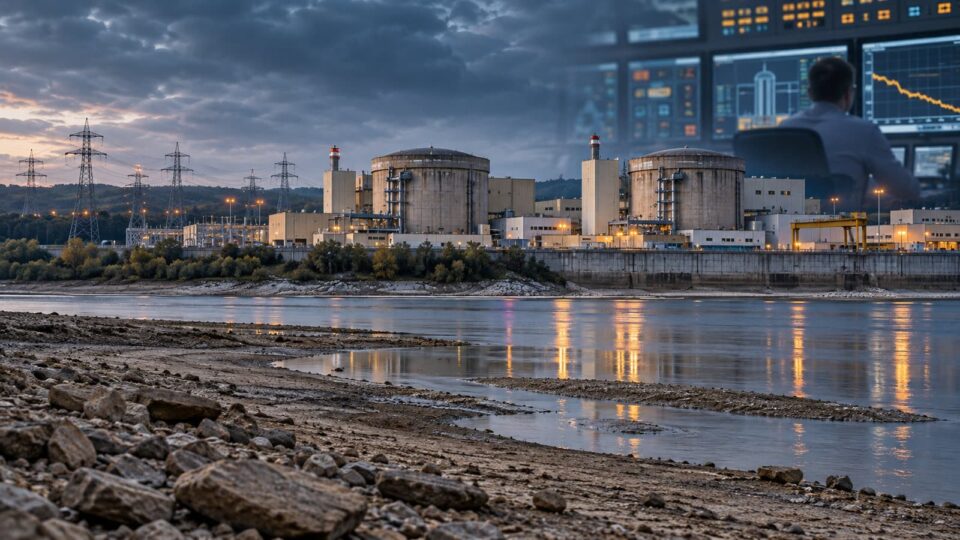
Where does Romania’s electricity come from on an ordinary day? There is no single, fixed answer. The generation mix changes every hour according to river flows, wind, sunshine, the availability of nuclear reactors, demand, market prices, and imports and exports through interconnectors with neighbouring countries.
On an annual basis, however, the picture is clear: Romania generates electricity from a mix of nuclear, hydro, gas, coal, wind, solar, biomass, prosumers and, increasingly, batteries. Transelectrica data show that around 66% of electricity generation had a low-carbon profile in 2025, including nuclear, hydropower and renewables.
Where Romania’s electricity comes from: the overall picture
In 2025, net domestic generation was around 49.5 TWh. Net domestic consumption was higher, at around 53.2 TWh, with the difference covered through cross-border exchanges. Romania imported around 11.1 TWh and exported around 7.4 TWh that year.
Net generation was divided approximately as follows:
- thermal power plants: 16.0 TWh;
- hydropower: 12.2 TWh;
- nuclear: 10.1 TWh;
- conventional renewables — wind, solar and biomass: 9.2 TWh;
- prosumers: around 1.8 TWh;
- batteries: around 0.18 TWh.
In practice, the mix is constantly changing. A day of strong wind and sunshine can drive renewable output very high. A dry spell cuts hydropower generation. An outage at Cernavodă can remove almost 700 MW from the system for each unavailable reactor. And in the evening, when solar generation disappears, the system must be balanced with other sources.
Nuclear power: Cernavodă’s stable backbone
Romania operates two CANDU reactors at the Cernavodă nuclear power plant, with combined gross installed capacity of around 1,413 MW. In 2025, nuclear power supplied around 21% of domestic generation.
Nuclear power’s main advantage is stability. The reactors operate at an almost constant level and can generate electricity day and night, independently of wind, sunshine or river flows.
It is therefore one of the sources that stabilise the system when renewable generation fluctuates. The drawback is that a planned or unplanned shutdown of a unit has an immediately visible effect on the national balance.
InfoBuz has separately documented cases in which Romania was temporarily left without nuclear generation and their impact on the power system.
Hydropower: one of the leading sources, but dependent on water
Romania has one of the region’s largest hydropower fleets. At the beginning of 2026, installed hydropower capacity stood at around 6,688 MW, the largest individual category in the country’s generation fleet.
For more on solar power, see Dama Solar Romania: one of Europe’s largest solar parks, with 1.3 GW capacity and a €728 million investment, which provides complementary detail on the subject.
Installed capacity does not mean that hydropower plants generate at that level continuously, however. Output depends directly on river flows, reservoir levels and operating strategy.
In 2025, hydropower generated around 12.2 TWh, down from 14.2 TWh in 2024 and 18.2 TWh in 2023. This trend illustrates how strongly hydrological conditions can affect the generation mix.
During periods of severe drought, hydro output falls and the system must compensate through thermal plants, imports, nuclear power or other sources.
InfoBuz has also examined the impact on Romania of very low flows on the Danube.
Natural gas: flexibility for difficult hours
Gas-fired power plants play an essential role in balancing the system. Unlike nuclear units, they can raise or lower output more quickly, offsetting changes in demand or temporary shortages of wind and solar power.
In Transelectrica’s statistics, gas is included in the thermal-power category alongside coal and other hydrocarbons. In 2025, thermal generation accounted for around 32% of net generation.
At the beginning of 2026, installed capacity using hydrocarbons was around 2,802 MW gross.
Gas has a major drawback, however: fuel costs and CO₂ emissions. Its future role is therefore seen more as one of flexibility and security than as a dominant baseload source.
Coal: less important than in the past, but still present
Coal is gradually losing ground in Romania’s power system. On 1 January 2026, gross installed coal capacity was around 2,095 MW; by 1 April 2026, it had fallen to around 1,620 MW.
Across the European Union, coal reached its lowest-ever share of electricity generation in 2025, at around 9.2% when hard coal and lignite are combined.
In Romania, lignite-fired power plants remain important to system security at certain times, but the cost pressure from emissions allowances and climate targets continues to reduce their role.
Wind power: highly productive when the wind blows
At the beginning of 2026, Romania had around 3,136 MW installed in wind turbines. Dobrogea, the country’s south-eastern region, remains Romania’s main wind area because of its favourable conditions.
Wind generation can be very high on a windy day, but almost negligible during a calm period. It cannot therefore be assessed through installed capacity alone.
In the 2025 annual mix, wind power accounted for around 12% of total generation.
Romania also has new projects in development, including regional interconnection and integration initiatives. InfoBuz has separately examined the 650 MW wind project associated with the Ukraine–Romania corridor.
Solar power: the fastest-growing source
Solar photovoltaics are the fastest-growing segment. On 1 January 2026, licensed photovoltaic capacity in the system stood at around 3,094 MW. This was supplemented by prosumers, who had already installed around 3,352 MW as of 1 December 2025.
That means Romania’s actual solar capacity is substantially greater than the capacity visible in conventional solar parks alone.
On a clear summer day, solar generation can rise sharply around midday. The problem comes in the evening: output drops rapidly just as part of household demand remains high.
This “evening ramp” is one of the major challenges for systems with large amounts of solar power, and explains why batteries, flexible hydropower plants and gas-fired power plants are becoming increasingly important.
Prosumers: Romania’s distributed power plant
Prosumers are fundamentally changing how national generation must be read. Electricity produced on the rooftops of homes and businesses does not always appear in real time in the same statistics as large power plants.
For 2025, Transelectrica estimates prosumer generation at around 1.77 TWh. By the end of 2025, prosumer installed capacity exceeded 3.3 GW.
This means that at midday on sunny days, a significant share of local consumption is covered directly behind the meter and does not need to be transmitted through the national grid.
Batteries: still small in energy terms, but increasingly important for stability
At the beginning of 2026, Romania had around 494 MW of installed storage capacity, with total energy capacity of around 914 MWh.
In 2025, batteries delivered around 185 GWh to the system. As a share of total generation, this remains small. But their role is not merely quantitative.
Batteries can respond very quickly to imbalances, store surplus solar generation at midday and release it in the evening. As solar and wind capacity grows, this function becomes increasingly valuable.
Why import electricity with nearly 20 GW installed?
Because installed capacity is not the same as capacity available at any given moment.
A country may have 6.7 GW of installed hydropower, while river flows permit only a fraction of that output. It may have more than 3 GW of wind capacity, yet produce very little on a windless day. It may have more than 3 GW of solar capacity, but solar generation is zero at night.
At the same time, power plants may be undergoing maintenance, while demand can rise suddenly on very cold or very hot days.
In 2025, Romania imported around 11.1 TWh and exported around 7.4 TWh. The country was therefore a net importer over the year as a whole, but that does not mean it imports electricity continuously.
Why Romania sometimes exports by day and imports in the evening
Electricity is traded in a regional market. If Romania has abundant hydro, wind and solar generation at a given time, and domestic prices are competitive, it can export.
A few hours later, if the sun sets, the wind drops and demand remains high, flows can reverse and Romania can import.
This alternation is not a sign that the system has “failed”, but a normal consequence of an interconnected market. The real issue arises when import dependence becomes persistent during expensive hours and there is insufficient flexible domestic generation.
What an “ordinary day” means in Romania’s power system
Early in the morning, before sunrise, the system is supported mainly by nuclear, hydropower, gas, coal and wind, depending on conditions.
After sunrise, solar output begins to rise. Around midday on a clear day, photovoltaics and prosumers can sharply reduce the need for conventional power plants.
In the evening, solar output falls quickly. Hydropower plants, gas-fired power plants, batteries and imports can cover the gap. Nuclear generation continues at a near-constant level.
At night, demand falls and the system returns to stable sources and whatever wind output is available.
Why installed capacity can be misleading
On 1 January 2026, Romania had around 19,368 MW of gross installed capacity in licensed power plants. The breakdown was approximately:
| Source | Gross installed capacity |
|---|---|
| Hydropower | 6,688 MW |
| Wind | 3,136 MW |
| Solar | 3,094 MW |
| Gas and other hydrocarbons | 2,802 MW |
| Coal | 2,095 MW |
| Nuclear | 1,413 MW |
| Biomass | 139 MW |
In addition, there were more than 3.3 GW of prosumer capacity and nearly 0.5 GW of batteries.
But every technology has a different capacity factor. Nuclear can operate almost continuously; solar produces only during the day; wind depends on wind conditions; and hydropower depends on water availability.
What 2026 looks like so far
Transelectrica data for the first quarter of 2026 show that net domestic generation rose by around 9% compared with the same period in 2025.
Hydropower increased by around 36% and renewables by 20%, while thermal generation declined slightly and nuclear generation fell by around 3%.
In the same quarter, physical exports rose by around 56%, while imports fell by 4% compared with the corresponding period a year earlier.
These figures show how quickly the energy balance can change from one year to the next, depending on weather, plant availability and new renewable capacity.
Romania has a relatively diverse generation mix
Diversity is an important advantage for Romania. The country does not rely on a single dominant source: it has nuclear power, hydropower, gas, coal, wind, solar and regional interconnections.
This diversity reduces the risk that a single disruption — a lack of wind, drought or a nuclear outage — will impair the system.
At the same time, the system needs modernisation. More solar and wind require stronger grids, storage, flexibility, digitalisation and balancing capacity.
What will change by 2030
Romania will probably have substantially more solar and wind capacity than it does today. Prosumer capacity will continue to grow, large battery projects are expanding, and new generation capacity is under development.
In parallel, nuclear plans at Cernavodă and small modular reactor projects could change the mix over the longer term, although timelines and costs remain critical.
The greatest challenge will not simply be building new power plants, but integrating them into a system that must remain stable every second.
Conclusion
Where does Romania’s electricity come from? From a mix that changes from hour to hour but has several clear pillars: nuclear provides steady output; hydropower offers volume and flexibility; gas and coal support the system when needed; and wind, solar and prosumers are growing rapidly.
In 2025, almost two-thirds of domestic generation had a low-carbon profile. In 2026, growth in hydropower and renewables had already improved the balance in the first quarter.
Romania’s future power system will not be dominated by a single technology. It will depend on how well the country combines stable generation, variable renewables, storage and regional interconnections.
Frequently asked questions
What is Romania’s largest source of electricity?
It depends on the period considered. In 2025, the thermal-power category made the largest aggregate contribution, at around 32%, followed by hydropower, nuclear and renewables. On some days, hydropower or renewables can become the dominant source.
How much does the Cernavodă nuclear power plant generate?
Its two operating units have combined gross installed capacity of around 1,413 MW and supplied about 21% of Romania’s domestic electricity generation in 2025.
Does Romania import or export electricity?
It does both. In 2025, Romania imported around 11.1 TWh and exported 7.4 TWh, resulting in a net import balance.
How much solar capacity does Romania have installed?
At the beginning of 2026, licensed power plants had around 3,094 MW of photovoltaic capacity, supplemented by more than 3,300 MW installed by prosumers.
Why does Romania not use only solar and wind power?
Because these sources are variable. The system also needs stable generation, storage, flexible hydropower, gas-fired power plants and interconnections to balance demand at every moment.
Sources: Transelectrica — 2025 annual report; Transelectrica — first-quarter 2026 report; Eurostat — electricity from renewable sources in the EU in 2025; Eurostat — coal’s declining share in electricity generation.









Discuția cititorilor
Ai o opinie sau o întrebare despre acest articol? Spune-ne ce crezi.
Fii primul care deschide discuția.
Te rugăm să păstrezi un limbaj civilizat și să discuți la subiect. Comentariile spam sunt filtrate automat.