
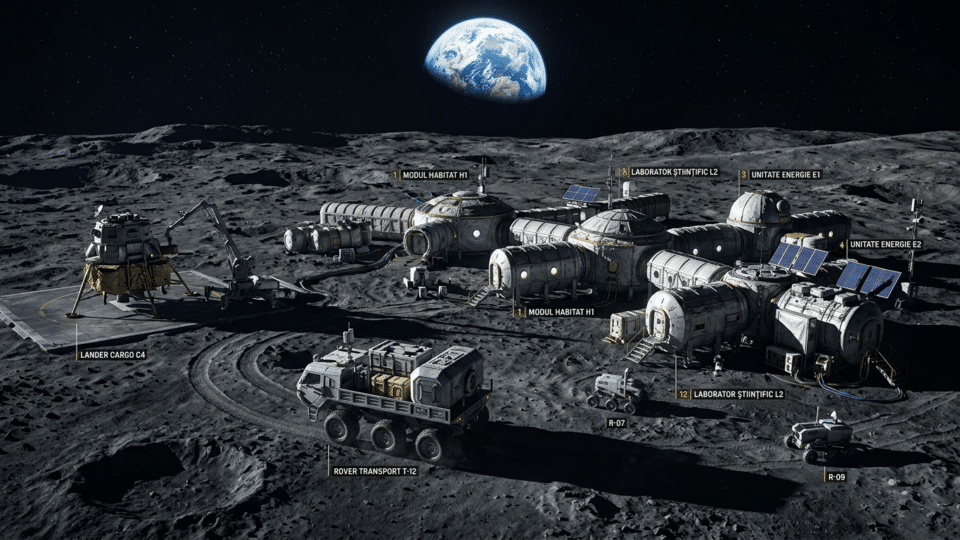
NASA has selected eight companies eligible to compete for future commercial missions to the Moon under a new contract framework capped at up to $10 billion over 10 years. The announcement, made on November 7, 2026, matters to the US ambition to progressively build the services needed around the lunar south pole: transportation, landing, rovers, communications and power.
For more on the Moon, see NASA prepares vehicles for the first lunar base: VIPER, Astrolab and Pegasus, the robots set to explore the south pole, which offers complementary details on the subject.
What we know now: the $10 billion has not been divided among the eight companies, nor does it represent the already funded cost of an operational lunar base. It is the maximum ceiling of a framework contract called CLPS 2. NASA will issue individual orders over time, depending on approved missions and available budgets.
The distinction matters. A contract ceiling indicates what the agency could buy over a given period; it does not automatically show how much has been budgetarily committed, paid or turned into launches. That is why the announcement is both a significant step for the lunar programme and a promise that will need to be demonstrated through repeated missions.
NASA lunar base contracts: what CLPS 2 actually is
CLPS stands for Commercial Lunar Payload Services, the programme through which NASA buys services from private companies to carry scientific and technological payloads to the Moon. Rather than designing and operating every vehicle itself, the agency sets objectives and purchases mission delivery or operations.
The new phase, CLPS 2, is an IDIQ (indefinite-delivery/indefinite-quantity) contract. In practical terms, NASA is not buying $10 billion in services all at once. It is establishing a list of eligible providers and a framework under which it can later issue orders for quantities and schedules that have yet to be determined.
According to NASA’s announcement, the cumulative ceiling is $10 billion over 10 years. Procurement documentation on SAM.gov shows that the contract’s scope extends beyond simply putting instruments on the lunar surface: it may include mission architecture, payload integration, launch-vehicle selection and operation, transportation, delivery to the surface or orbit, and mission operations.
| Term | What it means in NASA’s announcement |
|---|---|
| Contract ceiling | The maximum value that can be ordered under CLPS 2, not money already spent. |
| Selected company | Eligible to compete for future orders; selection does not guarantee an immediate mission. |
| Task order | A specific order, with defined activities and value, issued under a framework contract. |
| Budget obligation | The amount the US government legally commits for a contract or order. |
| Actual payment | Money spent on work and deliveries completed; it may differ over time from both the ceiling and the obligation. |
The providers selected for CLPS 2 are Blue Origin, Firefly Aerospace, Intuitive Machines, ispace-U.S., Lockheed Martin Space, Northrop Grumman Space Systems, SpaceX and Voyager Technologies. Their names confirm access to future competitions, not an equal share of the $10 billion ceiling.
From standalone landers to an infrastructure that must work together
The genuinely new element in NASA’s package is its attempt to connect several services that might previously have appeared as separate projects. A longer presence at the lunar south pole does not depend only on a lander arriving safely at its destination. It requires power during difficult periods of illumination, communications when terrain blocks a direct link to Earth, surface mobility and transport between orbits.
NASA outlined several parts of this picture in the same announcement:
- a $94 million base contract for Blue Origin to deliver the PROMISE rover;
- six VADR orders for orbital transportation, navigation and communications, with a combined value of about $1.3 billion;
- a cislunar communications demonstration awarded to SpaceX under an existing lunar logistics contract;
- the first miniCAST phase, involving components for power generation, storage and wireless transfer.
VADR, short for Venture-Class Acquisition of Dedicated and Rideshare, is a mechanism separate from CLPS 2. NASA says the six orders, awarded to Arrow Science and Technology, Blue Origin and Impulse Space, support demonstrations of orbital transportation, navigation and communications. They include CAPSTONE 02 and tests for cislunar orbits, among other activities. They are not evidence that the infrastructure is already operating, but missions intended to reduce technical risk.
miniCAST has the same intermediate status. NASA selected Honeybee Robotics for energy storage, Redwire for generation and Yank Technologies for wireless transfer. The agency specifies that this first phase purchases components, not a fully integrated power system. In other words, the selection determines who will develop certain parts; it does not yet certify that they will work together on the lunar surface.
PROMISE could turn robotic exploration into data for future sites
The PROMISE rover is among the orders in the package with a specific value. NASA announced a $94 million base contract for Blue Origin and an option worth up to $140 million, conditional on performance. The federal USAspending database lists a potential value of about $234.2 million for this award, illustrating why the base amount and the potential value should not be confused.
NASA is targeting a launch in late 2028 and an 18-month mission. PROMISE is expected to explore the lunar south pole, drill to a depth of about one metre and analyse the characteristics of the soil and potential volatile compounds. The rover is designed to operate during the lunar night and in permanently shadowed areas.
These goals have practical significance: data on terrain, subsurface conditions and resources could help NASA decide where later activities might be best placed. But they remain mission objectives. PROMISE has not yet demonstrated the extraction of lunar resources and does not confirm the existence of a base. For context on vehicles being prepared to explore the south pole, InfoBuz previously examined the rovers and robotic platforms under consideration by NASA.
Why the $10 billion figure does not by itself show how close a base is
A large framework contract can be useful even before all orders have been issued. NASA has multiple providers, can compare solutions and can build a sequence of missions without starting the procurement process from scratch for every need. In the difficult lunar environment, redundancy and the ability to change approach after a failure have real value.
Success nevertheless depends on three factors not reflected in the nominal ceiling. The first is the cadence of orders: companies need enough missions to maintain their teams and vehicles. The second is provider viability, particularly in a market where NASA remains the dominant buyer. The third is interoperability: power, communications, transportation and mobility must work as compatible services, rather than merely as individually successful demonstrations.
These are not theoretical concerns. A 2024 report by the NASA Office of Inspector General, on the first CLPS phase, identified delays, cost pressures and financial risks for providers. At that point, the inspectors cited 10 task orders issued to six of 14 eligible providers, one terminated order and the insolvency of Masten Space Systems.
The report does not assess CLPS 2 performance, as it was only announced in 2026. It does, however, offer a relevant warning: moving from occasional commercial missions to repeatable lunar infrastructure requires not only potential budgets but also a predictable flow of orders, technical oversight and companies able to survive between launches.
What remains unclear in public documents
NASA’s release puts the CLPS 2 ceiling at $10 billion over 10 years. Intuitive Machines, one of the selected companies, said in its own release that the ceiling could rise to $15 billion if NASA exercises an option for a five-year extension. Without the final contract model and relevant annexes, the cautious wording is NASA’s: a $10 billion ceiling, with a possible extension cited by a recipient.
There is also no complete public breakdown showing how much each of the eight CLPS 2 companies is expected to receive. Nor does the general announcement show what part of the ceiling has already been obligated or paid. Any calculation mechanically dividing $10 billion among eight providers would therefore be misleading.
NASA has also increased the ceiling for CLPS 1.0, from $2.6 billion to $4.2 billion. The original contract remains active until November 2028, while awards already issued can be completed through November 2033. This overlap shows that the new framework does not abruptly replace all existing missions; it gradually expands the agency’s procurement capacity.
In its current form, the lunar base project is more accurately described as an architecture under construction than as an outpost ready to be installed. NASA now has a broader mechanism for purchasing services, a specific order for the PROMISE rover and several demonstrations for transportation, communications and power. The next test will be whether these elements can become regular, compatible missions robust enough for conditions at the lunar south pole.
Frequently asked questions
Has NASA already allocated $10 billion for a lunar base?
No. NASA announced a ceiling of up to $10 billion for CLPS 2, a 10-year framework contract. The money may be committed through future orders; it was not fully distributed through the initial selection.
Which companies were selected for CLPS 2?
Blue Origin, Firefly Aerospace, Intuitive Machines, ispace-U.S., Lockheed Martin Space, Northrop Grumman Space Systems, SpaceX and Voyager Technologies. Their selection allows them to compete for future NASA orders.
What is the PROMISE rover?
PROMISE is a rover planned to explore the lunar south pole. NASA announced a $94 million base contract for Blue Origin, with an additional performance-based option. Launch is targeted for late 2028.
Sources consulted
- NASA Awards Moon Base Transportation, Technology, Science Projects
- Commercial Lunar Payload Services 2.0 — SAM.gov solicitation
- Contract to Blue Origin, LLC — USAspending
- NASA’s Commercial Lunar Payload Services Initiative, IG-24-013 — Office of Inspector General
- Intuitive Machines Selected for NASA’s Next-Generation Lunar Delivery Services


Discuția cititorilor
Ai o opinie sau o întrebare despre acest articol? Spune-ne ce crezi.
Fii primul care deschide discuția.
Te rugăm să păstrezi un limbaj civilizat și să discuți la subiect. Comentariile spam sunt filtrate automat.