
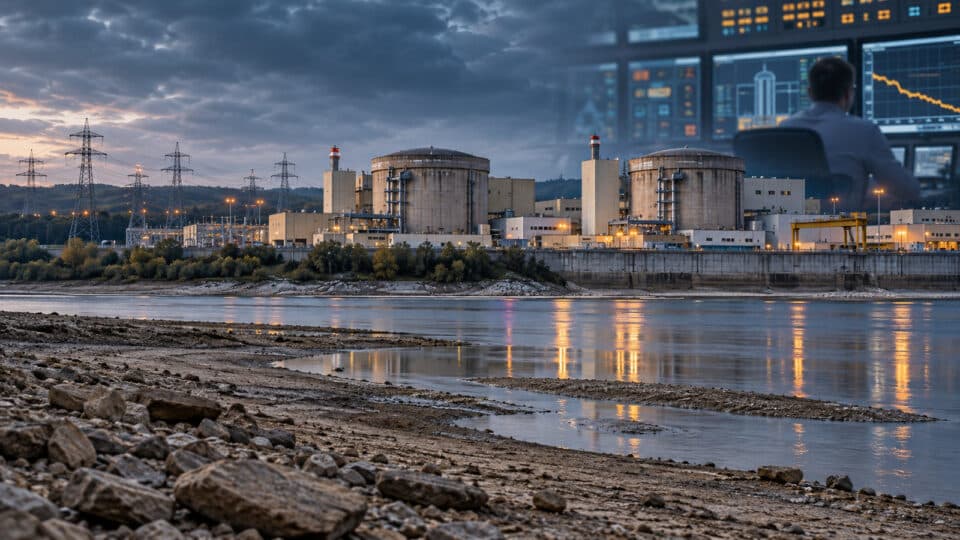
Both units at the Cernavodă Nuclear Power Plant are being kept in a safe shutdown state amid low water levels on the Danube. Nuclearelectrica officially announced on Sunday, 11 October 2026, that the shutdown affects electricity generation, not nuclear safety. The distinction is crucial: a shut-down reactor does not automatically mean a facility is in danger, but the temporary loss of its output raises serious questions for the power system.
For more information on Cernavodă, see also Romania left without nuclear power: what happens after both Cernavodă reactors were shut down, which provides additional details on the issue.
According to reporting by Radio Romania Constanța, the river level came within just three centimetres of a safety threshold. That figure illustrates the immediate hydrological pressure, but should not be mistaken for a claim that the plant’s safety functions had been lost. The operator says precisely the opposite.
What Nuclearelectrica announced on 11 October
In its official statement of 11 October, the company said Units 1 and 2 would remain in a safe shutdown state until the Danube level allows operations to resume. To protect pumps and maintain redundancy, the plant uses cooling systems designed for different hydrological conditions, alongside measures taken by the authorities.
Nuclearelectrica stressed that nuclear safety is ensured through redundant systems, procedures and permanently available specialist staff. The operator also said the shutdown period is being used for maintenance work and to assess longer-term resilience measures.
Why Danube water matters at a nuclear power plant
A reactor turns the energy released through fission into heat, while the facility uses technological systems to generate electricity and discharge residual heat in a controlled manner. Water available for cooling is an important operating requirement. When hydrological parameters reach a range requiring restrictions, the operator may decide to halt generation in a controlled way while keeping safety functions active.
Cooling and protection systems are not all the same and should not be conflated. Particularly at a nuclear facility, the continuity of safety-related cooling has requirements and reserves distinct from the conditions needed for normal power generation. That is why the term “safe shutdown” has a precise technical meaning.
How much power is, in principle, missing from the system
Cernavodă operates two CANDU units, each with electrical generating capacity in the order of 700 MW. Their simultaneous shutdown therefore means that installed capacity of roughly 1,400 MW is not producing electricity during that period. This is a capacity reference, not a measurement of the actual shortfall, which depends on the units’ previous output, demand and the rest of the generation fleet.
The power system must be balanced at all times: generation and imports must cover consumption and exports, while maintaining the required reserves. Hydropower plants, thermal plants, renewable sources, imports and shifts in demand can each contribute differently from one hour to the next. It does not automatically follow that every megawatt unavailable at Cernavodă is fully replaced by imports.
Will energy bills rise?
The simultaneous shutdown of two large units may put pressure on the wholesale market, especially if it coincides with high demand or lower output from other sources. However, there is not enough basis to attribute a specific rise in household bills to this situation without data on the duration of the outage, replacement power, hourly prices and suppliers’ contracts.
For household consumers, the eventual effect may differ from short-term movements in the spot market. The type of contract, a supplier’s procurement arrangements and the applicable legal mechanisms all matter. A serious financial estimate must be based on measured lost output and the difference between the cost of alternative electricity and planned generation, rather than a simple calculation using an arbitrary price.
What conditions must be met before restarting
According to Nuclearelectrica, the resumption of operations depends on how the Danube level develops and on verification of safe operating conditions. The company has promised a further update when the units are reconnected to Romania’s National Energy System. Until that announcement, any exact restart date would be speculative.
What to watch in the coming days
- Changes in Danube water levels and flows, including hydrological forecasts relevant to Cernavodă.
- Nuclearelectrica statements on the status of each unit and their actual reconnection.
- Public data on power generation and imports, using the correct hourly time periods.
- Any structural measures intended to reduce operational dependence on low water levels.
InfoBuz conclusion: the immediate issue is the availability of electricity generation in difficult hydrological conditions. The official information available on 11 October 2026 states that the facilities are in a safe shutdown state. The economic consequences should be monitored, without turning a controlled shutdown into a false nuclear-accident alert.
From the InfoBuz archive: see also Romania’s energy data, explained LIVE, to follow the context of generation and consumption. The data must be interpreted at the time they are displayed, rather than used retrospectively as proof of a shortfall.
Sources and verification
Nuclearelectrica – official statement of 11 October 2026; Radio Romania Constanța – the Danube water-level situation; CNE Cernavodă – technical information on capacity and technology. The information reflects the situation documented on the publication date.









Discuția cititorilor
Ai o opinie sau o întrebare despre acest articol? Spune-ne ce crezi.
Fii primul care deschide discuția.
Te rugăm să păstrezi un limbaj civilizat și să discuți la subiect. Comentariile spam sunt filtrate automat.