
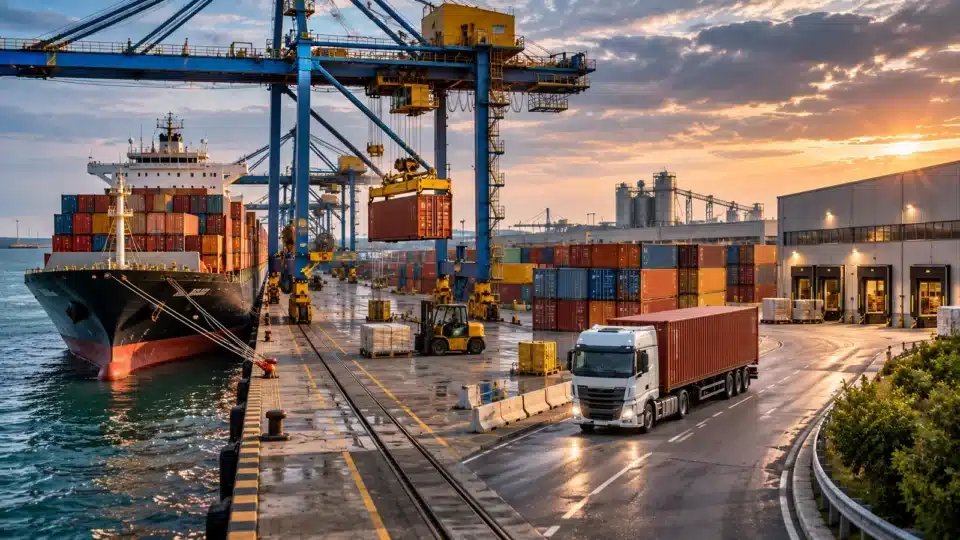
From the Port of Constanța to the shelf, an imported product passes through more stages than its journey by ship. These can include loading at origin, freight, insurance, terminal charges, customs formalities, domestic distribution, storage, compliance with European rules, commercial services, wages and VAT. Yet none of these costs is the same for every product, and the gap between the factory price and the shop price is not the profit of a single company.
We have created a wholly illustrative financial case study for 1,000 generic non-food products, imported from outside the European Union and unloaded in Constanța. The examples are not a real invoice, rates negotiated by an operator or the exact duties for a category identified under TARIC. The aim is to understand the order in which costs arise and the documents that can substantiate them. The rule for identifying customs duty by product code is explained on the European Commission’s official Access2Markets portal.
Why the Port of Constanța matters beyond container numbers
The Port of Constanța is an important logistics gateway on the Black Sea, linked to road, rail and river transport. But the port authority’s revenue, cargo volumes, terminal costs and the price paid by shoppers are different indicators. A port can handle more cargo without every company involved earning higher margins. InfoBuz has separately examined who benefits from Black Sea routes and cargo traffic through Constanța. Here, we follow a single consignment rather than the port’s profit and loss account.
From the Port of Constanța to the shelf: nine links in the final price
- The factory makes the goods, packs them and prepares the commercial documents.
- The exporter and inland carrier organise transport to the loading terminal in the country of origin.
- The shipping line delivers the container to the destination port under the relevant contracts.
- The port terminal unloads, handles, temporarily stores or releases the container, according to the contracted services.
- The customs declarant determines the applicable classification and procedure; the customs value, origin and documents are checked.
- The importer pays the amounts due and bears the commercial costs for which it is responsible.
- The container is collected and the goods travel by road or rail to the warehouse.
- The distributor stores, sorts and prepares the goods for delivery to shops.
- The retailer sells the product, bearing the shop’s operating costs and collecting VAT where it is due.
Depending on the contract, some links are managed by the same company or invoiced together. The importer may also be the distributor and retailer. In such cases, the same activity must not be counted twice.
The real cost of importing: the example of a 1,000-product consignment
Assume that each non-food product costs €10 at the supplier’s factory. For simplicity, we use a consignment of 1,000 units and a single currency, the euro. The assumption includes expenses borne by the importer at each stage and a fictional 6% customs duty rate, chosen solely to illustrate the calculation. The actual duty rate depends on the product code, origin, documents and trade measures in force on the day of import.
| Simulation item | Cost per consignment / 1,000 products | Calculation / explanation |
|---|---|---|
| Purchase of goods | €10,000 | 1,000 × €10 |
| Freight and transport before entry into the EU | €1,400 | Commercial assumption |
| Transport insurance | €100 | Commercial assumption |
| Simplified customs value | €11,500 | 10,000 + 1,400 + 100 |
| Illustrative 6% customs duty | €690 | 11,500 × 6% |
| Handling / terminal services after entry | €650 | Hypothetical cost, distinct from a published official tariff |
| Customs brokerage and formalities | €150 | Hypothetical cost |
| Domestic transport to warehouse | €750 | Hypothetical cost |
| Storage and inventory operations | €300 | Hypothetical cost |
| Local distribution / final leg | €250 | Hypothetical cost |
| Documentation, testing and compliance | €260 | Hypothetical cost |
| Total cost entering the domestic supply chain | €14,550 | Total excluding recoverable VAT and commercial mark-ups |
The result is €14.55 per product, rather than the €10 factory price. The additional €4.55 reflects freight, insurance, the fictional customs duty, services and logistics activities in the simulation. It is not a “Port of Constanța tax” and does not represent an observed average tariff. A dangerous, bulky, fragile product or one subject to special controls may have an entirely different cost structure.
Note: customs value and import VAT do not have the same base
For most transactions, the customs valuation base starts with the transaction value, subject to adjustments provided for under EU law. Transport and insurance costs to the point of entry into the Union customs territory are, under the conditions laid down in the rules, included in the customs value if they are not already included in the price. The calculation must be adapted to the actual route and documents. European Commission — calculation of customs duties.
The base for import VAT may include the customs value, customs duties and incidental expenses up to the first place of destination or other known destinations under the rules. It is therefore not enough simply to apply 21% to €11,500. In this case study, VAT is calculated only at the final sale stage, to make the shelf price clear; we have not separately modelled the cash flow or the specific import-VAT base. Subject to legal conditions, an importer entitled to deduct VAT may recover the VAT due, which is not the same as a final cost of the product. European Commission — taxable amount for import VAT.
How the label price rises from €14.55 to €32.11
We now add three successive hypothetical mark-ups for the importer, distributor and retailer. These are percentages applied to the cost at the preceding stage, not net profit margins; VAT is added only at the end in this simplified example. Real-world distribution may involve one, two or more links.
| Stage | Formula | Price per product |
|---|---|---|
| Full cost to warehouse | €14,550 / 1,000 | €14.55 |
| Importer: 22% mark-up | 14.55 × 1.22 | €17.75 |
| Distributor: 15% mark-up | 17.751 × 1.15 | €20.41 |
| Retailer: 30% mark-up | 20.41365 × 1.30 | €26.54 excluding VAT |
| Standard VAT at 21% | 26.537745 × 0.21 | €5.57 |
| Theoretical shelf price | 26.537745 × 1.21 | €32.11 including VAT |
In this scenario, a product bought from the factory for €10 reaches €32.11 including VAT. But it does not follow that €22.11 is profit. Part of it represents actual logistics costs, part is VAT, and successive mark-ups help fund companies’ operations and, only after their own expenses have been deducted, any profit. Romania’s standard VAT rate has been 21% since 1 August 2025, according to official material from ANAF, Romania’s tax authority.
Commercial mark-up, gross margin and net profit: three different concepts
If a retailer buys a product for €20 excluding VAT and sells it for €26 excluding VAT, the commercial mark-up is 30% of the purchase cost: (26 − 20) ÷ 20. But the gross margin measured against sales is about 23.1%: (26 − 20) ÷ 26. Neither figure is net profit. The gross difference may pay for rent, wages, energy, inventory losses, promotion, payment fees, financing and other costs.
That is why an analysis that merely says a product is “three times more expensive than at the factory” does not explain what happens economically. To show who benefits in a verifiable way, it is necessary to examine the contracts, expenses and profits of the companies involved, where those data are public. Even then, a company’s total profit cannot automatically be attributed to a single product.
Who charges fees in the port — and why there is no single charge per product
A terminal may involve services provided by the port authority, terminal operator, shipping agent, handling companies, carriers and other suppliers. They may be invoiced on different bases: vessel, tonnage, container, movement, period, infrastructure or service provided. The Constanța Maritime Ports Administration publishes rules and tariffs applicable to port infrastructure, but an authority tariff is not automatically the handling price charged by a commercial terminal.
In our table, the €650 is solely an assumed port-cost figure for the consignment. We have not presented it as an official tariff for 2026 because actual costs depend on the operator, contract, container, cargo and services. A study using verifiable figures would require the editorial team to obtain the terminal invoice, the tariff applied and documents covering the services actually delivered.
Why a container can become far more expensive before leaving the port
Demurrage and detention: costs determined by time
In container shipping, the terms demurrage and detention commonly describe charges associated with exceeding free periods at a terminal or using a container beyond contractual limits. Definitions and calculation methods can vary between carriers and contracts. A missing customs document or a delay in scheduling a truck may generate a substantial extra cost, but not every delay is attributable to the port.
Controls, storage and cargo type
Food, chemicals, electrical goods and other categories may require separate controls or documentation. Temperature-controlled, fragile or bulky cargo also carries different costs from dry, non-hazardous goods. A generic example of 1,000 products cannot provide a universal cost for all these categories.
Incoterms: the port does not decide who pays for transport
EXW, FOB, CIF, DAP and DDP are Incoterms commercial rules used to allocate responsibilities for transport, risks and certain costs between seller and buyer. The precise terms must be read in the contract, together with the named place and edition of the rules. CIF concerns cost, insurance and freight to the agreed port; in ordinary terms, DDP assigns the seller much broader responsibilities for delivery with duties paid.
Using the phrase “delivered to the Port of Constanța” without an Incoterm, precise location and contract can obscure who pays for unloading, formalities, inland transport or possible delays. Moreover, transport risk may transfer at a different point from when payments are made. A real analysis requires the contractual document, not only the final invoice.
How the actual customs duty is determined: code, origin and import date
The European Commission explains that every imported product receives a tariff classification and that the tariff must be checked by code and country of origin. Tariff preferences, anti-dumping measures, quotas, suspensions or other obligations may apply. For EU imports, the TARIC classification normally uses 10-digit codes in customs declarations. Access2Markets — questions about the TARIC code.
Accordingly, the 6% customs duty in this simulation is neither a recommendation nor a rate assigned to any particular product. For a real invoice, the importer or customs representative must check the classification, origin, commercial documents and any measures in force on the date of declaration. Official Access2Markets tariff-checking assistant.
VAT at 21%: why the tax cannot be added repeatedly
VAT is a consumption tax, with rules on collection and deduction throughout the chain of transactions. In this simulation, standard VAT is calculated once on the net shelf price of €26.54, producing a VAT-inclusive price of about €32.11. A common mistake would be to add another full VAT rate at every link without accounting for the deduction mechanism.
There are exceptions and specific situations: products subject to reduced rates, importers without a full right of deduction, exemptions or special schemes. This study assumes a generic non-food product subject to the standard rate and operators deducting VAT under the law. For a specific product, the tax base and point at which VAT becomes chargeable must be checked.
Comparative scenario: what happens if freight doubles
In the original example, freight is €1,400 per consignment. If it rose to €2,800 while all other assumptions remained unchanged, the customs value would increase by €1,400 and the illustrative 6% customs duty by a further €84. The warehouse cost of the consignment would therefore increase by €1,484, or €1.484 per product.
If the same percentage mark-ups were retained, the effect on the final price would be magnified. In the market, however, a distributor or retailer may accept a lower margin, renegotiate, use earlier-purchased stock or pass on only part of the increase. Higher freight costs alone therefore cannot produce an exact forecast of shelf prices.
What happens if a container holds fewer products
Fixed costs are allocated differently. If a €650 operation is spread across 1,000 products, it amounts to €0.65 per product. If the same operation were allocated to a consignment of 500 products, the cost would become €1.30 per product. If the goods take up substantial volume or weight, it cannot be assumed that the same per-unit allocation applies. The logistics price per unit depends on the actual load and the allocation method.
Who bears the risk when transport is delayed?
A logistics chain may operate on orders, safety stock or fixed-deadline contracts. Delays can generate financing costs, stockouts, penalties or lost sales. But not every additional day at sea or in port turns into an official charge. It is necessary to check whether a contractual cost exists, what free period was granted and who bore the risk under the contract.
EU compliance: a cost that is almost invisible on the label
Some imported products require technical documentation, information in the language of the market, safety checks, traceability or applicable markings. Compliance costs are sometimes negotiated with the producer and at other times borne by the importer or retailer. It is not correct to say that every imported product must carry CE marking: it applies only to categories for which the relevant legislation requires it.
In the 1,000-product scenario, we have allocated €260 to documentation and compliance, but this is an assumption. For an electrical product requiring additional checks, or a simple object subject to other obligations, the amount may differ. Calculating the exact cost requires knowledge of the category and the specific regulations.
Documents needed for a genuine audit of an imported product
- The commercial invoice and an exact product description, including quantity and price.
- The contract and Incoterms term, including the place of delivery and applicable edition.
- Transport, freight and insurance documents identifying costs already included.
- The customs declaration, TARIC code, origin and the basis for calculating amounts due.
- Invoices for terminal services, handling, storage and any time-related charges.
- Contracts and documents for inland transport and warehousing.
- Compliance costs and any additional controls.
- Sales invoices to distribution and retail, while respecting commercial confidentiality.
- The final shelf price, date observed and applicable VAT rate.
- Operating expenses and gross/net margins, if they can credibly be attributed to the product.
How much of the price actually reaches the Port of Constanța?
The answer cannot be obtained from the shop invoice. It requires identifying services invoiced by the port authority and private operators, then establishing what share of them is incorporated into the commercial price. Not every sum paid in connection with a container becomes revenue for CN APM Constanța, and a road carrier or warehouse may operate outside the port.
For a reproducible documentary analysis, the official website of the Constanța Maritime Ports Administration has sections on tariffs, terminals and services. Infrastructure tariffs, however, do not replace specific commercial offers from terminals and carriers. There is no verified universal percentage such as “the Port of Constanța adds 12% to every product”.
The link to inflation: why prices do not fall instantly when transport becomes cheaper
A retailer may hold goods bought months earlier, be tied to fixed contracts, face higher rents or need to clear stock. A fall in freight rates may be reflected with a delay and differently across products. Competition, exchange rates, financing and demand also affect prices. For comparison, InfoBuz has published an analysis of the four prices from farm to shelf, covering food and agricultural statistics; this explanation is based instead on a non-food import and customs value.
Frequently asked questions: imports through the Port of Constanța and shelf prices
Is there a fixed port charge for every imported product?
Not a universal one. Services and tariffs vary by type of operation, infrastructure, container, tonnage and contract. An amount allocated per item is usually an importer’s internal calculation, not a single official charge.
Is customs duty always 6%?
No. The 6% used in this article is fictional and was chosen for calculation purposes. The actual duty must be checked through the TARIC code, origin and applicable measures.
Why is import VAT not the same as VAT in the shop?
The import base may include customs value, customs duties and incidental expenses under the rules. In the commercial chain, collected and deductible VAT operate through separate mechanisms. The final shelf price includes VAT applicable to the sale.
If a product costs €10 at the factory and €32 in a shop, who earns €22?
No single entity “earns” that difference. It includes logistics, taxes, commercial costs and VAT. Actual profit is determined after the costs of the companies involved are deducted.
What do FOB and CIF prices mean?
They are Incoterms commercial rules governing responsibilities and costs, used with an agreed place. CIF includes cost, insurance and freight to the named port, but it should not be assumed to cover every formality and service after arrival.
Can I check the actual duty for my product online?
Yes, by using Access2Markets and the correct product classification; for legal certainty on classification, binding tariff information procedures may be used.
Why is sea freight not always the largest component?
It depends on the product’s value, weight, volume, characteristics and contracts. Storage, distribution or compliance can become significant for some categories.
Who pays when a product remains in port for too long?
It depends on the contracts, the causes of delay and the responsibilities assumed. Demurrage and detention may arise in specific circumstances, without being the same as a universal charge imposed by the port authority.
Conclusion: the price difference must be traced through documents, not guessed
The cost of an imported product results from multiple economic and legal decisions: who pays for transport, what value is declared to customs, which services are contracted and how many commercial links exist. Our study shows mathematically how a factory price of €10 can become €32.11 on the shelf in a wholly hypothetical scenario, without the €22.11 difference automatically being profit.
A real investigation into Constanța would require an identifiable consignment, commercially obtained documents and responses from the importer, terminal, carrier and distributor. Only then could it establish which part of the difference comes from port infrastructure, taxes, logistics and commercial activity. That level of transparency would explain more than a ranking of the “most expensive products in Romania”.
Primary sources and methodology
- CN Administration of Maritime Ports Constanța — information on tariffs for using infrastructure: sources for port tariffs and rules; they do not determine an individual terminal invoice.
- European Commission, Access2Markets — Tariffs: customs classification, origin, measures and procedures.
- Access2Markets — TARIC code and product classification: use of codes in declarations.
- European Commission — Calculation of customs duties: customs valuation methods.
- European Commission — Import VAT base: duties and incidental expenses included subject to legal conditions.
- ANAF — VAT rates from 1 August 2025: the standard 21% rate.
- InfoBuz — the Port of Constanța economy in 2026: related article on revenue and traffic, distinct from the calculation for an imported unit.
- InfoBuz — from farm to shelf: a separate perspective on agricultural product prices.
Editorial note: research checked on 17 November 2026. The simulation involving 1,000 units, €1,400 in freight, €650 in port services, a 6% customs duty and mark-ups of 22%, 15% and 30% is wholly hypothetical. It does not represent official tariffs, offers, a real invoice or the margins of any particular company. The 21% standard VAT rate is provided for by Romanian law, but its application to a specific good must be checked under the applicable tax regime. The representative image is an AI illustration, not a documentary photograph of an identified terminal in Constanța.








Discuția cititorilor
Ai o opinie sau o întrebare despre acest articol? Spune-ne ce crezi.
Fii primul care deschide discuția.
Te rugăm să păstrezi un limbaj civilizat și să discuți la subiect. Comentariile spam sunt filtrate automat.