
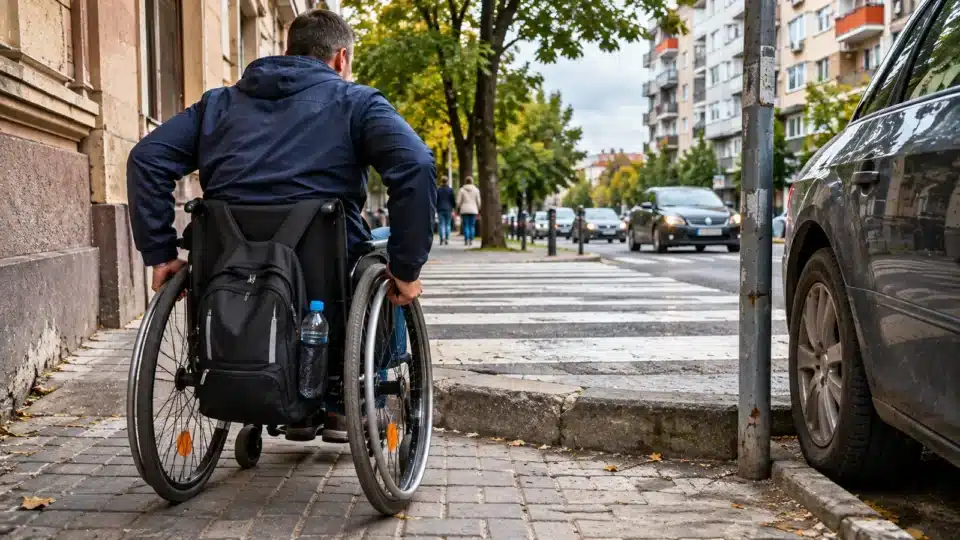
Urban accessibility can be reduced to a very concrete question: can a person who uses a wheelchair travel one kilometre independently, from home to a pharmacy, park or bus stop, without being forced into the road? For someone who walks without difficulty, a high kerb, a car on the pavement or a ramp that is too steep are often minor obstacles. For a person with reduced mobility, just one of them can interrupt the entire route.
Romania has explicit obligations on the accessibility of public spaces. Law 448/2006, Articles 62–64, refers to public-service buildings, access routes, streets, public transport and stops. The technical standard NP 051-2012 sets out requirements for routes, ramps and access points. The public-interest issue is not simply whether a ramp appears in a photograph, but the continuity of the entire journey.
This InfoBuz ORIGINALS report proposes a reproducible one-kilometre audit. The route and scores in the example are hypothetical, not the result of an inspection carried out on the streets of Constanța. Publishing a genuine ranking of neighbourhoods would require on-site measurements, observations by users and confirmation from the bodies responsible for the infrastructure.
An impossible kilometre: why one kerb can negate 900 accessible metres
Imagine a 1,000-metre route. The first 450 metres are smooth. Then comes a crossing with a kerb that is difficult to negotiate. After crossing, the pavement is wide enough for another 450 metres, but in the final stretch a car is parked in a way that leaves no room to pass. If the person has to turn back or enter the road at risk, the route cannot meaningfully be described as “90% accessible”.
A route’s accessibility is limited by its most serious interruption. That is the editorial principle behind this audit. It is not an assessment formula expressly set out in NP 051-2012, nor is it an official municipal score. It is a transparent public-service journalism method.
What an audit checks: ten required points on every route
| Observable criterion | How to check it | What to record |
|---|---|---|
| Clear width for movement | Measure the actual space between obstacles, not the full built width | Metres, location, time and photograph |
| Pavement continuity | Follow the route for interruptions, steps or closures | Accessible or blocked section |
| Kerbs and transitions at crossings | Check the change in level and the transition towards the carriageway | Height, configuration, risk |
| Longitudinal and cross slope | Measure with a suitable instrument; do not estimate visually alone | Direction, gradient and location |
| Surface and unevenness | Look for missing paving slabs, potholes, raised covers and slippery surfaces | Type of obstacle |
| Turning and passing spaces | Check whether there is space to change direction | Dimensions and locations |
| Posts, terraces, cars and street furniture | Measure the remaining clear passage | Permanent or temporary obstacle |
| Crossing and traffic lights | Check access on both sides of the street and the actual signal timings | Complete or interrupted route |
| Stop and bus | Check access to the platform, kerb and boarding | Accessible bus and usable stop |
| Entrance to the destination | Check the threshold, door, ramp and whether the service can be used | Independent entry or assistance required |
For every deviation, record the location and type of barrier. A checklist without photographs or measurements documents perceptions, not technical compliance. Nor does a route that works for one person guarantee accessibility for every user: wheelchair type, independence, weather conditions and individual needs all matter.
NP 051-2012: usable width is not the pavement’s total width
The standard on adapting civil buildings and urban spaces lays down requirements for accessible routes, manoeuvring areas, crossings, ramps and other elements. For example, a width of 1.80 m is specified for two-way pedestrian movement with constant traffic; in other configurations, different solutions and dimensions may be permitted or required, together with passing and turning opportunities. There is no simple rule under which “every 1.20-metre pavement is automatically legal and accessible”.
If a pavement is 2.00 m wide on the plan, but a post occupies 45 cm and a parked car removes another 70 cm from the practical passage, the remaining space is 85 cm. This is a mathematical and hypothetical example, not a situation observed in a particular city. The relevant measurement is the clear passage width at the narrowest point, not the width shown on an urban-planning plan.
A ramp may exist but still be unusable
A ramp does not become accessible simply because it has been painted or bears a symbol. Its slope, width, non-slip surface, landings, changes in level and manoeuvring areas must all be checked. Geometrically, a rise of 15 cm over a horizontal length of 1.50 m produces a 10% gradient. This is a mathematical relationship, not a claim that a 10% ramp complies in every circumstance.
Permitted requirements may vary according to the type and length of the ramp and the circumstances — new construction or an existing building. A legal or technical assessment must use the precise section of NP 051-2012, not an isolated percentage threshold. A ramp that is too steep can increase the risk of tipping or slipping.
Pedestrian crossings: the issue is the entire crossing
A well-designed drop kerb at one end of a crossing solves nothing if there is a high kerb on the other side, or if a ramp ends in an area where cars park. People with visual impairments also need appropriate markings and orientation. Article 64(4) of Law 448/2006 concerns adapted crossings and tactile signage, as well as audible and visual signals at busy intersections.
A sound audit records the exact position of both transitions, the continuity of the surface and the presence of obstacles. It does not stop at the existence of a zebra crossing or traffic light. The fact that a companion can lift a wheelchair over a kerb does not mean independent access is possible.
Accessible stop + accessible bus: both must work together
A low-floor public-transport vehicle with a ramp is not enough if the stop is inaccessible, the bus cannot pull up properly or the ramp cannot be used safely. Article 64 of Law 448/2006 includes obligations concerning the adaptation of public transport and stops, including guidance elements for different types of disability.
For an investigation in Constanța, the actual route through the stop, the type of vehicle used on the service, the procedure for requesting the ramp and access from the pavement to the door would need to be checked. Without examining a specific service and stop, we do not claim that all CT BUS buses are accessible or inaccessible.
Law 448/2006: rights on paper and obligations to implement them
Article 62 provides for the adaptation, in line with applicable standards, of public-service buildings, access routes, streets and public roads, transport, parking and the information environment. Article 63 also concerns the conditions for authorising public-service construction. Article 65 establishes that organised car parks covered by the law must provide at least 4% of spaces, but no fewer than two, adapted and reserved for persons with disabilities, under the relevant legal framework.
Importantly, accessibility obligations are established by law, but seeing a high kerb alone is not enough automatically to identify the legal entity responsible or establish that an offence has occurred. It is necessary to determine who administers the pavement or building, what works have been carried out and which technical rules apply.
What a one-kilometre assessment looks like in figures: a hypothetical example
| Section assessed | Imaginary situation | Functional consequence |
|---|---|---|
| 0–250 m | Continuous pavement with sufficient clear space | Passage possible without detour |
| 250–300 m | A post reduces the passage below the user’s needs | Narrowing that may require turning back |
| 300–600 m | Good paving, but a crossing with a kerb and no transition | Route effectively blocked for some users |
| 600–850 m | Adapted pavement with no obstacles | Usable section |
| 850–1,000 m | Stop with difficult boarding access | The mobility chain is incomplete |
This scenario contains five segments invented solely for explanatory purposes. It is not an inspection of a Constanța neighbourhood and does not produce a statistic about the city. Its purpose is to show why an average score for paving quality may conceal the fact that the destination cannot be reached.
The InfoBuz method for a real, reproducible audit
- Select the route with a wheelchair user, between two clearly defined destinations relevant to daily life.
- Obtain the participant’s informed consent for participation, photography and publication of personal details where applicable.
- Record the date, time, weather and means used; photograph obstacles without exposing unnecessary personal data.
- Measure widths, gradients, kerbs and turning areas using appropriate tools.
- Try alternative routes only where they are safe; do not ask anyone to enter traffic to demonstrate a barrier.
- Map obstacles and identify the infrastructure administrator where possible.
- Request a response from the relevant institutions, along with existing projects or corrective measures.
- State the limits of the observations explicitly: a visit on one date does not prove the permanent condition of every street.
Five different barriers, five different solutions
| Barrier | Solution to investigate | Why one measure alone is insufficient |
|---|---|---|
| High kerb | Properly designed accessible transition | The crossing on the opposite side must also be checked |
| Pavement narrowed by cars | Parking enforcement and reorganisation of space | Without consistent functional width, the problem returns |
| Non-compliant ramp | Rebuilding based on a technical design | A simple metal plate may be unsafe |
| Uneven paving | Adapted rehabilitation and maintenance | An isolated good surface does not remedy other barriers |
| Inaccessible stop | Coordination of the operator, stop and road | An accessible vehicle alone does not guarantee boarding |
What an inclusive city means for other people, too
Accessibility also serves parents with pushchairs, older people, people using crutches, people with visual impairments and those with temporary mobility difficulties. But these needs are not identical. A ramp useful for a pushchair does not replace tactile paving, visual signs, audio guidance or safe routes for blind people.
The UN Convention on the Rights of Persons with Disabilities, ratified by Romania, treats accessibility to the physical environment and transport in Article 9 as part of equal participation in society. It is a rights standard, not simply an urban-design choice. UN Convention, Article 9.
How to report an inaccessible pavement or crossing
The first step is to identify the body responsible for the road, stop or building, then submit a report including the location, photographs, a description of the barrier and a request for inspection and remediation. Depending on the situation, it may also be useful to request project documents under Law 544/2001 — for example, the acceptance report, accessibility drawings or rehabilitation programme. Deadlines and legal routes vary according to the subject of the request.
InfoBuz has already explained the difference between a petition and a public-information request. In cases of possible discrimination, the National Council for Combating Discrimination accepts petitions under its procedure, including within one year of the act or of the date on which the petitioner became aware of it. Not every pavement problem is automatically classified as discrimination; the assessment depends on the specific circumstances and evidence.
Short template for reporting an urban barrier
Subject: report concerning the accessibility of the pedestrian route [street, intersection, landmark]. On [date], on the section [description], I identified the following barrier: [kerb, narrow passage, ramp, crossing, stop]. It prevents or makes more difficult the independent movement of people with reduced mobility. I request identification of the responsible administrator, verification of compliance with Law 448/2006 and standard NP 051-2012, communication of the proposed measures, the estimated deadline and relevant documents. I attach photographs and indicative measurements. Please register this report and reply in writing to [address].
Such a petition does not replace a technical expert or court proceedings. But it is specific enough for the institution to know what must be checked. In an urgent case involving immediate danger, appropriate emergency channels should be used rather than waiting solely for a response to a petition.
Documents to request from city hall before calling work non-compliant
- The technical design and accessibility drawings for the section, where they can legally be disclosed.
- The dates of construction and acceptance of the works, including any observations in the acceptance report.
- The identity of the administrator of the road, pavement or stop.
- The standard and version applicable when the work was designed and accepted.
- The local adaptation programme and allocated budget, if any.
- Responses to previous reports and documented corrective measures, with personal data protected.
- The position of representatives of persons with disabilities involved in the adaptation process.
Constanța: what can be stated, and what remains to be investigated
We can state that national accessibility standards are relevant to urban infrastructure in Constanța. We can identify the official adaptation obligations. What we cannot do today is publish a ranking of Constanța’s least accessible neighbourhoods without measurements taken on real routes. An AI-generated image and a one-kilometre scenario are not an inspection of the city’s streets.
The next journalistic step for a local investigation would be to test at least three different routes — for example, a residential route to a stop, one to a public institution and one to a medical service — selected together with users familiar with the everyday barriers. Each route would have checklists, photographs, measurements and a right of reply for the relevant administrator.
Why a new bus or a new pavement alone does not solve the problem
Mobility is a chain: home → exit from the building → pavement → crossing → stop → vehicle → pavement at the destination → entrance to the institution. If the sixth link is accessible but the fourth is not, the user cannot fully benefit from the investment. For comparison with access to buildings and tourist destinations, see InfoBuz’s articles on adaptable housing and on checking accessibility when booking.
Frequently asked questions about urban accessibility
Must pavements be accessible to people with disabilities?
Law 448/2006 provides for the adaptation of streets, public roads and access routes in accordance with applicable standards. Assessing a particular pavement requires identifying the administrator, the project and the relevant technical rules.
Is a ramp at a pedestrian crossing enough?
No. The ramp on the opposite side, slope, surface, manoeuvring space and continuity of the route must also be checked.
Is there one legal minimum width for every pavement?
No. NP 051-2012 covers different traffic situations and configurations, including routes with varying flows and passing areas. The clear usable width must be assessed in the context of the standard.
Can I measure a ramp’s slope myself?
You can carry out an indicative check with suitable tools, but official compliance depends on the measurement method, the complete configuration and applicable standards. Do not put a user at risk to test a questionable ramp.
Is a stop accessible if the bus has a ramp?
Not necessarily. The stop, platform, vehicle positioning and use of the ramp must be compatible for safe boarding.
Where can I report a barrier on a public street?
To the infrastructure administrator and the competent authority, once the circumstances have been identified. For a discrimination issue, the CNCD procedure is also available under the law. Law 544/2001 can be used to request public documents.
Is a photograph of a high kerb sufficient evidence?
It is useful evidence of the observed condition, but a complete assessment requires measurements, context, the administrator, the project and the applicable technical framework.
Why does this article not name a particular street in Constanța as inaccessible?
Because no on-site inspection has been carried out. The examples were devised for educational and methodological purposes, not to attribute unverified barriers to a real area.
Conclusion: a city’s accessibility is measured door to door
An administration may report hundreds of metres of rehabilitated pavement and dozens of ramp-equipped vehicles without knowing how many destinations can be reached safely by a person with reduced mobility. A one-kilometre audit based on measurable data can show where the route breaks down. The indicator that matters is not simply the number of ramps built, but the proportion of real journeys that can be made independently and safely.
For InfoBuz, the next step that would turn this guide into a distinct local investigation is collaboration with wheelchair users, engineers, specialist organisations and infrastructure administrators on field checks. Without that step, this article properly remains an audit guide, not a map of purportedly observed barriers.
Official sources, methodology and limitations
- Law 448/2006 on the protection and promotion of the rights of persons with disabilities — Legislative Portal: obligations concerning accessibility, roads, transport and parking.
- NP 051-2012 — standard on adapting civil buildings and urban spaces: technical design and accessibility requirements.
- UN — Convention on the Rights of Persons with Disabilities, Article 9: access to the physical environment and transport.
- CNCD — submitting a petition: steps and conditions for reporting discrimination.
- Government Ordinance 27/2002: the general framework for petitions.
- Law 544/2001: requesting public documents.
Editorial note: researched on 17 November 2026. The one-kilometre route, the 250–300 m segments, the width example and the slope calculation are hypothetical. We did not carry out field measurements and do not attribute unverified obstacles to any street in Constanța. The featured image is an AI-generated illustration, not a photograph of a real identified person or place. Legal information does not replace a technical expert assessment or individual legal advice.






Discuția cititorilor
Ai o opinie sau o întrebare despre acest articol? Spune-ne ce crezi.
Fii primul care deschide discuția.
Te rugăm să păstrezi un limbaj civilizat și să discuți la subiect. Comentariile spam sunt filtrate automat.