
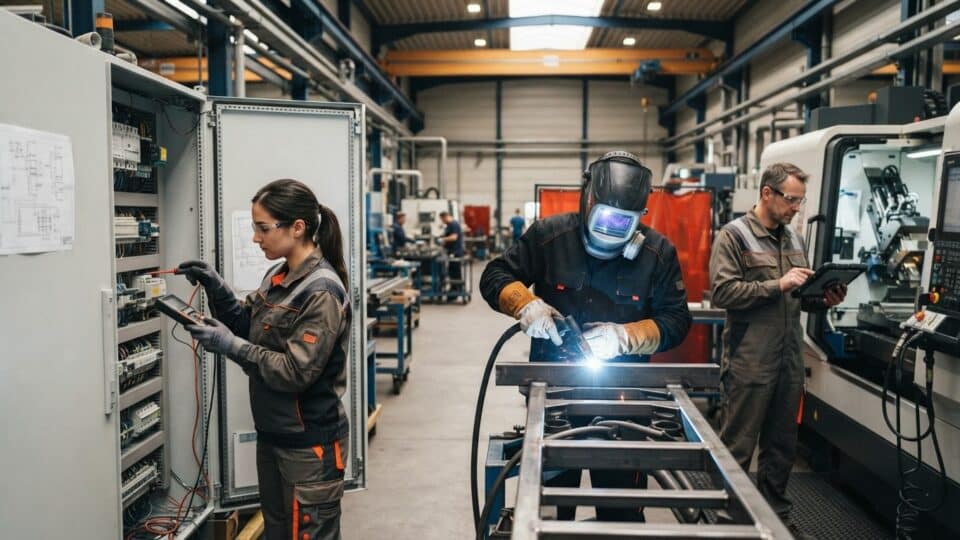
Technical trades are returning to the centre of the labour market. While some of the careers debate is dominated by artificial intelligence, programming and office jobs, the real economy faces a more concrete problem: there are not enough electricians, welders, plumbers, mechanics, maintenance technicians and skilled operators for the volume of work that needs to be done.
This is not only a Romanian phenomenon. The European Labour Authority says welders and construction electricians are among the shortage occupations in most European countries. Cedefop, meanwhile, points to persistent shortages in metalworking, construction, installation work, transport and maintenance — precisely the fields in which practical qualifications and experience matter greatly.
Technical trades are more valuable because they are hard to replace
A good electrician cannot be replaced by a chatbot when an installation needs to be measured, insulated, diagnosed and made safe. A qualified welder cannot be replaced by software alone when a joint must be completed to a procedure, in a difficult position, with strict tolerances and quality control.
Likewise, a maintenance technician must combine theory with direct observation of:
- unusual sounds;
- vibrations;
- temperatures;
- mechanical play;
- wear;
- electrical measurements;
- how an installation behaves under load.
AI can assist with diagnostics, documentation and planning, but physical work and technical responsibility remain in the field.
What Europe says about the shortage of skilled tradespeople
The EURES report on labour shortages and surpluses identifies the following among the most widespread shortage occupations:
- welders and flame cutters;
- construction electricians;
- plumbers and pipe fitters;
- machinery mechanics and repairers;
- machine-tool operators;
- metal structure workers;
- air-conditioning and refrigeration mechanics.
The European Labour Authority says these shortages are not isolated episodes, but structural problems that recur from one report to the next.
Romania is among countries with many shortage occupations
In European reporting for 2024, Romania was among the countries reporting a high number of shortage occupations.
On 11 November 2026, Romania’s National Employment Agency (ANOFM) reported 31,059 job vacancies nationwide. Not all of these are technical roles, but the overall picture is of a market in which employers continue to seek staff across a wide range of fields.
InfoBuz separately examined the nearly 30,000 jobs available in Romania and the sectors facing staff shortages.
For more information on Cedefop, see also The jobs of the future are not chosen from a ranking: seven skills for 2030 and a realistic 90-day reskilling plan, which provides complementary details on this subject.
Why electricians are in short supply
The electrification of the economy is increasing demand for electrical skills.
There are more and more:
- photovoltaic panels;
- charging stations;
- heat pumps;
- smart buildings;
- storage systems;
- industrial automation systems;
- data centres;
- electricity grids that need upgrading.
All of this requires not only engineers, but also electricians, technicians and maintenance staff.
The energy transition does not eliminate technical trades. On the contrary, it multiplies them.
Why welders remain hard to replace
Welding is a strong example of a trade in which technology raises the standard but does not remove the human role.
Industry uses welding robots, but they work best in repetitive, controlled production.
In steel construction, shipbuilding, energy, offshore work, maintenance, pipelines and repairs, situations are far more varied.
A qualified welder needs to understand:
- joint preparation;
- welding position;
- the base material;
- the filler material;
- preheating, where necessary;
- distortion control;
- compliance with the WPS;
- acceptance criteria.
The higher the quality standard, the greater the difference between someone who can weld and a qualified professional.
Maintenance technicians are becoming one of the most important trades
Modern factories use more automation, sensors and software. That does not mean less maintenance.
It means more complex maintenance.
Today’s technician must often understand, at the same time:
- mechanics;
- electricity;
- pneumatics;
- hydraulics;
- automation;
- PLCs;
- sensors;
- digital diagnostics.
This is one reason good technicians are difficult to find: the role is becoming multidisciplinary.
Technical trades no longer mean only manual work
The old image of a tradesperson working exclusively with mechanical tools is increasingly outdated.
Many modern technical jobs use:
- tablets;
- digital electrical diagrams;
- 3D models;
- 3D scanners;
- connected measuring instruments;
- maintenance software;
- augmented reality;
- AI-assisted diagnostics.
In practice, technical trades and digital skills are being combined.
AI will change technical trades, not eliminate them
Artificial intelligence can help a technician find a procedure more quickly, interpret an alarm, compare a manual or generate a checklist.
But AI cannot independently enter a technical room to measure voltage, inspect a flange, replace a bearing or test a cable’s insulation.
The most valuable profiles will probably be hybrid ones:
practical trade skills + digital capability + diagnostic ability.
Why pay should not be assessed by job title alone
One reason misleading comparisons arise is that “welder”, “electrician” or “technician” can describe very different levels of skill.
Income may be affected by:
- qualifications;
- certifications;
- experience;
- the type of industry;
- shift work;
- travel;
- offshore or construction-site work;
- responsibility;
- foreign-language skills;
- the ability to read technical documentation.
A professional with certifications and industrial experience may hold a completely different position from an entry-level worker with the same general job title.
Certification is becoming a professional currency
In technical trades, a CV matters, but practical proof of competence matters even more.
Depending on the field, relevant credentials may include:
- authorisations;
- welding certifications;
- electrical accreditations;
- qualifications for working at height;
- safety courses;
- equipment certifications;
- industrial procedures and standards.
These documents reduce risk for employers and make competence easier to verify.
Practical experience remains hard to replace
Two people may have the same diploma yet deliver very different results in the field.
Experience means recognising a problem before it becomes a breakdown.
It means knowing when a noise is normal, when a vibration is not, when a component is operating but outside tolerance, and when work must be stopped.
These abilities are built over years of real work.
Why too few young people enter these trades
One cause of the shortage is their social image.
For years, the route regarded as “successful” was:
secondary school → university → office job.
Vocational school and technical qualifications were often viewed as secondary options.
The result is a smaller generation of tradespeople entering the market just as many experienced professionals approach retirement.
Demographics intensify the problem
The European Labour Authority says some shortage occupations have few young workers.
As older generations leave employment, the shortage may become more severe if there are not enough trained people to replace them.
This is why the shortage cannot be solved simply through a quick recruitment campaign.
Training a good electrician, welder or technician takes time.
Dual education could become much more important
The dual-education model combines schooling with practical training at a company.
Its advantage is that students see real equipment and real processes, rather than theory alone.
For employers, the system offers an opportunity to train future staff on the technology they actually use.
For students, the transition into a first job can become easier.
But initial qualification is only the beginning
In technical fields, learning does not end when a diploma is obtained.
An electrician who worked with conventional installations 15 years ago may now need knowledge of photovoltaics, inverters, batteries and EV charging stations.
A mechanical technician may need to work with sensors, PLCs and predictive analysis.
A welder may move from carbon steel to stainless steel, aluminium or special alloys.
Skills that most increase a tradesperson’s value
Alongside a core trade, several skills can significantly improve professional attractiveness:
- reading technical drawings;
- understanding electrical diagrams;
- measurements and tolerances;
- technical English;
- occupational safety;
- using digital tools;
- documenting work;
- diagnostics and troubleshooting;
- communication with engineers and supervisors.
English can make a difference
In international companies, construction, energy, shipbuilding and offshore work, technical documentation is often in English.
Manuals, procedures, technical data sheets and standards are frequently written in the language.
A professional who can speak directly with a client or an international engineer has a clear advantage.
Technical trades can offer international mobility
An important advantage of a well-certified technical skill is its transferability.
Welding, installation work, electrical work, mechanics and maintenance exist in every industrial economy.
EURES was created precisely for worker mobility within the European Economic Area and continuously publishes cross-border job vacancies.
Not all technical jobs are “heavy and dirty”
Some modern trades are carried out in highly controlled environments:
- data centres;
- automated factories;
- laboratories;
- HVAC installations;
- renewable energy;
- equipment servicing;
- building automation.
For this reason, the idea that a technical trade automatically means difficult construction-site work is outdated.
What students should consider before choosing a technical trade
They should not choose only the field with the most job advertisements.
It is worth considering:
- what they enjoy repairing or building;
- whether they enjoy practical work;
- how much mathematics and physics the field involves;
- which authorisations are required;
- which schools or programmes offer genuine practical training;
- which companies work with the school;
- what progression route is available.
From tradesperson to technician, specialist and supervisor
A technical career need not remain at the same level throughout a person’s working life.
One possible progression is:
apprentice → skilled worker → technician / specialist → team leader → supervisor → works coordinator.
In some companies, solid practical experience is a major advantage in management roles because the person understands the actual work, not only the planning.
Technical trades and the green transition
Europe is investing in electrification and decarbonisation.
That means installing and maintaining a vast amount of infrastructure:
- solar panels;
- electricity grids;
- charging stations;
- heat pumps;
- batteries;
- energy-renovated buildings;
- modernised industrial installations.
Without electricians, plumbers, technicians and mechanics, the green transition remains only a plan on paper.
What Cedefop projects for Romania to 2035
Cedefop projects significant shortage pressure in Romania across several occupational categories by 2035, including craft workers, technicians and operators.
Its indicator combines employment growth, the need to replace people leaving work and the mismatch between skills demand and supply.
In other words, demand comes not only from the creation of new jobs, but also from the need to replace many experienced workers.
Technical trades are not a Plan B
Choosing a technical career should not automatically be seen as the alternative for someone who does not go to university.
It is a different professional path, with its own requirements and potential.
For some people, the combination of qualifications, experience, certifications and foreign languages can produce a more stable career than a generic office job.
InfoBuz has also examined 15 professions with growth potential in Romania to 2035, including both digital roles and technical occupations.
What lies ahead for the labour market
In the coming years, competition will not be only between people and AI.
There will also be competition between companies for people who can:
- install;
- repair;
- measure;
- diagnose;
- keep infrastructure running.
And these people are harder to train than they may appear.
Technical trades: the conclusion
Electricians, welders and technicians are becoming more valuable not because technology has stalled, but precisely because it is advancing.
More automation means more complex equipment. More electrification means more installations. More investment in infrastructure means a greater need for people who can turn a project into completed work.
The job of the future is not necessarily one performed exclusively on a laptop. It may be one in which a laptop helps someone do better work that only a qualified professional can carry out.
Frequently asked questions
Are welders in demand in Europe?
Yes. The European Labour Authority includes welders and flame cutters among the most widespread shortage occupations in Europe.
Are electricians a job of the future?
Yes. The electrification of transport, renewable energy, building automation and grid modernisation are increasing the need for electrical skills.
Will AI replace technicians?
AI can automate diagnostics, documentation and analysis, but many physical installation, repair, testing and maintenance tasks remain dependent on qualified personnel.
Is a university degree required for a good technical career?
Not for every route. Many trades rely on vocational qualifications, practical training and certifications. Higher education is required, however, for certain engineering or design roles.
Which additional skill helps the most?
It depends on the field, but technical English, reading drawings, diagnostics, digital tools and recognised certifications can significantly increase professional value.
Sources: European Labour Authority – Labour shortages and surpluses in Europe 2025; European Labour Authority – labour shortages in Europe; Cedefop – job quality and labour shortages in Europe; ANOFM – job vacancies, 11 November 2026.


Discuția cititorilor
Ai o opinie sau o întrebare despre acest articol? Spune-ne ce crezi.
Fii primul care deschide discuția.
Te rugăm să păstrezi un limbaj civilizat și să discuți la subiect. Comentariile spam sunt filtrate automat.