
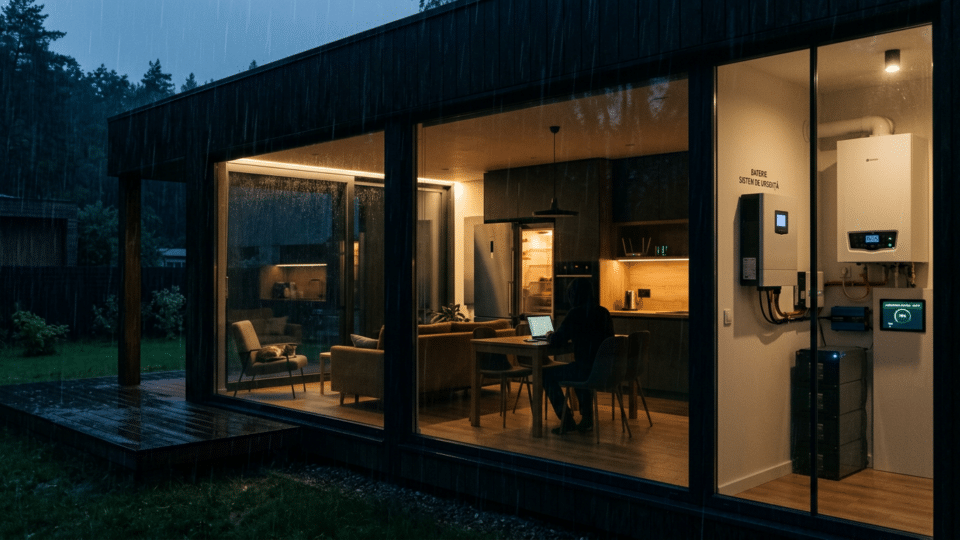
A blackout-ready home does not mean powering the entire property as though the grid were operating normally. During a serious power outage, the right strategy is to prioritise essential loads: the refrigerator, freezer, lighting, internet, phones, pumps, the gas boiler and, where applicable, medical equipment.
The difference between 24, 48 and 72 hours of autonomy is substantial. A 5 kWh battery may seem large, but a 2 kW electric water heater can drain it within hours. By contrast, the same battery can keep a router, several LED bulbs, a refrigerator and a gas boiler running for almost a day if loads are managed correctly.
A blackout-ready home: the basic rule
Before calculating battery or generator capacity, divide your appliances into three categories:
- essential: refrigerator, freezer, lighting, internet, phones, boiler, and necessary pumps;
- important: laptop, television, home automation, gate, cameras and desktop computer;
- non-essential: a large electric water heater, electric hob, oven, dryer, high-power air conditioning, sauna and direct electric heating.
Real autonomy begins when the third category is switched off.
What 1 kWh means in practice
One kWh can power approximately:
- a 10 W LED bulb for 100 hours;
- a 12 W router for more than 80 hours;
- a 50 W laptop for 20 hours;
- a refrigerator averaging 50 W for around 20 hours;
- a 2,000 W water heater for only around 30 minutes.
These figures are indicative. Actual consumption varies by model and operating conditions.
Nominal capacity is not usable capacity
A 10 kWh battery does not necessarily deliver 10 usable kWh at the sockets.
You need to take account of:
- the minimum state-of-charge reserve;
- inverter losses;
- the inverter’s own consumption;
- temperature;
- battery degradation;
- battery-management-system limits.
As a conservative rule of thumb, depending on the system, 80–90% of nominal capacity can be treated as usable energy.
A baseline scenario for a family
Consider a home seeking to keep the following running:
| Load | Indicative daily consumption |
|---|---|
| Refrigerator | 1–1.5 kWh |
| Freezer | 0.8–1.2 kWh |
| Router + ONT | 0.3–0.6 kWh |
| LED lighting | 0.3–0.6 kWh |
| Phones/laptops | 0.5–1 kWh |
| Gas boiler + pumps | 0.5–1.5 kWh |
| Cameras/security | 0.2–0.5 kWh |
The total can be around 4–7 kWh per day without high-consumption appliances.
24-hour autonomy
For 24 hours, around 5–8 kWh of usable battery capacity may be enough for the essentials in an efficient home.
With 6 usable kWh, you can, as an indication, keep running:
- the refrigerator and freezer;
- the router;
- LED lighting;
- phone charging;
- laptops;
- the gas boiler;
- several hours of television.
It is not realistic, however, to use an electric hob, water heater and air conditioning simultaneously.
48-hour autonomy
At 48 hours, strategy becomes more important than battery size.
If your requirement is 5 kWh per day, you need around 10 usable kWh without solar input.
For a system with a 12 kWh nominal battery, 10–11 usable kWh may be realistic, depending on the discharge limit and losses.
If you have photovoltaic panels and good weather, autonomy can be extended substantially because daytime production covers consumption and recharges the battery.
For more information on photovoltaic panels, see Photovoltaic panels, batteries or a heat pump? How to calculate the right investment for your home, which provides complementary details on the subject.
72-hour autonomy
For 72 hours, relying on batteries alone becomes expensive if there is no solar generation or generator.
At 5 kWh per day, the requirement is around 15 usable kWh.
At 7 kWh per day, it rises to 21 usable kWh.
That is why, for 72-hour blackouts, the most robust solution is usually:
- a battery for the first hours and overnight;
- photovoltaic panels for daytime generation;
- a generator for extended periods without sun;
- load shedding for high-consumption appliances.
The refrigerator does not necessarily need continuous power
The FDA recommends keeping doors closed as much as possible. An unopened refrigerator can keep food cold for around 4 hours, while a full freezer can do so for around 48 hours; a half-full freezer, for around 24 hours.
This means that, during a blackout, you can reduce refrigerator consumption through controlled cycles if you monitor temperature and food safety.
The freezer matters more than it may seem
A full freezer has considerable thermal inertia. The fuller it is, the longer it retains its temperature.
You can use ice packs or containers of frozen water to increase thermal mass.
Internet is a very small load
Together, a router and optical network terminal (ONT) often consume 10–25 W.
At 20 W, daily consumption is only:
0.48 kWh per day.
This means the internet can remain online for a long time even with a modest battery, provided the operator’s infrastructure is working.
A gas boiler during a blackout
A gas boiler does not operate without electricity. It needs power for:
- the electronic control board;
- the fan;
- the pump;
- ignition;
- automation systems.
Its electricity consumption is usually much lower than that of an electric boiler, but it still needs to be included in the calculation.
A water pump can become a critical load
If the home relies on a well and booster pump, a blackout may also mean no water.
A pump may draw 500–1,500 W or more, and its starting current can be several times higher.
The inverter must be sized not only for average consumption, but also for the starting surge.
Why an electric hob is a problem
A hob may consume 2–7 kW. Even a single 2 kW ring can use 2 kWh in one hour.
In an emergency, electric cooking should be reduced or replaced with more efficient and safer methods.
An electric water heater is a major load
A 2 kW electric water heater running for two hours uses 4 kWh.
That may account for almost all the energy available in a small battery.
During a blackout, hot water needs to be treated separately from basic power provision.
Heat pump
A heat pump may consume 1–4 kW or more, depending on its capacity, outdoor temperature and operating mode.
During a short blackout, a large battery may support it. During a 72-hour winter outage, maintaining autonomy becomes much more difficult.
Air conditioning
A modern inverter air conditioner may consume relatively little once stabilised, but it remains a significant load.
During a heatwave, it can become essential for vulnerable people, but must be prioritised carefully.
What battery capacity do you need for 24, 48 and 72 hours?
| Average essential consumption | 24 h | 48 h | 72 h |
|---|---|---|---|
| 3 kWh/day | 3 kWh | 6 kWh | 9 kWh |
| 5 kWh/day | 5 kWh | 10 kWh | 15 kWh |
| 7 kWh/day | 7 kWh | 14 kWh | 21 kWh |
Add a margin for losses and the state-of-charge reserve to these figures.
Inverter power matters just as much
You may have a 20 kWh battery and still be unable to start a large pump if the inverter cannot handle the power surge.
Check:
- continuous power;
- peak power;
- how long it can sustain the peak;
- maximum battery current;
- compatibility with motors and compressors.
Solar panels do not automatically work in a blackout
A conventional grid-connected photovoltaic system shuts down when the grid fails, even if the sun is shining.
This is an anti-islanding safety feature.
For backup, you need:
- a hybrid inverter or compatible backup solution;
- a battery, if the system requires one;
- an EPS/backup output;
- a separate consumer unit for essential circuits;
- correct configuration.
InfoBuz has separately explained when a solar battery buys autonomy and when it only buys savings.
A backup consumer unit is essential
The best solution is not to power the entire home, but to have dedicated circuits for:
- the refrigerator;
- the freezer;
- the router;
- lighting;
- the boiler;
- pumps;
- essential sockets.
This prevents the battery from being accidentally drained by the oven or water heater.
A generator: very useful, but with real risks
A generator can extend autonomy almost indefinitely as long as fuel is available.
But it must be used correctly.
The CDC recommends using a portable generator outdoors only, at least approximately 6 metres from doors, windows and vents. Carbon monoxide is colourless and odourless and can be fatal.
Never use a generator in a garage, basement, carport or indoors, even with the door open.
A generator and battery are often the ideal combination
A battery is excellent for:
- silent operation;
- night-time use;
- brief interruptions;
- low consumption.
A generator is excellent for:
- recharging the battery;
- long periods without sun;
- temporary high-consumption loads.
Combined, they can greatly reduce fuel consumption.
Water for 72 hours
During a regional blackout, water supply may also become a problem.
The FDA, FEMA, CDC and Red Cross recommend a minimum of around 1 US gallon, or 3.8 litres of water per person per day, for drinking and basic needs, with at least a three-day supply.
For a family of four:
3.8 × 4 × 3 ≈ 46 litres.
In practice, a larger reserve is useful.
Emergency lighting
LED bulbs are highly efficient. Four 8 W bulbs used for five hours consume only:
0.16 kWh.
This is one of the easiest loads to support from a battery.
Phones, radio and communications
A phone uses very little energy. A 1 kWh battery can charge dozens of phones.
More important are:
- power banks;
- a battery-powered radio;
- torches;
- car chargers;
- backup internet.
Starlink as a communications backup
If the local fibre or mobile operator has problems, satellite internet may be useful.
But Starlink consumes more power than a conventional router and must be included in battery calculations.
A blackout plan for the first 24 hours
- Switch off high-consumption appliances.
- Check the battery’s state of charge.
- Keep the refrigerator and freezer closed.
- Switch to essential circuits.
- Charge phones.
- Check the water supply.
- Follow official information.
Plan for 24–48 hours
After the first day, you need to move from comfort mode to conservation mode.
- Reduce use of televisions and desktop computers.
- Power the refrigerator in a controlled way.
- Use light only where needed.
- Switch off unnecessary automation systems.
- Prioritise pumps and communications.
Plan for 48–72 hours
At this point, you should assume the outage may continue.
The following become important:
- generator fuel;
- drinking water;
- food;
- heating;
- medicines;
- communications;
- remaining battery energy.
What not to do
- Do not run a generator indoors.
- Do not improvise backfeed connections at the home consumer unit.
- Do not connect a generator to a standard socket to “feed power into the house”.
- Do not leave candles unattended.
- Do not open the refrigerator unnecessarily.
- Do not spend battery power on non-essential appliances.
What is worth buying before a blackout
- LED torches;
- power banks;
- a refrigerator thermometer;
- a battery-powered radio;
- quality extension leads;
- a UPS for the router;
- a carbon monoxide detector;
- water and non-perishable food;
- potentially a generator or battery.
How large should the battery be?
Do not start with “I want 10 kWh”. Start with consumption.
If you measure 5 kWh per day for essential circuits:
- 24 h → around 6 kWh nominal capacity with a reserve;
- 48 h → around 12 kWh;
- 72 h → around 18 kWh;
without solar input.
If you have 5 kWh per day of solar generation during the blackout, the outlook for autonomy changes completely.
Conclusion
A blackout-ready home is not the one with the largest battery, but the one that knows what needs to be powered and what needs to be switched off.
For 24 hours, 5–8 usable kWh may be enough for the essentials. For 48 hours, 10–15 kWh becomes considerably more comfortable. For 72 hours, the most robust solution is a combination of battery, solar and generator.
Autonomy is not bought only in kWh. It is built through prioritisation, separate circuits, storage, alternative sources and a clear plan.
Frequently asked questions
How long does a refrigerator last without power?
The FDA indicates around four hours if the door remains closed.
How long does a freezer last?
About 48 hours if it is full and remains closed, or about 24 hours if it is half full.
How much battery capacity do I need for 24 hours?
For essential consumption of 4–6 kWh per day, a battery with around 5–8 usable kWh may be enough.
Can I use solar panels when the grid fails?
Only if the inverter and installation are configured for backup/EPS. A conventional grid-connected system shuts down.
Where should a generator be placed?
Outdoors only, away from doors, windows and vents. The CDC recommends a minimum of about 20 ft, or roughly 6 metres.
Sources: Ready.gov – Power Outages; FDA – Food and Water Safety During Power Outages; CDC – Power Outage Safety.



Discuția cititorilor
Ai o opinie sau o întrebare despre acest articol? Spune-ne ce crezi.
Fii primul care deschide discuția.
Te rugăm să păstrezi un limbaj civilizat și să discuți la subiect. Comentariile spam sunt filtrate automat.