
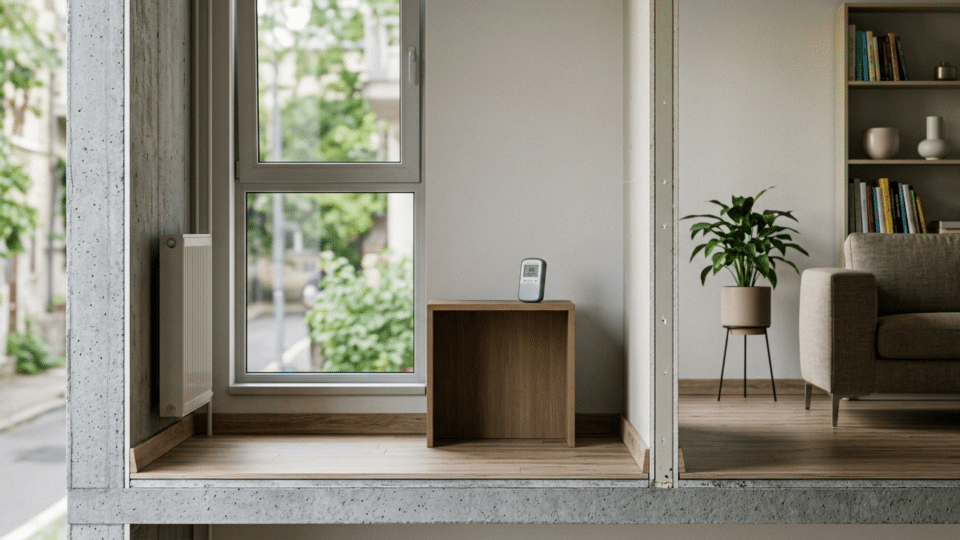
Radon is a naturally occurring radioactive gas that can enter buildings from the ground without leaving any smell, colour or recognisable sensation. In Romania, the serious answer to the question, “Do I have radon in my home?” does not come from a county-level map or a reading taken over a few hours. It comes from a radon measurement in the home, carried out over a sufficiently long period and interpreted in light of how the building is constructed and used.
The national reference level is 300 Bq/m³ for the annual concentration of radon in indoor air. It is neither a magic line between “safe” and “dangerous” nor a medical verdict for a home’s occupants. It is the level at which Romania’s regulatory framework requires an assessment and the application of reduction measures suited to the source and layout of the building.
In brief: the CNCAN map can show where data exist and where testing may deserve priority. It does not diagnose an individual address. For a home, the official methodology requires at least two detectors in frequently used rooms and screening lasting at least 90 days.
The CNCAN map is a starting point, not your home’s result
Romania’s National Commission for Nuclear Activities Control (CNCAN) publishes data on radon measured inside buildings. Its mapping methodology uses 10 × 10 kilometre grid cells and requires at least five measurements for an occupied cell, with additional measurements in densely populated areas. This is a useful planning and prioritisation tool, not a test for every building.
Two homes on the same street can produce different results. Contact with the ground, the presence of a basement, cracks and service penetrations through the slab, the type of foundation, ventilation, floor level, and the way rooms are used all affect how radon enters and remains in indoor air.
CNCAN data for 2025 also show another important limitation: the number of measurements is not evenly distributed between counties. A small number of exceedances in an area with few measurements therefore does not prove that the area is free of a problem. Conversely, many high readings do not automatically mean that every building in that county faces the same conditions. CNCAN’s published series on measurements in buildings should be read as administrative and mapping evidence, not as a ranking of “safe” or “dangerous” addresses.
The same principle applies before buying a home. A map may justify adding a radon test to the technical checks, especially for buildings with a ground floor or basement in contact with the soil. It cannot replace a test conducted in the property you intend to buy.
Home radon measurement: what the Romanian methodology requires
The methodology approved by CNCAN Order No. 153/2023 treats screening as a measurement integrated over time, rather than a snapshot. A home uses at least two detectors: usually one in the bedroom and one in the living room, or in other frequently used rooms.
Detectors must be placed to represent the air occupants breathe, rather than a draught from a window or heat near a radiator. The practical rule in the methodology is:
- approximately 1–2 metres above the floor;
- at least 30 cm from walls;
- away from windows, doors and direct heat sources;
- in rooms used normally, not in a storage space the household does not use.
In a multi-storey house, the choice of rooms should be discussed with the laboratory. A ground floor or habitable basement may be particularly relevant because of its contact with the ground, but a detector placed in just one location does not automatically describe the entire house. In a flat, the floor level and relationship to service areas or the ground remain useful information for interpretation, but do not rule out testing.
Screening must last for a minimum of 90 days. Radon concentrations vary with the season, the temperature difference between indoors and outdoors, and ventilation. A reading taken over 24 hours or a few days can help show variations or check the effect of an intervention, but it is not automatically equivalent to an annual average concentration.
A low-cost electronic detector or a designated laboratory?
A consumer electronic detector can serve a useful purpose: it can signal fluctuations, show how values change after airing out a room or altering ventilation, and help an owner understand that a result is not fixed from one hour to the next. Its limitation arises when that number alone is used to make a costly decision, support a property transaction, or design remediation work.
A meaningful screening result must be documented: the method used, the exposure period, the room, detector identification, and the laboratory that processed the result. CNCAN’s list of designated laboratories is worth checking on the day of ordering, because designations, validity periods and fields of activity may differ.
Not all services answer the same question. Some laboratories are authorised for passive measurements in indoor air, others for continuous measurements, or radon in soil or water. An owner seeking the concentration in living spaces should state the request clearly: a radon screening measurement in indoor air, in accordance with the methodology applicable to homes.
Before ordering, ask for written answers to four questions:
- How many detectors are included, and in which rooms does the laboratory recommend placing them?
- What is the actual measurement period, and how are the detectors returned?
- What information will the final report contain, and is the result seasonally corrected where the procedure requires this?
- What course of action does the laboratory recommend if the result exceeds the reference level?
Why 300 Bq/m³ should not be read as an on-off switch
In Romanian documents, the annual concentration of radon in indoor air is expressed in becquerels per cubic metre, Bq/m³. A becquerel indicates radioactive activity: one Bq corresponds to one decay per second. The figure does not say how “toxic” a room is on a single day; it helps estimate long-term exposure.
The World Health Organization links the risk of lung cancer to prolonged exposure to higher radon concentrations. Where national conditions allow, the WHO recommends a reference level of 100 Bq/m³ and identifies 300 Bq/m³ as the upper reference limit. The risk is higher for smokers because smoking and radon exposure act together as risk factors. This is explained in the WHO fact sheet on radon and health.
| What the result indicates | A reasonable step |
|---|---|
| Below 300 Bq/m³ | There is no exceedance of the national reference level. Keep the report and consider repeating the measurement after renovations, ventilation changes or major alterations to the building. |
| Above 300 Bq/m³ | Do not draw conclusions from a single step, such as airing the home for a few days. Ask the laboratory or a specialist to assess the result, carry out any necessary confirmation, and investigate the sources and entry pathways. |
| Very different values between rooms | Do not calculate a “whole-home average” yourself without knowing the method applied. The difference may itself offer a clue about radon pathways or how the rooms are used. |
Hypothetical example: in a 90-day screening, the living-room detector reports 340 Bq/m³ and the bedroom detector 150 Bq/m³. This does not automatically mean the home has “245 Bq/m³”, because interpretation must follow the laboratory’s methodology, applicable corrections and the relevance of the spaces. The difference is nevertheless practical information: the ground floor, cracks, service routes and ventilation in the two rooms may need to be checked before any work is undertaken.
For more information on home safety, see Smoke, gas or carbon monoxide detector? A guide to what to install at home, which offers complementary information on the subject.
After an exceedance: investigate the building before buying a solution
A value above the reference level does not mean the home must be abandoned, nor that one intervention will work in every house. The next step is a proportionate identification of the source and entry routes: contact with the ground, slab joints and cracks, pipe penetrations, the basement, service voids and the way the building is ventilated.
Possible measures include carefully sealing entry points, improving ventilation, or systems that reduce radon pressure beneath the building. The choice depends on the construction. A visible crack may be relevant, but is not necessarily the dominant cause; similarly, more intensive ventilation may temporarily reduce the concentration without resolving the route from the soil.
For this reason, an air purifier should not be presented as a universal radon remedy. It may filter certain particles, but recirculation alone does not remove the source of gas entering from the ground. Nor is it prudent to hastily seal structural cracks solely because of a radon result. If there are concerns about the foundation or structure, they require their own assessment route, also explained in InfoBuz’s article on wall cracks and foundation problems.
Energy-efficiency renovations can change the way air circulates in a home. After insulation work, window replacement or changes to ventilation, the methodology provides for repeat measurements in relevant situations. In a sealed home without a ventilation strategy, this check makes more sense than assuming that new windows alone have solved or created the problem. For larger projects, the choice of ventilation should be coordinated with the building design, rather than reduced to occasionally opening a window.
A responsible check in four steps
A realistic route for a homeowner is as follows:
- Use the CNCAN map for orientation. Check whether the area has measurements, and avoid conclusions based on a grid cell’s colour or the absence of data.
- Order screening suited to the home. Choose a designated laboratory, check its field of activity on the official list, and request at least two detectors in frequently used rooms.
- Maintain normal living conditions. Do not move the detectors or turn the 90 days into an experiment in constant airing; the aim is to measure representative exposure.
- Act on the report, not assumptions. In the event of an exceedance, seek guidance on confirmation, investigation of the building and checking the result after remediation.
The method does not provide the instant answer sometimes promised by an off-the-shelf device. It does, however, provide something more useful: a documented basis for deciding whether the home needs only monitoring, another measurement, or a technical intervention designed for the actual cause.
Frequently asked questions
Can I find out my home’s radon level from the CNCAN map alone?
No. The CNCAN map is a mapping and prioritisation tool based on aggregated measurements. It cannot establish the concentration at an individual address, which requires a measurement in the home.
How long should radon testing in a home last?
Romanian methodology requires a minimum of 90 days for screening in homes. Short measurements may capture variations, but are not automatically equivalent to the annual average relevant to interpretation.
Are two radon detectors enough?
At least two detectors are the minimum requirement for a home, usually in the bedroom and living room or other frequently used spaces. For a house with several levels or an unusual layout, the laboratory may recommend additional placements.
What should I do if the report shows more than 300 Bq/m³?
Keep the report and ask the laboratory or a specialist about the steps for confirmation and investigating the sources and entry pathways. Do not assume that airing the home, an air purifier or sealing one crack will automatically resolve the situation.
Sources consulted
- CNCAN — Number of radon measurements inside buildings, carried out by CNCAN-designated laboratories
- CNCAN Order No. 153/2023 on the methodology for determining radon concentration
- Methodology for determining radon concentration in indoor air and producing the radon map
- CNCAN — List of laboratories designated for radon testing
- World Health Organization — Radon and health




Discuția cititorilor
Ai o opinie sau o întrebare despre acest articol? Spune-ne ce crezi.
Fii primul care deschide discuția.
Te rugăm să păstrezi un limbaj civilizat și să discuți la subiect. Comentariile spam sunt filtrate automat.