
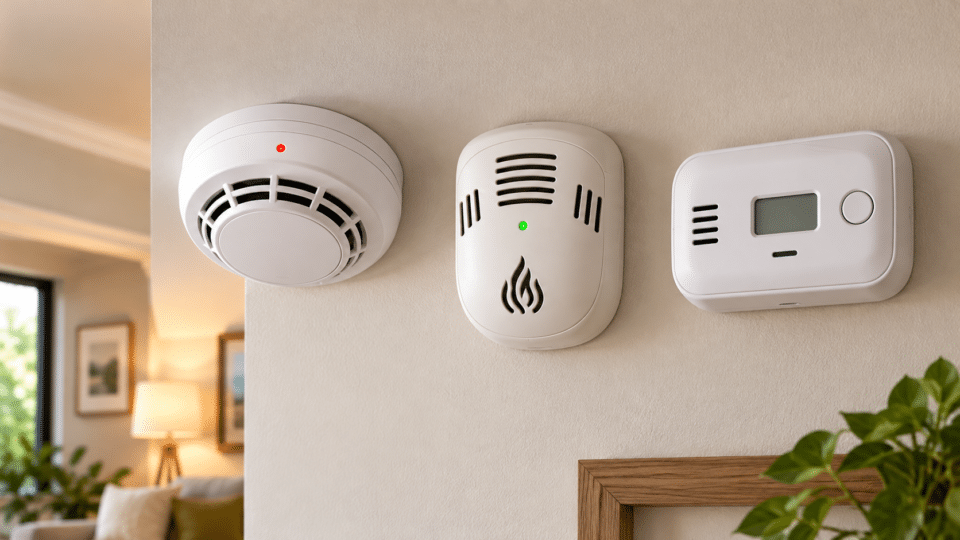
A smoke alarm can provide an early warning of a fire, but it cannot replace a natural-gas sensor or a carbon monoxide (CO) alarm. The three hazards are not detected by the same sensor. A device sold as a “gas detector” is not automatically able to warn of smoke or carbon monoxide (CO).
The guide below explains the differences, general placement rules and an important provision in Romanian rules on natural-gas systems. For the exact position and connection of a solenoid valve, follow the instructions for the specific model and the system design, using authorised personnel where necessary.
Smoke detector: early fire warning
An optical smoke detector detects particles produced by combustion and can issue a warning before a fire becomes visible throughout the home. It is particularly useful while occupants are asleep. However, a smoke detector does not automatically determine whether carbon monoxide levels are dangerous, nor does it shut off the natural-gas supply.
For more information on home safety, see Radon has no smell: how to check the real risk in a Romanian home, which offers complementary details on the subject.
As a safety benchmark, the US Consumer Product Safety Commission (CPSC) recommends smoke alarms on every level of a home, in every bedroom and outside sleeping areas. In Europe, choose products that meet the relevant EN 14604 standard and have the appropriate conformity documentation. They are commonly placed on the ceiling, but distances from corners, walls and air currents are set out in the manufacturer’s instructions.
Avoid installing one indiscriminately directly above a cooker or in areas with steam unless the model is designed for those conditions: repeated false alarms may tempt users to disable it. In the long term, maintenance and replacement at the end of the device’s service life matter as much as the initial purchase.
2. Natural-gas detector: for methane leaks
In homes supplied with natural gas, a specialised sensor monitors for an abnormal concentration of combustible gas. Methane (CH4), the main component of natural gas, is lighter than air and tends to collect in higher areas, which is why methane sensors are often installed towards the top of a room. This does not replace the installation guidance for the specific device.
A sensor designed for liquefied petroleum gas (LPG), by contrast, must be assessed differently because propane and butane are heavier than air. The same placement rule should not be applied to methane, LPG and CO. Check the type of gas stated on the device, not merely the word “gas”.
In Romania, Article 129(2) of the Technical Rules for the Design, Construction and Operation of Natural Gas Supply Systems, as amended in 2023, requires automatic natural-gas detectors that operate the solenoid valve of the shut-off tap in regulated situations involving thick or specially constructed windows, including double-glazed window units. A device with an audible alarm but without the required function to control the solenoid valve should not automatically be regarded as equivalent to the installation required by the rules.
3. Carbon monoxide detector: for an odourless toxic gas
Carbon monoxide is produced by incomplete combustion of fuels and can come from faulty or improperly ventilated appliances. CO has no smell and cannot be detected by the senses. Symptoms may include headache, dizziness, weakness, nausea and confusion. If carbon monoxide poisoning is suspected, move into fresh air immediately and seek emergency medical help.
The CPSC recommends CO alarms on every level and outside sleeping areas, in accordance with the manufacturer’s instructions. For devices intended for the European market, check for the EN 50291 standard. Do not install the sensor directly above a fuel-burning appliance or next to a ventilation airflow without consulting the manual; an unsuitable location can delay detection.
What each device can and cannot detect
| Device | Detects | Should not be assumed to detect |
|---|---|---|
| Smoke alarm | Smoke particles associated with fire | Methane, CO |
| Methane detector | Natural-gas/methane leaks | Smoke, CO |
| CO alarm | Carbon monoxide | Methane, smoke |
Combined devices are available, but each function should be identified separately on the technical label and in the declaration of conformity. A multi-function device is not automatically suitable for every installation location.
Where to install them in a flat or house
In a flat with a boiler and cooker, it is useful to treat fire, natural-gas leaks and CO as separate safety risks. The methane detector and solenoid valve depend on the system configuration and the applicable rules. Smoke alarms should be positioned to protect sleeping areas and escape routes, while a CO alarm should be placed where it can warn occupants, in line with its manual.
In a multi-storey house, the coverage recommendation extends to every level. For boilers, stoves or fireplaces, checking flue-gas discharge and carrying out periodic maintenance remain safety requirements, regardless of how many sensors are installed. A detector cannot repair a faulty chimney or compensate for an improvised gas installation.
What to do when an alarm sounds
Smoke alarm
Evacuate people using a safe route, close doors if this can be done without risk, and call 112 from outside. Do not go back in for personal belongings, and do not assume it is a false alarm before it has been checked.
Natural-gas alarm or smell of gas
Avoid flames, electrical switches and other ignition sources. Leave the hazardous area; if you can do so without risk, shut off the gas supply. Call the emergency services and the network operator from outside. Do not try to check for leaks with a flame, and do not restore the supply before it has been checked.
CO alarm
Move into fresh air immediately with the other occupants, call 112 and report suspected CO exposure. Do not return to the building until emergency responders and checks have confirmed that it is safe.
Maintenance: the tests people forget
The CPSC recommends testing alarms monthly, monitoring batteries and following the sensors’ stated service life. The “TEST” button checks the operation of some alarm components; it does not guarantee the sensor’s accuracy in all conditions. Read the servicing and replacement guidance, check the end-of-life signal, and do not disable an alarm after repeated activations without addressing the cause.
An inspection of the boiler and system by competent personnel serves a different purpose from testing an alarm. We also set out other seasonal checks in InfoBuz’s guide to preparing a home for winter.
Frequently asked questions
Does a smoke detector also detect carbon monoxide?
No, unless the product explicitly includes a separately certified CO function.
Is a natural-gas detector mandatory with double-glazed windows?
Romanian rules set out situations in which an automatic natural-gas detector that operates a solenoid valve must be installed. Whether they apply to a particular system must be determined under the regulatory text and technical documentation.
Can I install the solenoid valve myself?
Work on a natural-gas user installation must be carried out in line with regulations and by authorised persons, not through improvised work.
Official sources
Romanian Legislative Portal — Technical Rules for Natural Gas, Article 129 as amended; US CPSC — CO alarms, placement and testing; US CPSC — Carbon Monoxide Fact Sheet.




Discuția cititorilor
Ai o opinie sau o întrebare despre acest articol? Spune-ne ce crezi.
Fii primul care deschide discuția.
Te rugăm să păstrezi un limbaj civilizat și să discuți la subiect. Comentariile spam sunt filtrate automat.