
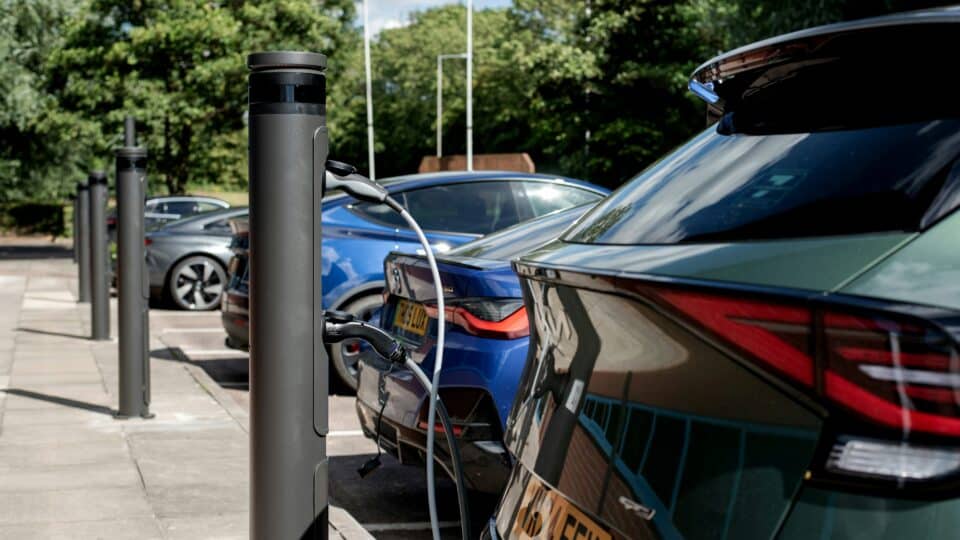
European Car of the Year 2027 marks a first: all seven finalists in the Car of the Year competition are fully electric. The official list, announced on 30 October 2026, includes the BMW iX3, Cupra Raval, Hyundai Ioniq 3, Kia EV2, Renault Twingo E-Tech electric, Volkswagen ID. Polo and Volvo EX60.
The shift matters not only to the car industry, but also to what a Car of the Year finalist now represents. A few years ago, an electric model reaching the final would primarily have been judged on range and charging infrastructure. In 2026, the jury is already comparing EVs with one another on far more conventional criteria: price, space, comfort, driving enjoyment, efficiency, technology and value for money.
This InfoBuz article was updated on 1 November 2026. Specifications come from manufacturers’ official pages and the official Car of the Year website. Prices are those available in the indicated markets at the time of research and may differ in Romania depending on the version, VAT, equipment and incentive schemes.
European Car of the Year 2027: the seven official finalists
- BMW iX3
- Cupra Raval
- Hyundai Ioniq 3
- Kia EV2
- Renault Twingo E-Tech electric
- Volkswagen ID. Polo
- Volvo EX60
The list was published by the organisers of Car of the Year. The finalists will undergo further extensive testing, final voting closes at the end of December, and the winner is due to be announced on 8 January 2027 at the Brussels Motor Show.
At a glance: range, battery, charging and price
| Model | Maximum WLTP range | Relevant battery | DC charging | Verified reference price |
|---|---|---|---|---|
| BMW iX3 | up to 805 km | 108.7 kWh usable in the 50 xDrive | up to 400 kW | from €67,518 in Romania |
| Cupra Raval | up to around 446 km in Endurance form | 37 or 52 kWh net | up to 105 kW | from €25,985 in Romania |
| Hyundai Ioniq 3 | up to 497 km | 42.2 or 61 kWh | 10–80% in about 29 min | varies by market and trim |
| Kia EV2 | up to around 440 km | 42.2 or 61 kWh | 10–80% in about 30 min | from around €30,907 in checked Kia Romania stock |
| Renault Twingo E-Tech | up to 263 km | 27.5 kWh usable | 50 kW optional; 10–80% in around 30 min | from €19,490 in France |
| Volkswagen ID. Polo | up to 454 km | 37 or 52 kWh net | up to 105 kW | from €24,995 in Germany |
| Volvo EX60 | up to 810 km | 83, 95 or 117 kWh | 10–80% in 16–19 min, depending on version | from €63,150 in Romania |
Note: This comparison places versions from different markets alongside one another to show each model’s positioning. Not every figure refers to the entry-level specification, and not every price is a Romanian price. A purchasing comparison should use the same market, version and equipment level.
1. BMW iX3: Neue Klasse technology and 805 km of range
The BMW iX3 is the finalist that sets the highest technological bar in the 2027 field. It is the first production SUV of the Neue Klasse generation and uses BMW’s new eDrive Gen6 technology, an 800-volt architecture and a 108.7 kWh usable battery in iX3 50 xDrive form.
BMW Romania quotes a WLTP range of 717–805 km, depending on configuration, and up to 372 km of additional range after 10 minutes of charging in suitable conditions. Maximum charging power is 400 kW. The recommended starting price displayed in Romania is €67,518. Official data are available on BMW iX3 Romania.
The iX3’s advantage is clear: very long range, top-level charging and an entirely new platform. Its potential weakness in the vote is the flip side: it is far more expensive than most of the finalists and competes in the premium segment, where the value-for-money criterion becomes more difficult.
2. Cupra Raval: a compact, sporty EV built in Barcelona
The Cupra Raval is among the most interesting models because it attempts to combine the price of a compact EV with a sporty character. It is based on the front-wheel-drive MEB+ platform and built in Martorell, Spain.
The range uses 37 kWh LFP or 52 kWh NMC batteries. The 155 kW Endurance version can reach around 413–446 km WLTP, while the Raval VZ produces 166 kW/226 hp and can accelerate from 0 to 100 km/h in about 6.8 seconds. DC charging for the 52 kWh battery reaches 105 kW, with a 10–80% charge taking around 24 minutes.
In Romania, Cupra’s official offers page lists the Raval from €25,985 including VAT. The manufacturer’s published technical specifications confirm a 441-litre boot, an impressive figure for a car around 4.05 metres long. See Cupra Romania offers.
3. Hyundai Ioniq 3: efficiency, 497 km and a surprisingly large boot
The Hyundai Ioniq 3 is the electric hatchback through which Hyundai is seeking to bring the Ioniq line’s DNA into a far more affordable segment. It has front-wheel drive, a 400-volt EV platform and two batteries: a 42.2 kWh LFP unit and a 61 kWh lithium-ion unit.
The Standard Range version offers up to 344 km WLTP, while the Long Range reaches 497 km with the appropriate wheels. Hyundai quotes around 29 minutes for a 10–80% DC charge, while AC charging can optionally reach 22 kW. Total stated luggage capacity is 441 litres, including the Megabox compartment.
It could become one of the best-balanced finalists: close to 500 km of range, low official consumption, good space and an Android Automotive-based Pleos Connect multimedia system. Full specifications are available from Hyundai Motor Europe.
4. Kia EV2: the family-oriented rival to the Ioniq 3
The Kia EV2 uses a technical recipe close to that of the Hyundai Ioniq 3, but packages it in a body with more of an urban-SUV appearance. Its batteries are rated at 42.2 and 61 kWh, with stated range reaching around 315 km for the Standard Range and up to 440 km for the Long Range.
Kia quotes a 10–80% charging time of around 30 minutes. The EV2 also emphasises cabin flexibility: the rear bench can slide and recline, while boot capacity can reach around 403 litres in the favourable configuration.
A relevant detail for Romania: on 1 November 2026, Kia Romania’s online stock already listed EV2 MY27 units. The least expensive checked offer, for the Air version with the 42.2 kWh battery, was around €30,907 including VAT, while Long Range versions rose towards €35,000–€38,000. Stock and prices change, so these figures should be treated as market snapshots rather than fixed list prices.
5. Renault Twingo E-Tech electric: the sub-€20,000 outsider
The Twingo E-Tech electric has the shortest range in the final, but it may have one of the strongest stories for the jury: a European city EV starting below €20,000 in France, before any subsidies.
Renault uses a 27.5 kWh usable LFP battery and a 60 kW/82 hp motor. WLTP range is up to 263 km. The standard AC charger is rated at 6.6 kW, while the Advanced Charge package adds 11 kW AC charging, 50 kW DC charging and V2L/V2G functions. With DC charging, 10–80% takes around 30 minutes.
The list price of the Evolution version is €19,490 in France. Renault has also confirmed that the model is produced in Europe, at Novo Mesto in Slovenia. More information is available from Renault Media.
6. Volkswagen ID. Polo: probably the most “normal” EV in the final
The Volkswagen ID. Polo matters because it seeks to bring the classic Polo formula into the electric era without turning the car into a niche product. It is built on the front-wheel-drive MEB+ platform and has two net battery capacities: 37 kWh LFP and 52 kWh NMC.
The 85 and 99 kW versions with the smaller battery offer up to around 329–334 km WLTP. The 155 kW variant with the 52 kWh battery reaches 454 km WLTP. DC charging is up to 88–90 kW for the smaller battery and 105 kW for the larger one, with 10–80% taking around 23–24 minutes.
Volkswagen launched the model in Germany from €24,995. Another major point in its favour for everyday use is its 441-litre boot. Specifications are published by the Volkswagen Newsroom.
7. Volvo EX60: 810 km and charging in 16 minutes
Alongside the BMW iX3, the Volvo EX60 is the finalist that shows how far premium electric SUVs have progressed technically. It uses an 800-volt architecture and three main powertrain versions: P6 Electric, P10 AWD and P12 AWD.
Volvo Romania quotes up to 611 km for the P6, 660 km for the P10 AWD and up to 810 km for the P12 AWD. Batteries are rated at 83, 95 and 117 kWh, while a 10–80% charge can take around 16 minutes for the P6 and P10, or 19 minutes for the P12, at sufficiently powerful charging stations.
The starting price displayed by Volvo Romania is €63,150. The P12 AWD develops up to 680 hp, while the EX60 remains strongly focused on safety, software and range. See Volvo EX60 Romania.
Which has the longest range?
Based on the maximum WLTP figures published so far, the contest is extremely close between the Volvo EX60 P12 AWD – up to 810 km and the BMW iX3 50 xDrive – up to 805 km. The five-kilometre gap is effectively irrelevant in real-world use, where temperature, speed, tyres and equipment can alter range by far more.
For the average buyer, it may be more relevant that the Ioniq 3 approaches 500 km, while the ID. Polo and Raval exceed 440 km with much smaller batteries and substantially lower prices.
Which charges fastest?
The Volvo EX60 and BMW iX3 lead on maximum power and charging time. The EX60 can drop to around 16 minutes for a 10–80% charge in certain versions, while the iX3 can add energy for hundreds of kilometres in around 10 minutes at a 400 kW charger and in ideal conditions.
Among the compact cars, the ID. Polo and Raval offset their lower DC power with smaller batteries: around 23–24 minutes for 10–80% are very good figures for the segment.
Best for the city: Twingo or Raval?
If city use is the main mission, the Twingo has a major advantage in size, cost and simplicity. Its 263 km range may look modest on the motorway, but it is well beyond the daily needs of most urban commutes.
The Raval, however, is much more versatile. With the 52 kWh battery, it can comfortably travel beyond the city, offers more than 400 km WLTP and delivers hot-hatch-like performance in VZ specification. For buyers wanting one car for urban use and longer trips, the Cupra is the more complete option.
Best-balanced for a family: Ioniq 3, EV2 or ID. Polo?
This is where the contest becomes particularly interesting. The Ioniq 3 offers up to 497 km of range and a generous boot. The Kia EV2 brings a higher driving position and a flexible rear bench. The ID. Polo has a 441-litre boot and a very aggressive starting price in Germany.
In InfoBuz’s editorial assessment, the Hyundai Ioniq 3 appears to be the most balanced technical package, while the ID. Polo could become the price-to-space champion if pricing remains competitive in Eastern European markets as well.
Best for long journeys: BMW iX3 or Volvo EX60?
Both offer more than 800 km of range in their highest-range configurations and use 800-volt architectures. BMW is betting on efficiency, dynamics and the Neue Klasse system; Volvo on comfort, safety and extremely fast charging.
In Romania, the gap between their starting prices is not large for the segment: the Volvo EX60 starts at around €63,150 and the BMW iX3 at €67,518. The configurations that achieve the maximum range figures are more expensive than the entry-level versions, however, so the comparison must be made version by version.
Why an all-electric final matters more than it may seem
For the first time in the competition’s more than six-decade history, every finalist is electric. This does not mean the internal-combustion engine has disappeared from the market, or that all European buyers are ready for EVs. It does mean that, in the jury’s view, electric cars have matured enough to fill all seven places without being treated as a separate category.
More importantly, the final is not made up solely of €70,000–€100,000 premium SUVs. The Twingo, ID. Polo and Raval shift the competition towards affordable EVs, where battery cost, efficiency and simplicity matter as much as power.
For a broader comparison of powertrain costs, see InfoBuz’s analysis, Diesel vs petrol vs hybrid vs electric in 2026: total cost over 200,000 km.
Which has the best chance of winning? InfoBuz analysis
The jury does not vote solely on maximum range. Value for money, technology, driving dynamics, design, innovative character and market positioning can completely change the ranking. That is why a €20,000–€25,000 model can beat a premium SUV with twice the range.
| Model | Strength | Possible weakness | Finalist profile |
|---|---|---|---|
| BMW iX3 | technology, range, charging | premium price | technology favourite |
| Cupra Raval | design, price, dynamics | less range than premium rivals | emotional/value favourite |
| Hyundai Ioniq 3 | efficiency and balance | less iconic identity | all-round favourite |
| Kia EV2 | practicality and space | higher local price than some rivals | very strong outsider |
| Renault Twingo | price and urban relevance | modest range | favourite for democratising EVs |
| Volkswagen ID. Polo | price, space, familiar name | more conservative design | value/mainstream favourite |
| Volvo EX60 | range, charging, safety | premium price and high weight | premium favourite |
InfoBuz editorial prediction, not official information: the ID. Polo, Twingo and Ioniq 3 appear to have particularly strong arguments if the jury prioritises affordability and relevance to the European market. The BMW iX3 and Volvo EX60 may dominate on technology, but their premium prices could limit their advantage against much more affordable compact models.
European Car of the Year 2027: frequently asked questions
Which cars are the 2027 Car of the Year finalists?
BMW iX3, Cupra Raval, Hyundai Ioniq 3, Kia EV2, Renault Twingo E-Tech electric, Volkswagen ID. Polo and Volvo EX60.
Are they all electric?
Yes. In a first for this European competition, all seven finalists are fully electric models.
When will the 2027 Car of the Year be announced?
The winner is due to be announced on 8 January 2027 at the Brussels Motor Show.
Which finalist has the longest range?
Based on maximum WLTP figures published as of 1 November 2026, the Volvo EX60 P12 AWD reaches up to 810 km, while the BMW iX3 50 xDrive reaches up to 805 km.
Which finalist is the cheapest?
The Renault Twingo E-Tech electric starts at €19,490 in France before subsidies. Prices vary from country to country, however.
Conclusion: the 2027 final suggests the electric car has entered the mainstream
European Car of the Year 2027 will not simply be a contest for the largest battery. The final brings together two approaches: premium SUVs costing more than €60,000 and capable of exceeding 800 km WLTP, and €20,000–€30,000 compact cars seeking to make the EV a mass-market product.
While the BMW iX3 and Volvo EX60 show how far electric technology can go, the Renault Twingo, Volkswagen ID. Polo and Cupra Raval show how far prices can fall without making a car rudimentary. The Hyundai Ioniq 3 and Kia EV2 sit squarely between those two worlds. That variety is precisely what makes the 2027 Car of the Year final one of the most interesting in recent years.


Discuția cititorilor
Ai o opinie sau o întrebare despre acest articol? Spune-ne ce crezi.
Fii primul care deschide discuția.
Te rugăm să păstrezi un limbaj civilizat și să discuți la subiect. Comentariile spam sunt filtrate automat.