
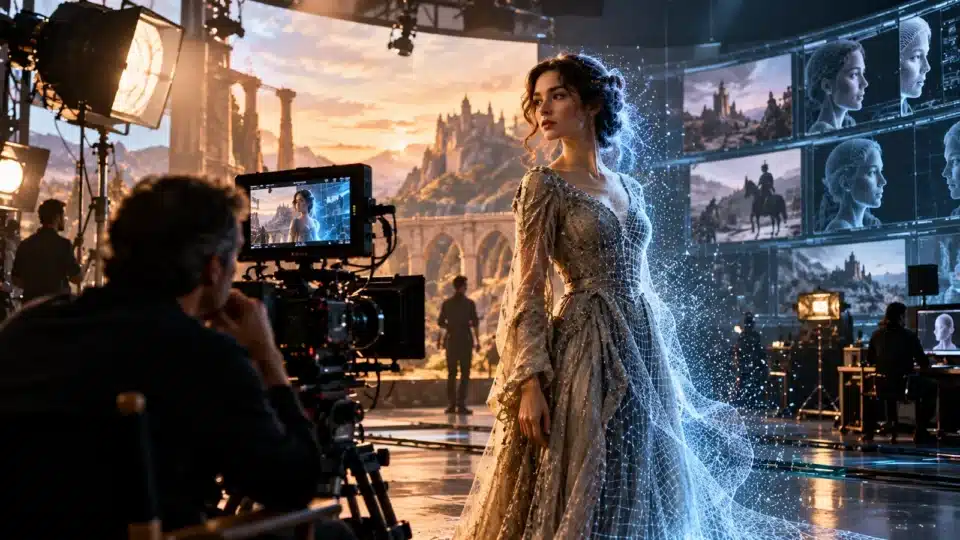
The film without actors is no longer merely a prediction about what might happen a decade from now. In 2026, an experimental feature of roughly 95 minutes, with artificially generated characters and sets, was presented to industry professionals around the Cannes Film Festival. Its producers reported a budget of under $500,000 and a team of 15 people. Yet beneath those striking figures lies a revealing detail: the first 25 minutes reportedly required 16,181 video generations for only 253 final shots.
That is the paradox of generative cinema. Artificial intelligence can already produce cinematic images that, viewed in isolation, look as though they were taken from a big-budget film. But a feature film is not a collection of attractive clips. It needs characters recognisable from scene to scene, convincing performances, dialogue, continuity, editing, sound, dramatic pacing and clear rights to the material used. If a character’s face or costume changes between two close-ups, the illusion breaks.
For more on AI, see AI energy consumption reaches the scale of a city: what happens when artificial intelligence hits the electricity limit, which offers complementary details on the subject.
Hollywood, meanwhile, faces an uncomfortable question: if a digital star can be invented, why hire an actor? The answer is more complicated than either AI companies’ marketing claims or predictions of acting’s disappearance. In June 2026, SAG-AFTRA, the US actors’ union, ratified a new agreement with studios containing additional protections for digital replicas and synthetic performers. In the European Union, certain labelling obligations for AI-created or AI-modified content have applied since August 2026.
This InfoBuz analysis explains what had actually been demonstrated by 23 October 2026, what remains marketing, how an AI film is made, how credible the costs being cited are, what Tilly Norwood changes, and where the line lies between technology, creativity and performers’ rights. We do not confuse a market screening in Cannes with the festival’s official selection, nor a virtual character with a real actor who consented to being recreated digitally.
The film without actors: the short answer in 2026
Yes, a feature film made predominantly or entirely from AI-generated video is now technically possible. Hell Grind shows that a human team can assemble such material into a production of around 95 minutes. No, the technology still cannot reliably produce a coherent, commercial film from a single instruction, without human creators. The practical test involved tens of thousands of generation attempts, selection, corrections, direction and editing.
And no, commercial success is not demonstrated by the length of a video file. A film can exist and be screened while still having unconvincing dialogue, inconsistent action or pacing that cannot sustain attention for an hour and a half. The near future appears more likely to favour a mix of human performances, virtual sets, generated effects and AI-assisted post-production, while fully synthetic films remain, for now, an experiment with uneven artistic results.
1. The case that changed the discussion: Hell Grind, 95 minutes generated with AI
In May 2026, the company Higgsfield presented Hell Grind, an action film with fantasy elements and synthetic characters. According to reporting by Screen International, the film runs for around 95 minutes, was made by a team of 15 people, and had a declared total cost of under $500,000. It was built from artificially generated sequences rather than conventional performances by a cast filmed on a traditional set.
The crucial clarification is where it was presented. The film was not selected for the official competition at the Cannes Film Festival. Screenings were organised in the context of Cannes’ market and professional meetings, including at a commercial cinema in the city. CineD set out the distinction, which matters in avoiding headlines that falsely suggest an AI-generated film won or was accepted into the festival’s official competition.
The producers described an accelerated production phase of about two weeks, but the idea and screenplay had been developed by the team over previous years, according to information the company provided to the press. It is therefore inaccurate to say that the entire process, from first idea to a screening-ready film, took 14 days. Likewise, the stated sum is not a publicly audited budget that allows a perfect comparison with a traditional studio’s accounting.
The experience of a TechRadar journalist who watched a screening in June 2026 highlighted both visual progress and the difficulty of sustaining a narrative, especially when a full film requires more than spectacular moments. The point is not that the experiment “doesn’t matter”, but that it should be judged as evidence of production capability, not as a guarantee that conventional filmmaking will be replaced.
2. The 16,181 generations: a figure more important than the budget
For the first 25 minutes of Hell Grind, the team reported 16,181 generations and 253 edited shots. That works out at an average of almost 64 versions produced for every selected shot in that section. We do not claim the same ratio applied to the full film, because the public data expressly concern the first 25 minutes.
| Reported Hell Grind metric | Value | How it should be interpreted |
|---|---|---|
| Film running time | About 95 minutes | An experimental feature, not simply a trailer |
| Reported budget | Under $500,000 | A producer statement, not an independently audited financial comparison |
| Team | 15 professionals | Direction, production, cinematography, selection and editing required people |
| Attempts for the first 25 minutes | 16,181 video generations | A producer-reported number for that portion |
| Final shots in the same portion | 253 | Works out at roughly 64 attempts per retained shot |
| Fast production phase | About two weeks | Does not include the prior years spent developing the idea and screenplay |
Sources: Screen International, Fortune and CineD, May–September 2026. Budget and production figures come from Higgsfield’s statements. The 16,181/253 ≈ 64 ratio is an editorial arithmetic calculation.
Why are so many attempts needed? A character’s hand may deform; a camera may pass impossibly through an object; movement may defy physics; lighting may change without explanation; or a costume detail may disappear. The director is not merely choosing “the prettiest clip”, but the one that can work alongside the other 250 shots.
According to Fortune, 30 September 2026, around $400,000 of the $500,000 cited for the project represented computing costs. Again, this is a breakdown communicated in the context of the project, not a standard price for every future AI film. A studio may face different costs, from licences to sound, insurance, marketing and distribution.
3. A 90-minute film is not the equivalent of a 90-minute prompt
Video-generation tools generally work in short sequences. The official documentation for Google Veo 3.1, for example, describes generations of 4, 6 or 8 seconds, with extension functions and controls using reference images. Runway Gen-4.5 offers clips of between 2 and 10 seconds. The progress is striking, but making a feature remains work of composition, editing and verification.
A purely illustrative calculation: 90 minutes is 5,400 seconds. If every final sequence lasted exactly eight seconds, it would require 675 usable sequences, before accounting for variants, transitions, shortened shots and rejected material. This is not an estimate of the number of generations for a real film; editing may use much longer or much shorter shots.
A single dialogue scene may contain dozens of cuts: a wide shot, close-up, reverse shot, the listener’s reaction, a hand detail, the object on the table. If the system generates every shot independently, it must retain the same person, the same set, the position of objects and the logic of the action. This is one of the core problems in generative feature-film production.
4. What video generators can actually do in October 2026
| Tool or tool family | Verified capability | Relevant limitation for a feature film |
|---|---|---|
| Google Veo 3.1 | Clips of a few seconds, natively generated sound, reference images, start and end frames, extension | Continuity across hundreds of sequences must be managed through the workflow |
| Runway Gen-4.5 | Text-to-video and image-to-video; 2–10-second sequences; motion and composition controls | Repeated generations, selection and editing; credits are consumed with every attempt |
| Generation-orchestration platforms such as Higgsfield | Combine models and production workflows to select and assemble many sequences | Success depends on people, prompts, consistency, selection and post-production |
| OpenAI Sora | An important landmark in the development of video generation | Not an active service at the date of this article: the apps closed on 26 April 2026 and the API on 24 September 2026 |
Capabilities and service availability may change. This table is based on providers’ documentation checked on 23 October 2026, not on an independent comparative quality test.
Google announced improvements in January 2026 to character and set consistency, visual-reference options, and improved 1080p and 4K outputs for certain Veo 3.1 workflows. Google’s official announcement substantiates these features; it does not mean every generated sequence is cinematic without corrections.
Runway says in its product documentation that Gen-4.5 uses 12 credits for every generated second. Even before a dollar estimate, this shows that every iteration has a processing cost. It is not accurate to multiply a full film by an advertised subscription price and declare that to be “the film’s budget”: rejected generations, sound, upscaling and post-production matter. Source: Runway’s explanation of credits.
A useful detail for readers: Sora should no longer be recommended as an active application in 2026. OpenAI’s official page on Sora’s discontinuation gives the two closure dates. Older examples comparing Sora’s prices and features with competitors should be updated.
5. The character whose face changes between two shots
Audiences recognise a character through features, voice, expressions, gait, costume and behaviour. For a generative model, maintaining all these characteristics at once across hundreds of generations is a complex problem. Two clips may look flawless separately while showing two slightly different versions of the same character.
Creators use reference images, character sheets, start and end frames, 3D modelling, pose controls or post-production work. Google and Runway publish tools intended to improve consistency, but “improved consistency” does not mean perfectly guaranteed identity for 90 minutes. In a stylised animated film, audiences may accept minor deviations. In a realistic dramatic close-up, a subtle facial change may be immediately apparent.
This is the difference between a viral demo and a feature. A demo displays the best shot from many attempts. A film must move from shot to shot without pulling the viewer out of the story. Imitating skin texture or the reflection of light in an eye is not enough; the character must remain recognisable and react coherently.
6. Dialogue and performance: where a real actor still changes a film
Generators can create facial expressions, lip movements, synthetic voices and apparent emotions. A strong acting performance, however, also involves intention, subtext, pauses, listening and responding to a partner. A look before a line, a deliberate hesitation or an almost imperceptible shift in tone can carry more story than a spectacular effect.
In an analysis published by The Guardian on 20 October 2026, experts and filmmakers discuss precisely the boundary between a virtual character convincing at first glance and the subtlety of a human performance. Views differ: some believe AI may be capable of more nuanced acting as direction and models develop; others see human experience and an actor’s unpredictability as something statistical imitation does not reproduce in the same way.
This is not a scientific verdict that AI will be “forever incapable” of generating a moving scene. It is an observation about the quality and control of productions currently available, especially when an emotional relationship must be sustained over a full film. That is why the claim that “actors will disappear tomorrow” is as poorly substantiated as the promise that “nothing will change”.
7. Tilly Norwood: can a digital character become a star?
In 2025, the UK company Particle6 presented Tilly Norwood, an AI-created female character promoted as a potential digital performer. The announcement prompted strong reactions in the US industry. In its official statement of 30 September 2025, SAG-AFTRA opposed replacing human performers with synthetic characters and raised concerns about training data and actors’ work.
In July 2026, Particle6 announced that Tilly Norwood would be set to lead Misaligned, a comedy-drama about a digital being trying to become more human. CBS News and Variety reported that the project was conceived as a hybrid production, in which film professionals work alongside AI specialists.
At the date of this analysis, the development announcement should not be confused with a confirmed commercial release or box-office success. Norwood is not a human actor who was scanned and recreated with their consent; she is a synthetic character. But that does not remove questions about the data used for training, possible resemblance to real people, rights and effects on employment.
8. A real actor’s digital replica is not the same as an invented character
At least three situations must be separated. First: a new artificial character not intended to be recognised as a real actor. Second: a digital replica of an identifiable actor’s face or voice, created with their consent. Third: the imitation of a person without consent, which may raise serious issues involving rights, identity and exploitation.
In March 2026, SAG-AFTRA issued a statement on the digital replication of Val Kilmer for the film project As Deep as the Grave. The union explained that the applicable agreements and relevant rules require the consent of those legally representing the deceased actor; based on the information that had emerged, the statement said the family had given its consent. The example shows that technical feasibility is not equivalent to the right to use someone’s image.
An authorised digital recreation should not be confused with a deepfake clip putting words into a celebrity’s mouth that they never said. For a general guide to signs and labels, InfoBuz has published how to spot a deepfake under the EU’s new rules; for voice replication, see how cloned voices work and the risks they pose.
9. The 2026 SAG-AFTRA agreement: Hollywood negotiates the limits of AI use
On 4 June 2026, SAG-AFTRA members ratified a multi-year agreement for film, television and streaming, covering 1 July 2026 to 30 June 2030. The union said the document strengthened protections for digital replicas and the use of synthetic performers, following the major dispute over labour and AI in previous years. Source: SAG-AFTRA’s ratification announcement.
In its contractual explanations, the union sets out a principle of preference for human performances. When a synthetic performer is used in a human role that would otherwise have been played by a person, the agreement includes notification and bargaining conditions, and a standard requiring “significant additional value” to the production. Failure to meet the obligations can lead to arbitration mechanisms and contractual remedies. Source: the 2026 agreements page and the union’s explanations.
This is not a blanket federal ban on all AI actors. It is a negotiated framework that matters for productions and companies covered by the relevant contracts. Independent productions, projects in other jurisdictions and uses not covered by the same agreement require separate analysis.
The protection also includes the principle that a digital replica should not become an arbitrary substitute for a performer on strike, and that actors’ biometric data or scans require clear rules. The distinction is significant: Hollywood is deciding not only what technology costs, but who controls an actor’s digital identity after filming.
10. What about screenwriters? Why an AI-generated script does not automatically mean an “AI screenwriter”
A model can suggest narrative structures, loglines, dialogue, scene descriptions or variations on a story. But a film project involves revisions, decisions about characters and pacing, and agreement on exploitation rights. The fact that a tool generates text does not make it a contractual author in the industry sense.
The Writers Guild of America (WGA) explains that its 2023 agreement establishes that AI is not a writer and that AI-generated material is not treated as “literary material” under the collective bargaining agreement. Under the conditions described, a producer cannot simply give a screenwriter AI text and use that to pay them as a mere rewriter of a fictional author. A writer may use AI in certain circumstances, but an employer cannot require them to use it.
These provisions do not automatically describe every Romanian filmmakers’ contract. They nevertheless show a structural question: if AI produces proposals, who remains responsible for the story, authorship and final decisions? In a feature film, the answer is not reducible to the number of prompts written.
11. What does an AI film really cost? The calculation advertisements leave out
The producers of Hell Grind cited a cost of under $500,000 for a 95-minute feature. Using $500,000 only as an illustrative ceiling gives approximately $5,263 per minute of film. But this calculation is not a universal price: the actual budget was described as below that ceiling and depended on the project’s own infrastructure, models, team, workflows and accounting approach.
In traditional production, costs include actors, technical crew, sets, locations, transport, insurance, post-production, rights, logistics and often release campaigns. In AI production, some of these may be reduced or disappear, but other expenses arise: GPU computing, subscriptions or API contracts, generation and continuity specialists, editors, sound, rights clearance, image correction and many rejected attempts.
| Production element | Traditional film | Predominantly AI-generated film |
|---|---|---|
| Filmed human cast | Contracts, filming, preparation and workdays | Can be reduced to zero for synthetic imagery, but rights may arise for voices or authorised replicas |
| Locations and sets | Rental, construction, logistics | Generation, reference design, corrections and continuity control |
| Cinematography and lighting | Camera, crew, lighting, camera movement | Visual direction, specifications, multiple generations, compositing and grading |
| Editing and sound | Editor, sound design, mixing, music | Still necessary; may include generative tools and additional checks |
| Legal risks | Licences, contracts, cast and music rights | Adds data provenance, consent for replicas and the status of AI material |
| Marketing and distribution | Separate costs, sometimes substantial | Do not automatically disappear because AI is used |
The company’s claim that a comparable film would cost tens of millions of dollars if made conventionally should be treated as a promotional comparison, not as an independent estimate of a film of equal quality, with the same obligations and the same artistic outcome. A lower production cost does not prove that audiences would pay the same for the result.
12. If actors can be removed from the frame, why is a film crew still needed?
An AI-produced feature may remove the physical presence of a cast on set, but it does not automatically remove the work of a director, editor, producer, screenwriter, visual designer, sound specialist or rights coordinator. In Hell Grind, the human team’s work was precisely what made it possible to select usable sequences from a large volume of variable material.
In hybrid productions, moreover, actors may perform real scenes while AI alters sets, helps with previsualisation or creates shots impossible to obtain at a reasonable cost. This model retains the human emotional centre of a story while selectively reducing costs or speeding up particular stages. It is less viral than the announcement “a film without any actors”, but may be more practical for studios.
One likely change concerns jobs, not only their number: demand may grow for consistency supervisors, AI visual directors, editors, data and rights specialists, sound design and quality control. At the same time, some repetitive pre-production and post-production tasks may be affected. The pace of this change depends on cost, contracts, audience response and the quality of systems, not just on the best demos.
InfoBuz has also examined skills for 2030 and career retraining, focusing on the difference between changing occupations and exaggerated forecasts of their total disappearance.
13. Hollywood is not ignoring AI, but it has not handed over its entire film library
Hollywood studios have conflicting incentives: they could use AI to reduce certain costs, but they also own valuable libraries of characters, scripts, images and performances that they do not want reproduced without a licence. Some of the conflict is therefore moving from the editing room into courtrooms and commercial negotiations.
The Los Angeles Times reported on 31 August 2026 on talks between Google and major studios over possible licences to use intellectual property in AI tools. At the time of that article, the cited sources indicated that no deals had been concluded, because of complicated legal and contractual issues. These discussions should not be turned into a claim that “Hollywood has already signed a general agreement with AI”.
Meanwhile, an analysis published by the American Bar Association in 2026 describes litigation and unresolved questions over the use of protected works in training models. The framework varies by jurisdiction and by the type of data or licence. Using AI legally does not mean every generated character may freely resemble a protected franchise.
14. Copyright: can an AI-generated film be owned exclusively?
The answer is not identical in every jurisdiction. In the United States, the US Copyright Office explained in a report published on 29 January 2025 that AI-generated elements can form part of a protected work when the human author determines sufficient expressive elements, arranges them creatively or modifies them in an original way. Entering a simple prompt, without other relevant creative contributions, does not guarantee protection for the whole automated result.
This summarises the US authority’s position on the protectability of the output, not a final ruling for every court and every country. Separately, there is the issue of the material on which the model was trained, permissions for faces and voices, and any recognisable protected elements in the result. These questions are not resolved by the same rule.
For an international production, a producer must establish who holds rights to the screenplay, editing, music, synthetic materials, reproduced identities and software licences. A film does not become free of rights simply because a conventional camera was not used. Nor does a platform’s contractual permission for commercial use, by itself, demonstrate that every component of a film is free from legal risk.
15. The AI Act in Europe: must audiences be told that a film is generated?
From 2 August 2026, the EU transparency provisions in Article 50 of the AI Act apply. They contain obligations for providers of some content-generation systems and for those using certain synthetic deepfake content. Romania’s telecoms regulator, ANCOM, has published a Romanian-language explanation of the obligations and transitional periods.
The important detail for cinema is that not every AI-created visual effect is automatically a deepfake requiring the same on-screen label. The European Commission distinguishes material that can falsely appear authentic from artistic and technical uses where audiences understand the context. For works that are clearly artistic, creative, fictional or satirical, Article 50 allows the disclosure that generated content exists to be made in an appropriate manner that does not impair enjoyment, where the obligation applies.
Model providers are, under certain conditions, required to make outputs machine-detectably marked. Some systems placed on the market before 2 August 2026 have a transitional period until 2 December 2026 for the particular marking-and-detection requirement. This does not mean all obligations for all industry actors are postponed until December.
A producer distributing in the EU must check the specific applicability of the rules, including whether a product is a deepfake, whether it is clearly fictional, and who is the provider and who is the professional user. For an accessible explanation, InfoBuz has published a guide to checking AI labels under the new European rules. This section is not a substitute for legal analysis of a specific film.
16. Three scenarios for Hollywood’s future: where the impact may come first
Scenario A: AI as a production assistant. Studios use models for storyboards, previsualisation, sets, certain effects and promotional material, while casts and stories remain human-led. This is compatible with many workflows and does not require audiences to give up human performances.
Scenario B: hybrid feature films. Some characters are real, others synthetic; some locations exist, others are generated. This model may appeal to science fiction, animation, fantasy or independent productions with limited resources. The difficulties remain continuity, rights, final quality and the integration of human performance with AI material.
Scenario C: almost entirely synthetic features. Hell Grind shows that a long-form prototype already exists. But turning this into a stable category of profitable, widely distributed films watched for their stories rather than merely for the novelty of the technology remains a market hypothesis. Without convincing audience and profitability data, there is no reason automatically to declare the disappearance of traditional studios.
17. What this means for Romanian cinema and independent filmmakers
In Romania, generative tools can help independent directors visualise expensive scenes, prepare a teaser, explore sets or create effects in low-budget productions. A small team can test ideas before renting locations and equipment. These opportunities are real, but they do not amount to instantly making an award-winning festival film.
A filmmaker must plan dialogue and performance, maintain an artistic direction, secure rights, honour collaborators’ contracts and deliver a final file that meets festivals’ or distributors’ requirements. A film made through hybrid methods can use AI creatively without removing authors, actors or crew. In some cases, the aesthetic choice to use real people may itself be the production’s distinguishing feature.
For context on contemporary cinema, InfoBuz has reported on the film Fjord and debates around auteur production, and on the 2026 BIFF festival and screenings in Bucharest. These examples are not AI-created films, but reference points in an artistic ecosystem that may confront the new tools.
Another implication is digital distribution. Algorithms can influence what content reaches audiences, whether it was conventionally filmed or generated. InfoBuz has separately examined how platforms recommend music and video and the growth of synthetic content online.
18. Six questions that separate a convincing AI film from a viral demonstration
- Do the characters remain consistent? Are they recognisable from every angle, in every scene and through every lighting change?
- Can the story be followed without external explanation? Or is the material merely a succession of attractive moments?
- Do the dialogues have subtext and rhythm? Do the characters genuinely seem to listen and respond to their partners?
- Do movements and objects maintain continuity? Does a glass, door or wound remain in the same state between two shots?
- Are rights and consent clear? Were voices, likenesses and third-party materials licensed where necessary?
- Would audiences watch the film without the “made by AI” label? This may be the best question of artistic quality and commercial viability.
A film can pass the first four technical tests and still lack rhythm or emotion. The reverse is also possible: an original story with an overtly artificial visual style may impress without imitating blockbuster realism. Cinema’s aim is not photorealistic perfection in itself, but the experience it creates for the viewer.
19. Myths about films without actors worth correcting
“No one has ever made an AI feature film.” False in the experimental sense: Hell Grind is a reported and screened 2026 example. “The film competed at Cannes.” Also false: its presentation was not part of the festival’s official selection.
“AI makes 95 minutes from one prompt.” False for the documented production workflow: it required many generations, selection and editing. “A declared $500,000 budget proves every cinema film will cost that much.” No: costs, quality, wages, rights and distribution differ.
“A digital replica of a deceased actor can be used without consent.” That is not a valid rule. Relevant contracts and laws may require authorisation, as SAG-AFTRA stressed in the Val Kilmer case. “Using AI automatically eliminates copyright.” No: human creative contribution, licences and pre-existing materials matter.
“Sora is still the leading application for AI cinema in October 2026.” Incorrect: Sora services closed in 2026, according to OpenAI’s official page. Existing tools should be compared using current documentation, not articles left over from 2024 or 2025.
Frequently asked questions about AI-generated films
Is there already a feature film created entirely with AI?
Experimental projects such as Hell Grind, presented in 2026, exist, with around 95 minutes of synthetic imagery. But the production required a human team, an extensive selection process and editing; it did not result from a single instruction.
Was Hell Grind officially selected for the Cannes Film Festival?
No. The film was presented in professional settings in the city of Cannes, on the film-market circuit, outside the festival’s competition and official selection.
How much did Hell Grind cost?
The company reported a budget of under $500,000, of which around $400,000 was said to be computing costs. The figures come from producer statements, not a public independent financial audit.
Can AI create a two-hour film from a single prompt?
Not in a reliable professional workflow publicly demonstrated as of the date of this analysis. Generators generally produce short sequences, while a feature requires the selection and assembly of hundreds of shots and continuity corrections.
What are the most important AI video tools in 2026?
Documented examples include Google Veo 3.1, Runway Gen-4.5 and platforms that orchestrate multiple models. Availability, costs and features should be checked directly with providers.
Can Sora still be used in October 2026?
According to OpenAI’s documentation, Sora’s web experiences and application were discontinued on 26 April 2026, and its API on 24 September 2026. It should not be treated as an active service for a new project.
Who is Tilly Norwood?
She is a synthetic character developed by Particle6 and publicly presented in 2025. In July 2026, the development of a hybrid feature, Misaligned, in which she was set to appear, was announced; the announcement does not confirm that a commercial release has already taken place.
Will real actors be replaced by AI in Hollywood?
Some tasks and roles may be affected, but a general disappearance is not an established fact. The 2026 SAG-AFTRA agreement negotiated protections for human performances and the use of synthetic performers in covered productions.
Can an actor’s face be used without consent?
Do not assume so. Image and voice rights, collective agreements and relevant legislation may require specific consent; the Val Kilmer digital-replica case illustrates the need for authorisation.
Must an AI film be labelled in the European Union?
Article 50 of the AI Act sets transparency obligations applicable from 2 August 2026, with qualifications for clearly artistic and fictional works and for the type of content. Applicability depends on the producer’s role, the nature of the material and the specific circumstances.
Can copyright be registered for AI-generated images?
In the United States, the Copyright Office’s 2025 position requires sufficient human creative contribution to protect the relevant expression. A simple prompt does not guarantee protection for every element; other jurisdictions may apply different rules.
Will AI make films much cheaper?
Some stages may become cheaper, but costs arise for generation, reworking, supervision, rights, sound, editing and distribution. There is no guaranteed percentage reduction in budget for every genre and type of production.
Verified sources for this analysis
- Screen International, May 2026 – the production of Hell Grind, its 95-minute running time, 15 people and reported generations.
- CineD, 28 May 2026 – clarification of Cannes screenings and their status.
- TechRadar, June 2026 – review of a screening of the feature.
- Fortune, 30 September 2026 – computing costs for AI films.
- Google AI for Developers – Veo 3.1 specifications and clip lengths.
- Google, January 2026 – Veo 3.1 updates for continuity and resolution.
- Runway – Gen-4.5 specifications, running time and per-second cost.
- OpenAI – dates of Sora’s discontinuation in 2026.
- SAG-AFTRA, 4 June 2026 – ratification of the TV/Theatrical agreement.
- SAG-AFTRA – contractual provisions on digital replicas and synthetic performers.
- WGA – rules on AI and screenwriters’ work.
- CBS News, July 2026 – the Misaligned project with Tilly Norwood.
- SAG-AFTRA, March 2026 – Val Kilmer’s digital replica.
- The Guardian, 20 October 2026 – the potential and limitations of synthetic performances.
- US Copyright Office, 2025 – protection for works with human and AI contributions.
- ANCOM, 2026 – AI Act transparency requirements in Romanian.
- European Commission – Article 50, deepfakes and exceptions for creative works.
Editorial fallback featured image: Cemrecan Yurtman / Pexels, under the Pexels licence. It is an illustrative photograph of a film set, not a documentary image from Hell Grind or Misaligned. The original InfoBuz image is a digitally created artistic composition that does not depict an identifiable person or an existing film.
The film without actors exists as an experiment, but cinema’s future is not a “Generate” button
The film without actors moved in 2026 from the realm of short demonstrations into experimental feature films. Hell Grind shows that generative video production can be assembled into a narrative of roughly 95 minutes, using resources different from those of a traditional set. But the data on thousands of attempts and the work of the team show that AI has not removed direction, selection or human decision-making.
At the same time, Tilly Norwood and digital-replica projects have brought a question more important than GPU performance to the foreground: who can use a performer’s identity, voice and work, and on what terms? The 2026 SAG-AFTRA agreement, WGA positions, European transparency rules and copyright disputes show that technology is already at the centre of industry negotiations.
In the years ahead, more hybrid films and fully synthetic productions of increasingly high quality may emerge. But it has not been demonstrated that audiences will give up favourite actors, or that excellent films will automatically become cheap. The real test will not be the length of a clip or the number of generated images, but whether viewers remain in the cinema for the story.









Discuția cititorilor
Ai o opinie sau o întrebare despre acest articol? Spune-ne ce crezi.
Fii primul care deschide discuția.
Te rugăm să păstrezi un limbaj civilizat și să discuți la subiect. Comentariile spam sunt filtrate automat.