
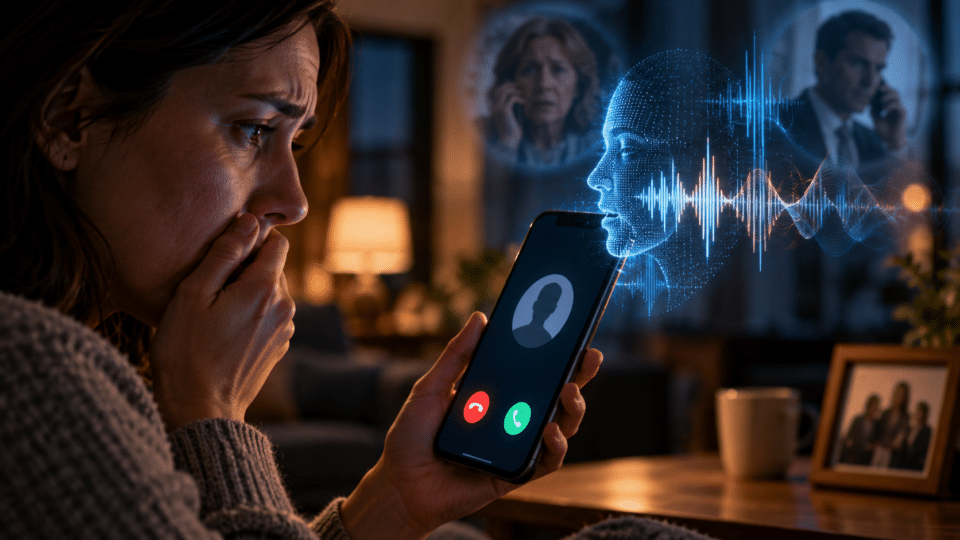
AI-cloned voice: you receive a call and hear the voice of your son, mother or colleague. The accent, pacing and expressions sound familiar. The person says they have had an accident, their phone has broken or they urgently need a transfer. The resemblance to a familiar voice is precisely what can turn an ordinary call into a scam that is hard to recognise.
The rule that protects you is simple: do not confirm someone’s identity solely from their voice, image or the number displayed. End the suspicious call and check the situation through a contact you already knew before transferring money, sharing a code or installing an app. If there is a genuine emergency, verifying independently does not mean ignoring the problem: it helps you respond correctly.
Voice-cloning technology can reproduce certain characteristics of a person, but an attack does not need to be perfect to work. Pressure, fear and haste are often more important to the scammer than sound fidelity. This guide explains how an AI-cloned-voice scam works, how to tell it apart from a legitimate call, what to do if you have already sent money, and how to protect your family.
Updated: 22 October 2026. Sources: Romania’s Siguranța Online campaign (DNSC, the Romanian Police, and the Romanian Banking Association), ANCOM, the FTC, the FBI and the European Commission. The conversation examples are illustrative scenarios, not transcripts of real cases.
AI-cloned voice: the short answer in four steps
- Stop any payment or disclosure of information. An unexpected call, voice message or video is not sufficient proof of identity.
- End the call and start a new communication yourself using an old number you have previously verified. Do not automatically call back the number in your call history or use a number dictated by the caller.
- Confirm through an independent source. Call another relative, colleague, close friend or the relevant institution through contact details found separately.
- Do not send money, passwords, PINs, CVVs or authentication codes until the request and the person have been confirmed through the usual channels.
This protocol is based on principles described by the Federal Trade Commission (FTC) and the FBI’s warnings about impersonation: verification must be independent even if the voice and details appear genuine.
What voice cloning is — and why a familiar voice may be fake
AI voice cloning means using a voice-synthesis system that seeks to reproduce a person’s timbre, rhythm, intonation and other recognisable traits. The technology also has legitimate uses, including accessibility, authorised dubbing and assistance for people who can no longer speak. The problem arises when an imitation is used without consent to deceive.
The reference audio may come from a video, a public appearance, a voice message that has fallen into the wrong hands or other recordings. The FTC warns that relatively short audio clips can be enough for some impersonation tools. There is, however, no universal number of seconds that guarantees a perfect copy; quality varies according to the tools and source material.
An attack may use a prepared recording, a synthesised voice message or a conversation with voice generation adapted to responses. Not every fraudulent call uses AI. A person may imitate a relative, a messaging account may be compromised, or an authentic message may be taken out of context. The defensive rule remains the same: verify identity separately.
The scammer seeks to borrow the credibility of someone known to you and turn it into a financial transfer, sensitive data or access to accounts. Explaining the mechanism should therefore not be confused with instructions for reproducing the attack.
Scenario 1: “Mum, I’ve had an accident. Please send money now”
Imagine receiving a call in the evening. You hear a voice very similar to your child’s, speaking hurriedly and saying they are at a hospital or police station. Another person joins in, claiming to be a doctor, lawyer or institutional representative. They demand an immediate transfer to “resolve the case” and insist that you tell no one.
This is an illustrative scenario of the family-emergency scam. The FTC has documented how AI-generated voices can reinforce such a story. Its recommendation is to end the call and contact the family member on a number you already know. If they do not answer, call other relatives or trusted people.
Importantly, a real accident is possible. Do not automatically assume that every alarming call is fake, but do not confuse legitimate concern with compliance with an unverified financial demand. For an immediate and credible threat to life, contact emergency services through official channels while also checking on the family member.
Scenario 2: “I’m calling from the bank. Your money must be moved to a secure account”
In this version, the voice may imitate a financial institution’s representative or belong to an ordinary caller. The person claims there is a suspicious transaction, then asks you to install an app, read out a code received by SMS or move your savings to another account. The displayed number may resemble the bank’s.
ANCOM explains CLI spoofing: falsifying the caller identity shown on a phone screen. The displayed number does not authenticate the person speaking. Nor does the fact that it is saved in your contacts remove the risk.
Siguranța Online recommends ending the call and contacting the bank through its official app, the number on your card, or a website address you enter yourself. No supposedly urgent procedure justifies disclosing passwords or authentication codes, or transferring savings to a “safe account” provided by a stranger.
For more detail, see InfoBuz’s guide, “The bank or an institution is calling: what to do in the first 15 minutes”.
Scenario 3: your director’s voice asks you to change a payment account
In a workplace setting, a voice resembling that of a director may ask an accountant to make an urgent payment to a new IBAN, citing confidentiality, a penalty or the temporary absence of the person who usually approves the transaction. The attacker may also send an audio message through a compromised messaging account.
The FBI has documented impersonation campaigns targeting senior officials through messages and AI-generated voice material. The warning underlines that fraud can target organisations as well as families.
At a company, protection should not depend on an employee’s ability to recognise their boss’s voice. Changing an IBAN, approving a payment or sharing sensitive documents must be confirmed through existing internal procedures. An unexpected call should not override financial-authorisation rules.
Why listening alone cannot reliably detect a cloned voice
Some synthetic recordings have odd pauses, unusual intonation, delays or repeated phrases. But an authentic call may show the same signs because of a weak signal, microphone quality, emotion or illness. And a fake recording can sound very natural.
Do not turn an audio cue into a verdict: breathing, accent, laughter or background noise do not certify authenticity. Nor are automatic detectors universal evidence. For a call received by a member of the public, verification through an independent channel is more robust than trying to identify whether a voice is artificial.
AI labels and technical marking mechanisms may help, but a scammer will not necessarily label a fraud. The absence of a label does not prove the material is real. Read InfoBuz’s article, “An AI label does not prove that a clip is fake”.
Six warning signs: behaviour matters more than sound
| What the caller says | What to do instead |
|---|---|
| “It’s me, something happened — send money now.” | End the call and call the person on a number you have already saved. If they do not answer, contact another relative. |
| “Don’t hang up, don’t tell anyone.” | Do not accept isolation or pressure. Confirm the information through an independent channel. |
| “I’m calling from the bank; move the money to a safe account.” | End the call and contact the bank through its official app or the number on your card. |
| “Tell me the code you received by SMS.” | Do not disclose MFA codes, passwords, PINs or card details. |
| “I’m the director; pay the new IBAN immediately.” | Use the internal payment-verification procedure and call the responsible person through a known channel. |
| “The displayed number really is mine.” | Do not treat the displayed number as proof of identity: it may be spoofed. |
One sign is not forensic proof, and the absence of warning signs does not certify a call as genuine. Still, an unexpected request for money, codes or an immediate change to an ordinary process is sufficient reason to stop the conversation until it has been checked.
A family password: an extra layer, not a talisman
The Siguranța Online campaign, 6 April 2026, backed by the Romanian Police, DNSC, the Romanian Banking Association and partners, recommends agreeing on a family password: a secret phrase known to those close to you for situations in which someone asks for something unusual.
Agree the phrase in advance. It should not appear in public posts or match a banking password, date of birth or easily guessed security question. Share it through an appropriate channel, not in a public group, and change it if you suspect it has been disclosed.
The limits matter. A password can be forgotten, compromised or learned by an attacker. Someone facing a real emergency may be unable to answer. Even if the response is correct, an unusual financial request must be confirmed separately. The password is an aid, not a replacement for independent verification.
The displayed number can be spoofed: what ANCOM changed
From 7 July 2025, ANCOM introduced measures blocking certain calls originating outside Romania that fraudulently display Romanian numbers. The authority explains that the measures can reduce spoofing, but cannot eliminate it entirely.
In an 8 October 2025 statement, ANCOM stressed why overly broad blocking can affect legitimate communications, including roaming. The practical conclusion remains constant: the identity shown on the screen is not proof of the identity of the person you are speaking to.
Whether the screen shows a bank, hospital or relative, end the call and make your own call to a known contact. If suspicions persist, check with a second person or institution.
What to do if you answered but have not sent money
- End the conversation. Do not let threats, promises or pressure keep you on the phone.
- Do not open links or install apps sent to “confirm” identity, and do not agree to screen sharing.
- Contact the person or institution independently using a number verified before the incident.
- Consult someone close to you if the story seems dramatic and the request involves money or sensitive information.
- Keep evidence, including call times, messages, links and the details of requested payments, without needlessly redistributing personal data.
If you clicked a link or disclosed information, see InfoBuz’s analysis, “How to recognise a phishing message and what to do if you clicked the link”.
Already sent money? The order of actions in Romania
Contact your bank immediately through its official channels and explain that you suspect fraud. Ask it to examine whether the transfer can be blocked, cancelled or recovered. The outcome depends on the type of transaction, the recipient and when you report it; recovery is not guaranteed.
If you disclosed passwords or authentication codes, or installed a remote-access app, inform the bank, change passwords from a trusted device, check active sessions and follow the security instructions. Simply blocking the caller’s number does not resolve compromised accounts.
A report to the Police can include proof of the transaction, conversations and available identifying information. For cyber incidents, Romania’s National Cyber Security Directorate (DNSC) provides PNRISC for individuals and the number 1911, used to report incidents in Romania, during the operating hours communicated by the institution.
The FTC recommends quickly contacting the payment institution if you have been scammed. But there is no guarantee that a sum can be recovered if you report it within the first 10 or 30 minutes.
Watch for recovery scams, too. After an incident, people may claim they can return your money for an upfront fee. Do not send further funds or banking information to strangers promising a full recovery.
Reducing the risk without disappearing from the internet
There is no realistic way to remove every public recording of a voice. A teacher, journalist, entrepreneur or ordinary user may appear in interviews and videos. That does not mean they will automatically become a fraud victim.
Review who can see personal posts, avoid unnecessarily publishing relatives’ telephone numbers, and control the sharing of private voice messages. More importantly, create clear verification rules for urgent requests for money and sensitive information.
A video call does not solve the problem by itself, because images can also be manipulated and legitimate accounts can be compromised. When money or account access is at stake, the request must be authenticated through a separate channel, rather than simply adding an image to an unexpected conversation.
The AI Act and transparency obligations from 2026
Article 50 of the AI Act sets obligations for certain AI systems and uses of artificial content. According to the European Commission, the relevant transparency rules apply from 2 August 2026, including the marking of certain AI outputs and information about deepfakes, under the conditions set by law.
This does not mean that every synthetic call will automatically be labelled on a phone. The rules include exceptions, different duties for providers and users, and transitional provisions. The Commission’s official FAQ explains the distinctions and certain transition periods.
Someone deliberately attempting fraud will not necessarily comply with labelling requirements. Detection tools and regulation can be useful, but independent verification remains indispensable.
A protection plan for the whole family
- Agree that no unusual financial transfer will be made on the basis of a single call or voice message.
- Agree a secret verification phrase that is not public and does not match account passwords.
- When an alarming request arrives, end the communication and call the person on a previously known number.
- Explain to relatives less familiar with technology the difference between pressing “call back” and starting an independent communication.
- Save official contact details for your bank and the institutions you use, rather than relying on links sent by strangers.
- Enable multi-factor authentication and never share the codes you receive.
This plan is useful against traditional scams as well as those using artificial intelligence.
Frequently asked questions about AI-cloned voices and phone scams
Can a person’s voice be cloned from a video?
Some systems can generate a recognisable imitation from audio clips, including clips from videos. Quality depends on the material and the tool; there is no universal duration that guarantees perfect imitation.
Can I spot a cloned voice from its accent or pauses?
Audio clues sometimes appear, but they are not sufficient for authentication. A fake voice can sound natural, while an authentic voice can sound strange because of the network or emotion.
What if the call comes from a relative’s real number?
The displayed number may be spoofed. End the call and start a new check yourself using the contact you have previously saved, plus an independent confirmation when the situation is unusual.
Does a family password protect me completely?
No. It is an additional layer recommended by Siguranța Online. If the password is compromised, forgotten or learned by an attacker, it can no longer securely authenticate the person. Separately verify any unexpected financial request.
Can a video call be faked?
Yes. Video material and accounts can be manipulated or compromised. An image does not replace confirmation through an already verified channel.
Can I give an SMS code to someone claiming to work for the bank?
Do not give passwords, PINs, MFA codes or full card details to an unexpected caller. End the call and contact the institution through its official channel.
What if my relative does not answer immediately?
Contact another relative, close friend or institution through official channels. Do not send money simply because the first check was unsuccessful. If there is imminent and credible danger, call emergency services.
Where can I report a scam attempt in Romania?
You can report it to the Police and report the cyber incident to DNSC through PNRISC or by calling 1911. If you made a payment, notify your bank immediately as well.
Does the AI Act block all fake voice calls?
No. It establishes transparency obligations for certain systems and uses, but does not guarantee the detection or blocking of every telephone scam.
Is it wrong to publish recordings of my own voice?
Not automatically. Audio content has legitimate uses. It is nevertheless prudent to control the personal data you expose and prepare independent ways to verify unusual requests.
Official sources and verification resources
- Siguranța Online, 6 April 2026 — campaign on family passwords and voice imitation.
- ANCOM, 8 October 2025 — CLI spoofing and the limits of technical measures.
- FTC — voice imitation in family-emergency scams.
- FBI, 2025 — impersonation through messages and AI voices.
- European Commission, 31 July 2026 — AI Act transparency obligations.
- European Commission — FAQ on Article 50.
- DNSC / PNRISC — incident reporting for individuals.
- FTC — what to do if you have been scammed.
The best defence is not your ear, but independent verification
An AI-cloned voice can make a stranger sound like your mother, child, colleague or an institution’s representative. But a scam succeeds when an urgent request is accepted before it is checked. In 2026, it is no longer enough to say: “I recognised the voice” or “the number was correct”.
End the call. Make your own call through a verified contact. Confirm through another source. Do not transfer money or disclose codes under pressure. It is a useful habit against voice cloning and traditional scams alike, including those based on authority, fear and false identities.
For more on cybersecurity, see Fake QR codes: how to spot parking, restaurant and parcel scams before you lose money, which offers complementary information on the subject.




Discuția cititorilor
Ai o opinie sau o întrebare despre acest articol? Spune-ne ce crezi.
Fii primul care deschide discuția.
Te rugăm să păstrezi un limbaj civilizat și să discuți la subiect. Comentariile spam sunt filtrate automat.