
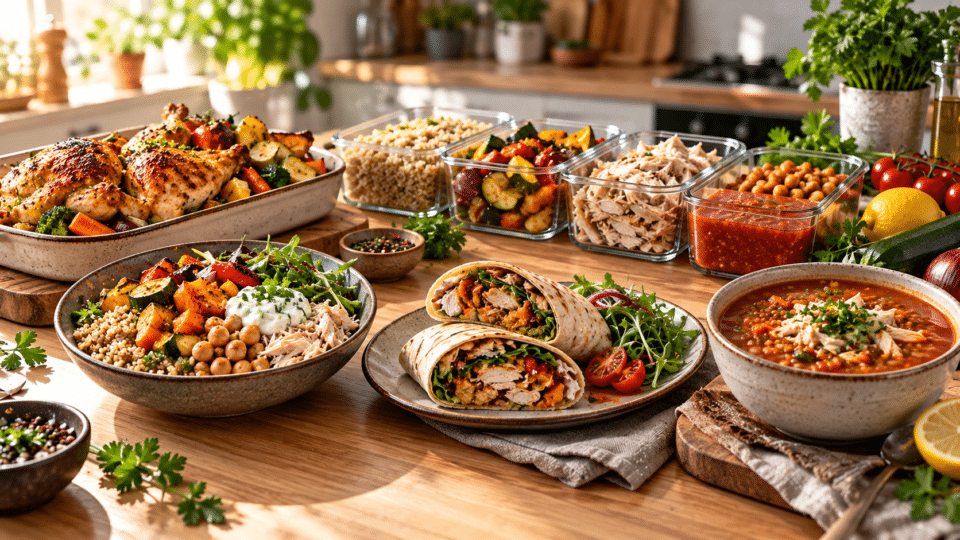
Cook once, eat for three days: it sounds simple, yet it often means three identical containers of chicken and rice that no one wants by the second evening. There is a more flexible approach: cook one core component once, divide it into portions, then change its texture, seasoning, accompaniments and role on the plate. Oven-roasted chicken can become a crisp flatbread filling and then a soup; roasted vegetables can move from a warm bowl to a frittata and then a blended vegetable soup.
For more information on cooking ahead, see Can reheated food become dangerous? The truth about rice, pasta, meat and the fridge, which offers complementary details on the subject.
You do not need to make all 10 foundations on one Sunday. The 10 foundations in this guide are 10 alternative plans, each producing three different meals, generally for two people. Choose one or two that suit your week; do not buy every ingredient mentioned in the article. This reduces the time actually spent at the stove without turning the fridge into a storehouse of food you will not eat.
The article includes 30 meal ideas, indicative quantities, quick assembly methods, a plan for the first 90 minutes, an example shopping list and essential hygiene rules. Storage information is based on the European Food Safety Authority (EFSA), the USDA and the UK Food Standards Agency. It also explains why cooked rice is a special case and should not be left on the table for hours.
InfoBuz editorial update: 23 October 2026. Quantities are indicative for roughly two people and three main meals; energy needs and portions vary from one household to another. The recipes are practical examples, not a medical meal plan. Additional ingredients, including eggs, dairy, gluten, sesame and nuts, must be adapted to individual allergies and preferences.
Cook once, eat for three days: how the method works without repeating the same dinner
On day one, prepare the component that takes the most time: oven-roasted meat, chickpeas, lentils, tomato sauce, roasted vegetables or meatballs. Portion it immediately, then finish each meal with fresh ingredients: a flatbread, an egg cooked on the day of serving, a few salad leaves, a lemon sauce or a side dish. Do not assemble three complete salads and leave them to go soggy in containers.
For safety, the portion intended for day three should be cooled quickly and frozen on day one if it cannot be eaten within the more conservative refrigerated-storage window. The UK Food Standards Agency advises using refrigerated leftovers within 48 hours or freezing them, while USDA guidance often uses 3–4 days for many properly stored cooked leftovers kept at no more than 4°C. This guide takes the conservative, easier-to-follow approach for home cooking and accounts for the type of food; it does not assume that all dishes are alike.
The basic rule: reheat only the portion you will eat, rather than reheating the whole pot three times. If you made four portions and need two, take out only two. When turning a foundation into soup, a stew or a frittata, cook the new dish properly and do not keep transformed leftovers indefinitely. Defrost in the refrigerator, not on the counter. For a more extensive plan, see also InfoBuz’s recipe for chicken meatballs turned into two meals.
Before the recipes: how to portion six servings properly
For each of the 10 options below, the quantities aim to provide roughly three meals for two people. Each meal may need additional sides or protein to be complete. A bowl of roasted squash, for example, is not necessarily a sufficient dinner on its own for everyone.
| When | What to do with the cooked foundation | What to do with fresh ingredients |
|---|---|---|
| Day 1 | Cook it, serve two portions and divide the remainder into shallow containers | Prepare only the salad, dressing or side for the current meal |
| Day 2 | Take only two portions from the fridge and turn them into a new dish | Add flatbread, raw vegetables, herbs, eggs or dairy only then |
| Day 3 | Use the portion frozen on day 1 and safely defrosted | Build the third recipe with different textures and flavours |
Label containers with their contents, cooking date and whether they belong in the “fridge” or “freezer”. For meat portions and ready-to-eat dishes, check the fridge temperature with an independent thermometer. EFSA advises keeping the refrigerator below 5°C and cooling cooked products quickly; the fridge’s own display may not perfectly reflect the temperature on every shelf.
1. Roast chicken: roast dinner, crisp flatbread and fragrant soup
Foundation: one whole chicken of about 1.8–2 kg, or an equivalent quantity of chicken pieces; one tablespoon of oil; sweet paprika, garlic, pepper and thyme. Cook the chicken in a roasting tray, as appropriate for the cut and according to cooking instructions, and check that the thickest part reaches the safe internal temperature of 74°C, without the thermometer touching bone. After cooking, remove the bones, portion the meat and set aside the part intended for soup. Do not wash raw chicken under running water, as this can spread contamination around the kitchen.
Day 1 – Roast chicken with salad and potatoes: serve two portions of chicken with boiled or baked potatoes made on the day, plus a cabbage salad with lemon. If you roasted carrots alongside the chicken, use them as the side dish. The flavour remains that of a classic roast, while the accompaniment is made separately rather than stored in the same container as raw vegetables.
Day 2 – Chicken flatbreads with yoghurt sauce: thoroughly reheat the chicken for this meal, then place it in two flatbreads with finely shredded cabbage, cucumber and a cold sauce of yoghurt, lemon and garlic. Do not heat the yoghurt sauce or salad; add them once the chicken is ready. The result has a different texture and flavour profile.
Day 3 – Chicken and vegetable soup: defrost in the fridge the portion frozen on day 1, add it to stock or water with carrot, celery and onion, then simmer until the soup and chicken pieces are fully heated through. Finish with herbs and a little lemon juice. Do not reboil a carcass that has been left at room temperature for hours; use only properly stored ingredients.
Time-saving tip: if the potatoes are already cut and the vegetables washed, the roast can become the first item in a three-day cooking schedule. See also InfoBuz’s chicken, sweet cabbage and carrot tray bake.
2. Tray-roasted vegetables: warm bowl, frittata and blended soup
Foundation: around 1.6–1.8 kg of vegetables before cooking: two courgettes, three carrots, two peppers, one or two onions and some broccoli, depending on the season. Cut them into similarly sized pieces, spread them in a tray without overcrowding, drizzle with two tablespoons of oil and season with pepper, paprika and thyme. Roast until tender and browned at the edges. Divide into three equal portions.
Day 1 – Warm vegetable bowl with cheese: combine the first portion with fresh salad leaves, 100–150 g of fresh cheese or tofu for two people, and a lemon dressing. Anyone with higher energy requirements can add wholegrain bread or a freshly prepared side dish.
Day 2 – Vegetable frittata: heat this day’s portion in a frying pan, beat four eggs for two people and pour them over the vegetables. Cook until the eggs are fully set; for a precise check, US guidance recommends 71°C for egg dishes. The result is a compact dish that can also be packed for later if cooled and stored correctly.
Day 3 – Roasted vegetable soup: defrost the vegetables set aside on day 1, simmer them for a few minutes in vegetable stock or water, then blend. Add pasteurised yoghurt only after the foundation has been heated, at serving, and serve with pumpkin seeds or cooked beans for additional protein.
The frittata technique is also covered in InfoBuz’s guide to which leftover vegetables can be used in a frittata and when they should be discarded.
3. Homemade tomato sauce: pasta, eggs in sauce and bean stew
Foundation: around 1.2–1.5 litres of tomato sauce, made with passata or canned tomatoes, two onions, four garlic cloves, two tablespoons of olive oil, basil and oregano. Briefly sauté the onion, add the garlic, tomatoes and herbs, then simmer until thickened. Divide the sauce between three separate containers and freeze the day-three portion.
Day 1 – Pasta with tomato sauce and basil: cook 160–200 g of dried pasta for two people, depending on the desired serving size. Combine freshly cooked pasta with one third of the sauce, some basil and grated cheese. It is not identical to the meals on subsequent days, as the pasta provides the main texture and role.
Day 2 – Eggs in tomato sauce, shakshuka-style: heat the second portion of sauce in a frying pan, make four small hollows and crack one egg into each. Cover and cook until the eggs reach a safe degree of doneness appropriate for those eating the meal. Serve with toast and parsley. Do not cook the eggs a day ahead to reheat repeatedly.
Day 3 – Bean and vegetable stew: heat the defrosted sauce thoroughly with 300–400 g of cooked or canned, drained beans, peppers and a little cumin. Simmer until completely hot and serve with a fresh salad. It is a spoonable dish, distinct from the first two.
For a simpler version of the first meal, see InfoBuz’s pasta with tomatoes and basil recipe. The basic sauce can be made without meat, making it useful in households with different dietary preferences.
4. Cooked chickpeas: crunchy salad, hummus and curry
Foundation: around 900 g of cooked, drained chickpeas, from low-salt canned chickpeas or dried chickpeas that have been soaked and cooked correctly. For convenience, canned chickpeas are the simplest option: check the label and rinse them if you want to reduce some of the salt in the canning liquid. Divide immediately into three portions.
Day 1 – Warm chickpea salad: lightly brown 300 g of chickpeas in a frying pan or oven with paprika and a little oil, then add salad leaves, tomatoes, cucumber, lemon juice and a yoghurt dressing. It is a fresh lunch option, with the crisp element made immediately before serving. For inspiration, see InfoBuz’s warm chickpea salad.
Day 2 – Hummus with flatbreads and vegetables: blend the second portion of chickpeas with one or two tablespoons of tahini, lemon, a little garlic and cold water until smooth. Serve immediately with two flatbreads and carrot and pepper sticks cut that day. Tahini contains sesame, which matters where allergies are present; the recipe can be adapted without sesame.
Day 3 – Chickpea curry: on the day of cooking, freeze the third portion. For the final meal, defrost it in the fridge, then cook it with 200 ml coconut milk, tomatoes, turmeric and spinach. Serve with bread or a freshly cooked side. There is no need to cook rice for three days; if you choose rice, prepare it on the day.
These three variations show why seasoning later is useful: plain chickpeas can take on Mediterranean, Middle Eastern or curry-style flavours.
5. Cooked lentils: lemon salad, vegetarian patties and substantial soup
Foundation: around 350–400 g of dried green or brown lentils, generally producing close to one kilogram of cooked lentils, depending on variety and hydration. Cook in water according to the product instructions until tender but still holding their shape. Drain and divide into three portions; do not over-salt the foundation, as each recipe has its own seasoning.
Day 1 – Lentil salad with parsley: combine one third of the lentils with tomatoes, peppers, red onion, parsley, lemon and olive oil. Add cheese or properly cooked boiled eggs if you want a more substantial meal. Raw ingredients should be washed, and dressing added at serving.
Day 2 – Oven-baked lentil patties: coarsely mash one third of the lentils with an egg, two or three tablespoons of breadcrumbs, chopped onion and a little paprika. Shape six to eight patties and bake until thoroughly cooked and firm. Serve with cabbage salad and yoghurt. Add and cook the eggs on day two; do not store a raw egg mixture from the beginning of the week.
Day 3 – Lentil and spinach soup: defrost the final portion and simmer with carrot, passata, water or stock, and a handful of spinach. Finish with lemon and parsley. For a faster lentil recipe, see InfoBuz’s red lentils with tomatoes, spinach and lemon; red lentils have a different texture, however, and the patties may require different binding proportions.
6. Turkey meatballs: with sauce, in a sandwich and in a gratin
Foundation: around 900 g minced turkey, one egg, one small onion, two tablespoons of breadcrumbs and seasonings. Shape 20–24 meatballs, depending on size. Put them on baking paper and cook until the centre reaches 74°C, the reference temperature for poultry, including minced poultry. Divide them into three meals for two people.
Day 1 – Meatballs in tomato sauce with mămăligă: heat the first portion in separately prepared tomato sauce and serve with mămăligă, Romania’s traditional cooked cornmeal dish, made at the time. It is a hot meal with a traditional flavour profile.
Day 2 – Meatball sandwich with salad: heat the portion intended for day two, halve the meatballs and place them in a baguette or two flatbreads with salad leaves and a cold mustard-yoghurt dressing. It makes for a dinner with a different texture, without transforming the whole tray of meatballs again.
Day 3 – Vegetable and meatball gratin: place the defrosted portion in a baking dish with courgette, tomato sauce and a little cheese, then bake until all components are thoroughly hot, with no cold spots. Serve straight away, without another period of storage for the transformed leftovers.
A different approach, closer to children’s tastes, appears in InfoBuz’s recipe for chicken meatballs with carrot and courgette. For packed meals, keep sauces in a separate container so that the bread does not go soggy.
7. Jacket potatoes: stuffed potatoes, tortilla and rustic soup
Foundation: around 1.6–1.8 kg of potatoes, preferably of a similar size. Wash well, prick the skins with a fork and bake until the centres are completely soft. If using aluminium foil, remove it after baking and cool the potatoes quickly before refrigerating, rather than keeping them warm and wrapped for hours. Baked-potato dishes should be stored under the same temperature rules as other perishable leftovers.
Day 1 – Stuffed potatoes with cheese and herbs: split two to four potatoes, depending on size, and add fresh cheese, yoghurt, spring onion and parsley. A large salad can be served alongside. Make the filling on the day of serving; do not keep potatoes already stuffed for three days.
Day 2 – Potato and egg tortilla: slice the refrigerated portion, brown it in a frying pan with onion, then add four beaten eggs. Cook until the eggs are fully set. The result is closer to a substantial Spanish omelette than to the first dish.
Day 3 – Potato and leek soup: freeze the potatoes intended for soup on day one; their texture may become softer after defrosting, which is acceptable in a blended soup. Cook with leek, carrot and a little thyme, partly blend, then serve with yoghurt or croutons. For another recipe in the same family, see crushed crispy potatoes with yoghurt and lemon sauce.
8. Bulgur or cooked wheat: salad, stuffed peppers and mushroom skillet
Foundation: around 350–400 g dried bulgur, prepared according to the packet instructions to yield several portions. Bulgur contains gluten, so it is unsuitable for people who must avoid it. Cooked grains and starchy foods can allow bacteria to grow when left at room temperature for long periods; cool quickly in a shallow layer, refrigerate the day-two portion immediately and freeze the day-three portion.
Day 1 – Bulgur, parsley and lemon salad: mix the first portion with tomatoes, cucumber, plenty of parsley and lemon juice. Add cubes of tofu, cheese or chickpeas for more protein. Do not mix all three portions with fresh vegetables from the outset.
Day 2 – Bulgur and bean stuffed peppers: combine the second bulgur portion with 200–300 g cooked beans, chopped tomatoes and spices; fill two large peppers or four smaller ones. Bake until the peppers are soft and the filling is hot at the centre. This produces an oven-baked meal, not another salad.
Day 3 – Bulgur skillet with mushrooms: defrost the portion frozen on day one, then cook it with browned mushrooms, garlic and thyme. Heat completely, stirring to avoid cold spots. Serve with a fresh salad. For ideas on seasoning mushrooms without a heavy sauce, see InfoBuz’s recipe for browned mushrooms with garlic.
Safety note: UK guidance on rice and some grain dishes is stricter. The NHS advises cooling cooked rice within one hour, refrigerating it and eating it within 24 hours, because of the risk associated with Bacillus cereus. For that reason, we do not recommend keeping cooked rice in a fridge container for three days. If you want rice with these recipes, cook a fresh portion or cool and freeze individual portions quickly, following safe instructions.
9. Cooked beans: Romanian-style salad, chilli and bean purée
Foundation: around 900–1,000 g cooked, well-drained beans, ideally commercially canned for simplicity and consistency. If using dried beans, follow soaking and thorough cooking instructions, especially for red kidney beans, which may contain toxic lectins if undercooked. Do not eat dried beans that have only been soaked or lightly heated.
Day 1 – Bean salad with red onion: combine one third of the beans with onion, pepper, parsley, vinegar and oil; add bread and fresh vegetables. It is a simple meat-free meal, also suitable for packing if kept cold.
Day 2 – Meat-free chilli: simmer the second portion with tomatoes, smoked paprika, cumin, a pepper and a little sweetcorn. Adjust the amount of chilli to taste. Serve with yoghurt, bread or a side cooked on the day; the consistency becomes that of a stew, entirely different from the previous day’s salad.
Day 3 – Warm garlic bean purée: defrost the separately frozen portion from day one, heat it through with a little water, garlic and thyme, then blend. Serve the hot purée with freshly sautéed onions and toast. Do not keep a large bowl of purée at room temperature for repeated snacking.
Budget option: compare the cost of a can with that of a bag of dried beans, taking account of preparation time, the energy used for boiling and the final usable quantity. Do not treat a lower price per kilogram of dried product as automatic proof of savings for every household.
10. Roasted squash: fragrant soup, pasta sauce and sweet-savoury patties
Foundation: around 1.5–1.8 kg squash with the seeds removed, cut into cubes with a little oil, moderate salt and thyme. Roast until very tender, cool quickly in portions and set aside two small containers for the fridge and freezer. This foundation is useful in autumn, though canned or frozen squash may be available at other times if you want to adapt the menu.
Day 1 – Squash soup with yoghurt and seeds: briefly simmer the first portion with vegetable stock and blend, then add pumpkin seeds and yoghurt at serving. For a main meal, add wholegrain bread and a protein source, such as fresh cheese or beans.
Day 2 – Pasta with creamy squash sauce: blend the refrigerated portion with a little of the water from pasta cooked on the day, garlic and Parmesan or nutritional yeast. Combine with 160–200 g dried pasta for two people and a little pepper. The flavour is entirely different from day one’s soup.
Day 3 – Squash and chickpea patties: defrost the day-one portion and blend with around 200 g drained chickpeas, two or three tablespoons of flour or breadcrumbs, a little onion and coriander. Adjust the consistency, shape into patties and bake until hot and firm; serve with a fresh salad. If the squash is very watery, drain it before adding flour.
Do not confuse the softer texture of defrosted squash with food spoilage. However, a normal smell and appearance alone do not prove that improperly stored food is safe; follow time and temperature rules.
At a glance: 10 foundations, 30 meals
| Cook once | Day 1 | Day 2 | Day 3 — portion frozen at the outset |
|---|---|---|---|
| 1. Roast chicken | Roast with potatoes | Chicken flatbread | Chicken soup |
| 2. Roasted vegetables | Warm bowl with cheese | Frittata | Blended soup |
| 3. Tomato sauce | Pasta | Eggs in sauce | Bean stew |
| 4. Cooked chickpeas | Crunchy salad | Hummus in flatbread | Curry |
| 5. Cooked lentils | Lemon salad | Vegetarian patties | Lentil soup |
| 6. Turkey meatballs | With sauce and mămăligă | Sandwich | Vegetable gratin |
| 7. Baked potatoes | Stuffed potatoes | Tortilla | Leek soup |
| 8. Bulgur | Parsley salad | Stuffed peppers | Mushroom skillet |
| 9. Beans | Bean salad | Chilli | Warm purée |
| 10. Roasted squash | Squash soup | Pasta sauce | Squash patties |
These are 10 alternative plans for roughly two people, not one menu that must be cooked in full. Day three requires freezing the foundation portion early, then defrosting it under appropriate conditions.
How to organise 75–90 minutes of cooking: a realistic example for three compatible foundations
You cannot efficiently cook all 10 foundations in 90 minutes in an ordinary kitchen. You can, however, intelligently combine roast chicken, roasted vegetables and tomato sauce if you have an oven with enough space and two hob burners. Timings depend on tray size, preheating and oven type; this schedule is indicative, not a certified time trial.
- Minutes 0–15: wash hands and vegetables, prepare separate chopping boards, preheat the oven and start the tomato sauce in a pot. Handle raw meat separately and wash utensils and hands after contact.
- Minutes 15–25: put the chicken in the oven and prepare a separate vegetable tray, ensuring that raw-meat juices do not touch ready-to-eat ingredients. Plan tray positions according to your oven.
- Minutes 25–60: monitor the roasting and sauce, wash utensils, prepare labels and containers. Check the chicken’s internal temperature, not only the colour of the skin.
- Minutes 60–90, or as long as the oven actually requires: remove food only when fully cooked, portion it into shallow containers and begin rapid cooling and refrigeration/freezing. Do not leave it on the counter “to come to room temperature” for several hours.
The real cost of planning includes time spent shopping, cleaning and reheating each day. We do not promise that three dinners will inevitably take “10 minutes” if you still need to boil pasta, cook eggs or get home from work. The advantage is that the slowest operation—the preparation of the foundation—is not repeated.
Example shopping list for two people over three days
To show how planning works, we have chosen one foundation only: roast chicken. This is not a list for all 10 recipes. For three distinct main meals suitable for roughly two people, first check what you already have in the fridge and cupboard.
| Group | What to buy, approximately | What it is for |
|---|---|---|
| Foundation | Chicken of around 1.8–2 kg | Roast, flatbreads, soup |
| Vegetables | 1 small cabbage, 4 carrots, 1 small celery root, 1 onion, 1 cucumber, 1 lemon | Salad, flatbreads, soup |
| Sides | 600–800 g potatoes, 2–4 flatbreads | First and second meal |
| Dairy | 150–200 g plain pasteurised yoghurt | Flatbread dressing, optional at the meal |
| Cupboard | Oil, thyme, paprika, pepper, garlic, parsley | Seasoning without repeating the same flavour |
Before shopping, establish how many actual portions the household eats. An adult doing intense physical work may need a larger side dish than in this example, while children have different portion sizes. If there is not enough chicken left for one meal, add legumes or adapt the menu rather than forcing an unrealistic division.
How to calculate savings without invented prices: the cost-per-portion formula
Food prices vary between shops, towns and weeks. There is therefore no guaranteed saving of “300 lei a month” simply because you began using food containers. Compare the total cost of ingredients actually used, cooking energy and the quantity left uneaten with what you would otherwise have bought and eaten.
Estimated cost per portion = (ingredients used + relevant cooking costs) ÷ number of portions eaten. If a packet of cheese cost 15 lei but you used only one third, the menu cost includes the amount used, while the rest must be planned into another meal rather than thrown away.
For example, if you hypothetically spent 84 lei on six portions for a particular foundation and all its additions, the simplified cost is 14 lei per portion before cooking energy. If two portions are discarded, the actual cost rises to 21 lei for each of the four portions eaten. These figures are an invented arithmetic example, not a verified price quotation for products in October 2026.
The European Commission and EFSA include meal planning, shopping lists and responsible use of leftovers among methods of cutting food waste. Commission data updated in 2026 show that households generate more than half of the European Union’s total food waste. Read also InfoBuz’s analysis of how to interpret food-waste figures in Romania, without confusing the mass of waste with a quantity consisting exclusively of food that was still edible.
Food safety: six rules more important than any recipe
1. Keep the fridge cold. EFSA advises refrigerating cooked and perishable products at below 5°C. In US guidance, the usual threshold is 4°C or below. Check the actual temperature, including when the fridge is very full.
2. Do not leave food on the counter. Perishable food should not remain at room temperature for more than two hours; the USDA advises a maximum of one hour above 32°C. Use shallow containers for rapid cooling; do not leave a huge pot of warm soup overnight.
3. Separate raw food from cooked food. Use clean utensils, do not put cooked meat back on the plate that held raw chicken, and wash hands after handling raw food. This is one of the WHO’s five keys to safer food.
4. Reheat thoroughly. For leftovers, FoodSafety.gov guidance specifies 74°C at the centre; use a thermometer where practical. Stir microwave-heated food to eliminate cold spots, and reheat only the portion taken from the fridge.
5. Freeze from the outset for day three. The Food Standards Agency advises eating refrigerated leftovers within 48 hours or freezing them; the USDA generally allows 3–4 days for many properly refrigerated leftovers. For a general household guide, keeping the first and second portions refrigerated and freezing the third is a prudent choice, particularly if you do not know the exact, stable temperature of the fridge.
6. Smelling fine does not automatically mean safe. Foodborne bacteria or toxins are not always detectable by taste or smell. If the cold chain has been interrupted, the use-by date has passed, or you do not know how long a perishable food has been kept warm, do not try to “save” it by boiling it. For power cuts, see InfoBuz’s guide to keeping food safe in the fridge during a power outage.
Rules for food stored in its packaging must be followed separately. EFSA explains the difference between a “use by” date, which concerns safety, and a “best before” date, which concerns quality. The former should not be exceeded merely because a product looks fine.
Rice, pasta and bulgur: why cooked grains should not sit in the pot for hours
Raw rice may contain spores of Bacillus cereus, which survive boiling. If cooked rice remains at room temperature for a long time, bacteria can multiply and some toxins may remain problematic even after reheating. The NHS and Food Standards Agency advise cooling rice in about one hour, refrigerating it and eating it within 24 hours, without repeated reheating. Source: NHS.
This does not mean you cannot eat rice in a three-day plan. It means that you do not cook a pot of rice on Sunday to eat from the fridge on Wednesday. Cook rice fresh on the day of the meal, or cool and freeze individual portions quickly, following official defrosting and reheating conditions. This article favours vegetables, legumes, sauces and properly portioned meat as main foundations.
For pasta salads and other starchy foods, keep raw vegetables and dressing separate and follow time and temperature rules; do not consider a cold salad safe merely because it contains no meat. For fresh alternatives, see InfoBuz’s summer vegetable pasta salad.
Adapting the method for vegetarians, children and people with allergies
The chickpea, lentil, bean and vegetable plans can be vegetarian; use plant-based ingredients instead of yoghurt or cheese when you want a dairy-free version. If you avoid eggs, replace the frittata with roasted vegetables and tofu or another suitable dish. If you cannot tolerate gluten, do not use bulgur and check flatbreads, breadcrumbs and sauces carefully.
For children, adjust piece sizes, seasonings, potential choking hazards and dietary needs according to age. For pregnant people, older adults, people with reduced immunity or conditions requiring dietary restrictions, food-safety rules and permitted foods may be stricter; check relevant medical advice. Do not treat a general recipe as a therapeutic diet.
Nutritionally, a balanced meal can include vegetables, an appropriate protein source, starchy foods or grains according to need, and a reasonable amount of fat. Not all 30 ideas are complete meals without the recommended additions. For labels and the distinction between simple preparations and ultra-processed foods, see InfoBuz’s analysis of ultra-processed foods.
Seven mistakes that turn meal prep into waste
- Cooking 10 foundations at once. You end up with too many portions and too little fridge space. Start with one foundation for three meals.
- Putting every side dish into the same container. Salad becomes soggy, croutons soften and you can no longer vary the flavour.
- Leaving a large pot to cool overnight. Slow cooling increases microbiological risks; divide food into shallow portions.
- Reheating the entire dish repeatedly. Take out only the amount needed and heat it through.
- Not labelling containers. By day three, you no longer know what was made on Monday and what was opened on Friday.
- Assuming 30 ideas means 30 free meals. Side dishes and fresh ingredients have a cost and take time to prepare.
- Trying to rescue improperly stored food to avoid waste. Food safety takes priority over financial savings.
Frequently asked questions about cooking for three days
What does “cook once, eat for three days” mean?
It means preparing a core component, portioning it and turning it into three different meals. It does not mean eating the same fully assembled dish for three days.
Do I have to prepare all 10 foundations on the same day?
No. They are 10 planning alternatives, each with three transformations. Choose one or two, depending on the number of people, storage space and time available.
How long does cooked food keep in the fridge?
It depends on the food and storage conditions. The USDA frequently indicates 3–4 days for many leftovers kept at no more than 4°C, while the FSA recommends 48 hours or freezing. For day three, this guide recommends freezing the portion on day one.
Can I cook on Sunday and eat it on Wednesday?
Yes, if the Wednesday portion was cooled quickly and frozen in time, then defrosted in the refrigerator and reheated correctly. Do not automatically refrigerate every dish cooked on Sunday until Wednesday.
Is it safe to reheat the same dish three times?
It is not recommended. Keep individual portions and heat only the quantity eaten at one meal; the FSA recommends reheating leftovers only once.
Can cooked rice be kept for three days?
UK guidance recommends cooling it quickly within one hour and eating refrigerated rice within 24 hours, with no more than one reheating. For day three, use a portion quickly frozen on day one or cook fresh rice.
What containers are most practical?
Clean, food-safe containers that close securely, preferably not very deep to allow quicker cooling. Check their compatibility with the refrigerator, freezer and microwave according to the manufacturer’s instructions.
What should I do if my fridge is no longer cold enough?
Check the temperature with a thermometer and do not keep perishable prepared food in an overly warm fridge. If there has been a power cut and food has spent a long time at unsafe temperatures, follow disposal advice and do not rely on smell alone.
Can I meal-prep without meat?
Yes. Chickpeas, lentils, beans, roasted vegetables and tomato sauce offer many options. Add suitable protein sources and adjust meals to your nutritional needs.
Is cooking ahead always cheaper?
No. Savings depend on ingredient prices, energy used, the portions actually eaten and waste avoided. Compare real costs, not promotional percentages.
Can all the ingredients be frozen already mixed together?
Not all ingredients keep their texture. Salad leaves, cucumber and yoghurt-based dressings are better fresh; freeze mainly the foundations that tolerate freezing and add sensitive components at serving.
How many portions do these recipes make?
The quantities are intended to provide approximately three meals for two people, or around six portions. Yield and portions depend on the ingredients, bones in the meat, side dishes and each person’s appetite.
Official sources on food safety and reducing waste
- EFSA – Proper food handling: storage below 5°C, cooling and hygiene.
- EFSA – Food poisoning: risks and prevention.
- EFSA – Use-by dates and best-before dates.
- USDA FSIS – Leftovers and Food Safety: rapid cooling, shallow containers and 3–4 days for many leftovers.
- Food Standards Agency – Cooking Your Food: reheating once and the 48-hour recommendation.
- NHS – Starchy foods: specific risks associated with cooked rice.
- FoodSafety.gov – Safe minimum cooking and reheating temperatures.
- WHO – Five keys to safer food.
- European Commission – Food Waste: EU data, causes and waste reduction.
- EFSA – Reducing consumer food waste: meal planning and responsible shopping.
Provisional editorial photograph: Ella Olsson / Unsplash, under the Unsplash License. The photograph shows containers of prepared food but does not indicate how long the food pictured can actually be stored. The original InfoBuz image, separately available in WebP format, is a digitally generated visual composition, not a dish actually tested by the editorial team.
The difference between useful meal prep and three days of repeated food
Cook once, eat for three days does not mean sacrificing flavour, variety or food safety to save a few minutes. It means identifying the component that takes the most time, preparing it efficiently and changing its role across three meals: roast, flatbread and soup; warm vegetables, frittata and blended soup; chickpeas, hummus and curry.
Start with one of the 10 foundations, adjust the quantities and notice which portions you actually eat. Keep raw vegetables separate, freeze the third-day portion early, heat food thoroughly and do not try to rescue food that has spent too long outside the fridge. The benefit is not only a more convenient menu: you may shop more consciously and reduce food thrown away without promising savings that have not been measured.
One solid foundation, three smart transformations and a safe storage plan: that is meal prep with a realistic chance of still working after the first week.




Discuția cititorilor
Ai o opinie sau o întrebare despre acest articol? Spune-ne ce crezi.
Fii primul care deschide discuția.
Te rugăm să păstrezi un limbaj civilizat și să discuți la subiect. Comentariile spam sunt filtrate automat.