
Train journeys in Romania can be much more than a way of getting from one city to another. You can see the Prahova Valley from an entirely different angle, reach the foothills of Piatra Craiului, cross historic viaducts in Banat, or follow the contours of Maramureș without taking the wheel. Sometimes the finest part of a holiday is not the destination, but the view passing your window.
That said, “without a car” does not automatically mean “without planning”. A regional train may run infrequently, a connection may require a different operator, and an attraction a few kilometres from the station may require a local bus or taxi. This guide is therefore more than a ranking of pretty photographs: for each route, it explains what is worth seeing, how easy it is to reach, where the difficulties arise, and what to check before buying a ticket.
The selection includes ten rail journeys, from Bucharest and Brașov to the Apuseni Mountains, Bucovina, Maramureș and Banat, plus a distinctive tourist experience on the Mocănița. Service information was checked against sources from CFR Călători, CFR Infrastructură, Regio Călători, Informatică Feroviară and tourism operators. We do not guarantee that every service runs every day: in 2026, modernisation work, temporary cancellations and bus replacement services are in place, and the final timetable must be checked for the exact date of travel.
InfoBuz editorial update: 23 October 2026. The prices and times mentioned specifically were those published at the time of research and may change. This guide suggests real routes; it is not a booking or a commercial offer.
Train journeys in Romania: the 10 routes at a glance
| Route | Why choose it | How straightforward it is without a car |
|---|---|---|
| 1. Bucharest – Sinaia – Bușteni – Predeal – Brașov | Mountains, resorts and views from the train | Relatively straightforward; multiple trains and stopping points |
| 2. Brașov – Râșnov – Zărnești | Țara Bârsei and proximity to Piatra Craiului | Easy to the town; check the final kilometres for mountain trails |
| 3. Brașov – Întorsura Buzăului | The Budila bridge and the long Teliu Tunnel | Regional train; check connections and cancellations |
| 4. Alba Iulia – Zlatna | The Ampoi Valley and quieter Apuseni Mountains | Regional train; limited frequency |
| 5. Suceava – Câmpulung Moldovenesc – Vatra Dornei | Basins, forests and Bucovina scenery | Rail access, with considerable variation among available services |
| 6. Salva – Vișeu de Jos – Sighetu Marmației | Mountains and rail travel through Maramureș | Best suited to an overnight stay, not an improvised return journey |
| 7. Oravița – Anina | The Banat Semmering: tunnels and viaducts | Regular tourist train on the branch line; getting to Oravița requires care |
| 8. Băile Herculane – Orșova | The Cerna Valley and proximity to the Danube | Interregional trains, though works may affect schedules |
| 9. Constanța – Eforie – Costinești – Mangalia | The Black Sea coast, station by station | Check the season and any road replacement services |
| 10. Brașov – Sighișoara | Transylvanian villages and a UNESCO-listed citadel | Possible, though works may change journey times in 2026 |
The ranking is editorial: it is not an official CFR ranking. Some routes are attractive chiefly for their panoramas, others for the railway experience or for the town where you get off.
1. Prahova Valley: Bucharest – Sinaia – Bușteni – Azuga – Predeal – Brașov
This is probably the most accessible introduction to mountain rail travel for anyone leaving Bucharest. As the plains fall behind and the mountains draw closer, the scenery changes: hills, a narrowing valley, wooded slopes and, on clear days, views towards the Bucegi Mountains. You do not have to choose just one town: get off at Sinaia for a full day, or continue to Brașov.
Different operators run trains on the Bucharest North–Brașov railway. The timetable published by Astra Trans Carpatic lists consecutive stops at Sinaia, Bușteni, Azuga and Predeal. For a specific ticket, also check the other services in the Informatică Feroviară journey planner.
Suggested experience: leave in the morning, stop in one of the resorts along the way, then continue to Brașov or return in the evening if the timetable allows. Sinaia’s central area can be explored on foot, while more distant or uphill attractions require checking local transport and opening hours. In Bușteni, do not assume that arriving at the station takes you directly to demanding alpine trails.
Worth knowing: popular trains can be crowded at weekends and during holidays. Reserve a seat where the service permits or requires it, and check the return journey and the weather. In winter, mountain hiking is a different activity from walking around a resort; do not set off on an unmarked trail simply because the train arrived on time.
2. Brașov – Râșnov – Zărnești: Piatra Craiului begins near the station
The regional Brașov–Zărnești line offers a very different experience from an Interregio service on a main line: settlements in Țara Bârsei, hills and the nearby Piatra Craiului massif. If you enjoy slow travel and rural scenery, it is an excellent choice for a weekend without a private car.
The Brașov–Zărnești service is among the routes operated by Regio Călători. The timetable for 23 October 2026 lists trains passing through Râșnov and arriving in Zărnești. Do not, however, mistake the number of scheduled services for a guarantee that all will run unchanged on another date.
What to do after getting off: explore central Zărnești, then continue to the Piatra Craiului National Park Visitor Centre if you arrange a local connection. The park administration publishes the centre’s opening hours and its admission fees and visiting rules. For Plaiul Foii, the Zărnești Gorges and other natural areas, check the actual distance from the station, access conditions and the weather.
The pitfall to avoid: reaching Zărnești by train does not automatically mean a mountain attraction outside the town is accessible without a transfer. Check minibus timetables, local taxis or distances that can safely be covered on foot. For mountain walks, use marked trails only and choose a route suited to the group’s experience.
3. Brașov – Întorsura Buzăului: the Budila bridge and a seemingly endless tunnel
This is one of the Romanian rail network’s less familiar surprises. The Brașov–Întorsura Buzăului line runs through the Hărman and Teliu areas before continuing towards the Întorsura Buzăului basin. It is not a route with celebrated resorts at every stop, but it offers a combination of rural scenery and railway engineering worth discovering.
The line includes the Teliu Tunnel, more than 4 kilometres long, known for its unusual length within Romania’s railway network. After a bridge in the Budila area was destroyed by flooding, rail services resumed in September 2022 following reconstruction. CFR Infrastructură documented the work.
In October 2026, Regio Călători continues to list this route, but also notes temporary cancellations or changes between 27 and 30 October 2026 for some trains. This is exactly the sort of route for which checking a week beforehand is no substitute for checking again on the day of departure.
Best for: railway enthusiasts, photography from the route and a quiet outing—not those hoping to fit dozens of tourist attractions into one afternoon. You will not see the scenery in the tunnel, but crossing it is part of what gives the journey its character.
4. Alba Iulia – Zlatna: the Ampoi Valley train and the understated Apuseni
If you want a less publicised route, try Alba Iulia–Zlatna. The train leaves the historic city and passes through settlements in the Ampoi Valley towards the foothills of the Apuseni Mountains. It is not a high-speed line, which is precisely why it should be regarded as a journey in its own right rather than simply transport to a destination.
The Regio Călători timetable published for the 2025–2026 timetable season lists the stations and stops on the route, including Ampoița, Poiana Ampoiului, Feneș and Zlatna. The operator also includes the route in its current list.
There is an interesting local railway story here: the historic narrow-gauge railway has disappeared from present-day service, but passenger links continue on a standard-gauge line. It would be inaccurate to market an ordinary railcar journey as a “steam Mocănița ride”. A local feature published in 2026 explains that continuity and the difference in rolling stock.
How to make the trip: allow time for Alba Iulia’s historic centre, then check the outbound train and, crucially, the last useful return service from Zlatna. With limited frequency, a plan that ignores the return train can turn a day trip into an unplanned overnight stay.
5. Bucovina from the window: Suceava – Gura Humorului – Câmpulung Moldovenesc – Vatra Dornei
For changing mountain scenery, this is one of the strongest options for a longer journey. As the train climbs from Suceava towards Gura Humorului and Câmpulung Moldovenesc, settlements, valleys, forests and mountain outlines unfold in succession. Vatra Dornei is a destination where it is worth spending more than an hour.
The route is real and used by passenger trains. Official CFR Călători searches show trains on this corridor calling at Gura Humorului City, Vama, Câmpulung Moldovenesc and Vatra Dornei Băi; some continue to Ilva Mică. The official Gura Humorului City station page and Infofer are useful for comparing services.
What to choose: for a short break, book one or two nights in one of the resorts and use the train for the scenic segment. If you want to see Bucovina’s monuments and monasteries, check the last mile: many are not near a station and require additional local transport. Do not claim that every monastery can be visited solely on foot from railway stations.
Keep in mind: there are similarly named stations, including Vatra Dornei and Vatra Dornei Băi. For accommodation, check which is closer to your address. The return journey may use a different type of train from the one on arrival, and the cost and duration may change.
6. Rail travel through Maramureș: Salva – Vișeu de Jos – Sighetu Marmației
This is the kind of route that shows why some slow journeys are worth planning specifically for the scenery. The train heads through mountain regions, villages and wooded areas towards historic Maramureș. It is not a “leave at lunchtime and return for dinner” excursion, especially if you are travelling from a distant city.
An important 2026 update: on 23 February 2026, CFR Infrastructură announced a reduction of around 30 minutes on the Salva–Sighetu Marmației route through operational measures and the removal of some restrictions. This is not a promise that every Maramureș train will be exactly 30 minutes faster than its published timetable.
There are two ways to approach the experience. The first is to travel to Sighetu Marmației and stay overnight to explore the city. The second is to get off around Vișeu de Jos and separately arrange a visit to Vișeu de Sus, where the tourist Mocănița on the Vaser Valley departs. Do not confuse the two towns or their two stations; the connection between them must be checked and is not automatically included in a CFR ticket.
For more information on tourism in Romania, see also European tourism is growing, but Romania lost accommodation nights in 2026, which offers complementary details on this subject.
Practical recommendation: for a Maramureș itinerary, allow at least two days, find accommodation near a confirmed transport connection, and check transport to rural attractions as well. The Merry Cemetery at Săpânța, for example, is not at the end of a passenger railway line that drops visitors at its entrance.
7. The Banat Semmering: Oravița – Anina, a journey from another century
If you were to choose one train journey for scenery and railway history, Oravița–Anina would be among the first recommendations. Over about 34 kilometres, the line winds through difficult terrain, tunnels cut into the mountains and striking viaducts. Its curves and changes in elevation turn the low speed into an advantage for anyone wanting to watch the landscape.
The official CFR Călători page specifies 14 tunnels and 10 viaducts, along with a single tourist fare of 37 lei one way in second class, valid from 14 December 2025. Its published offer lists train R 9695, Oravița 11:15 – Anina 13:17, and the return R 9694, Anina 14:40 – Oravița 16:42. Seat reservations are compulsory, and tickets are limited by available seats.
Although these were official details at the time of research, cancellations or changes may occur. Check the specific travel date in the CFR system before making a long journey. Historic trains on this line should not automatically be assumed to use a steam locomotive: the type of rolling stock may vary.
Getting to Oravița is the part that requires planning. There is no guaranteed direct rail service to this station from every major city. Regional or road connections may be needed from Timișoara or Reșița; confirm both arrival and onward transport before booking the Oravița–Anina train. Spending a night in the area may be much more relaxed than improvising a series of tight connections.
For an overview of the line, see Eurail’s guide to the Oravița–Anina route. Do not confuse remarkable engineering heritage with automatic UNESCO status, however: Oravița–Anina is not presented here as a UNESCO site.
8. The Cerna and the Danube: Băile Herculane – Orșova
Some of south-western Romania’s most appealing rail views appear between Băile Herculane and Orșova, amid the dramatic terrain of the Cerna Valley and near the Danube. The route is short in itself, but can form part of a wider journey through Banat and Oltenia.
Services on this section are documented in CFR Călători’s published train itineraries for interregional services. Still, the number of trains, passing time and travel conditions must be checked for the selected day, particularly on a corridor where infrastructure works may bring changes.
In Băile Herculane, visitors can explore the spa town and its architectural heritage, but the station is not the same as the historic centre. Check the local connection and the distance you are prepared to walk. In Orșova, the Danube waterfront promenade is worth enjoying; boat trips on the river are a separate service, with their own schedule, weather conditions and cost.
Do not promise readers that the train runs through the whole of the Danube Gorges. The dramatic river views around the Great and Small Kazan gorges are largely seen from other locations and on road or boat excursions. The railway offers a different experience, which is worth appreciating for what is actually visible from the window.
9. The coast by rail: Constanța – Eforie – Costinești – Mangalia
In summer, the train lets you turn Romania’s Black Sea coast into a sequence of stops, without worrying about traffic on the roads into the resorts. South of Constanța, the line passes through the Eforie, Tuzla, Costinești and Neptun areas before reaching Mangalia. It is a good way to see several places during one holiday, especially if you are travelling light.
Astra Trans Carpatic has published services on the Bucharest–Constanța–Mangalia route, and CFR Călători also runs regional or seasonal services on this axis. Important for 2026: traffic on the Constanța–Mangalia section was suspended from 1 October 2025 to 2 February 2026 for works, with buses replacing trains. This is a concrete example of why the current situation must be checked rather than assuming trains always run. Source: CFR Călători.
A plan that works: choose one resort as a base and use available trains for one or two outings. Before leaving, check which station is most convenient—for example, stops called Costinești and Costinești Tabără are not the same—and how far it is to the beach.
Out of season: hotels, restaurants and some local connections operate on different schedules. Even if a train appears in the timetable, that does not guarantee that all visitor services are open. For a researched Dobruja trip, pair this with InfoBuz’s guide to the Danube Delta in 2026, which requires different connections from the coastal route.
10. Brașov – Sighișoara: a route to a UNESCO-listed citadel amid major works
The rail connection between Brașov and Sighișoara crosses a distinctive cultural landscape of Transylvanian villages, valleys and places where historic architecture meets modern infrastructure. The destination makes an excellent car-free weekend because Sighișoara’s historic centre can be explored on foot, provided you have suitable footwear for cobbled streets and steep sections.
UNESCO confirms that Sighișoara’s historic centre has been on the World Heritage List since 1999. It is the old town, not the entire railway journey, that has this recognition. The town deserves at least a full day, ideally an overnight stay.
The major caveat for 2026: the Brașov–Sighișoara line is being modernised. CFR Infrastructură describes work on the Brașov–Apața, Apața–Cața and Cața–Sighișoara subsections, while the European Investment Bank announced additional financing of €630 million for the modernisation in September 2026.
What this means for visitors: do not publish a “fixed” journey time or build a weekend around very tight train changes. Check for possible replacement transfers and changes immediately before departure. If travel is complicated on your chosen date, a reasonable alternative may be to book accommodation directly in Sighișoara and plan one return rail journey rather than multiple stops.
Bonus experience: the Vișeu de Sus Mocănița is not a connecting CFR train
Few Romanian rail experiences are as memorable as the Vaser Valley Mocănița in Vișeu de Sus. It is a separate tourist service, using historic trains for a several-hour trip through the Maramureș landscape—not an ordinary train that can be used as a transfer between Salva and Sighetu Marmației.
According to the official Mocănița Maramureș website, the 2026 schedule provides daily departures from May to October, with more limited programmes in other months. The stated return-trip duration is around six hours, while the published standard adult fare for 2026 is 136 lei. Special holiday timetables and seat availability must be checked separately.
Without a car, the plan must include getting to Vișeu de Sus, not simply to the railway station at Vișeu de Jos. Check a local connection or pre-booked transfer, as well as accommodation for the night before the morning departure. It is generally more relaxed to arrive in the area a day earlier than to risk missing the tourist train because the mainline train is late.
Do not confuse a photograph of the Vaser Valley steam locomotive with the Oravița–Anina line. They are different experiences in different regions, with different operators and booking arrangements.
Choosing the right route: two days, three days or a full holiday?
For one day: from Bucharest, choose Sinaia or Brașov depending on departure and return times. From Brașov, Zărnești or Întorsura Buzăului can make day trips when the timetable allows a return. From Alba Iulia, the route to Zlatna can be a very good outing, though train numbers are more limited.
For two days: Vatra Dornei, Sighișoara or Băile Herculane can become bases for exploration. One night’s accommodation gives you greater flexibility when services change and means you are not dependent on one evening train.
For three or four days: Maramureș is an excellent choice if you want to combine the Salva–Sighetu Marmației train, a visit to Sighet and the Mocănița, though local-transport segments must be checked. Oravița–Anina can be integrated into a wider Banat circuit, with enough time to connect to Oravița.
For more lesser-known places, InfoBuz also has the guide The Romania few people know: 25 spectacular hidden places a few hours from major cities. It is complementary: many hidden destinations do not have a station, and access should not be presented as easy simply because a train runs in the region.
You can travel without a car, but not always without a final transfer
A responsible guide should recognise the difference between “the destination has a railway station” and “all the attractions are a 10-minute walk away”. In Zărnești, access to mountain areas depends on the precise destination. In Maramureș, some rural attractions are kilometres from the station. In Bucovina, a monastery may be near a settlement served by train without having direct transport from the station.
The recommended approach is to mark the station, accommodation, attraction and local bus stop on a map. Calculate the real time required for the final leg, especially on the return journey, when you may be tired or there may be no evening public transport. If you choose a taxi, confirm the fare and availability in advance; do not assume ride-hailing apps operate in every town.
In larger cities, it is useful to check the local public-transport network. For isolated routes, consider an overnight stay or an alternative attraction accessible on foot. A holiday without a private car should not be turned into a promise that every part of the trip is exclusively by rail.
Tickets and prices in 2026: where to check instead of relying on outdated tables
For national train timetables, start with Informatică Feroviară. The site aggregates data from several operators. To buy tickets, check Integrated Tickets where the route is available, as well as the operators’ official platforms: CFR Călători, Regio Călători, Astra Trans Carpatic and other relevant operators.
Do not confuse CFR Infrastructură, which manages the tracks, with CFR Călători, which operates passenger trains. Informatică Feroviară provides information and ticketing platforms; it does not guarantee that every operator is included in one booking. The Infofer contact page explains this division.
In every case, check the train number, exact date, carrier, seat reservation, connection time and any cancellation notices. A railway ticket and a ticket for the tourist Mocănița are not interchangeable. For Oravița–Anina, CFR Călători publishes the special fare and compulsory reservation requirement; on other routes, a fixed price quoted in an article may expire much sooner than the landscapes recommended here.
What does a train weekend cost? A model budget without invented fares
We do not present transport costs as “current CFR fares” without searching for the specific date. Instead, you can build a simple weekend budget that helps compare destinations:
| Expense | How to calculate it correctly | What is often overlooked |
|---|---|---|
| Return train journey | Fares displayed by the operator for the chosen date | Seat reservations and different operators |
| Local transport | Bus, taxi or transfer to the attraction | The last mile and getting back in the evening |
| Accommodation | Number of nights × final room price | Local taxes and distance from the station |
| Food and water | Personal budget for each day | Shops closed in smaller resorts |
| Admission and activities | Museum, park and tour tickets; Mocănița | Seasonal schedules and advance booking |
| Contingency fund | An amount suited to delays or changes | Extra accommodation and alternative transport |
A calculation such as “the Oravița–Anina ticket costs 37 lei each way” is legitimate for the official offer published in October 2026. Promising that an entire weekend in Banat costs 74 lei would be misleading: you still need to reach Oravița, eat, perhaps stay overnight, and return home. The final price depends on the departure city and the specific itinerary.
Which train seat should you choose for views and photographs?
The scenery does not remain on the same side of the carriage throughout a journey. A train may cross the mountains on different slopes, change direction through curves, and have windows with reflections. We do not promise that the left-hand seat is always perfect on a given route. If reservations are available, choose a window seat; if not, arrive earlier and follow the operator’s signs and rules.
For photographs, avoid flash and bring your phone lens close to the window without inconveniencing other passengers. Do not put hands or equipment out of the window, and do not attempt photographs from outside a moving train. Missing a photograph is better than putting anyone at risk.
In autumn, forest colours can make mountain sections particularly striking; in winter, snow transforms the scenery, but delays and low temperatures may occur. In summer, longer daylight offers more light, though coastal and tourist trains are often busier.
Mistakes to avoid on a rail holiday
- Checking only the outbound train. On regional lines, the final return service is sometimes the decisive part of the trip.
- Confusing Vișeu de Jos with Vișeu de Sus. The tourist Mocănița departs from Vișeu de Sus; the local connection must be arranged separately.
- Assuming every train to the coast runs in the same way in October and July. There are seasonal periods and works.
- Attempting five-minute connections between operators. A minor delay can derail the rest of the itinerary.
- Assuming an attraction in a national park is near the station. Check actual access and visiting rules.
- Confusing a tourist train with a regular train. Oravița–Anina and the Mocănița have distinct booking rules.
- Using an old timetable found in a photograph. Check the date, possible cancellations and the operator’s website.
- Having no backup plan. For infrequent connections, an extra night’s accommodation may be wiser than returning by an unfamiliar route.
Frequently asked questions about train travel in Romania
What is Romania’s most scenic train journey?
There is no objective ranking, but Oravița–Anina is among the best-known routes for its historic engineering, 14 tunnels and 10 viaducts. For easier access and mountain panoramas, the Prahova Valley is an excellent choice.
Can you go to the mountains by train without a car?
Yes, including Sinaia, Bușteni, Predeal, Brașov, Zărnești and Vatra Dornei. For mountain trails or attractions far from the station, check local transport, walking distances and safety conditions.
How much does the Oravița–Anina train cost in 2026?
The official CFR Călători offer published as valid from 14 December 2025 states 37 lei for a one-way second-class journey. The price and availability should be checked again before booking.
Is a reservation compulsory on Oravița–Anina?
Yes. CFR Călători states that seat reservations are compulsory for the service presented in its offer. Do not assume you will be able to board without a reservation if the train is full.
Can I reach Zărnești by train?
Yes. The Brașov–Zărnești route is operated by Regio Călători according to its October 2026 listing. The specific timetable must be checked for the date of travel.
Can you reach Sighișoara by train in 2026?
There are connections on the railway route, but Brașov–Sighișoara is being modernised and changes, slower journeys or replacement transfers may occur. Check the official timetable for your chosen date.
Does the Vișeu de Sus Mocănița run all year?
The operator publishes a schedule that varies by season. Daily departures are announced for May–October 2026, while other months have limited days or special programmes. Check availability and the official timetable.
Does a CFR ticket include the Mocănița?
No. The Vișeu de Sus Mocănița is a separate tourist service, with its own booking and ticket, while transport between Vișeu de Jos and Vișeu de Sus must be arranged separately.
Where can I check train cancellations and delays?
Use the official Mersul Trenurilor / Infofer app, the operator’s notices and its real-time tracking tools. Information may change, so check on the day of departure as well.
Is travelling by train cheaper than travelling by car?
It depends on passenger numbers, the route, ticket type, local transport costs and any discounts. It can be very economical for a solo traveller, but there is no universal answer without a comparable budget.
Can you visit the coast by train out of season?
Some services may continue, but there have also been temporary line closures and bus replacements, as occurred from 1 October 2025 to 2 February 2026. Check the exact route, season and connections to the resort.
Where can I buy tickets for multiple operators?
Use the Integrated Tickets platform when the route is available, or the operators’ official websites. Check whether a single booking covers every segment; some services require separate tickets.
Verified sources and official platforms
- Informatică Feroviară – train timetables, operators and checks for the selected date.
- Informatică Feroviară – integrated tickets.
- CFR Călători – Oravița–Anina, 14 tunnels, 10 viaducts, fare and reservation.
- Regio Călători – the Brașov–Zărnești, Brașov–Întorsura Buzăului and Alba Iulia–Zlatna routes.
- Astra Trans Carpatic – timetables for the Bucharest–Brașov and coastal routes.
- CFR Infrastructură – reopening of the line to Întorsura Buzăului.
- CFR Infrastructură, 23 February 2026 – optimisation of the Salva–Sighet route.
- CFR Infrastructură – Brașov–Sighișoara works.
- EIB, 14 September 2026 – financing for Transylvanian railway modernisation.
- UNESCO – Sighișoara Historic Centre.
- Piatra Craiului National Park – visitor-centre opening hours.
- Mocănița Maramureș – 2026 timetable and tickets.
- CFR Călători – official example of bus replacement on the Constanța–Mangalia section.
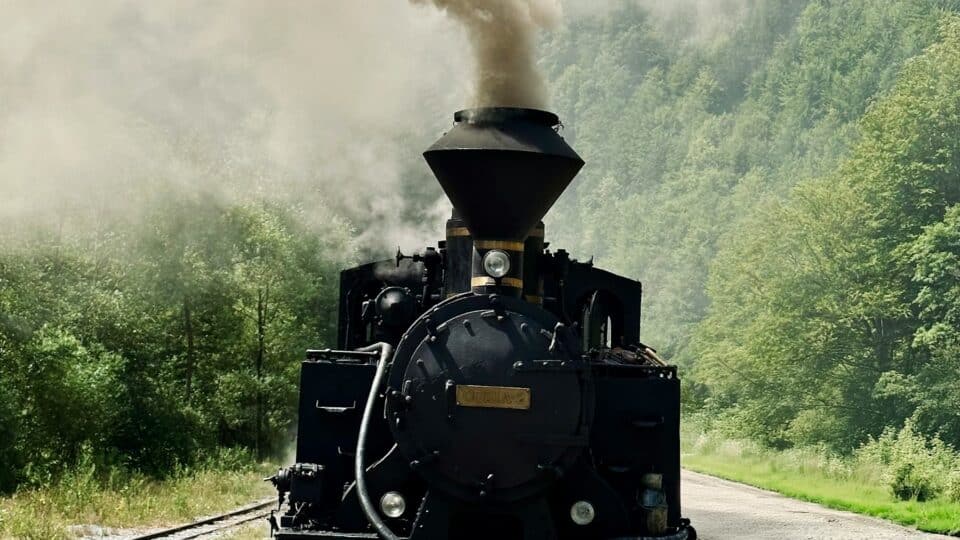
Provisional featured image: Maarten van den Heuvel / Unsplash, a photograph from the Mocănița in Vișeu de Sus, Maramureș, under the Unsplash licence. The original InfoBuz panoramic image is a digitally generated artistic illustration, not a documentary photograph or an identifiable real train on a particular line.
Conclusion: Romania looks different when you are not in a hurry
Train journeys in Romania give you the freedom to watch the landscape, explore a town without worrying about parking, and rediscover branch lines that might otherwise pass unnoticed. Some routes stand out for mountains and forests, others for tunnels and viaducts, and others for the places reached after getting off.
For a first experience, the Prahova Valley or Brașov–Zărnești are accessible choices. For a journey through railway history, Oravița–Anina is worth arranging in advance. For a slower circuit, try Bucovina or Maramureș. And if you want a cultural destination, Sighișoara awaits—provided you take account of the line’s modernisation work.
The decisive rule remains simple: check the outbound train, the return train, the final transfer and the attraction’s opening hours. The journey itself does the rest. Romania need not be crossed only as quickly as possible; sometimes it is worth simply watching it from a train window.




Discuția cititorilor
Ai o opinie sau o întrebare despre acest articol? Spune-ne ce crezi.
Fii primul care deschide discuția.
Te rugăm să păstrezi un limbaj civilizat și să discuți la subiect. Comentariile spam sunt filtrate automat.